Paycoin

272 posts

Paycoin banner
Paycoin

Paycoin

@payprotocol

Driven by PayFi, we’re building the bridge between Web2 and Web3. Connecting real-world payments with decentralized finance. Easy to use. Built to last.

เข้าร่วม Ağustos 2018
39 กำลังติดตาม13.4K ผู้ติดตาม
ทวีตที่ปักหมุด
Paycoin
Paycoin@payprotocol·
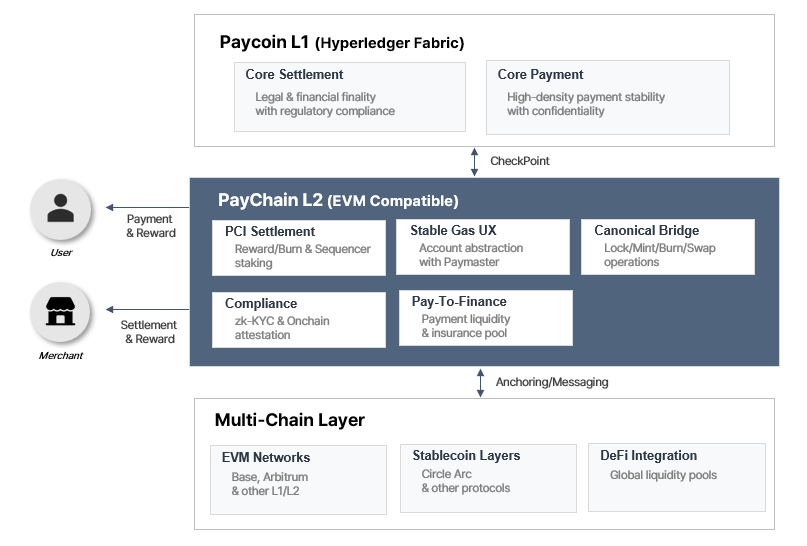
📘 PayProtocol White Paper V10 (Rebranded) We are thrilled to release our latest White Paper V10 (Rebranded), presenting the next stage of the blockchain-based payment infrastructure. This updated white paper outlines our vision for structural innovation across the ecosystem — emphasizing PayChain, Stablecoin Infrastructure, P2F (Pay-to-Finance), and the $PCI Token Economy as the core pillars. 🌐 PayChain, Expanding the Global Payment System PayChain is a purpose-built chain designed to fundamentally expand payment and settlement infrastructure. It introduces a two-layer structure that bridges traditional systems with a blockchain-based global network. - Paycoin L1: Hyperledger-based mainnet providing legal finality and regulatory compliance - PayChain L2: EVM-based extension layer enabling global settlement, liquidity management, and stablecoin operations PayChain serves as a dedicated blockchain for payments, providing convenience to both users and merchants while supporting regulation-friendly Web3 transactions. Key Features - Gas Abstraction: Allows users to execute transactions without holding a native token (e.g., ETH). Transactions are automatically sponsored through an Account Abstraction-based Paymaster, enabling a simplified, gas-agnostic user experience. - Performance & Finality: Delivers instant soft finality for user transactions, with financial and legal finality guaranteed through periodic L1 checkpoints. - Governance: Core parameters such as gas fees, incentives, and burn ratios are managed via on-chain governance, with delegation mechanisms expanding community participation. - Interoperability: PayChain supports a multi-chain environment via Cross-chain Messaging, ensuring seamless connectivity with external networks. We aim to establish a secure and open global blockchain payment infrastructure through the combined operation of PayChain and the Paycoin mainnet. 💵 Stablecoin Platform, A Trusted Hub for Global Settlement Built atop PayChain, the PayProtocol Stablecoin Platform serves as a global hub for fiat-backed stablecoin settlement. It connects multiple stablecoin systems and ensures transparent, compliant transaction flows. Core Components: - Cross-chain Messaging & Anchoring: Synchronizes mint/burn/settlement events across chains to prevent duplication. - Multi-chain Oracle: Verifies exchange rates, circulation, and data consistency across multiple networks. - Gas Sponsorship: Enables designated sponsors to cover transaction fees on behalf of users, providing an optimal UX. - Compliance Framework: Enforces on-chain KYC-based transaction control for regulatory alignment. Through this architecture, we aim to enable a stablecoin-based, real-world payment ecosystem that bridges traditional finance and Web3. 💰 P2F (Pay-to-Finance) — Combining Payments and Financial Activity P2F is PayProtocol’s newly designed Web3-native payment model, merging DeFi mechanisms with traditional payment flows. It enhances the value of payments by transforming every transaction into a yield-generating financial action. Process Overview: - Payment & Deposit: User payment assets are automatically deposited into a liquidity pool. - Liquidity Utilization: Funds remain in the pool and generate interest until settlement. - Settlement Request: Merchants can request settlement at any chosen time, with rewards varying by liquidity pool status and duration. - Reward Distribution: Yield generated within the pool is distributed among users, merchants, and the protocol. P2F seamlessly integrates with existing PayProtocol payment infrastructure. Merchants can adopt P2F without additional onboarding complexity, while users maintain the same familiar payment experience. 🔥 PCI Burn & Circulation Model — Building a Sustainable Value Cycle The latest white paper introduces a new burn and distribution model for the $PCI token, aimed at ensuring sustainable value creation within the ecosystem. 1. PCI Burn Model A portion of transaction fees from payments and transfers will be burned, ensuring that network activity directly contributes to the asset’s long-term value. - 50% of payment transaction fees are burned - 50% of transfer transaction fees are burned 2. PCI Circulation & Lockup Model The $PCI token’s distribution model has been restructured to establish a transparent and predictable operating framework. - Foundation Holdings: 844 million $PCI locked (100%) - Scheduled Unlock: 28.8 million $PCI (3.4% of holdings) to be unlocked over two years All $PCI lockup and release schedules are transparently executed on Arbitrum, with real-time data available on the official PayProtocol website. Read PayProtocol White Paper V10 (Rebranded) 👉 payprotocol.io/white-paper
Paycoin tweet mediaPaycoin tweet mediaPaycoin tweet media
English
4
2
13
1.8K
Paycoin รีทวีตแล้ว
Bitget
Bitget@bitget·
Crazy 48H with $PCI @payprotocol: 11,500 BGB up for grabs! 🏆 410 winners | Up to 800 BGB each ⏳ 48 hours only: Jan 28, 16:00 – Jan 30, 16:00 (UTC) Join now: bitget.com/launchhub/trad…
Bitget tweet media
English
20
27
79
9.3K
Paycoin
Paycoin@payprotocol·
🟦 FAQ Series – P2F: Connecting Payments with Finance The fourth topic in the FAQ series is 'P2F (Pay-to-Finance)'. PayProtocol is building #P2F, a new model where payments and finance connect seamlessly, on top of #PayChain and stablecoin infrastructure. In #P2F, liquidity generated during the payment process is utilized to create new financial returns. Payers through spending, merchants through settlements, and the network through operations - everyone shares benefits within a single circular structure. In this content, we'll explore in detail how payments become finance - from #P2F's basic concept to asset management structure, risk management methods, and synergy with #PayChain and stablecoins. Q1. What is #P2F (Pay-to-Finance)? How is it different from traditional payment models? #P2F is a new payment model that connects payments and finance in a single flow. In typical payments, once a payment is completed, money goes to the merchant at the settlement point, and the assets in between play no role. However, in #P2F, this payment amount is deposited in a liquidity pool until settlement and operated, with the returns distributed to everyone who participated in the payment. For example, when a user pays 5,000 won for coffee, if there's a waiting period of several days until settlement, those funds are operated through DeFi strategies during that time. The returns generated are then shared among the user, merchant, and network. In other words, payments are no longer just payment acts, but participatory financial activities. While in card payments profits only go to card companies, in #P2F those returns are fairly distributed to all participants in the payment ecosystem. Q2. How are assets operated after payment? Payment assets move to the #P2F liquidity pool on #PayChain and are operated during the remaining period until settlement. This pool consists mainly of stable assets like stablecoins and is used for strategies that generate short-term returns, with all operation methods and processes recorded on-chain for anyone to transparently verify. From the moment a user pays for coffee, everything - which pool and how it's operated - can be tracked in real-time. Q3. When can sellers receive settlement? Sellers can choose immediate settlement at any time. If they choose immediate settlement, funds don't move to the liquidity pool and are settled immediately just like traditional payments. If they choose delayed settlement, payment funds move to the pool and generate additional returns based on the operation period. For example, if a restaurant owner postpones today's sales settlement to the next day, the funds are operated during that day to accumulate returns, and the owner receives part of those returns as rewards. Therefore, merchants can choose settlement timing based on their cash flow status while simultaneously generating additional income. Q4. Who gets the returns generated from payments and how? Returns generated through #P2F operations are shared by everyone who participated in the payment. Payers receive payment rewards, merchants receive settlement bonuses, and the protocol receives a certain percentage as operational funding. At the initial launch of #P2F service, it will launch with fixed ratios, which can later be flexibly adjusted through #PayChain governance based on network usage or transaction volume. Q5. If losses occur in the #P2F structure, who is responsible? #P2F is designed to maintain the essence of payment services while ensuring user assets aren't exposed to unnecessary risks. However, returns from asset operations may not meet expectations, or temporary losses may occur. An Insurance Pool is prepared for such situations. The insurance pool is initially funded by the foundation and later transitions to a self-sustaining structure through automatic accumulation of a portion of payment fees. In case of unexpected system errors, depegging, hacking, or other incidents, the insurance pool compensates losses first, and general return rate fluctuations due to operation gains/losses are managed within protocol-defined ranges. For example, even if market conditions become temporarily unstable and returns approach 0% or turn slightly negative, the protocol controls against loss expansion by limiting excessive leverage operations or high-risk asset investments. Users can indirectly participate in financial returns generated through #P2F structure while maintaining payment service stability. Q6. Through which protocols is #P2F's asset operation conducted? #P2F doesn't create its own DeFi protocol but operates assets through multiple external protocols approved by governance. For example, by selecting verified global protocols like @aave, @compoundfinance, and @CurveFinance for distributed operations, it prevents exposure to single risks. Thanks to this structure, assets are stably operated in multiple places simultaneously, preventing single platform issues from affecting the entire system. All operation records are recorded on-chain for anyone to verify. Q7. What benefits do users get from #P2F payments? Users can receive rewards just by making payments, because part of the operation returns generated during payment goes to users. For example, when paying for movie tickets with the Paycoin app, a certain percentage of #P2F rewards is automatically accumulated. Simple consumption leads to participation in asset operation returns, providing a new user experience where payment itself becomes financial participation. Q8. What advantages do merchants get from adopting #P2F structure? Merchants gain three benefits: settlement flexibility, additional income, and customer benefits. They can secure cash quickly through immediate settlement as before, or adjust settlement timing to gain additional returns. Also, using #P2F structure allows automatic rewards for customers, making payment itself a marketing tool. Especially, since all processes are automated based on #PayChain, there's no need for separate system construction or management burden. Q9. How do you adopt #P2F? #P2F can be immediately applied by any merchant using #PayChain payment infrastructure without complex procedures. Since it's a structure that automatically deposits liquidity generated during the period between payment and settlement into the #P2F pool and distributes operation returns to participants, almost no technical changes to existing payment processes are needed. Q10. What synergy effects does #P2F have with stablecoin payments or #PayChain? These three have different roles but work perfectly together within one structure. #PayChain is the infrastructure for payments and settlements, stablecoins are the foundation for value stability and actual payment use, and #P2F is the structure that utilizes liquidity generated in the process to create financial returns. When users pay with stablecoins, transaction data is recorded on #PayChain, and liquidity generated between payment and settlement is operated in the #P2F pool. As the returns generated are distributed to users, merchants, and protocol participants, a structure where the payment network circulates itself is completed. #PayChain guarantees data reliability, stablecoins secure payment stability, and #P2F utilizes liquidity to create added value. When these three pillars work together, payments evolve from simple payments into an engine that moves the ecosystem. 📌 Useful links: Whitepaper V10 👉 payprotocol.io/white-paper
Paycoin tweet media
English
5
0
7
915
Paycoin
Paycoin@payprotocol·
New $PCI Merchant: emart24! We are thrilled to announce that emart24 will be joining the Paycoin merchant network. Users will be able to pay with $BTC, $ETH and $PCI in any emart24 convenient stores in Korea. Emart24 official site: emart24.co.kr 🏪
Paycoin tweet media
English
2
1
2
790
Paycoin
Paycoin@payprotocol·
🟦 FAQ Series – Stablecoins: Trust-Based Payment Hub The third topic in the PayProtocol Whitepaper V10 FAQ series is #Stablecoins. At the heart of #PayChain, the next-generation payment infrastructure being built by PayProtocol, lies stablecoins. Blockchain payments have been difficult to apply to real life due to high asset price volatility. However, stablecoins are pegged 1:1 to fiat currency values, simultaneously providing the price stability and settlement reliability needed for payments. PayProtocol aims to complete the final puzzle of connecting crypto payments to everyday life through stablecoins. In this content, we'll explore PayProtocol's stablecoin strategy, focusing on what role stablecoins play in the PayProtocol ecosystem, how they circulate on #PayChain, and why $KRW stablecoins are necessary. Q1. What is the relationship between stablecoins and the PayProtocol ecosystem? Stablecoins are the core pillar of PayProtocol's vision for real-life payment expansion. PayProtocol is building a payment infrastructure centered on stablecoins without volatility to establish crypto payments in actual commerce. While blockchain payments have been difficult to apply to real-life payments due to its price volatility, stablecoins are pegged 1:1 to fiat currencies with fixed prices, allowing users to have a stable payment experience and merchants to have a predictable settlement environment. PayProtocol aims to simultaneously secure the stability verified in domestic payment infrastructure and global scalability by leveraging these advantages of stablecoins. Stablecoins will operate not just as payment methods, but as global settlement assets connecting various currencies in the #PayChain ecosystem that PayProtocol is building. Q2. What is the relationship between stablecoin payments and PCI? $PCI is the core asset that operates and drives stablecoin payments. While users use stablecoins for payments, all transactions inside PayChain operate centered on $PCI. For example, when a user pays with $pKRW, PayChain internally processes that transaction with sequencer rewards, network fees, burns, and all economic activities of the network based on $PCI. On the surface, stablecoins appear as payment methods, but behind the scenes, $PCI flows like fuel to maintain the system. Therefore, as the actual use of #PayChain-based stablecoin payment infrastructure increases, a structure is formed where $PCI's value circulates. Q3. What stablecoin projects is PayProtocol preparing? In short, we plan to create a stablecoin platform as a global settlement hub. The key is not simply issuing a single coin, but building infrastructure that comprehensively manages and settles various fiat currency-based stablecoins. This platform runs on #PayChain and directly connects with global networks like @circle ($USDC) and @Fiat24Official (European Web3 bank). Here, issuance, burn, lock-up, and settlement occur simultaneously, and multi-currency stablecoins like $pKRW, $pUSD, and $pEUR are synchronized in real-time. For example, even if a user uses Tron network-based $pKRW, merchants can receive settlement in Ethereum-based $pUSD, and #PayChain verifies transaction data from both chains in real-time and maintains consistency. In other words, even if one transaction spans multiple blockchains, users perceive it as 'one payment' and merchants as 'one settlement'. Thus, PayProtocol aims to position itself as a 'stablecoin infrastructure provider' rather than a 'stablecoin issuer'. Q4. Is PayProtocol also preparing to issue stablecoins? Yes, the issuance structure itself is already designed. Issuers issue stablecoins on each chain based on collateral assets (cash, deposits, etc.), and trust companies and financial institutions enter as #PayChain nodes to directly participate in accounting audits and consensus processes. In other words, "issuance → accounting verification → settlement" occurs simultaneously on-chain. In this structure, PayProtocol can be the direct issuer, or external financial institutions can enter as issuers to issue $pKRW or $pUSD on #PayChain. The 2026 roadmap includes 'KRW stablecoin issuance and payment', and specific schedules and detailed structures will be disclosed in stages. Q5. How does PayProtocol plan to spread stablecoins in real life? PayProtocol's expansion strategy is summarized by three keywords — UX simplification, distribution incentives, and institutional trust. - UX Simplification: By introducing a 'gas sponsorship structure', users can make payments immediately without having $PCI or $ETH in their wallets. Like card payments, payments are made with a single click without complex wallet settings. - Strengthening Distribution Incentives: To increase stablecoin usage rates, we designed a structure where both users and merchants participating in payments can receive rewards. We plan to build an incentive structure where the reward pool increases as transaction volume grows, and one of the core components of this incentive model is the #P2F (Pay-to-Finance) structure. - Securing Institutional Trust: Through on-chain KYC authentication, identity verification at the level required by regulators can be automatically verified without exposing personal information. In other words, it's a structure that simultaneously achieves "decentralization" and "regulatory friendliness". Q6. What services will the stablecoin platform built on PayChain provide? PayProtocol's stablecoin platform is designed not as a simple payment infrastructure, but as a hub providing integrated stablecoin-based financial services. This will expand to various financial and business services beyond payments, remittances, and settlements. - Payment and Settlement Services: Real-time payments are possible with various stablecoins such as $USDC, $USDT, and $pKRW, and each payment record is automatically settled through #PayChain. Merchants can receive settlements in their desired currency ($pKRW, $pUSD, $pEUR, etc.), simplifying global transactions. - Stablecoin Swap and Rebalancing Services: Asset exchanges between multiple currencies occur in real-time through the platform's automatic swap function. For example, if a user pays with $pKRW, merchants can automatically receive settlement in $pUSD. This rebalancing is automatically processed in #PayChain's unified ledger. - Corporate Settlement and Accounting Services: Corporate merchants can easily process transaction records through blockchain-based settlement reports. API services that automatically connect with existing accounting infrastructure, including tax invoices, invoice issuance, and ERP integration, are also provided. - #P2F and On-chain Financial Service Integration: The #P2F structure is applied to generate profits by operating waiting assets between payment and settlement through DeFi strategies, and distributing these profits to users, merchants, and protocol participants. Additionally, new forms of on-chain financial services such as micro-lending, subscription payments, and rewards based on payment data will be added in stages. - Regulatory and Compliance Services: Trust institutions and financial institutions participate as nodes to verify issuance and settlement data, and also meet anti-money laundering regulatory requirements through on-chain KYC and transaction tracking. Ultimately, #PayChain's stablecoin platform aims to evolve into a one-stop blockchain financial service ecosystem where you "pay with stablecoins, settle, operate, and complete accounting". Q7. Is there a need for $KRW stablecoins? Aren't dollar stablecoins sufficient? $KRW stablecoins are absolutely necessary. While dollar stablecoins are useful for global transactions, they have several limitations in replacing the domestic payment environment. The biggest reason is that all payment, settlement, tax, and accounting systems in Korea operate based on $KRW. Using dollar stablecoins complicates exchange rate calculations, accounting processing, and tax settlements, and from the merchant's perspective, there's also the risk of settlement amounts changing due to exchange rate fluctuations. In contrast, $pKRW provides a predictable payment environment regardless of exchange rates because payments are made in $KRW. Also, payments are made in price units familiar to consumers ("6,900 won", etc.), making usability much higher. In the payment market, the display currency must match. Of course, for global remittances or overseas payments, dollar stablecoins like $USDC and $USDT remain important. Therefore, PayProtocol is adopting a two-track strategy of "$pKRW domestically, $USD stablecoins internationally". #PayChain can automatically rebalance these two currencies within the same settlement hub, so users get a natural payment experience like a single network without currency distinctions. Ultimately, $pKRW will serve as the 'base currency' for domestic real-life payments, while dollar stablecoins will serve as the international currency for global liquidity. 📌 Useful links: Whitepaper V10 👉 payprotocol.io/white-paper
Paycoin tweet media
English
0
1
4
617
Paycoin
Paycoin@payprotocol·
🟦 FAQ Series – PayChain: Expanding Global Payment Infrastructure One of the biggest changes in the Whitepaper V10 update is the introduction of #PayChain. #PayChain is an EVM-based mainnet designed to scale PayProtocol's existing Hyperledger-based payment infrastructure to a global level, serving as the core pillar for overcoming structural limitations in payments and settlements and evolving into an open payment network. While PayProtocol has focused on regulatory friendliness and stability centered on the domestic payment market, will serve as a new expansion layer interconnected with global services, stablecoins, and Web3 payments. This FAQ addresses the most frequently asked questions about #PayChain's structure, role, technical features, and future direction. Q1. Why build PayChain when PayProtocol already exists? What's the difference between the two chains? PayProtocol chose a dual-layer structure to secure both stability and scalability simultaneously. The #Hyperledger-based L1 mainnet safely records payment data and serves as a 'settlement network' ensuring legal finality and accounting transparency. It's similar to how card payment systems confirm transaction records and reconcile data with financial institutions. Hyperledger L1 already operates stably as a domestic payment and remittance infrastructure, providing a regulatory-friendly environment that can be verified at any time. However, the permissioned network structure has limitations in global expansion and integration with various blockchain ecosystems. Users want seamless payments regardless of which stablecoin they use, and businesses want to manage transactions scattered across multiple chains in a single system. #PayChain is being built as an EVM-based expansion network to meet these needs. It directly connects with major blockchains like @ethereum, @base, @avax, and @trondao, synchronizing issuance, burn, and settlement records into a single global unified ledger. Core data is recorded on the PayProtocol mainnet to ensure legal credibility. Q2. What changes does PayChain bring to existing merchants and users? With #PayChain, merchants and users can enjoy a simple and integrated payment experience without being aware of blockchain technology's complexity. From a user perspective, they receive the same payment experience regardless of the type of stablecoin they hold. For example, whether using Tron-based $USDT, Ethereum-based $USDC, or KRW stablecoins, #PayChain processes them all identically. Notably, users don't need to hold separate native tokens (like $ETH) as gas fees are automatically paid with stablecoins or $PCI, allowing even beginners to easily start digital asset payments. From a merchant perspective, they can support stablecoin payments from all major blockchains with just one #PayChain integration. There's no need to manage separate wallets for each chain or build settlement processes, and it directly connects with existing accounting systems, tax invoices, and ERP, simplifying business workflows. Additionally, without tracking transaction records scattered across multiple chains, merchants can view all payment and settlement records in real-time on #PayChain's integrated dashboard. It provides the same convenience as managing payments from multiple card companies through a single PG system. Q3. Will the Hyperledger mainnet be discontinued? No. The Hyperledger mainnet will be maintained for the time being and continue to operate as the core layer responsible for legal finality and settlement stability. PayProtocol has been operating actual services on Hyperledger for years, verifying payment reliability and stability. This stability will be maintained even after #PayChain's introduction. #PayChain is not replacing the existing infrastructure but being added for global expansion and Web3 payment integration. Initially, a dual structure will operate with the Hyperledger mainnet handling legal finality and regulatory reporting, while #PayChain manages multi-chain payment processing and global settlement. In the long term, as #PayChain matures, the center of payment and settlement data will be gradually integrated into #PayChain, and this process will proceed carefully with service stability as the top priority. Q4. Can services other than payments be built on PayChain? Yes, it's possible. #PayChain is EVM-compatible, allowing general smart contract development. However, #PayChain is designed as a lightweight structure specialized in payments and settlements, eliminating unnecessary complexity and optimized for fast, low-cost payment processing. Rather than providing all features like general-purpose blockchains, it focuses on natively providing core modules needed for payment infrastructure (gas abstraction, compliance hooks, depeg defense, etc.). Various payment-linked services can be built on this structure: - #P2F (Pay-to-Finance) - Payment data-based micro-lending systems - On-chain rewards and loyalty programs - Subscription payment automation systems - Cross-border remittance and exchange services - Creator support platforms Q5. How is the PayChain ecosystem structured and what are the requirements to participate? #PayChain is a participatory payment infrastructure where all participants perform roles based on $PCI and receive rewards. Main participants are divided into validators and bridge operators, each staking $PCI according to their responsibilities and contributing to network stability. Validators verify that all transactions on #PayChain are accurate and unaltered. Like a bank's audit team, they ensure the integrity of transaction records. Bridge operators safely transmit asset movements and settlement data between major blockchains like Ethereum, Base, Avalanche, Tron and #PayChain. It's similar to international remittance systems that mediate fund transfers between banks in different countries. #PayChain participants are required to stake $PCI, which serves as an economic guarantee that they won't harm the network. Through this structure, #PayChain secures the high level of reliability needed for payment infrastructure even in a decentralized environment. General users and merchants can conveniently use payment services without technical burden on the stable environment created by these infrastructure participants. Q6. Are you considering introducing native $USDC or $USDT on PayChain? #PayChain is fundamentally designed as a stablecoin-centric payment chain. To ensure payment stability and practical usability, stablecoins pegged to fiat currency values are used as core payment assets. We are currently in discussions with major global stablecoin issuers like $USDC and $USDT, aiming to natively support them on #PayChain. Q7. When will PayChain be launched? #PayChain is preparing for testnet launch in the first half of 2026 and will conduct real transaction environment verification with key payment partners and validators. 📌 Useful links: Whitepaper V10👉payprotocol.io/white-paper
Paycoin tweet media
English
1
0
1
585
Paycoin
Paycoin@payprotocol·
🟦 FAQ Series – Paycoin (PCI): The Core Utility Token of the PayProtocol Ecosystem In line with last week’s release of our Whitepaper V10, we’re kicking off the FAQ series. The first topic that we are going cover will be the core utility token of the #PayProtocol Ecosystem - $PCI (Paycoin) $PCI is evolving beyond a simple payment token – it is the native asset of #PayChain and a core tool for its governance participation. In the lastest version of our Whitepaper, we have redefined the value-circulation structure, burn mechanisms, and transparent distribution model for $PCI. In this content, we’ll answer the most frequently asked questions around $PCI’s role and structural changes. Q1. How has the value of $PCI been enhanced through the latest Whitepaper? The V10 update fundamentally strengthens $PCI’s demand generation and value circulation models. 1. Utility Expansion via PayChain: PayChain’s gas system is designed around $PCI. Even when users pay fees in stablecoins, they’re converted to $PCI for sequencer rewards and burns. In addition, sequencers and bridge operators must stake $PCI as collateral, directly creating real transactional demand. 2. Burn Mechanism: More network activity means more $PCI burned. This deflationary design strengthens long-term value through a self-reinforcing cycle. 3. Restructured Distribution: All 844M foundation-held $PCI will be locked, with only 3.4 % (28.8 M) of these being unlocked over 2 years — minimizing extra supply. 4. Governance Participation: Stake $PCI to join on-chain governance and vote on key ecosystem parameters. 5. Payment & Settlement Incentives: Ongoing $PCI-based payment incentives sustain real utility and adoption. Q2. What is the relationship between $PCI and PayChain? PayChain is an EVM-based blockchain built entirely around $PCI. All gas fees on PayChain are ultimately settled in $PCI — used for sequencer rewards and token burns. Sequencer staking, bridge collateral, governance voting, and incentive distribution all depend on $PCI, making it the core asset that powers the PayChain ecosystem. Q3. What is wPCI, and how does it differ from Hyperledger $PCI and PayChain $PCI? Both represent the same economic value, but they operate in different environments and serve different purposes. The Hyperledger $PCI supports domestic payments and remittances, already used in real services through the PayCoin App — ensuring proven settlement stability and legal finality. The upcoming PayChain $PCI runs in an open EVM environment, designed for global expansion and DeFi integration. It will be used for gas fees, sequencer staking, bridge security, governance, and incentives — especially in the P2F (Pay-to-Finance) model that connects real-world payments with DeFi liquidity. Over time, PayProtocol plans to gradually migrate from the Hyperledger mainnet to PayChain, combining Hyperledger’s stability with PayChain’s openness to build a unified blockchain payment infrastructure. Q4. Which wallets support $PCI? - Hyperledger $PCI: PayCoin App (native) - PayChain $PCI: Any EVM-compatible wallet (MetaMask, OKX Wallet, Rabby, etc.) Q5. Can the 50% of fees that are returned to the foundation be sold on the market? These fees are reinvested into ecosystem growth and market sales are technically possible. However, these tokens collected from fees come from the existing circulating supply rather than newly issued tokens, so their impact on the market remains limited. Q6. Where can I check burned $PCI? For Hyperledger, $PCI burns occur based on monthly aggregated payments and remittances. Records are viewable on the PayProtocol Scan explorer. For PayChain, each transaction triggers real-time burning. Its dedicated explorer will disclose these details upon release. Q7. With 844 million $PCI held by the foundation and only 28.8 million unlocked over two years, is that excessive? Are additional burns or lock-ups planned? Correct. Only up to 28.8 million $PCI (3.4 %) will be unlocked in the next two years from the foundation's holdings. Post that, new plans for additional lock-ups or burns will be established and governed via the upcoming governance dashboard. Q8. Are additional listings of $PCI planned? PayProtocol prioritizes strategic over rapid listings. Official announcements will follow once opportunities are confirmed. 📌 Useful links: Whitepaper V10 👉 payprotocol.io/white-paper
Paycoin tweet media
English
0
0
2
494
Paycoin
Paycoin@payprotocol·
Paycoin x KBW 2025 Recap✨
Indonesia
2
1
6
600
Paycoin
Paycoin@payprotocol·
New $PCI Merchant: GS25! We are super thrilled to announce that @funGS25 will be joining the Paycoin merchant network. Users will be able to pay with $BTC, $ETH and $PCI in any GS25 convenient stores in Korea. 🏪
Paycoin tweet media
English
1
0
8
1.1K
Paycoin รีทวีตแล้ว
KBW2026
KBW2026@kbwofficial·
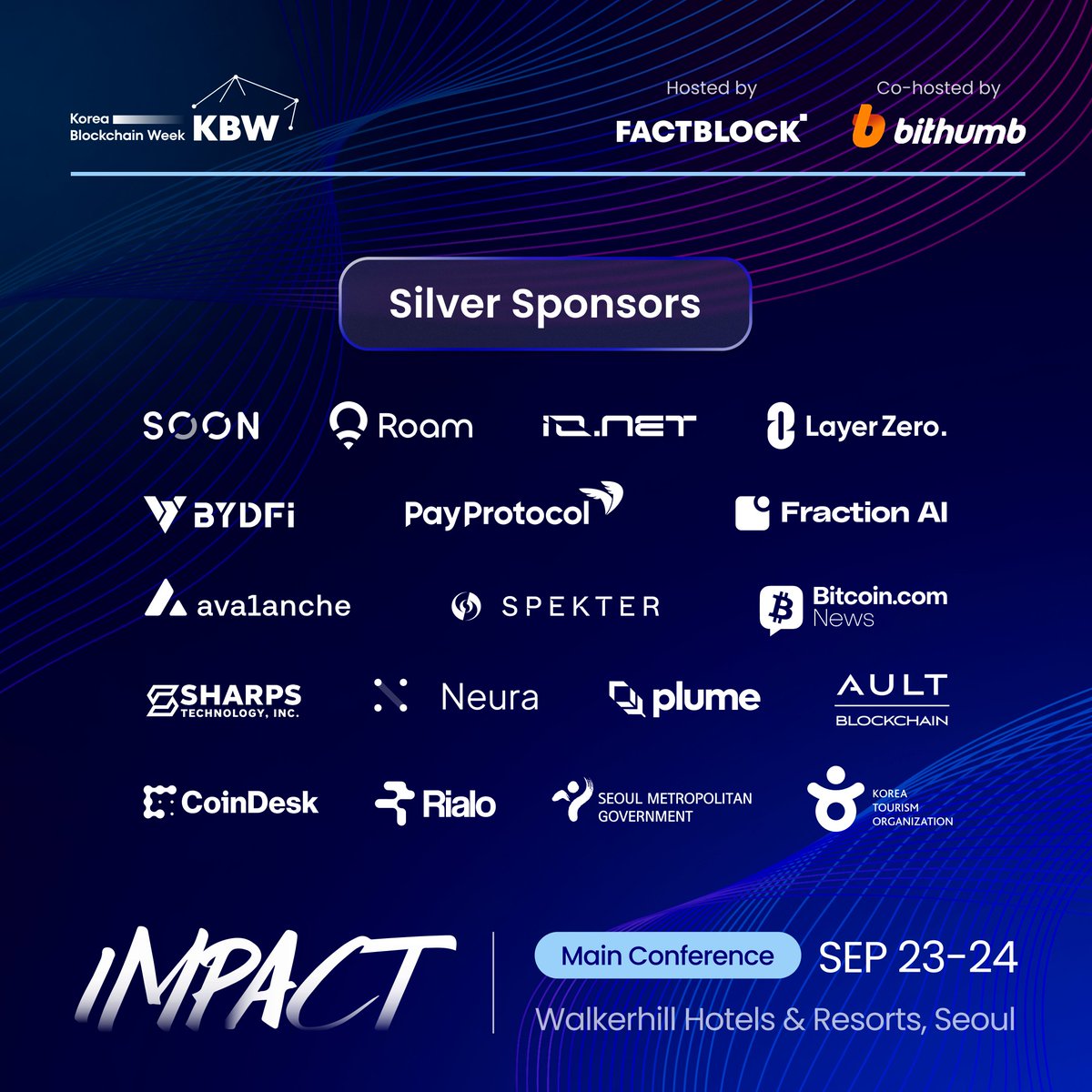
Welcoming our Silver Sponsors for KBW2025 main conference, IMPACT! @soon_svm@weRoamxyz@ionet@LayerZero_Core@BYDFi@payprotocol@FractionAI_xyz@avax@SpekterGames@bitcoinnews@Sharps_Tech@Neura_Web3_AI@PlumeEco@AultCompany@CoinDesk@RialoHQ@Seoul_gov@KoreanTravel 📍 Sept 23–24 | Walkerhill Hotels & Resorts, Seoul 🎟 koreablockchainweek.com #KBW #KoreaBlockchainWeek #Web3 #Crypto
KBW2026 tweet media
English
36
53
245
51.6K
Paycoin
Paycoin@payprotocol·
We are proud to be a Silver Sponsor at @kbwofficial 2025! Join us Sept 23-24 at the Paycoin booth to experience and explore: ✨ $PCI payment in action ✨ Stablecoin ecosystem presented by PayProtocol ✨ Our vision and strategy for digital asset payment ecosystem See you at the Paycoin booth! #KBW2025 #PayProtocol #Paycoin
Paycoin tweet media
English
1
0
5
947
Paycoin รีทวีตแล้ว
Justin Kim
Justin Kim@justinkim415·
Excited to partner with @payprotocol, Korea's leading payment gateway company, to build a compliant purpose-built @avax L1 for KRW stablecoin settlements, enabling secure transactions for their 150,000+ merchants nationwide. Welcome to the Avalanche!
Paycoin@payprotocol

We are thrilled to announce that Danal Fintech, the operator of #Paycoin, is partnering with @AvaLabs and @avax to strengthen our stablecoin platform. This collaboration marks a significant milestone in expanding stablecoin services both in Korea and globally. Together we will: - Support and integrate tech through combining Avalanche's blockchain tech with #Danal's payment expertise. - Build regulatory compliance models for South Korean framework. - Participate in regulatory sandboxes & govt. pilot programs. - Co-branding campaigns. @avax's unique chain architecture is perfectly aligned with our vision for stablecoin payment networks, and they have proven its reliability through major projects: - $FRNT, First state-level stablecoin by Wyoming government. - Onyx by @jpmorgan. - Capital market tokenization pilots under UK FCA regulation. This collaboration with @avalabs and @avax represents a crucial turning point in our journey to build a user-centric, secure, and convenient stablecoin payment ecosystem. More updates coming soon! 🔥

English
10
25
122
8.9K
Avalanche Korea🔺🇰🇷
Avalanche Korea🔺🇰🇷@AvalancheKorea·
다날핀테크, 아발란체와 스테이블코인 기술제휴 MOU 체결 다날의 블록체인 전문 계열사 ‘다날핀테크(@payprotocol)’가 스테이블코인 플랫폼 경쟁력 강화를 위해 아발란체와 MOU를 체결했습니다. 다날핀테크는 아발란체 C체인 유동성을 활용하고 규제준수형 L1 결제 네트워크를 구축할 예정입니다.
Avalanche Korea🔺🇰🇷 tweet media
Paycoin@payprotocol

We are thrilled to announce that Danal Fintech, the operator of #Paycoin, is partnering with @AvaLabs and @avax to strengthen our stablecoin platform. This collaboration marks a significant milestone in expanding stablecoin services both in Korea and globally. Together we will: - Support and integrate tech through combining Avalanche's blockchain tech with #Danal's payment expertise. - Build regulatory compliance models for South Korean framework. - Participate in regulatory sandboxes & govt. pilot programs. - Co-branding campaigns. @avax's unique chain architecture is perfectly aligned with our vision for stablecoin payment networks, and they have proven its reliability through major projects: - $FRNT, First state-level stablecoin by Wyoming government. - Onyx by @jpmorgan. - Capital market tokenization pilots under UK FCA regulation. This collaboration with @avalabs and @avax represents a crucial turning point in our journey to build a user-centric, secure, and convenient stablecoin payment ecosystem. More updates coming soon! 🔥

한국어
2
49
77
12.6K
Paycoin
Paycoin@payprotocol·
We are thrilled to announce that Danal Fintech, the operator of #Paycoin, is partnering with @AvaLabs and @avax to strengthen our stablecoin platform. This collaboration marks a significant milestone in expanding stablecoin services both in Korea and globally. Together we will: - Support and integrate tech through combining Avalanche's blockchain tech with #Danal's payment expertise. - Build regulatory compliance models for South Korean framework. - Participate in regulatory sandboxes & govt. pilot programs. - Co-branding campaigns. @avax's unique chain architecture is perfectly aligned with our vision for stablecoin payment networks, and they have proven its reliability through major projects: - $FRNT, First state-level stablecoin by Wyoming government. - Onyx by @jpmorgan. - Capital market tokenization pilots under UK FCA regulation. This collaboration with @avalabs and @avax represents a crucial turning point in our journey to build a user-centric, secure, and convenient stablecoin payment ecosystem. More updates coming soon! 🔥
Paycoin tweet media
English
25
39
228
35.2K
Paycoin
Paycoin@payprotocol·
🚀 Danal Fintech joins OBDIA’s Stablecoin Ecosystem Committee! Danal Fintech has officially become a member of the Open Blockchain & DID Association (OBDIA), Korea’s leading blockchain association authorized by the Ministry of Science and ICT. 💡 Why it matters: - OBDIA’s Stablecoin Committee initially led by major banks (KB, Shinhan, Woori, etc.) - Rising demand from fintech & enterprises led to the creation of a new “Stablecoin Ecosystem Committee” - Danal Fintech brings real payment expertise to explore stablecoin in practical payment systems 🔍 What’s next: - Digital asset trend research - Stablecoin pilot studies - Policy engagement Danal Fintech will keep driving innovation + practicality to shape Korea’s stablecoin future. 💪 #Stablecoin #Blockchain #Fintech #DanalFintech #OBDIA
Paycoin tweet media
English
1
1
6
1.1K