Pleometric

6K posts

Pleometric banner
Pleometric

Pleometric

@pleometric

Purple Penguin

The Pleorama เข้าร่วม Mart 2024
398 กำลังติดตาม6.4K ผู้ติดตาม
ทวีตที่ปักหมุด
Pleometric
Pleometric@pleometric·
GIF
ZXX
5
3
81
2.8K
Pleometric
Pleometric@pleometric·
Tang Dynasty drip
Pleometric tweet media
English
0
0
3
251
Pleometric
Pleometric@pleometric·
I memorized my first poem today! 白日依山尽 黄河入海流 欲穷千里目 更上一层楼 by 王之涣 Wang Zhihuan
Pleometric tweet media
中文
3
0
21
403
Core
Core@publicer_rivers·
@pleometric ah, I see. the submodule doesn't resolve properly in the repo for some reason, github thinks it's one of your repos.
English
2
0
1
14
Pleometric
Pleometric@pleometric·
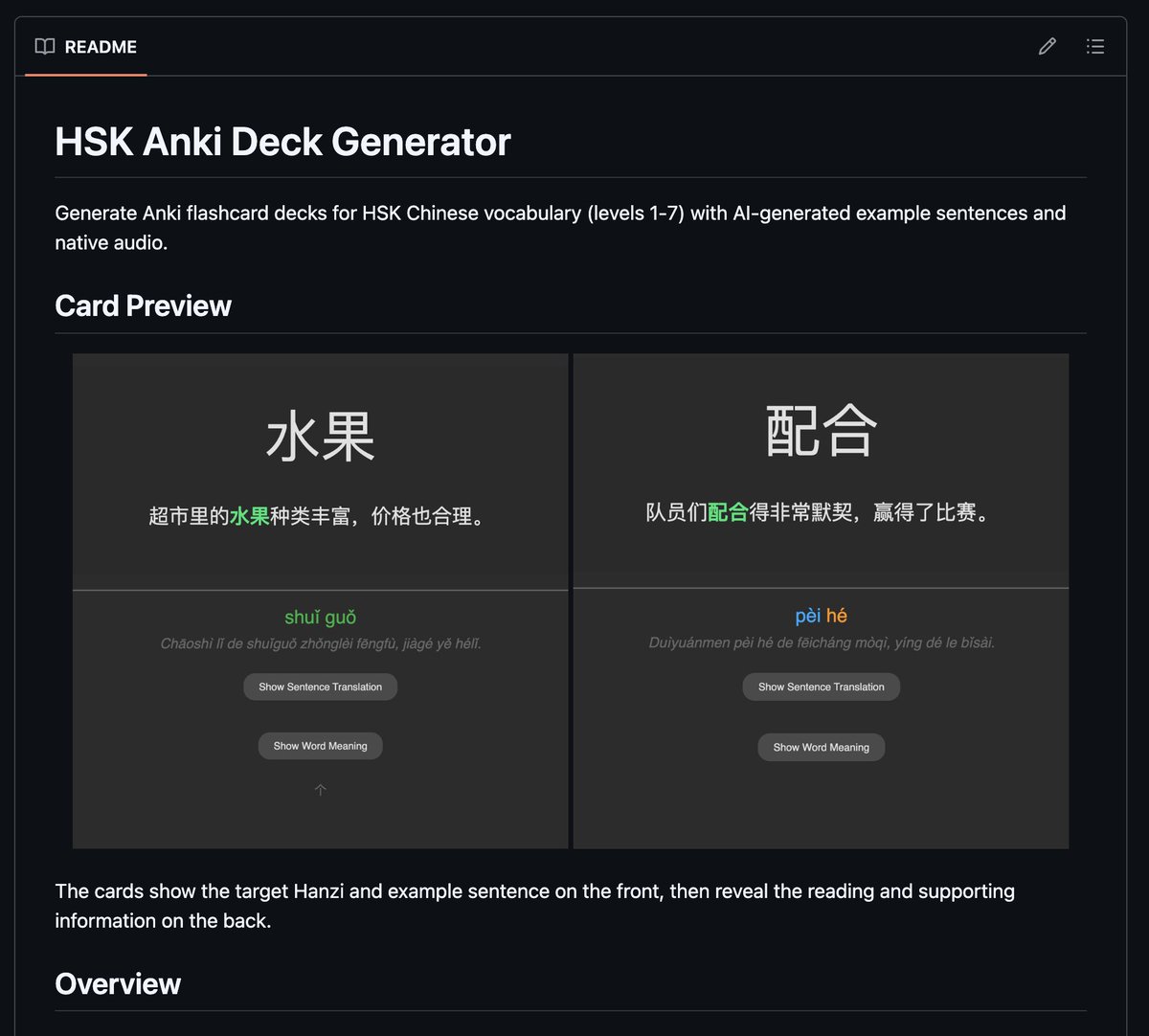
I updated the HSK wordlist anki deck generator to include tone coloring and to use Microsoft Edge TTS instead of elevenlabs for word and sentence audio. I also fixed some minor bugs based on user feedback. You can find the repo in my github, link below.
Pleometric tweet media
English
4
0
24
894
Core
Core@publicer_rivers·
@pleometric really cool project! one thing though, could you make the complete-hsk-vocabulary submodule repo public? I don't need it right now, I'm just starting out and you've committed the cleaned stuff for 1-5.
English
1
0
1
13
Pleometric
Pleometric@pleometric·
when you do this you will learn about insecurities you didn't know existed.
English
1
0
9
428
Pleometric
Pleometric@pleometric·
I like doing "ad expeditions" from time to time. I spoof an account with a fake persona and see what ads I get (needs to be done on a fresh phone with a new sim card ideally). What is a young looksmaxxer in Florida getting these days? "Deep masculine voice" courses, for example.
Pleometric tweet media
English
3
0
24
961
Pleometric
Pleometric@pleometric·
I think being in that environment can help if you're being proactive about it but even then, stories abound of expats who live years and years in a place and don't acquire anything. You have very dedicated learners getting to native level in their bedrooms. The learner sets their environment
English
0
0
2
29
Brie Wensleydale🧀🐭
Brie Wensleydale🧀🐭@SlipperyGem·
@pleometric I feel like acquiring a language, without being in said language environment, is a lost cause. I did Duolingo for Malay for a while, and I never got to use it, but I find that I can indeed understand like 30% of what I hear when I'm chillin' in KL. Its also an easier language.
English
2
0
2
105
Pleometric
Pleometric@pleometric·
This is true for learning in general, but every time somebody asks me about language acquisition, most of the conversation is spent on a pep-talk rather than on technical details. The discomfort of losing your ability to communicate is a barrier many never get past.
English
3
0
32
1.2K
Pleometric
Pleometric@pleometric·
This technique is great for when you encounter words like "set". A single word that has something like 464 definitions, but you probably only care about a small set of them (😀). So how do you know which definitions you care about? By encountering them in your daily life and in niche things you care about. If you're into tennis "set" will carry a different meaning from if you're a mathematician.
English
0
0
6
412
Pleometric
Pleometric@pleometric·
Ideally you do this in stages. First you learn how to read the characters, and then you map meanings into them as you encounter them in the wild. The most common spaced repetition card configuration you'll see language learners use for non phonetic systems (for something like Japanese) is: Character -> Reading -> Translation 大学生 -> だいがくせい -> College Student I think this has the fundamental problem of primarily mapping your target language to your own language. You're learning to map [word -> word] and not [word -> concept]. This allows you move much more quickly in terms of understanding text, with the downside of giving your brain a quick heuristic instead of true acquisition. The comprehensible input approach is concerned with understanding the target language without using other languages. At later stages of acquisition you can use your target language to explain itself, e.g. reading a dictionary entry. But at the start, you'll have to use contextual clues. For example, if I point to a dog and say the word for dog in your target language, you can make the educated guess the word means dog. By seeing that word associated with the concept enough times, in different contexts, you'll learn to do a subconscious map the Word <> Meaning. So how does that change from the above example? You just skip the translation part. You're trying your best to not contaminate your target language with your own. You learn how to read the word and then you're done. You might add some contextual clues like pictures and videos but right now you're just trying to be able to parse the symbols. Step 1: 大学生 -> だいがくせい Step 2: You start encountering the word enough times in input in the wild [see attached pictures] and you start to associate meaning to it through repeated exposure + contextual clues. You are trying to bootstrap understanding of the language without other harnesses. As you (slowly) progress through this, you'll find yourself in the strange position of understanding things without "thinking" about them. Repeat this a thousand times and you will have acquired your target language. What holds a lot of people back when learning languages is that they're not acquiring Japanese, Chinese, French etc they're trying to smash another system in a way that maps to a language they're native in. So a lot of English Speakers who try to learn Japanese are just speaking English with Japanese words.
Pleometric tweet mediaPleometric tweet media
hope ❊@realityarb

@pleometric @greegle_mudzone it's very clear to me how to do this with a phonetic writing system, but how do you learn the meaning <-> character -> sound representations? i see how to do CI in characters or in sounds, but how do you tend to connect the two? (or does this just work itself out if you do both?)


English
5
2
40
2.8K
Pleometric
Pleometric@pleometric·
@turtlelambvase I'm in that stage of Chinese right now. I'll celebrate being able to understand an entire video and then the next 10 videos I am left dumbfounded.
English
0
0
1
19
Pleometric
Pleometric@pleometric·
@turtlelambvase yeah but that valley of enjoyment doesn't last long. Once you learn enough to be able to grasp how much you _don't_ know, most people enter an abyss of despair and give up. Managing stage 2 is 90% of learning a language.
Pleometric tweet media
English
1
0
4
55
Pleometric
Pleometric@pleometric·
@LemmySmackett Always digging for the one weird trick that will save us from vita brevis, ars longa is the failure mode of most students of any discipline I think.
English
0
0
3
35
Storyteller Lemmy
Storyteller Lemmy@LemmySmackett·
@pleometric Storywriting and all the how-to books about it are much the same. All the relevant theory, where it matters, can be learned in a month. All that remains after is relentlessly grinding your face into unforgiving stone for ten or twenty years.
English
1
0
3
59
Pleometric
Pleometric@pleometric·
@aokassamali the core statement in Krashen's ideas is that the "critical period" for language learning in children applies to the rate of learning, not capacity. In other words, yes children learn faster but the mechanisms by which they do still exist in adults.
English
0
0
2
38
Asad Kassamali
Asad Kassamali@aokassamali·
@pleometric That's very clever. So leveraging the process we use to acquire language as children and mimicking it as close as possible to reach native fluency. Def will update how I learn from now
English
1
0
1
49
Pleometric
Pleometric@pleometric·
@airkatakana of course! But I think that by the time you reach that level of abstraction you'll be pick up the definition entirely in the target language anyway. My entire knowledge of hydraulic engineering exists in a single language, it has no equivalent mapping in any others.
English
0
0
3
69
Air Katakana
Air Katakana@airkatakana·
@pleometric this is true but there is also no reason to re-learn the concept of "communism". you can just map 共産主義 to communism with no issues
English
1
0
7
537
Pleometric
Pleometric@pleometric·
Language learning content is mostly self help. It's aspirational, repetitive and it's constantly moving away from the subject itself. There isn't much you need to know to effectively learn a language, and that makes people very upset.
English
1
0
18
474
Pleometric
Pleometric@pleometric·
"can I learn X as a Y year old?" is a question that props up the entirety of the language learning industry and is the reason ineffective toys like Duolingo stay in business. It's about making you feel comfortable so you stick around an ineffective product.
English
1
1
24
653
Pleometric
Pleometric@pleometric·
for most the barrier for learning a language in not about the process itself but purely psychological. Being able to wade through the discomfort of not being able to express yourself for a long period of time. Thinking you've made good progress only to discover the gap is deeper.
English
0
1
16
528