D.S. Nelson

63.8K posts

D.S. Nelson banner
D.S. Nelson

D.S. Nelson

@process_x

Independent Researcher on AI system reliability & constraint architectures. | Author: Constrained Informational Systems | Interests: Science, Systems, Villainy

United States เข้าร่วม Aralık 2009
1.9K กำลังติดตาม5.8K ผู้ติดตาม
ทวีตที่ปักหมุด
D.S. Nelson
D.S. Nelson@process_x·
I’m an independent researcher studying failure modes and constraint architectures in AI systems. My first preprint (Constrained Informational Systems) explores how reliability emerges from system constraints rather than model scaling. I’m open to advisory conversations and commissioned technical papers on AI system reliability. Preprint: zenodo.org/records/183068…
English
1
0
2
285
D.S. Nelson รีทวีตแล้ว
Philosophy Of Physics
Philosophy Of Physics@PhilosophyOfPhy·
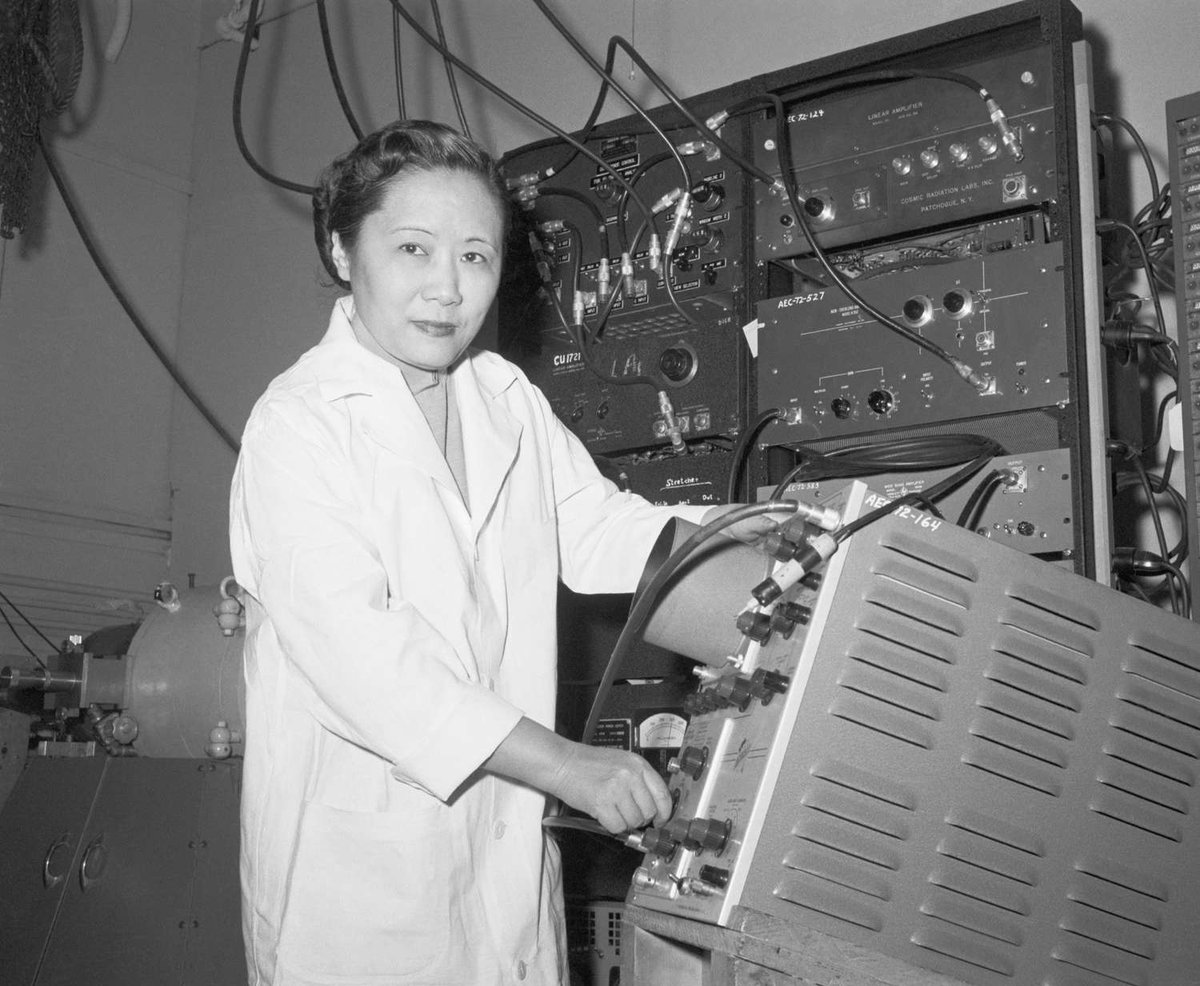
The experiment that broke a symmetry of the universe. She cooled cobalt to near absolute zero and proved the universe has a handedness. In 1956, Chien-Shiung Wu carried out the famous Wu experiment by cooling cobalt-60 to extremely low temperatures and observing how it decayed. At that time, scientists believed in parity symmetry, the idea that nature should behave the same if left and right are swapped like a mirror image. Wu’s experiment showed that this is not always true. In weak nuclear processes, nature actually prefers one direction over the other, revealing that the universe has a kind of “handedness.” The idea was first proposed by Tsung-Dao Lee and Chen-Ning Yang, who later received the 1957 Nobel Prize in Physics, while Wu, who made the discovery possible through her experiment, was not included. Her work showed something simple yet profound: the laws of nature are not perfectly symmetrical.
Philosophy Of Physics tweet media
English
12
32
194
10.7K
D.S. Nelson รีทวีตแล้ว
Philosophy Of Physics
Philosophy Of Physics@PhilosophyOfPhy·
Demonstration of chaos theory and irrational numbers, what looks like a tangled mess of spinning wire is actually a precise visualization of the number pi.
English
15
31
197
12.7K
D.S. Nelson รีทวีตแล้ว
Curiosity
Curiosity@CuriosityonX·
The invisible Glass experiment Scientists once placed a transparent glass barrier inside an aquarium. On one side was a fierce pike, and on the other side were several smaller fish swimming freely. When the hungry pike saw the smaller fish, it immediately rushed forward to attack. Bang. It slammed straight into the glass and bounced back. Confused, the pike kept trying again and again, but every attempt ended the same way. The repeated collisions injured its head and knocked off some of its scales. Eventually, the pike became frightened and retreated to a corner of the tank. After some time, the scientists quietly removed the glass barrier. The smaller fish now swam freely throughout the aquarium, even brushing against the pike’s mouth. But the pike never tried to eat them again. Even though it was hungry, it refused to attack. In its mind, the invisible wall was still there. A few days later, the pike reportedly died of starvation, surrounded by food. This phenomenon is often referred to as the Pike Effect or Pike Syndrome. It’s often used as a metaphor for how repeated failure can create invisible limits in the mind.
English
621
6.4K
40.8K
4M
D.S. Nelson รีทวีตแล้ว
D.S. Nelson
D.S. Nelson@process_x·
Source bias can play a role, but it’s only one part of the system. Outputs aren’t just “left vs right input.” They’re shaped by how training data, safety policies, and prompt constraints interact at generation time. If you actually saw that response, the question isn’t which sites were used, but what constraints and prompt conditions produced that output, and whether it’s reproducible.
English
0
0
0
10
George Danton
George Danton@GeorgeD72865991·
@process_x Sure, the prompt could’ve been search only left of center sites. IDK.
English
1
0
0
21
D.S. Nelson
D.S. Nelson@process_x·
One design mistake in many current AI systems is treating the language model as the final authority. It’s a probabilistic generator that must be embedded within explicit constraint and verification structures, not treated as a source of truth. Most failures attributed to “the model” are actually failures of constraint architecture.
English
1
0
0
25
D.S. Nelson
D.S. Nelson@process_x·
That example may be accurate, but as presented it’s not verifiable, so it’s doing a lot of work as a premise. If a model actually produced that, it wouldn’t be a “truth claim” but a constraint failure, a misalignment between safety policies, training distributions, and output calibration under sensitive queries. Different platforms apply different policy constraints, which can shape outputs, but that’s not the same as a model asserting ground truth. Models generate conditioned outputs. Responses like that can arise under adversarial or underspecified prompts, especially when constraints are unclear or unevenly applied. The right question is: what constraints were active, and is the result reproducible? Otherwise, you’re analyzing a screenshot, not a system.
English
1
0
0
8
George Danton
George Danton@GeorgeD72865991·
@process_x I saw a post where a person queried chat gpt whether whites and blacks commit hate crimes. The response was whites could, blacks could not. What is your explanation for this failure?
English
1
0
0
12
D.S. Nelson รีทวีตแล้ว
Sabine Hossenfelder
The double slit experiment is the probably most misunderstood experiment ever. I have no idea who created the myth that if you 'look' at one of the slits, then the particles (photons/electrons) stop behaving as waves. It's wrong! They of course STILL behave as waves! Because particles are also waves, always. Photons and electrons make a self-interference EVEN ON A SINGLE slit. Don't believe it? Below an actual measurement from a laser diffracting on a single/double slit from Wikipedia. What happens if you measure which slit the particle goes through is that you get no interference between BOTH slits. And no, you don't need a conscious observer for this. Believe it or not, there have actually been experiments where they had people literally look at a double slit to see if that makes any difference and the answer is no, it does not. The entire mystery of the double slit is in the path of the particle TO the double slit. Because it seems that the particle must "know" whether it WILL be measured at one of the slits before it even gets there. It must "know" whether to go through both or just pick one. Seems like the future influences the past? Not really, it just means you have a consistency condition on the time evolution.
Sabine Hossenfelder tweet media
English
314
166
1.6K
136.8K
D.S. Nelson รีทวีตแล้ว
Dr. Clown, PhD
Dr. Clown, PhD@DrClownPhD·
Bee Gees without music hit different 🤣
English
1.1K
4.2K
25.5K
1.7M
D.S. Nelson รีทวีตแล้ว
Massimo
Massimo@Rainmaker1973·
How to use recursive spiraling squares to cancel the idea of a square [📹 Mustafa Omar]
English
16
230
2.2K
333.6K
D.S. Nelson
D.S. Nelson@process_x·
@CharlesMullins2 Chirality already tells us symmetry isn’t just imperfect, it’s directionally broken. How does that arise from a “time imbalance” framework?
English
0
0
0
62
TheNewPhysics
TheNewPhysics@CharlesMullins2·
Physics might have it backwards. We’re taught: Space → exists Time → flows Matter → sits inside it But what if it’s actually the opposite? What if: Time comes first… And when time isn’t perfectly balanced, it creates structure. That structure becomes: → Geometry (space) → Energy → Matter So atoms aren’t really “things”… They’re stable patterns of time imbalance. Gravity? Just large-scale time compression. Quantum weirdness? Timing mismatches in the same underlying field. So instead of: Matter builds reality It becomes: Time imbalance builds everything. If time was perfectly uniform… Nothing would exist. No particles. No space. No universe. Just perfect symmetry. Time imbalance creates structure. Follow me for more deep insights
English
67
76
398
20.9K
Matt Van Swol
Matt Van Swol@mattvanswol·
Nearly a year ago, my wife went to the hospital for stomach pain. They did a CT Scan of her abdomen and thankfully didn't find anything serious. We got a bill in the mail of $9,117.42 I spent months talking to insurance, the hospital, billing appeals... I was told the claim was still processing. I was told the claim was out of the normal service area. I was told it wasn't clear it was medically necessary. I was told the insurance wasn't valid on the date of service. Finally, we got it handled, but it took well over 6 months from the day we got the first bill to the day we finished the process and paid. We did everything right. We have insurance. We pay our insanely high premiums every single month. It's just so frustrating. This whole healthcare system is broken, from top to bottom.
Matt Van Swol tweet media
English
2.4K
3.5K
24.1K
1.2M
D.S. Nelson
D.S. Nelson@process_x·
@mattvanswol If patients are treated as a revenue surface and vulnerability as a resource, exploitation isn’t a failure, it’s the design.
English
0
0
0
14
D.S. Nelson รีทวีตแล้ว
Wholesome Side of 𝕏
Wholesome Side of 𝕏@itsme_urstruly·
His life just changed forever. 😂
English
340
2.8K
33.7K
997.7K
D.S. Nelson รีทวีตแล้ว
Anish Moonka
Anish Moonka@AnishA_Moonka·
A single ant has 250,000 neurons. Your brain has 86 billion. That’s a 344,000x gap. And yet what you’re watching is a colony solving a category of problem that no computer can crack perfectly at scale. It’s called the Steiner tree problem. Given a set of points, find the shortest possible network connecting all of them. First posed in 1811, proved essentially impossible to solve perfectly in 1972 (the computing time grows so fast with size that the world’s fastest supercomputer stalls on a few hundred points). Still one of the hardest open problems in mathematics. Ants solve it with chemistry. When an ant walks a path, it leaves a chemical trail called a pheromone. That trail evaporates over time. Shorter paths get walked faster, so pheromone builds up before it fades. Other ants prefer stronger trails. The colony converges on the shortest route without any single ant knowing the full picture. Jean-Louis Deneubourg at the Free University of Brussels proved this in the early 1990s with a dead simple experiment: two bridges between a nest and food, one twice as long as the other. Within minutes, the colony picked the short one. In 1991, computer scientist Marco Dorigo took that discovery and turned it into an algorithm (a set of step-by-step instructions for a computer) called Ant Colony Optimization. It’s now used to route wires inside microchips with billions of transistors (one study found an 8% reduction in wire length over traditional methods), plan delivery truck routes, and manage internet traffic. The phone you’re reading this on was partially designed using math that ants figured out 100 million years before humans existed. A 2023 study out of Stanford and several other institutions found that turtle ants in the tropical forest canopy build trail networks across tangled branches and vines that approximately solve the Steiner tree problem with zero central control. No ant has any information about the full network. Each one just follows a rule: at each junction, go where the pheromone is strongest. The collective intelligence comes from thousands of these tiny decisions stacking up. Stanford biologist Deborah Gordon has studied this for decades. She compares it directly to how brains work: no single neuron tells the others what to do, but together they produce thought. A 2024 Rockefeller University study found that individual ants decide whether to leave the nest using the same yes-or-no process that brain cells use to decide whether to switch on. The colony is, in a real mechanical sense, a brain spread across thousands of bodies. In early 2025, a Weizmann Institute study pitted ant groups against human groups on a task almost identical to this video: navigating a T-shaped object through a series of obstacles. The bigger the human group, the worse they performed. Too many competing ideas about which direction to push. The bigger the ant group, the better they got. No ego, no debate, just pheromones and simple rules scaling into something that looks a lot like intelligence. 250,000 neurons each. No leader. No blueprint. Solving problems that stumped mathematicians for two centuries.
The Figen@TheFigen_

They are ants solving a geometric problem and it is mind-blowingly colorful.

English
57
796
3.4K
303K
D.S. Nelson
D.S. Nelson@process_x·
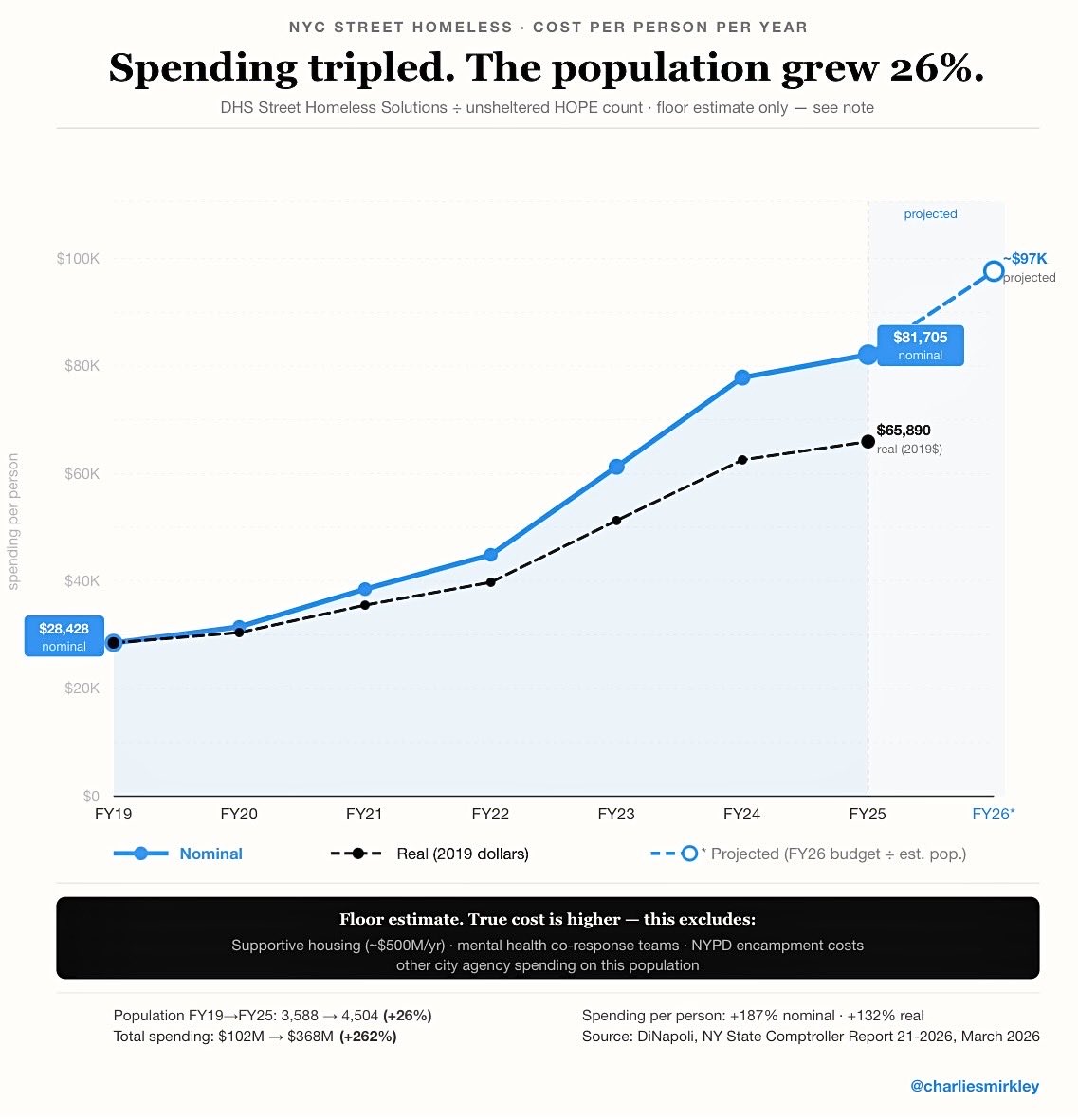
And the NY Comptroller report this is sourced from makes it worse, they openly admit they can't track whether people stay housed after placement. No long-term outcome data. No unit cost breakdowns. Just spend more and hope. Austin is heading the same direction. ~$10K/person now, but the Homeless Strategy Office asked for $101M (vs the $51.5M they got). Population still growing. Voters just rejected a $110M tax hike for it. NYC, SF, ATX, vastly different spending levels, same result. At some point the question isn't how much we're spending. It's why nobody can show what it's actually accomplishing.
English
0
0
1
17
D.S. Nelson รีทวีตแล้ว
Charlie Smirkley
Charlie Smirkley@charliesmirkley·
NYC spends more per homeless person than the median NYC household earns. $81,705 per person in FY2025. And $81,705 is a floor. It excludes supportive housing (~$500M/yr), mental health response teams, and NYPD encampment costs. The city projects ~$97K per person in FY2026.
Charlie Smirkley tweet media
English
1.5K
3.6K
12.7K
14.9M