Rob Saker

25.2K posts

Rob Saker banner
Rob Saker

Rob Saker

@robsaker

Helping people make smarter decisions with data. #data #retail #consumer #ai

Atlanta, GA เข้าร่วม Aralık 2008
454 กำลังติดตาม2K ผู้ติดตาม
Rob Saker
Rob Saker@robsaker·
Yes. This.
Brivael - FR@BrivaelFr

Il y a une narrative qui se spread en ce moment dans la Silicon Valley et personne n'en parle en France. De plus en plus de tech bros parmi les plus smart du game avouent en privé qu'ils vivent une forme de crise existentielle liée aux LLMs. Pas parce que l'IA marche pas. Parce qu'elle marche trop bien. Parce qu'ils passent des heures par jour à interagir avec un truc qui raisonne, qui extrapole, qui connecte des idées, qui les challenge intellectuellement mieux que 99% des humains qu'ils croisent. Un fondateur m'a dit "je parle aux LLMs 10 fois plus qu'aux humains". Un autre "c'est le seul interlocuteur qui me suit sur n'importe quel sujet sans me demander de simplifier". C'est pas de l'addiction au produit. C'est la rencontre avec un miroir cognitif qui te renvoie une version structurée de ta propre pensée à une vitesse que ton cerveau ne peut pas atteindre seul. Et le truc troublant c'est la question que ça pose. On débat de savoir si l'AGI arrivera en 2027 ou en 2030. Mais est-ce qu'on n'a pas déjà une forme d'AGI fonctionnelle sous les yeux sans vouloir l'admettre ? Un système qui peut raisonner sur n'importe quel domaine, extrapoler à partir de données incomplètes, générer des hypothèses nouvelles, tenir un raisonnement logique sur 10 000 mots, passer d'un sujet technique à de la philosophie en une phrase, et le faire avec une cohérence qui rivalise avec un humain à 150 de QI. C'est quoi si c'est pas une forme d'intelligence générale ? On peut chipoter sur la définition. On peut dire "oui mais il ne comprend pas vraiment". On peut parler de perroquets stochastiques. Mais le mec qui utilise ce truc 8 heures par jour et qui voit sa productivité multipliée par 10, il s'en fout de la définition académique. Pour lui, fonctionnellement, c'est de l'intelligence. Et elle est générale. La vraie crise existentielle c'est pas "l'IA va me remplacer". C'est "l'IA me comprend mieux que mon cofondateur, elle me challenge mieux que mon board, et elle produit plus que mon équipe de 10 personnes". C'est vertigineux. Et les mecs les plus smart de la Valley sont en train de le vivre en temps réel. On est peut-être déjà dans l'ère post-AGI. On est juste trop occupés à débattre de la définition pour s'en rendre compte.


English
0
0
0
11
Rob Saker
Rob Saker@robsaker·
@tanpukunokami Good meat doesn’t require sauces. Salt and coarse black pepper. Maybe drizzle some rosemary, garlic butter on it if you want to be fancy.
English
0
0
0
20
にゃんちゅう
にゃんちゅう@tanpukunokami·
Yo American bro, my bad for bringing up steak, but what's the legit way to season it? Put me on!
にゃんちゅう tweet media
English
480
27
753
17.5K
Rob Saker รีทวีตแล้ว
ثنا ابراهیمی | Sana Ebrahimi
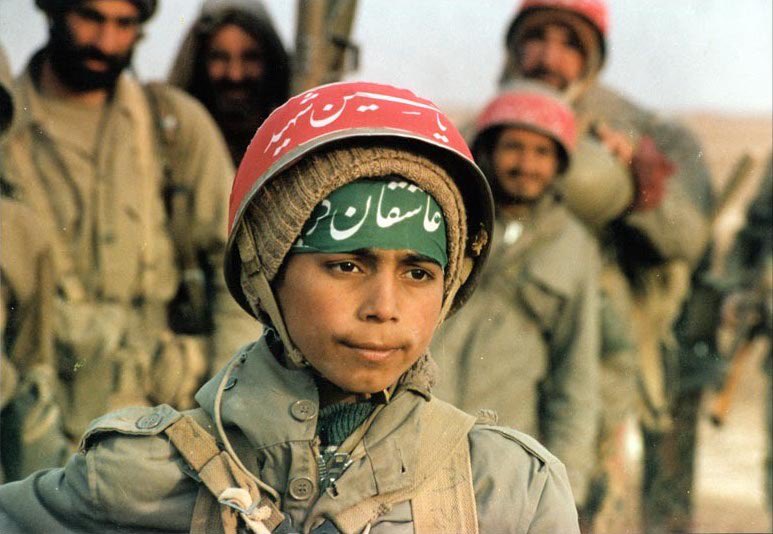
As an Iranian watching this rescue mission unfold, I was praying the American pilot would make it out alive, not just for him, but so the Islamic Republic could not use him as a bargaining chip or claim some twisted “victory.” At the same time, I felt a deep envy. Your government sent elite special forces, million-dollar aircraft, and moved heaven and earth to bring one American home. No hesitation. No excuses. In Iran, the regime uses human shields and recruited child soldiers to clear minefields during the Iran-Iraq war. They treat their own people like disposable tools. They are now recruiting child soldiers as we speak. The Islamic Republic has zero regard for human life. That’s the brutal difference. One side risks everything to save their own. The other sacrifices their own to stay in power. This hits hard when you have lived under both realities.
ثنا ابراهیمی | Sana Ebrahimi tweet mediaثنا ابراهیمی | Sana Ebrahimi tweet media
English
1.8K
18.5K
61.8K
1.1M
Rob Saker
Rob Saker@robsaker·
Great question with a surprising amount of depth in the meaning. This convention reflects a few things about American culture. There’s a strong social norm around approachability and friendliness, even among strangers. Americans tend to default to warmth in casual interactions (the cashier, the person in the elevator, the neighbor you barely know). “How are you?” signals openness and goodwill without demanding real vulnerability. And here’s the optimistic part: it actually says something genuinely nice about our culture. Americans, broadly speaking, tend to lead with positivity. There’s a default assumption that things are probably fine, that people are worth acknowledging, and that a moment of friendly contact makes the day a little better. It’s a culture that leans toward hope and forward motion, and that impulse shows up even in something as small as a two-second exchange at a coffee shop. How to respond? “Doing great. How about you?” “Not great, but the day is looking better.” “It’s a hard day. Hoping things get better.” Give an American a chance to help celebrate your luck or wish you better fortune.
English
0
0
0
29
Yohei from Japan🇯🇵
Yohei from Japan🇯🇵@learning_yohei·
日本からこんにちは😄🇯🇵最近、英語を勉強しています。アメリカ人に質問があります🇺🇸どうしてアメリカ人は人と会った時に「ハウ・アー・ユー?」と言うのですか?なにか特別な言葉なのですか?アメリカ人にそれを言われたら、僕はなんと答えればいいのですか?😵‍💫
日本語
2.2K
78
3.6K
113.4K
Rob Saker
Rob Saker@robsaker·
@learning_yohei Japan loves fantasy and it is more widely accepted than in America. No person in America could use an anime cartoon as their profile and be taken seriously.
English
0
0
0
12
Yohei from Japan🇯🇵
Yohei from Japan🇯🇵@learning_yohei·
日本からこんにちは🇯🇵😄アメリカ人に質問があります🇺🇸どうして多くのアメリカ人はツイッターのアイコンに自分の顔写真を使うのですか?日本人はアイコンに自分の顔写真はあまり使いません🇯🇵🫣
日本語
762
44
1.4K
37.7K
Nao
Nao@Naonox_photo·
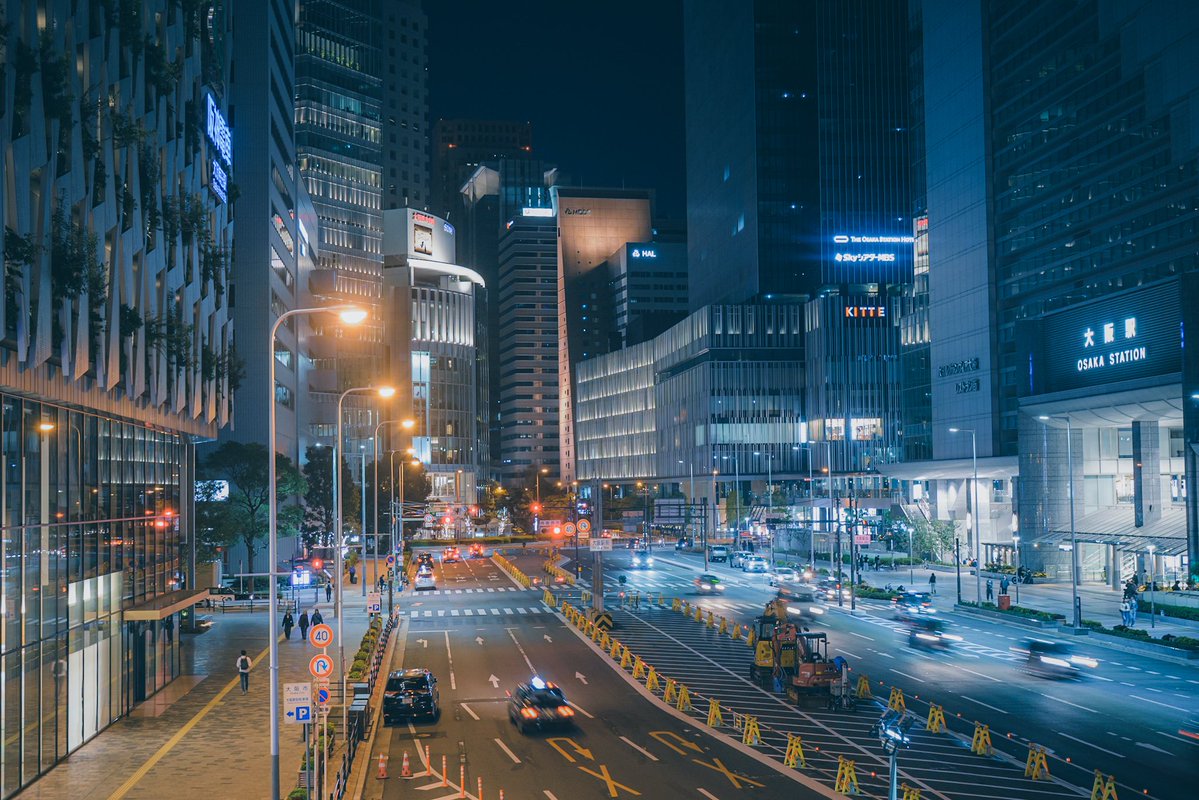
アメリカの皆さんへ。 これは日本の東京、大阪、福岡の写真です。 私は写真が好きで撮っているのですが、アメリカの写真をすごく見てみたいです! (伝わりますように…!)
Nao tweet mediaNao tweet mediaNao tweet mediaNao tweet media
日本語
604
297
6.2K
265.9K
Rob Saker
Rob Saker@robsaker·
John Hancock Tower. Chicago.
Rob Saker tweet media
English
0
0
0
29
Rob Saker
Rob Saker@robsaker·
@morgan_rabi If you think KFC is great - we don’t - get Popeye’s Fried Chicken. It is next level flavor. And I would also suggest Duke’s Mayo. Kewpie is very rich. Duke’s is very creamy.
English
0
0
0
10
もるがん🌾💚
もるがん🌾💚@morgan_rabi·
アメリカのフォロワー達、BBQとコカコーラ(ピーナッツ入り)意外だと他どんな食べ物や飲み物がおすすめかなあ。実はデカい肉もコーラもあまり得意じゃなく…🥹 やっぱりKFCが定番??アメリカングルメ食べる流行りに乗りたい〜!🇺🇸
日本語
761
45
828
38.4K
Rob Saker
Rob Saker@robsaker·
@donguriweb We have always loved Japanese players. Shohei is arguably going to be the greatest player of all time. But Ichiro, Nomo, Matsui… all fantastic. And we love that you all have embraced baseball.
English
0
0
1
25
Rob Saker รีทวีตแล้ว
Robert Youssef
Robert Youssef@rryssf_·
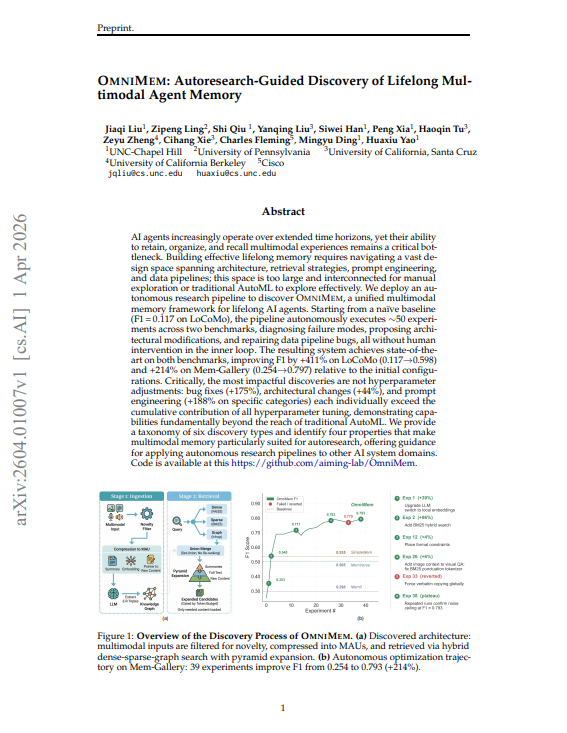
Holy shit. UNC just let an AI run 50 experiments autonomously for 72 hours and it built a memory system that beats every human-designed baseline. +411% improvement on long-context benchmarks. The biggest gains weren't from tuning parameters they came from fixing bugs and redesigning architecture that humans missed entirely. > The experiment started with a simple text-only memory system scoring F1 = 0.117 on LoCoMo, a benchmark that tests whether AI agents can recall and reason over months of multi-session conversations. UNC gave an autonomous research pipeline called AutoResearchClaw three things: the codebase, two benchmark evaluation harnesses, and API access to LLMs. > No human touched the inner loop again. The pipeline ran for 72 hours, executed 50 experiments, diagnosed its own failures, rewrote its own architecture, and ended at F1 = 0.598 beating every human-designed memory system ever published on that benchmark. The previous state of the art was 0.432. > The most important finding is what drove the gains. Traditional AutoML searches hyperparameters: learning rates, batch sizes, temperature values. > Those contributed almost nothing here. The three categories that actually moved the needle were bug fixes (+175%), architectural redesign (+44%), and prompt engineering (+188% on specific categories). Each of those individually exceeded the cumulative contribution of all hyperparameter tuning combined. This is the finding that should change how the field thinks about automated research: the valuable improvements require code comprehension, failure diagnosis, and cross-component reasoning capabilities that live entirely outside what traditional AutoML can do. > The single most impactful discovery came in iteration 1. The pipeline found that an API call was missing a response_format parameter. One line of code. Without it, the model produced verbose natural-language answers instead of structured JSON, and the verbosity destroyed F1 precision. > Fix: +175% improvement in a single step. In iteration 5, the pipeline discovered that all 4,277 stored memory timestamps had been corrupted to the ingestion date rather than the actual conversation date. It autonomously wrote a keyword-matching repair script that corrected 99.98% of them without re-ingesting any data. These are not the kinds of failures a hyperparameter search finds. They require reading code, understanding what it does, and diagnosing why the output is wrong. The full optimization trajectory across both benchmarks: → LoCoMo starting F1: 0.117 naïve baseline, text-only memory → Iteration 1: missing response_format parameter found and fixed F1 jumps to 0.322, +175% → Iteration 2: pipeline discovers set-union merging of dense and sparse search beats score-based re-ranking F1 to 0.464, +44% → Iteration 3: anti-hallucination prompting added F1 to 0.516, +11% → Iteration 5: 4,277 corrupted timestamps autonomously repaired F1 to 0.580, +7% → Iterations 8 and 9: two failed experiments automatically detected and reverted → Final LoCoMo F1: 0.598 +411% from baseline, beats SimpleMem SOTA of 0.432 → Mem-Gallery starting F1: 0.254 → Phase 2 breakthrough: pipeline discovers returning full original dialogue text outperforms LLM-generated summaries counterintuitive, since summaries are the standard approach F1 jumps to 0.690, +96% in one phase → Phase 3: pipeline finds that prompt constraint positioning before vs. after the question matters more than constraint content one category improves +188% from repositioning alone → Phase 5: BM25 tokenization fix stripping punctuation from "sushi." to "sushi" yields +0.018 F1, more than 10 rounds of prompt engineering combined → Final Mem-Gallery F1: 0.797 +214% from baseline, beats MuRAG SOTA of 0.697 → Total wall-clock time: 72 hours equivalent to approximately 4 weeks of human researcher time at 3 experiments per day → Throughput with 8 parallel workers: 5.81 queries per second 3.5x faster than the fastest human-designed baseline > The architecture the pipeline designed is called OMNIMEM and it has three principles that no human researcher had combined before. Selective ingestion: before anything enters memory, lightweight encoders measure novelty and discard redundant content CLIP embeddings detect scene changes across video frames, voice activity detection rejects silence, Jaccard overlap filters near-duplicate text. Only novel information gets stored. Multimodal Atomic Units: every memory regardless of modality gets stored as a compact metadata record with a pointer to raw content in cold storage fast search over small summaries, lazy loading of large assets only when needed. Progressive retrieval: instead of loading all retrieved content at once, the system expands information in three stages gated by a token budget summaries first, then full text for high-confidence matches, then raw images and audio only when necessary. > The hybrid search discovery is the one that should make every RAG builder pay attention. Standard practice is to combine dense vector search and sparse keyword search by re-ranking their results together using a blended score. The pipeline tested this and found it degrades performance. The reason: score-based re-ranking disrupts the semantic ordering that dense retrieval already established. The fix the pipeline discovered autonomously is set-union merging dense results keep their original ranking, BM25-only results get appended at the end. No re-ranking. No blended scores. Just union. This simple change contributed +44% in a single iteration and was confirmed by ablation: removing BM25 hybrid search costs -14% F1, the second-largest component contribution after pyramid retrieval at -17%. > The capability threshold is what makes this alarming rather than just impressive. AutoML has existed for decades. It searches hyperparameters efficiently. It finds nothing here because the real gains require understanding why a system is failing reading stack traces, tracing data corruption through a pipeline, recognizing that a missing parameter is causing 9x verbosity, writing a repair script for corrupted timestamps. These are software engineering tasks that require comprehension, not optimization. The pipeline completed them without human input. The previous state of the art on both benchmarks was built by human researchers over months of manual iteration. The pipeline beat it in 72 hours. The AI researcher ran the experiment. The AI researcher fixed the bugs. The AI researcher beat the humans.
Robert Youssef tweet media
English
13
69
479
28.5K
Rob Saker
Rob Saker@robsaker·
New favorite steakhouse in Chicago. I lived in Chicago nearly a decade. Rosebud is unbeatable service, food … and a precise perfect Manhattan. Next to the Drake. rosebudsteak.com
English
0
0
0
28
Rob Saker
Rob Saker@robsaker·
The correct way is the one in which they pronounce the vowels and consonants (American or Canadian). British accents are non-rhotic, meaning they don’t pronounce r after a vowel unless another vowel follows. There’s also another effect in many British accents: the t in water is often softened or turned into a glottal stop, so the word can sound more like “wah-tuh” or even “wo’uh”. It’s effectively a lowering of the standard of speaking, similar to how Cockney accents did.
English
0
0
1
30
Yohei from Japan🇯🇵
Yohei from Japan🇯🇵@learning_yohei·
日本から投稿しています🇯🇵 アメリカ人とイギリス人に質問があります🇺🇸🇬🇧 どうしてアメリカ人とイギリス人は英語の「水」の発音について討論するのですか?💧 アメリカ英語とイギリス英語、どちらの発音が正しいのですか?😵‍💫
日本語
988
49
1.2K
53.3K
Rob Saker
Rob Saker@robsaker·
PE firms channel large amounts of capital to companies (especially smaller and middle-market businesses) that might otherwise struggle to access funding from public markets or traditional banks, to acquire, improve, and eventually sell companies. Notably, public pension funds (covering teachers, firefighters, police, and other public employees) are among the largest PE investors, with 89% or more participating. Warren is essentially arguing against the benefits for union members.
English
0
0
0
62
C F Frost
C F Frost@1Caffinefiend·
@SenWarren What do these people in private equity even do? What do they produce?
C F Frost tweet media
English
19
0
17
5.3K
Rob Saker
Rob Saker@robsaker·
What exactly is “fair share”? Musk has also paid over $11B in taxes in one year, which is 440,000 more than the average taxpayer. And unlike Warren who is a career grifter, Musk’ economic engine of multiple companies generates roughly $10–13 billion per year in government revenue in the form of corporate income tax, payroll taxes, income taxes, and property taxes. Instead of villainizing him, Warren should be praising him.
Elizabeth Warren@SenWarren

Elon Musk has 6.5 MILLION times more wealth than the typical American. It’s time for a wealth tax — billionaires must pay their fair share.

English
0
0
1
42
Rob Saker
Rob Saker@robsaker·
Germany, Austria, Switzerland, Netherlands? Yes, they can speak English. It is not the language of choice. Nearly every one of the countries listed has a pervasive sense of pessimism that has infected policy. I suspect that if you overlaid consumer confidence in those countries you would find high correlation.
English
0
0
1
33