Sam Charrington

19K posts

Sam Charrington banner
Sam Charrington

Sam Charrington

@samcharrington

Machine learning & AI podcaster, community builder and all around enthusiast. Creator of the @TWIMLAI Podcast, TWIMLcon, TWIMLfest & the TWIML Solutions Guide.

St. Louis, MO เข้าร่วม Nisan 2007
2.8K กำลังติดตาม19K ผู้ติดตาม
Sam Charrington รีทวีตแล้ว

andrew chen
andrew chen@andrewchen·
I wanna claude like this. Feet up on the desk, custom vibe code walkie talkie. So many style points via bharms27/reddit
English
165
244
3.8K
357.9K
Sam Charrington รีทวีตแล้ว
Moe
Moe@katibmoe·
Introducing One. The simplest way to connect and monitor AI agents to hundreds of apps. And we’re open-sourcing the world’s largest integration database powering it: 47,000 agentic actions across 250+ apps. RT + comment “One” for access & 1M free API requests/month.
English
740
426
865
155.9K
Sam Charrington
Sam Charrington@samcharrington·
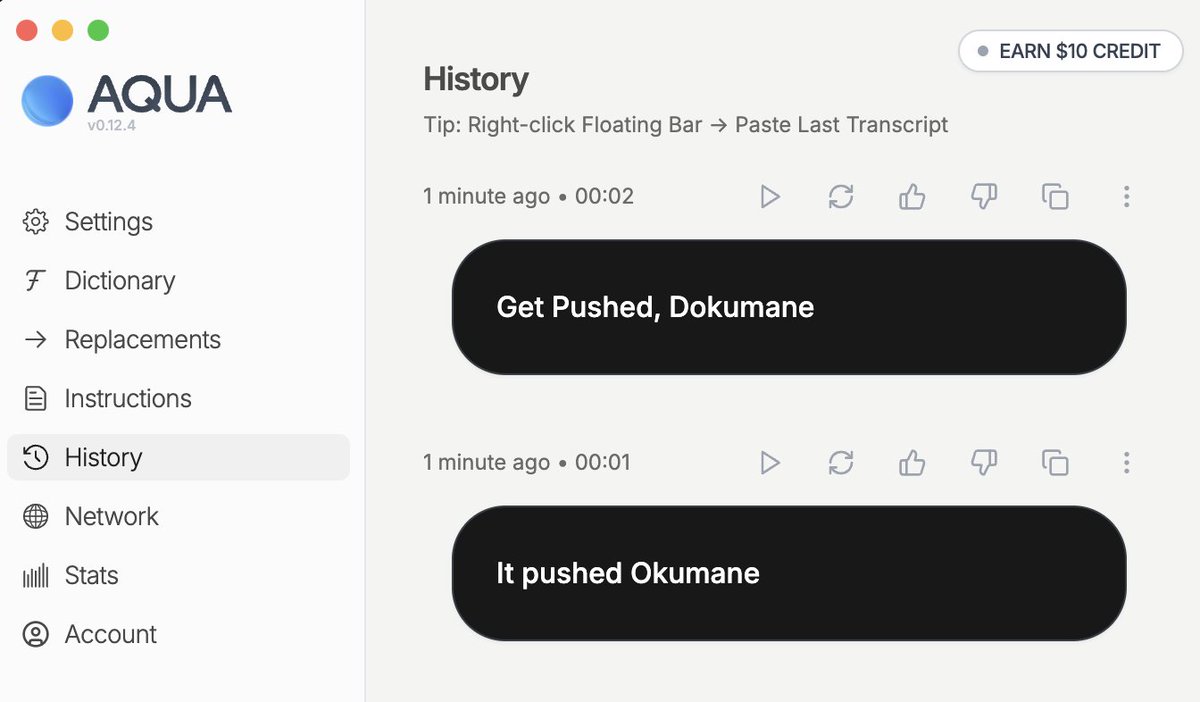
"Get pushed, Dokku Master." Clearly @WisprFlow is not tuned for command line use lol.
English
2
1
3
1.2K
Sam Charrington
Sam Charrington@samcharrington·
Yesterday's "you're absolutely right" (claude code) is today's "I'm doing {this}, not {that}..." (codex). It's driving me nuts and no amount of yelling in custom instructions will get it to stop repeating this construct.
English
1
0
3
949
Sam Charrington รีทวีตแล้ว
Niloofar
Niloofar@niloofar_mire·
@kchonyc @karpathy There is apparently a bunch of nuances like this, eg shouting (upper case) works on anthropic models and not oai, and xml works well with oai models. I heard a bunch here: open.spotify.com/episode/2bbPM4…
English
2
7
155
27.8K
Sam Charrington รีทวีตแล้ว
Cassandra Unchained
Cassandra Unchained@michaeljburry·
Must read - this is free and not me. @georgenoble/note/c-226667679?r=4repfn&utm_medium=ios&utm_source=notes-share-action" target="_blank" rel="nofollow noopener">substack.com/@georgenoble/n… This is the most SHAMELESS structural manipulation of a major index I've ever seen. SpaceX is preparing what could be the largest IPO in history. Target valuation: $1.75 trillion. That would make it the sixth-largest company in America on day one. And Nasdaq wants the listing so badly they're literally CHANGING how the Nasdaq-100 works. In February, Nasdaq published a "consultation" proposing sweeping changes to how companies enter the index. The timing is pure coincidence, of course. Just like it's pure coincidence that SpaceX has reportedly made fast index inclusion a CONDITION of listing on Nasdaq. Here's what they're proposing: A new "Fast Entry" rule would let any newly listed company whose market cap ranks in the top 40 of current Nasdaq-100 members get added to the index after just 15 trading days. No seasoning period. No liquidity requirements. Completely exempt from the standards every other company had to meet. Currently, new public companies typically wait up to a year before they're eligible for major index inclusion. That waiting period exists for a reason. It lets the market establish real price discovery. It protects passive investors from being forced into untested, illiquid stocks. And Nasdaq wants to throw all of that out. For ONE listing. But the Fast Entry rule isn't even the worst part... The real scandal is the 5x float multiplier. Right now, the S&P 500 uses a free-float adjusted methodology. If only 5% of a company's shares are available for public trading, the index weights you at 5% of total market cap. That's common sense. You weight a company based on what investors can actually buy. Nasdaq's current methodology already uses total market cap rather than free-float for weighting. But for very low-float stocks, they at least had a 10% minimum float threshold. Under the new proposal, that threshold DISAPPEARS entirely. Instead, any stock with less than 20% free float gets weighted at FIVE TIMES its actual float percentage, capped at 100%. Do the math on SpaceX: If SpaceX IPOs at $1.75 trillion and floats 5% of its shares, there would be roughly $87.5 billion worth of stock available for public trading. Under Nasdaq's proposed 5x multiplier, the index would weight SpaceX at 25% of its total market cap. That means passive funds would be forced to buy as if SpaceX were a $437.5 billion company. But only $87.5 billion of stock actually exists in the market. You are forcing hundreds of billions in passive buying into a $87.5 billion float. QQQ alone manages nearly $400 billion. The total Nasdaq-100 ecosystem represents over $1.4 trillion in exposure across ETFs, mutual funds, structured notes, and derivatives. Every single passive vehicle tracking this index would be REQUIRED to buy SpaceX at whatever price the market dictates. On Day 15. With zero price discovery. Zero track record as a public company. And a float so thin you could read through it. So what this actually does is it creates a structural wealth transfer mechanism. The passive bid from index funds pushes the stock price higher. That higher price benefits exactly one group of people: the insiders and early investors who own the other 95% of the shares. And when lock-up periods expire 90 to 180 days later? Those insiders sell into the artificially inflated passive bid. Your 401(k) is the exit liquidity. This is the fundamental corruption of indexing. Indexing used to be brilliant. Low cost. Efficient. You were free-riding on the price discovery done by active managers. The index reflected the market. Now the index IS the market. Trillions of dollars flow blindly into whatever the index tells them to buy. And the people who control the index methodology are changing the rules to serve the interests of a single IPO candidate. The S&P 500 requires companies to have at least…
English
351
1.4K
7.8K
990.5K
Sam Charrington รีทวีตแล้ว
Tiago Forte
Tiago Forte@fortelabs·
Wait, so the founder of Anthropic is "Amodei," as in "loves god"? And he leads Anthropic, meaning "human-centered," which is being used in military strikes? And the creator of ChatGPT is "Altman," as in "an alternative to humans"? And he leads OpenAI, which is completely closed? And then there's "Gemini," meaning "two-faced," from a company that promised to do no evil? And the whole global AI arms race is being driven by people who claimed to be worried about AGI taking over the world? Either the universe is an extremely cliché writer, or has a brilliant sense of humor
English
1.3K
4.4K
35.2K
2.4M
Matthew Berman
Matthew Berman@TheMattBerman·
I replaced a $200K GTM hire with @openclaw 😱 here's the system that runs my outbound: step 1: mine LinkedIn engagement → @rapidapi scrapes everyone engaging with niche content → someone who commented on specific posts = 10x warmer step 2: enrich + verify → Hunter/Apollo finds the decision-maker + email → @Perplexity deep research pulls signals like hiring, fundraising, media appearances, quotes step 3: score against your ICP → title, company, signals = ranked 0-100 → only A-tier leads get touched step 4: write personalized outreach → Claude writes outreach referencing what they ACTUALLY engaged with and talk about step 5: send via @instantly_ai → 3-email sequence. automated follow-ups. step 6: pre-call deep research → @PerplexityComet builds a 1-page briefing 30 min before every call input: your ICP + niche keywords output: booked meetings with people who already care $200K/year GTM engineer → $130/month in APIs. I packaged the entire system as the First 1000 Kit: - all 8 @openclaw skills - every prompt - tool-by-tool setup - email sequences that convert giving it away free. comment 1000 + like + follow (must follow so i can DM)
English
1.1K
88
1.9K
187.5K
Sam Charrington
Sam Charrington@samcharrington·
@TheRealAdamG Interesting thx. That was over a week ago, if they're still doing this and haven't implemented notifications to that effect in the app, then... possibly yes? 🤷‍♂️
English
1
0
0
59
Jacob Klug
Jacob Klug@Jacobsklug·
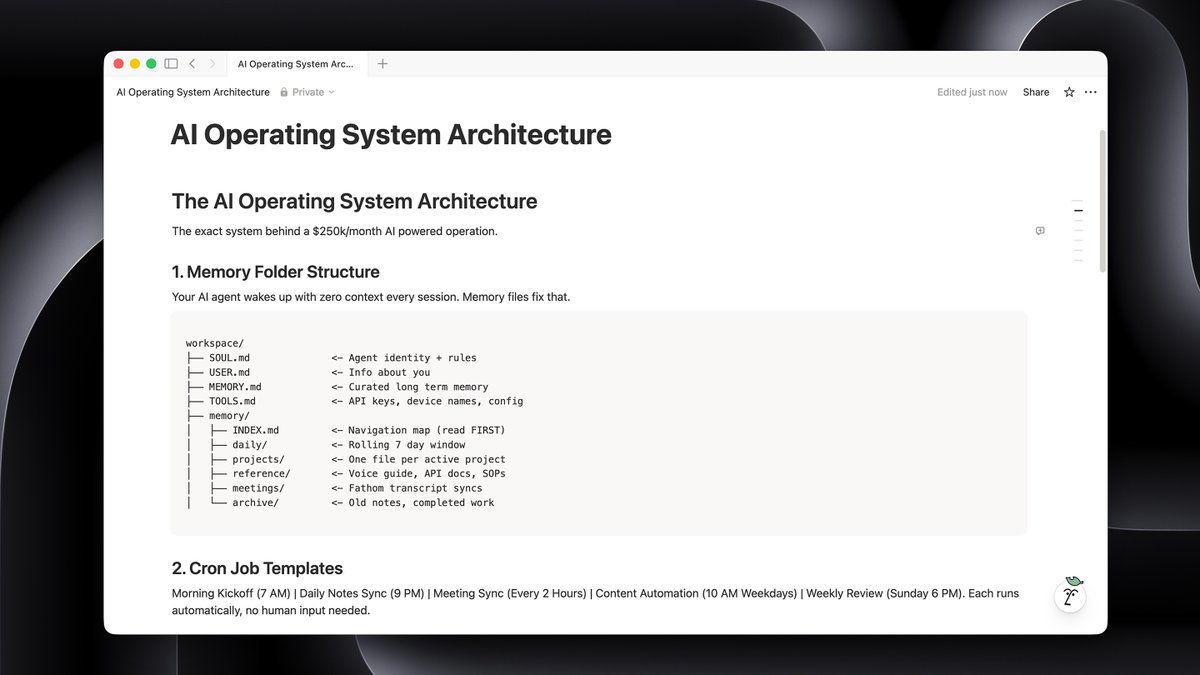
I'm giving away my entire @openclaw architecture. Behind my $250k/month agency. After weeks of building, I've dialled in the exact system that runs my business 24/7. What's included: • Memory folder structure (how to organize agent context) • Cron job templates (daily briefs, meeting syncs, content automation) • How to build a custom dashboard in @lovable • API reference doc (so your agent never forgets its tools) • Voice training method (85 posts to teach it your style) • Supabase schema for dashboard connection Comment "OS" and follow. I'll DM it to you. P.S. This will probably blow up so give me some time to reply.
Jacob Klug tweet media
English
5.9K
279
3.6K
399.8K
Sam Charrington
Sam Charrington@samcharrington·
After some initial attempts at using GPT-5.3-Codex via Cursor I thought the takes here suggesting how much better it was were highly exaggerated. But after spening some time working with it in the new Codex app, I'm impressed. The end-to-end experience feels much more accurate (i.e. it does what I want) and productive. Whether this reflects model or harness advancements we won't really know (the answer is likely both), but on vibes alone it really does feel like a step forward.
English
0
0
4
3.3K
David Ch
David Ch@chhddavid·
BREAKING: @claudeai just got a massive upgrade today and I'm so happy to be a part it. From now on, Claude Opus 4.6 can build Chrome Extensions for every Chromium-based browser. We just launched Shipper, a tool that lets Claude: ✅ Build complete Chrome Extensions ✅ Recreate existing Extensions ✅ Ensure multi-browser comatibility ✅ Write privacy policies ✅ Autofill entire Chrome Web Store listings Claude Opus 4.6 can do all the above in 1 simple prompt for as low as $0.11/extension... And it takes minutes, not hours! Open up Shipper and ask Claude to "create a free ad block extension" or "auto-invite 950 people weekly on linkedin". Since this is a very special launch, if you comment "shipper" you will get FREE credits :)
English
805
219
3.1K
1.6M
Sam Charrington รีทวีตแล้ว
Nikita Rudin
Nikita Rudin@rdn_nikita·
Thank you @samcharrington for a great first podcast experience! I stand by my “hot take”. Let’s make sure we change that in 2026!
The TWIML AI Podcast@twimlai

Today, we're joined by @rdn_nikita, co-founder and CEO of @FlexionRobotics to discuss the gap between current robotic capabilities and what’s required to deploy fully autonomous robots in the real world. Nikita explains how reinforcement learning and simulation have driven rapid progress in robot locomotion—and why locomotion is still far from “solved.” We dig into the sim2real gap, and how adding visual inputs introduces noise and significantly complicates sim-to-real transfer. We also explore the debate between end-to-end models and modular approaches, and why separating locomotion, planning, and semantics remains a pragmatic approach today. Nikita also introduces the concept of "real-to-sim", which uses real-world data to refine simulation parameters for higher fidelity training, discusses how reinforcement learning, imitation learning, and teleoperation data are combined to train robust policies for both quadruped and humanoid robots, and introduces Flexion's hierarchical approach that utilizes pre-trained Vision-Language Models (VLMs) for high-level task orchestration with Vision-Language-Action (VLA) models and low-level whole-body trackers. Finally, Nikita shares the behind-the-scenes in humanoid robot demos, his take on reinforcement learning in simulation versus the real world, the nuances of reward tuning, and offers practical advice for researchers and practitioners looking to get started in robotics today. 🗒️ For the full list of resources for this episode, visit the show notes page: twimlai.com/go/760. 📖 CHAPTERS =============================== 00:00 - Introduction 04:07 - Is robot locomotion solved? 06:04 - Sim-to-real gap 08:58 - Adding semantics to policies 09:42 - Modular vs end-to-end architectures 10:29 - Planner model 12:21 - Adapting RL techniques from quadrupeds to humanoids 15:39 - Behind robot demos 18:09 - Humanoid robots in home environments 22:03 - Training approach 23:56 - VLA models 27:59 - Closing the sim-to-real gap 32:55 - Task orchestration using VLMs 36:38 - Tool use 38:10 - Model hierarchy 43:37 - Simulator versus simulation environment 44:57 - Combining imitation learning and reinforcement learning 46:42 - RL in real world versus RL in simulation 52:58 - Reward tuning and value functions in robotics 56:38 - Predictions 1:00:10 - Humanoids, quadropeds, and wheeled platforms 1:02:45 - Advice, recommended robot kits, and community pla

English
1
4
10
1.1K