ทวีตที่ปักหมุด
Carsten Munk
32.1K posts

Carsten Munk
@stskeeps
wannabe manfred macx || building @lanelayer || verifiable linux maximalist
เข้าร่วม Mayıs 2009
6.5K กำลังติดตาม4.1K ผู้ติดตาม
Carsten Munk รีทวีตแล้ว

Carsten Munk รีทวีตแล้ว

Babe wake up, a new Rust QUIC implementation with multipath and NAT traversal just dropped!
iroh.computer/blog/noq-annou…
English
Carsten Munk รีทวีตแล้ว

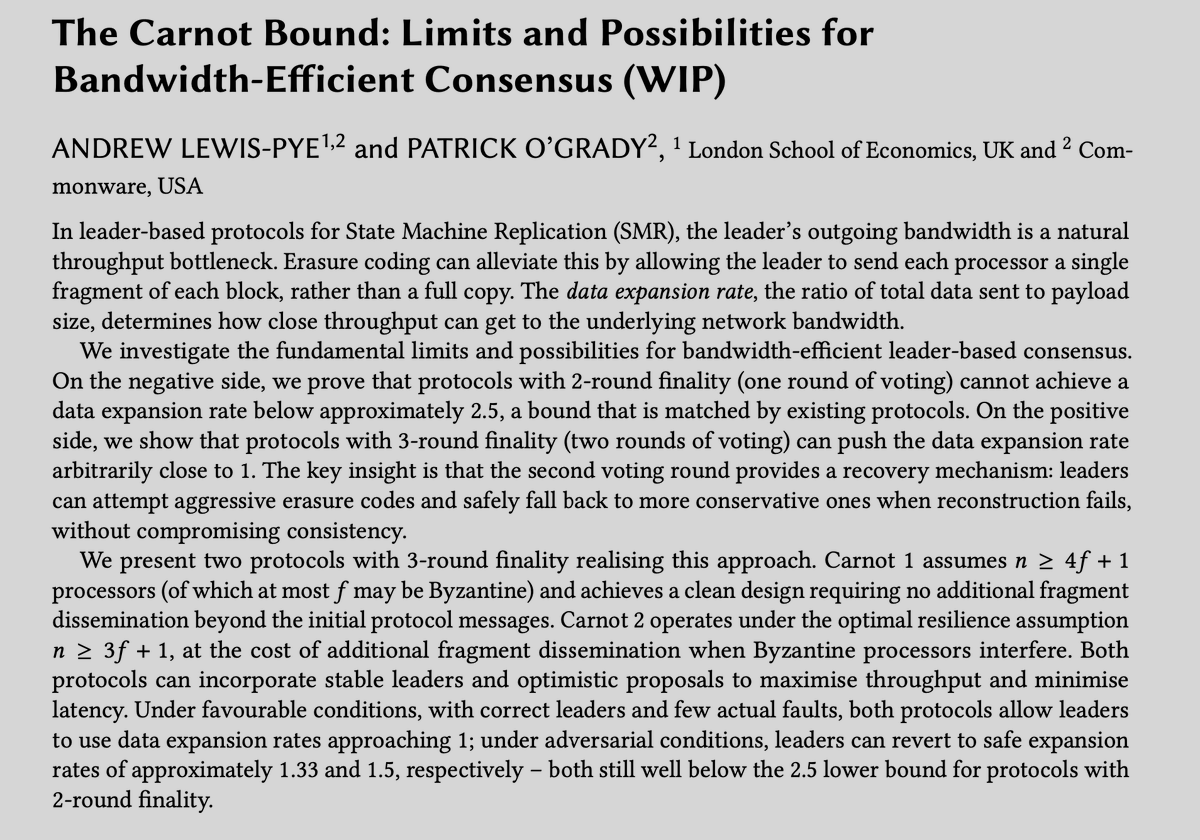
New paper with @_patrickogrady and @commonwarexyz: The Carnot Bound.
In leader-based consensus, the leader has to get each block out to every other processor. Erasure coding helps: instead of sending a full copy to everyone, the leader sends each processor a small fragment, from which the full block can be reconstructed once enough fragments are collected.
The efficiency of this encoding is captured by the data expansion rate — the ratio of total data sent to payload size. This is a key parameter for throughput: the closer it is to 1, the closer maximum throughput gets to the raw network bandwidth.
We prove that protocols with 2-round finality (one round of voting) can't achieve a data expansion rate below 2.5, which is a bound matched by existing protocols. We then show that an extra round of voting breaks the barrier, allowing rates arbitrarily close to 1.
Links to paper and blog below...

English
Carsten Munk รีทวีตแล้ว

Andy Weir showing some of the spreadsheets underlying the calculations in the book
youtube.com/watch?v=lYHCTE…
i mean, it's not quality scifi if it doesn't come with a supplementary whitepaper

YouTube

English
Carsten Munk รีทวีตแล้ว

Who’s got fast builds and a merch store? We do.
If you've been waiting for a reason to rep Depot, this is it → depot.dev/merch
Hooking you up on your first order:
50% off: ALL-ORDPCT50-LAUNCH-03-26
free shipping: ALL-FREESHIP-LAUNCH-03-26
GIF
English
Carsten Munk รีทวีตแล้ว

Quick announcement: After long and heavy suffering :) the S-two white paper is finally out:
eprint.iacr.org/2026/532
Although nothing new in regard to the basic principles (a circle STARK, etc.) the white paper yet contains several details of broader interest:
- A formal description of the flat AIR circuit model (used by several contemporary zkVMs)
- A thorough soundness analysis of multi-table proofs: If one does not use "lifted" FRI, taming the soundness error turns out to be more sophisticated as expected. We introduce the notion of "cross-domain correlated agreement", and show that multi-table FRI satisfies this property.
- A discussion of adjusted conjectures, which takes into account the recent boost of proximity gaps counter examples. We believe that it is plausible to hope for acceptable list- and line-decodability properties up to the information-theoretic barrier, the Elias bound.
Thanks for all the help from the StarkWare team, and in particular to Dmitry Krachun for the many helpful discussions around his counter example.
English
Carsten Munk รีทวีตแล้ว

"we built crypto for agents" is the new "we built crypto for institutions"
the reality is simple, crypto has use cases for everyone
agents, institutions, consumers, unbanked, cypherpunks, traders, everyone
Erik Voorhees@ErikVoorhees
It may be obvious in hindsight that we actually built crypto for the machines
English
Carsten Munk รีทวีตแล้ว

It's not quite that simple and I'm not sure if it'll really go anywhere (at least I've learned a lot!), but turns out you can get kinda far in a couple months (with otherwise no prior knowledge on hypervisors): github.com/dergoegge/bedr…
English
Carsten Munk รีทวีตแล้ว

there was an interesting part of this conversation where c-node (correctly) stated that your first amendment right to publish code does not additionally give you the right to run a business using said code
there seems to be pretty clear agreement among lawyers i've chatted with that centralized privacy applications can not operate as businesses even if they don't custody funds
centralized meaning the dev team // business running relayers, coordinators, sequencers, and more
this isn't very surprising, but even if you're not taking fees, you still have to be somewhat careful
basically anything that is run by a centralized operators // entity either is not making any money or is running some relatively serious risks
Eshita@eshita
Connor (@colludingnode) joins Khushi (@khushii_w) and I to talk about privacy as the adoption landscape shifts, alongside his work at Tachyon (@TachyonZcash). We cover: 01:24 - Privacy's performance last year 04:21 - When people care about privacy 05:44 - Zashi (Zodl) and Zcash's limitations 09:58 - Institutions won't adopt permissionless chains 14:34 - Why retail needs onchain privacy 19:42 - Tachyon's plan to launch 22:18 - Code is speech, until you make it a business 27:24 - An anti-privacy argument Full episode below 🍸
English
Carsten Munk รีทวีตแล้ว

Excited to share Visa CLI, the first experimental product from Visa Crypto Labs. Check it out and request access here
visacli.sh

English
Carsten Munk รีทวีตแล้ว

The idea that ZK'ing means that running nodes doesn't matter is itself misleading imo (and I was misled by this for a long time)
You need to be able to not just verify the correctness of headers, but be able to read the chain, in a privacy-preserving and censorship-resistant way. RPCs do not provide this, even Helios and Colibri do not provide this.
Ethereum's destiny is to be a network where the amount of data and transactions processed is far greater than the amount that needs to be handled by any one single node, but making this truly permissionless and chokepoint-free requires more work than ZK-proving alone.
English