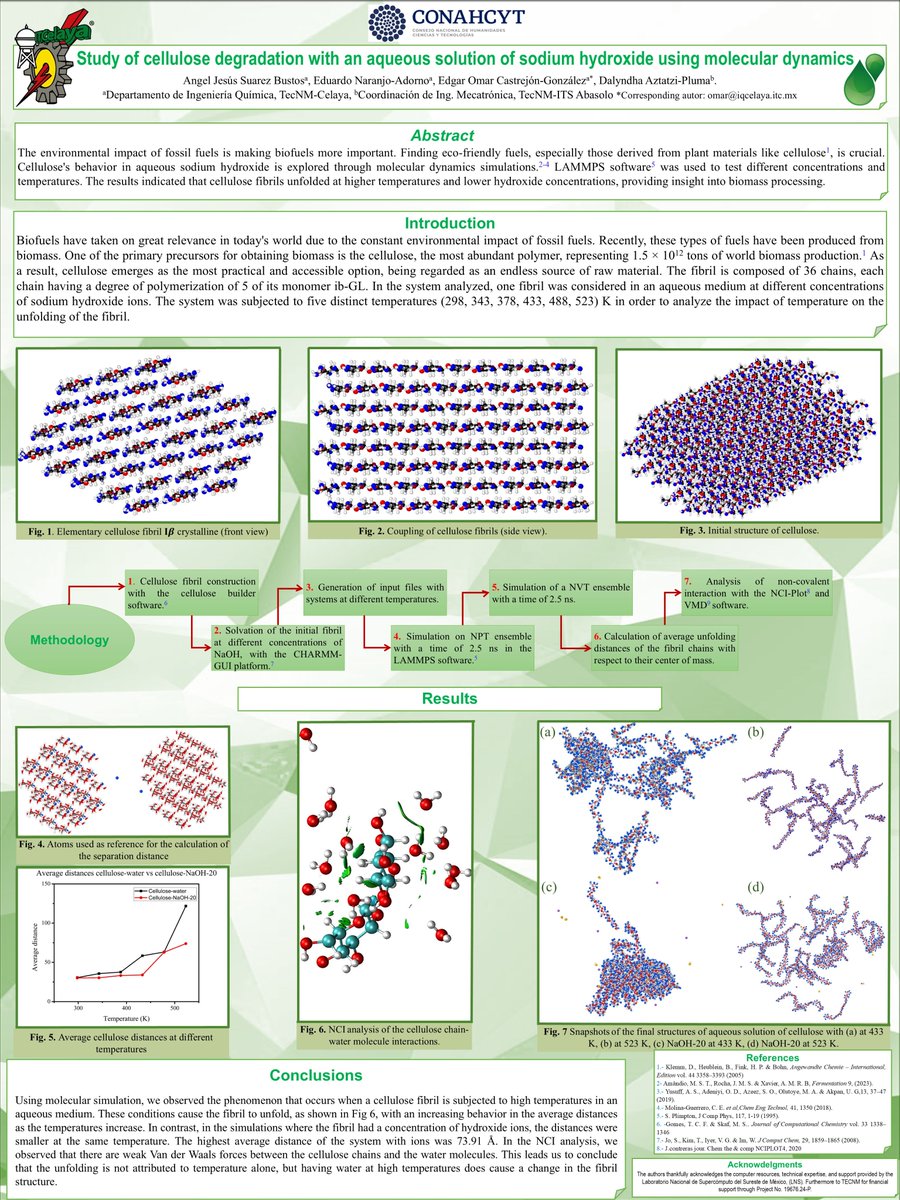
@tef_gs@LatinXChem Hello, at the moment from the tests that have been performed we can observe that the concentrations of hydroxide of sodium do not promote the unfolding of the fibril as well as the aqueous medium does. The concentrations were 10,15,20,25 and 30 sodium hydroxide ions.
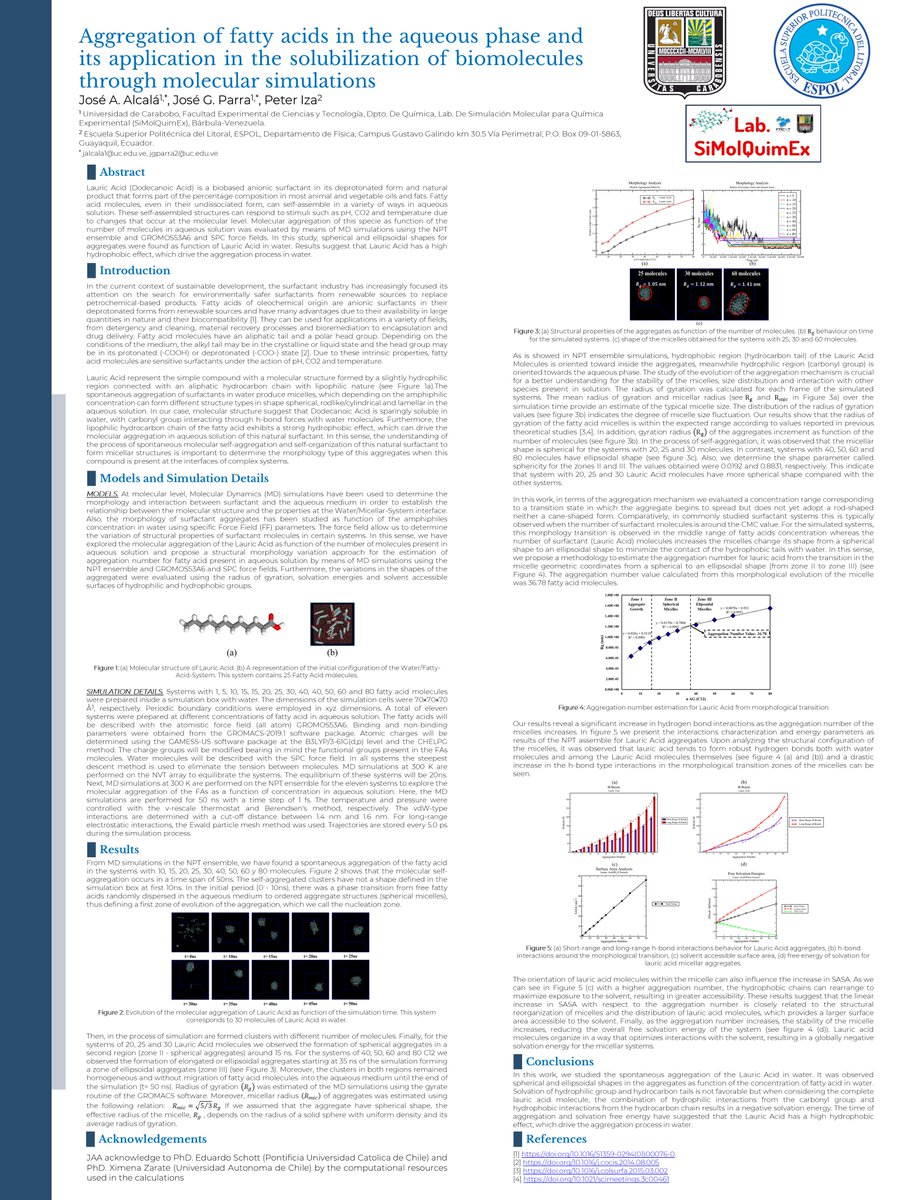
@tef_gs@LatinXChem en este trabajo utilizamos los acidos graso sin disociar. las cabezas polares estan 100% protonadas, en este etapa del trabajo no contemplamos el estimulo del pH sobre la morfologia de las micelas
Hi @LatinXChem, presenting my work ‘Estudio del acoplamiento molecular de nitrobencenesulfonamidas derivadas de tiazol y la ferredoxina de Trichomonas vaginalis.’ at #LatinXChem24#LatinXChemComp#Comp140.
@MarreroCRuben1@LatinXChem Hola Ruben, gracias por compartir tu trabajo. Cuán significativa es la diferencia para la energía de afinidad encontrada para los compuestos 1-4 con respecto al metronidazol? E incluso comparando entre los derivados calculados.
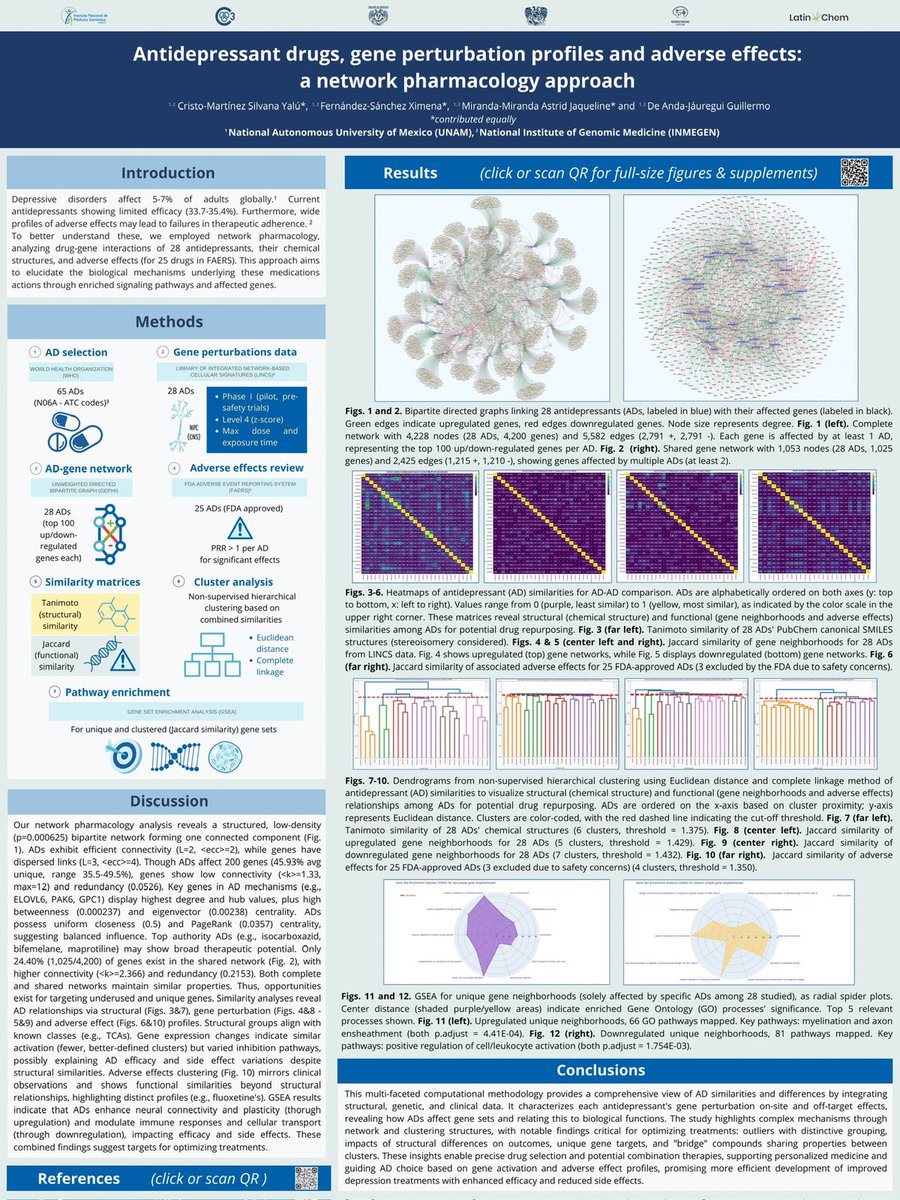
@ximena_fdzs@LatinXChem@astridmirandaaa@gdeandajauregui@silvannCM_ Hello Ximena, very nice work! Not quite in my are of expertise, so forgive my ignorance. Do you plan on performing calculation (QM, MD) with the identified gene targets? WOuld that be relevant for your analysis? Thanks!
@SebasDVargas@LatinXChem@insilicoRG@afcombariza Hello Sebastian! Nice work so far, much more coming ahead, as I can understand. But as previous comments, I am unsure about the questions about these systems that you want to answer.
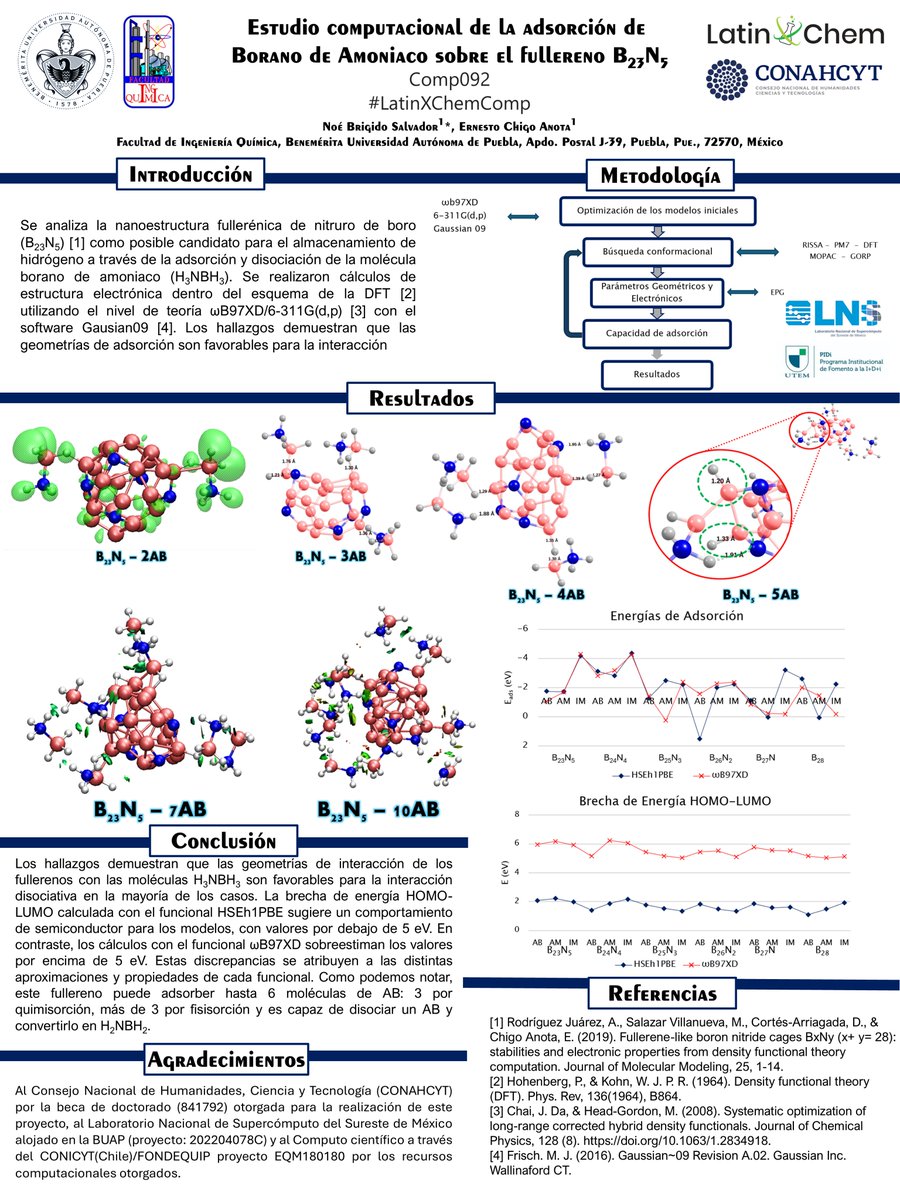
@Noe_Brigido@LatinXChem Hola Noé, muy interesante tu trabajo! Cómo llegan a la conclusión de que se pueden adsorber 6 moléculas de AB, con los distintos tipos de interacción que mencionas? Gracias!
@willloook@LatinXChem@OsYanezOsses@ctcgunab Hello, Williams, great work! Are you considering extended system calculations to confirm the trend observed for the monomers and dimers?
@liana_diaz9680@LatinXChem Hello Liana, nice work! I was wondering if you could expand on the effect of pH on the adsorption of paracetamol and how did you include pH into your calculations. Thanks!
I'm very happy to share this project with @LatinXChem , which uses calcium oxide (CaO) from eggshells for the adsorption of cadmium and paracetamol in water, analyzing the interactions through computer simulations. #Comp114#LatinXChemComp#LatinXChem24
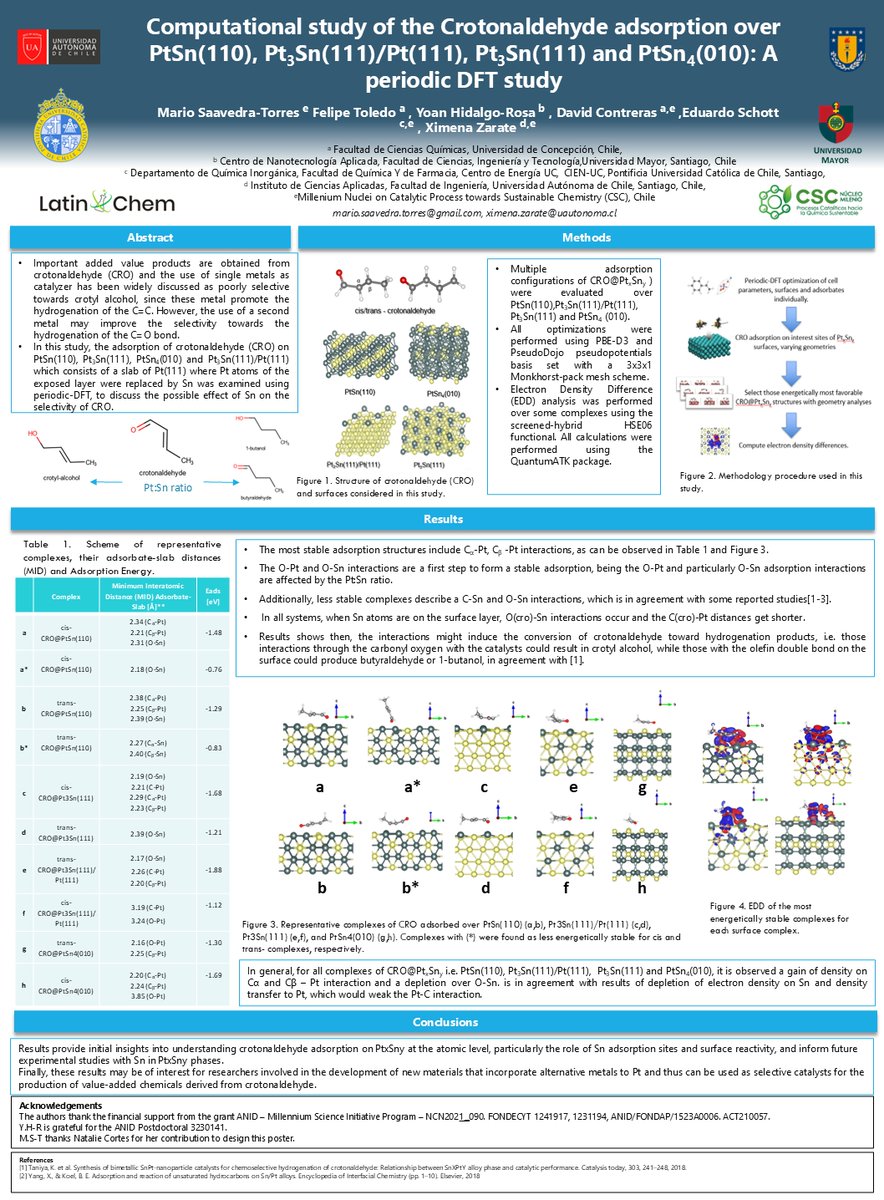
@mariosaavedrat@LatinXChem Hello Mario, nice work! To summarize, based on your calculations, what is the role of the Sn adsorption sites on surface reactivity? Thanks!
Hi @LatinXChem; presenting our work: "Computational study of the Crotonaldehyde adsorption over PtSn(110), Pt3Sn(111)/Pt(111), Pt3Sn(111) and PtSn4(010): A periodic DFT study" #LatinXChemComp#LatinXChem24
@tomas0821@Leandro_RuizH@LatinXChem@cicima_ucr Hello Tomas, nice work. How many graphene layers are there in the nanoscroll? If I understand figure 4 correctly, position A has the strongest interaction energy?
I am excited to present our aluminum-based battery research, a work in progress, at #LatinXChem24! We’re optimizing carbon nanoscrolls for AlCl₄ migration. Posting on behalf of @Leandro_RuizH , the student involved in this project! #LatinXChemComp#Comp068@LatinXChem
@cruz_moon22329@LatinXChem@softmatterlab@inifta_ok Hola Ana Maria, muy buen trabajo y excelente presentacion, muy clara. No llego a ver en la ultima slide, cambia el lambda de la transición de fase volumétrica al cambiar el numero de segmentos?
@cruz_moon22329@LatinXChem@softmatterlab@inifta_ok Hola Ana Maria, muy buen trabajo y genial presentación. No llego a ver en la última diapo si hay un cambio en el lambda al que ocurre la transición de fase volumétrica al aumentar el número de segmentos. Es asi?
@ainugalanodel@LatinXChem Hola Jose, interesante trabajo, muchos calculos. Podrias subir las figuras 2-5 como hilo para poder verlas mejor? Aun magnificando al máximo el poster no logro verlas bien.