
Ecstasy Language
210 posts

Ecstasy Language
@xtclang
Ecstasy is an apache-licensed, open source programming language, designed to develop scalable, secure and resource-efficient cloud applications.
เข้าร่วม Şubat 2018
42 กำลังติดตาม213 ผู้ติดตาม
@heyyrudyy404 @RaulJuncoV Additionally, for persistent data, the oodb module in Ecstasy supports transactional continuations, via the DBProcessor interface. github.com/xtclang/xvm/bl…
English

@RaulJuncoV What if we have compiler/lang with eventually stack-oriented VM components handling this scenario of computation/error/retry/backout/backoff like with #Erlang VM or newly @xtclang, instead of handling ourselves those tedious manual check, compensatory/reconciliation logic ?
English

I love asynchronous communication. It's scalable, decoupled, and resilient.
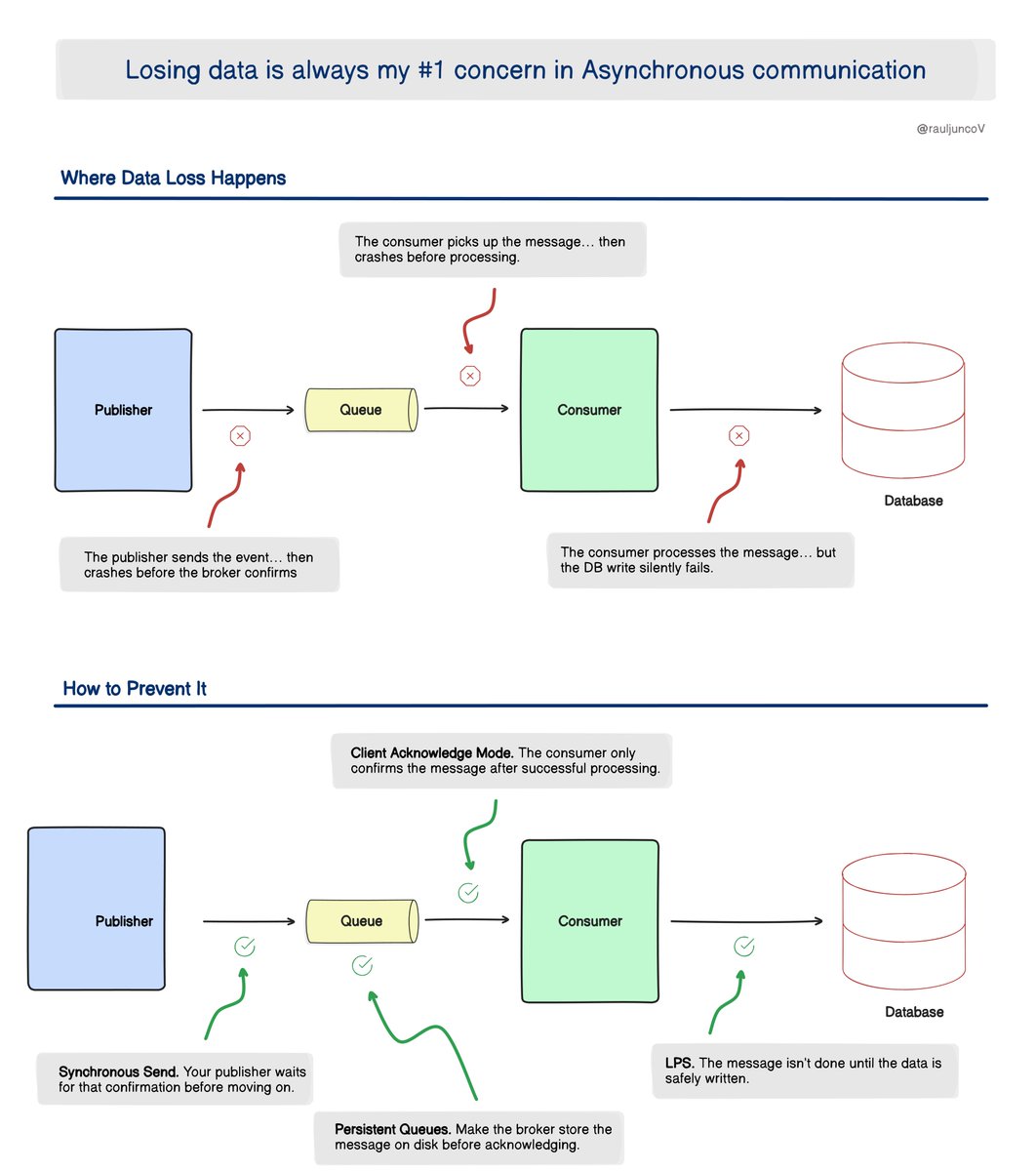
But losing data is always my #1 concern.
Event-driven systems look simple on the surface: You emit an event. Another service picks it up and acts.
But here’s where data slips through:
1. The publisher sends the event… then crashes before the broker confirms.
2. The consumer picks up the message… then crashes before processing.
3. The consumer processes the message… but the DB write silently fails.
Now, how do you prevent that?
1. Persistent Queues + Synchronous Send
Make the broker store the message on disk before acknowledging.
Your publisher waits for that confirmation before moving on.
2. Client Acknowledge Mode
The consumer only confirms the message after successful processing.
If it crashes midway, the message stays in the queue for retry.
3. Last Participant Support
The message isn’t done until the data is safely written.
If the DB call fails, you don’t ack.
Async isn’t risky. Ignoring the edge cases is.
Every message is a promise. Keep it, or retry it.
What do you do to stop silent data loss?
English
After lengthy consideration and until further notice, this account will be going dormant, and we will not be advertising on or otherwise supporting this platform.
You can follow our work and contact us via github.com/xtclang/xvm
English
Time flies! It's the 30th anniversary edition ... and the first one in 1995 completely sold out of tickets: oracle.com/javaone/
English
@KevinNaughtonJr Looks like three to me ... but that could be an off by one bug.
English



@SumitM_X If you need 20 questions to get a singleton to safely work, you really need to be questioning your sanity.
Just sayin'
English


@sampullara A day is on the order of 10^5 seconds.
2^10 is roughly 10^3.
Many floating point multiplications/divisions of integer numbers can be replaced by bitshifts combined with add/sub. For example, 0.75*r is (r >> 1) + (r >> 2).
English

1 year is about 𝜋 x 10^7 seconds. got any more useful approximations for quick calculations?
English
@arinarium @intellijidea Glad to hear it's a known bug. Thanks for the link!
English

@xtclang @intellijidea Hi there! Not a joke, just a bug: youtrack.jetbrains.com/issue/IJPL-592…. Sorry about that. You are welcome to upvote the ticket, subscribe to updates in it and leave comments for developers.
English
Hi @intellijidea ... is there some reason why "unsplit" on the tabs causes IntelliJ to re-order the tabs in exact reverse order? Is that a bug or a practical joke? 🤔
English

"Life is a constant oscillation between the excitement of buying something and the boredom of possessing something."
-- Anonymous
Coquitlam, British Columbia 🇨🇦 English
It's been 6 years.
Are we there yet?
Bruno Borges@brunoborges
Predictions 2025: - #Rust to become a major systems language - #Go to become a major infrastructure language - #JVM (#Scala #Kotlin #Java) & #dotNET languages will continue to be major general purpose languages for business, mobile & big data apps - #Javascript will kill us all
English
@jverce @ohmypy Erlang is pretty mainstream. It's not dominant by any stretch, but it's as mainstream as Smalltalk was after Java came out -- which is to say that everyone knows about it, and most people know someone who has programmed in it. And to its credit, it's still active and improving.
English


When I wrote that Go was the only mainstream language that got concurrency right, many people reminded me of Erlang.
But no one said anything about Clojure (maybe because it's not mainstream).
Meanwhile, Clojure's core.async is an excellent implementation of the Communicating Sequential Processes (CSP) approach as a library, not in the language runtime. (Don't be confused by the unfortunate "async" naming, it's NOT about async/await)
It's quite similar to Go (no surprise, Go also implements the CSP approach). But it's even more powerful! (Only in terms of the API, though; the scheduler implementation in Go is much more sophisticated, and it uses a preemptive approach, unlike cooperative core.async)
If you are programming in a language with async/await concurrency - I encourage you to read the core.async documentation. I'm not a fan of Clojure, but this library is a real gem.
English
Ironically, 25 years later, we hit a leap year bug on the 31st of December.
github.com/xtclang/xvm/co…
Basic Apple Guy@BasicAppleGuy
Happy 25th Anniversary to those who remember...
English

@speakjava @elonmusk To continue to refer to it as "the Information Age" seems like a poor choice of words at this point. This is an interregnum, and what follows cannot yet be predicted; it could as easily be a second Dark Age as it could be a second Age of Enlightenment.
English


@ddoomen It seems that adding typing functionality to an existing language and type system is always going to be ugly.
English
If there's one feature of C# I'm not convinced about is nullability. I've tried a project with that enabled by default. It feels like I'm using way too many attributes and exclamation marks.
English
If only there were a language and platform that could help lower the waste of power and servers that we have today ...
reuters.com/business/energ…
English

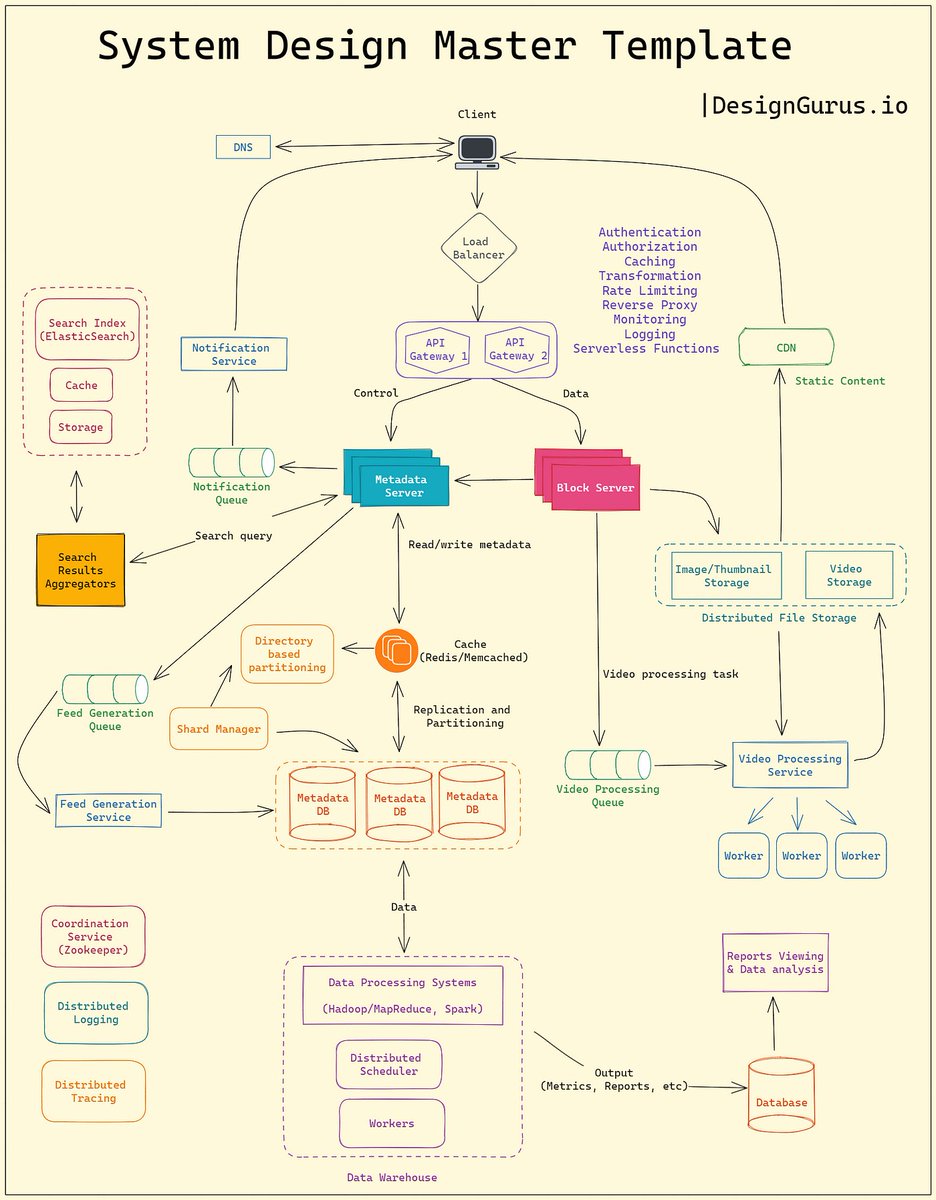
10 Best System Design Topics Developers Should Learn in 2025
1. Caching
2. Sharding
3. load-balancing
4. replication
5. fault-tolerance
6. high-availability
7. Concurrency
8. scalability
9. Performance
10. Indexing
learn more on DesignGuru - bit.ly/3pMiO8g
English