Adam Knight

5.6K posts

Adam Knight banner
Adam Knight

Adam Knight

@Adam8Knight

Investor. Chairman @BeZeroCarbon. Co-founder @SASCapital. Ex-Goldman (commodities). Building @BritBlueprint - fix our growth crisis: https://t.co/MkAapW6iQ3

London, England Sumali Eylül 2013
2.5K Sinusundan1.8K Mga Tagasunod
Naka-pin na Tweet
Adam Knight
Adam Knight@Adam8Knight·
New on @BritBlueprint: Britain has become too lawyerly for an age that rewards builders. Dan Wang’s Breakneck argues China builds while America argues. Britain has the same problem — not through litigation, but through process. The institutional accumulation of consultation, clearance, challenge, and review. Britain doesn’t need fewer arguments because arguments are un-British. It needs fewer arguments because too many of them now function as substitutes for action. britblueprint.com/blog/lawyerly-…
English
0
6
19
2.5K
Adam Knight nag-retweet
Dustin
Dustin@r0ck3t23·
Jensen Huang just told Silicon Valley it’s fighting on the wrong floor. Every boardroom in tech is locked on the same question. Which model wins. OpenAI or xAI. GPT or Claude. Grok or Gemini. Trillions moving on that bet alone. Huang zoomed out and showed them the whole building. Huang: “AI is actually essentially a five-layer cake.” Energy at the bottom. Chips above it. Cloud above that. Models next. Applications on top. Five layers. One war. Everyone crowded onto the fourth floor. Huang: “This is where most people think AI is.” He was pointing at the model layer. Every pitch deck. Every valuation. Every founder story. All packed onto one floor. One floor below the finish line. Three above the foundation. The middle of the building. Huang: “At the bottom is energy.” Not data. Not parameters. Not talent. Power. You cannot out-code the grid. You cannot train a frontier model with a press release. The smartest model on Earth still needs a dumb turbine spinning somewhere. The smartest engineers alive are building on top of someone else’s silicon, inside someone else’s cloud, powered by someone else’s electricity. They own nothing beneath them. Huang: “This layer on top ultimately is where economic benefit will happen.” Healthcare. Finance. Manufacturing. The only floors where AI actually meets money. Every dollar of real value lives at the top. Every physical constraint that decides who gets to play lives at the bottom. The model sits in between. Squeezed from above and below and owning neither end. Silicon Valley is burning hundreds of billions to build plumbing for somebody else’s economy. The basement decides if it runs. The penthouse decides if it pays. The companies building models think they are building the future. Huang just told them they are the middle layer in someone else’s cake.
English
125
627
2.6K
462.3K
Adam Knight nag-retweet
Big Brain Business
Big Brain Business@BigBrainBizness·
Martin Lewis, founder of MoneySavingExpert. com, on the four things it takes to be really successful, and why the most important one isn't what you'd expect: He opens with a clear framework: "It takes four things to be really successful. Talent, you've all got it, as do many more people than you think. Hard work. If you want to be really successful, you're going to have to work hard. Focus. Zone in on what you're good at." On focus, he pushes back against the idea that you need to be exceptional at everything: "Understand, none of us are unfailingly brilliant at everything. So, find the thing that you're good at and zone in on that. And that is what will create your success." But the fourth factor is where his message turns unexpected: "The most important thing is luck. You can do everything right, but it still not work for you. And you need to know that now." This reframes how he wants people to think about setbacks: "Failing does not make you a failure. Do not judge yourself. See it as a way to learn and to give yourself a better opportunity the next time." @MartinSLewis then challenges a common assumption about what success actually delivers: "Success can be stressful. Success is not a synonym for happiness. As you go through your working careers, at sometimes you may want to make a call. Do I continue to push that hard or do I smile at what I've got and enjoy happiness and the other things that life starts to give me?" He closes with a message aimed at those who do make it big: "One or two of you in here will make it really big. If that's you, remember of those four things, the most important one is luck. And that means if you're that super successful one in the room, you have a moral duty to give back."
English
7
79
607
185.1K
Adam Knight nag-retweet
Josh Hunt
Josh Hunt@iAmJoshHunt·
My last tweet was about PFI. How the government bought hospitals and schools on hire purchase and is still paying five times what they're worth. Billions draining out of NHS trust budgets every year in interest and service charges. But PFI isn't the only hidden liability buried in the government's accounts. There's another one that almost nobody knows about. And while the number is smaller, what it represents is arguably more disturbing. Because this one isn't about buildings. It's about people. It's roughly £60 billion. The second largest provision on the entire government balance sheet, after nuclear decommissioning. And it is the estimated future liability for NHS clinical negligence in England. To be clear about what that means. This isn't a pot of cash sitting in an account. It's an accounting provision. The government's best estimate of what it will cost to settle compensation claims arising from patient harm that has already occurred. Some of those claims have been filed. Many haven't yet. Almost 40% of the total, roughly £24 billion, is an actuarial estimate of claims that are expected to come but haven't been reported. Harm that has already happened. Claims that are still forming. Twenty years ago, that provision stood at £14.4 billion in real terms. It has roughly quadrupled. And it's still growing. The annual cost of settling these claims has more than tripled, from £1.1 billion in 2006 to £3.6 billion in 2024-25. NHS Resolution and the Government Actuary's Department project it will reach £4.1 billion a year by 2030. That's real money being taken out of the health budget every year. Money that could be funding doctors, nurses, beds, and equipment. Instead it funds compensation for harm the system caused. And the structure of these costs is extraordinary. Just 2% of claims by volume account for 68% of total costs. These are the catastrophic cases. Mostly brain injuries suffered during birth. Babies who should have been delivered safely but weren't. The average settlement for an obstetrics claim involving cerebral palsy or brain damage is £11.2 million. Each case takes an average of 11 to 12 years to resolve. Families waiting over a decade while caring for a profoundly disabled child. In 2024-25, brain injury at birth cases alone cost the NHS £1.5 billion. One category. One type of harm. A billion and a half pounds. Then there's the legal cost. Claimant legal fees on successful claims have risen from £148 million to £538 million in under two decades. And for low-value claims, those under £25,000, the legal costs are 3.7 times higher than the damages paid to the patient. The lawyers receive nearly four times what the injured person gets. Three quarters of all claims fall into this category. Overall, claimant legal costs alone now represent roughly 20% of total clinical scheme payments. One pound in every five goes not to the person who was harmed, but to the legal process of proving the harm happened. Behind all of this is a patient safety system that the government's own Public Accounts Committee describes as overwhelmed. The NHS reports around 2.4 million patient safety incidents a year. About 70% cause no harm. But roughly 0.5% result in severe harm or death, implying around 12,000 cases every year. The PAC's verdict, published in January, was damning. It said the Department of Health and Social Care "cannot provide reassurance that it has taken any meaningful action to address clinical negligence to date." That same warning was made in 2002. Again in 2017. Again in 2024. Three times in two decades. Nothing changed. The bill kept growing. And there's a detail that makes it worse. There is a risk that the taxpayer pays twice for the same harm. Claims are settled on the assumption that the patient will fund their future care privately. But some of those patients then go on to use the NHS or publicly funded social care. So the state pays the compensation and then pays again for the treatment. The government does not know how often this happens. Now step back and think about what this means for the system. The same hospital trusts paying billions in PFI repayments are also paying billions in clinical negligence settlements. The budget that's supposed to fund safe staffing, functioning equipment, and adequate care is being drained from both sides. PFI taking money out. Negligence claims taking money out. And patient care trapped in the middle. This is a doom loop. An overstretched system makes more mistakes because it's overstretched. Those mistakes generate claims. Those claims drain money from the budget. The reduced budget means fewer staff, more pressure, longer waits, more exhaustion. Which leads to more mistakes. Which generates more claims. The system for dealing with this is adversarial, blame-based, slow, and expensive. The Health and Social Care Committee called it "not fit for purpose." Instead of learning from errors, the system incentivises defensiveness. Clinicians are afraid to admit mistakes because admissions become evidence in legal proceedings. So the same errors repeat. The same harms recur. The same compensation gets paid. Year after year. Other countries handle this differently. New Zealand has a no-fault compensation scheme that is faster, less adversarial, and more focused on learning from what went wrong rather than proving who was to blame. The BMA has recommended the UK explore a similar model. The government has asked David Lock KC to review the system but has not committed to any specific reform. I want to be clear about something. This is not an attack on NHS staff. The overwhelming majority of clinicians and nurses go to work every day and deliver extraordinary care under impossible pressure. They are not the problem. They are working inside a system that sets them up to fail, and then punishes them when they do. And this is absolutely not an argument against patients receiving compensation. When a baby suffers a brain injury because of a preventable error, that family deserves every penny of support. The question isn't whether they should be compensated. It's why the system keeps producing the same avoidable harm, decade after decade, and why three parliamentary warnings have changed nothing. £60 billion. Second largest provision on the government's books. Quadrupled in two decades. And nobody has done anything about it. The money is the measure of the failure. But the failure is human.
Josh Hunt@iAmJoshHunt

This one will require a stiff drink. In the early 1990s, the government came up with a clever idea. Instead of borrowing money cheaply to build hospitals, schools, and roads, it would get the private sector to build them and then pay the private sector back over 25 to 30 years. The Private Finance Initiative. PFI. The attraction was obvious. You got a shiny new hospital today. The bill didn't show up on the government's books. The cost was deferred into the future. Politicians got ribbon-cutting ceremonies without the awkward conversation about borrowing. It was, in effect, the nation's credit card. Buy now, pay later. Except the interest rate was extraordinary. The total capital value of everything built under PFI was around £50 billion. As of March 2024, there were 665 PFI contracts still running across the UK, with roughly £136 billion in remaining payments stretching out to the early 2050s. These are payments public bodies are contractually locked into. Hospitals, schools, councils, government departments. Paying for buildings that in many cases were constructed twenty or thirty years ago. And the terms are extraordinary. PFI contracts were structured so the private sector would not just build the facility but manage its services. Cleaning. Maintenance. Catering. Portering. These services are bundled into long-term contracts with built-in inflation increases that the public sector cannot renegotiate, cannot exit without paying massive penalties, and often cannot even fully scrutinise because of commercial confidentiality clauses. In one case raised in Parliament, a hospital was charged £333 to change a lightbulb. That isn't an urban myth. It was cited in Hansard. The NHS has been hit hardest. According to parliamentary analysis, the capital cost of NHS PFI projects was around £13 billion. The total repayments are estimated at around £80 billion. And the peak of NHS PFI annual repayments isn't even here yet. It arrives in 2029. The bills are still going up. In 2020-21, NHS trusts paid £457 million purely in interest charges on PFI contracts. Not services. Not maintenance. Interest. In the last five years, NHS trusts have handed over more than £1.8 billion in PFI interest alone. We Own It calculates that money would have covered the starting salaries of over 50,000 new doctors. One NHS trust, Essex Partnership, has reportedly paid back 27 times what was originally borrowed. Some hospitals are spending more on PFI repayments than on medicines for patients. And remember, these repayments come out of the same NHS budget that's supposed to fund patient care, staff, and equipment. Scotland got it just as badly. Audit Scotland reported that Scottish taxpayers will pay a cumulative £40 billion for PFI assets worth just £9 billion. North Ayrshire Council will have paid £440 million by 2038 for four schools that cost £83 million to build. Now here's what makes this worse. Many of these contracts are starting to expire. The buildings are being handed back to the public sector. And the NAO has warned of significant risks around the handback process, including cases where public bodies were dissatisfied with the condition of assets being returned to them. Decades of payments. And some of these buildings may come back needing significant further investment. So what actually happened? The government could have borrowed money at significantly lower rates to build these hospitals and schools itself. Sovereign borrowing has always been cheaper than private finance. Instead, it paid the private sector to borrow at a premium and passed the inflated cost on to the taxpayer. The private sector took the profit. The taxpayer took the risk. The buildings are now ageing. The debts are still being paid. And the services that were supposed to benefit are being squeezed partly because so much of their budget is locked into contractual obligations they cannot escape. PFI wasn't investment. It was an accounting trick. A way for governments to build things without the borrowing showing up in the national debt figures. It made politicians look fiscally responsible while loading future generations with obligations they had no say in and no ability to renegotiate. Both parties did this. The Conservatives created PFI in 1992. Labour massively expanded it after 1997. More than 700 projects were signed. The coalition eventually wound it down. The current government scrapped the latest version. But the contracts remain. The payments continue. And the damage is already done. This is what it looks like when a country chooses to buy its infrastructure on hire purchase instead of investing properly. You lock in above-market rates for decades. You lose control of the assets. You tie the hands of future governments. And when the bill keeps coming due, you're told there's no money for doctors, teachers, or social care. There was always money. It just went somewhere else.

English
19
188
336
13.4K
Adam Knight nag-retweet
Eric Daugherty
Eric Daugherty@EricLDaugh·
🚨 HOLY SMOKES. Sec. Scott Bessent just said that because Iran BOMBED Gulf neighbors, those countries are suddenly opening up Iranian regime BANK accounts to Treasury So he can FREEZE their assets! Checkmate playing out. 🔥 "What may prove to be FATAL mistakes the Iranians made was bombing their [Gulf] NEIGHBORS." "Who are now willing to be much more transparent in terms of the funds, or do a deeper dive in investigating the funds that are held within their banking systems." "So, we have pushed out to them the request that we want to freeze more funds of the leadership of the IRGC and any members of Iranian leadership." "The other thing that we have done is we have told companies, we have told countries that if you are buying Iranian oil, that if Iranian money is sitting in your banks, we are now willing to apply secondary sanctions, which is a very stern measure." "The Iranians should know that this is going to be the FINANCIAL equivalent of what we saw in the KINETIC activities." Bessent is an economic ASSASSIN. 🇺🇸
English
1.2K
14.7K
66.6K
3.2M
Adam Knight nag-retweet
AI Highlight
AI Highlight@AIHighlight·
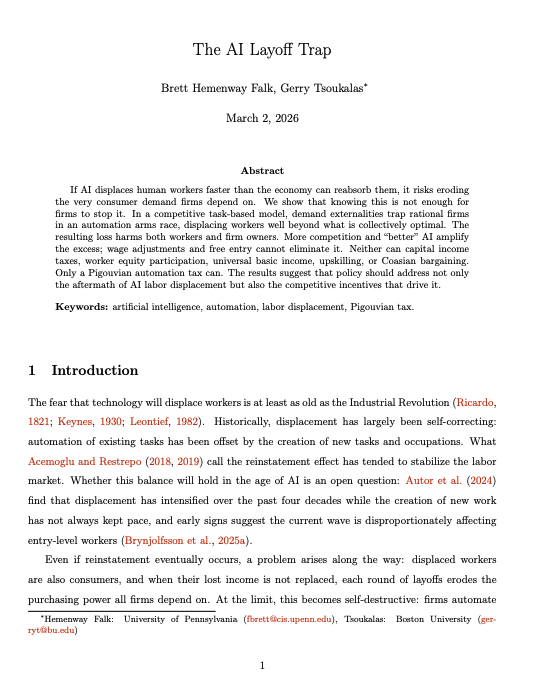
🚨BREAKING: Two researchers from UPenn and Boston University just published a paper that should be uncomfortable reading for every CEO automating their workforce right now. The argument is straightforward. Every company replacing workers with AI is also eliminating its own future customers. Laid off workers stop spending. Enough of them stop spending and nobody can afford to buy anything. The companies that fired everyone end up selling into an economy with no purchasing power left. Every executive can see this. The math is not complicated. But here is why nobody stops. If you do not automate, your competitor does. They cut costs, lower prices, take your market share, and you collapse anyway. So every company automates knowing it is collectively destructive because the alternative is dying alone while everyone else survives. The researchers proved this is a Prisoner's Dilemma playing out in real time. The numbers are already moving. Block cut nearly half its 10,000 employees this year. Jack Dorsey said AI made those roles unnecessary and that within the next year the majority of companies will reach the same conclusion. Salesforce replaced 4,000 customer support agents with AI. Goldman Sachs deployed a coding tool that lets one engineer do the work of five. Over 100,000 tech workers were laid off in 2025 and AI was cited as the primary driver in more than half those cases. 80% of US workers hold jobs with tasks susceptible to AI automation. The researchers tested every proposed solution. Universal basic income does not change a single company's incentive to automate. Capital income taxes adjust profit levels but not the per-task decision to replace a human. Collective bargaining cannot hold because automating is always the dominant strategy. They also identified what they call a Red Queen effect. Better AI does not solve the problem, it accelerates it. Every company chases faster automation to gain market share over rivals but at the end everyone has automated equally, the gains cancel out, and the only thing left is more destroyed demand. The one thing the math says could work is a Pigouvian automation tax. A per-task charge that forces companies to account for the demand they destroy each time they replace a worker. The conclusion is that this is not a transfer of wealth from workers to owners. Both sides lose. Workers lose income. Companies lose customers. It is a deadweight loss with no market mechanism to stop it on its own.
AI Highlight tweet media
English
438
3.2K
10.3K
2.2M
Adam Knight nag-retweet
Dmitry Sky
Dmitry Sky@Sky_Hustle·
Instead of building a forecast from scratch, which is an exercise in compounding guesses, you take the price the market is giving you and gradually work backward: what growth rate, margin, duration of competitive advantage does this price require to be justified? Then the only question is: is that plausible or insane? That's a dramatically easier cognitive task. You're not predicting the future. You're evaluating whether someone else's implied prediction is reasonable. Falsification rather than construction, Karl Popper would approve. And it naturally surfaces the best opportunities: cases where the market's implied assumptions are obviously wrong in one direction. You don't need to know what a company is worth to know that the market is pricing in something that can't possibly be true. @mjmauboussin has formalized this as "expectations investing" and it's probably the most intellectually honest valuation approach available. It admits what you can't do (forecast) and focuses on what you actually can (judge plausibility).
English
7
21
189
21.7K
Adam Knight nag-retweet
Alex Epstein
Alex Epstein@AlexEpstein·
A total of 38 countries have now signed a pledge to triple global nuclear energy by 2050. I have argued for years that countries should unleash nuclear power by removing the irrational policies holding it back. But the way to unleash nuclear power is not through mandates. Nuclear just needs to be freed from the pseudoscientific policies that have made it unnecessarily expensive and slow to build. That's what countries should focus on if they want nuclear to become economic in the long term.
Johan Christian Sollid@sollidnuclear

Five more countries sign the declaration to triple nuclear energy by 2050 At the Nuclear Energy Summit in Paris on March 10, hosted by the Government of France in cooperation with International Atomic Energy Agency (@iaeaorg), China, Brazil, Italy, Belgium and South Africa joined the global commitment to at least triple nuclear energy capacity by 2050. With these new signatories, a total of 38 countries now support the declaration. The pledge was first launched by Net Zero Nuclear (@NZNGlobal) at COP28 in Dubai, where countries committed to work together toward tripling global nuclear capacity from 2020 levels by 2050 as part of the effort to reach net-zero emissions. Since then, the coalition has continued to grow as more governments recognise the role nuclear energy can play in providing reliable, low-carbon electricity while strengthening energy security. With the latest additions, the countries supporting the pledge now represent around 70% of the global economy. What is particularly notable is the geographic diversity of the countries involved. The declaration now includes nations from Europe, North and South America, Africa, Asia and the Middle East. Momentum behind nuclear energy is clearly building. If the world is serious about decarbonising the energy system while meeting rapidly growing electricity demand, expanding nuclear power will be a key part of the solution.

English
22
49
213
11.7K
Adam Knight
Adam Knight@Adam8Knight·
@asentance Simple fix - make electricity cheap and we will get growth.
English
0
0
0
13
Andrew Sentance
Andrew Sentance@asentance·
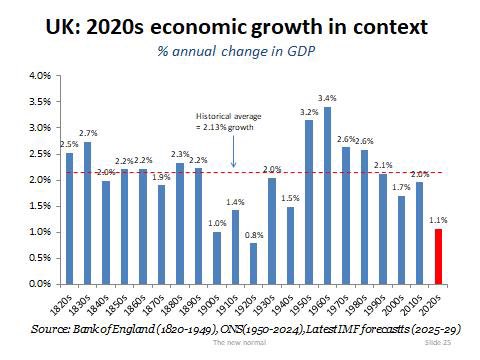
Rachel Reeves may be “angry” about the negative impact of the Iran war on the UK. But the more serious issue is her inability to combat the long-term slowdown in UK economic growth to 1.1pc this decade, confirmed by the latest IMF forecast. She’s made things worse, not better!
Andrew Sentance tweet mediaAndrew Sentance tweet media
English
5
32
100
3.6K
Adam Knight nag-retweet
Cut My Tax
Cut My Tax@CutMyTaxUK·
Brits don't understand how poor Britain has become - fascinating polling from @iealondon. People think that we're the 5th richest country in the world whereas in fact we're now the 21st - and falling. They think that we're 7th richest in comparison to US states, when in fact we're poorer than all of them. Just this morning far left Green leader Zack Polanski claimed that Britain was the 6th richest country in the world. In reality there's a lot less for him to loot than he mistakenly thinks. And that's before the vast outflow of wealth that his policies would cause. 1/2
Cut My Tax tweet media
English
12
88
224
5.3K
Adam Knight nag-retweet
James Melville 🚜
James Melville 🚜@JamesMelville·
The Great British net zero con-trick of Drax. The Labour government is trying to force through an extension that would give Drax an estimated £1.8bn in taxpayer funded subsidies on top of the £11bn it has already received. Drax has burned an amount of wood equivalent to 300 million trees. Burning wood creates 18% more CO2 emissions than coal. And here’s the con trick: Drax is a sneaky way of exporting our CO2 emissions. We pay billions of pounds to cut down ancient forests in the US and Canada, ship the wood across the Atlantic in diesel tankers, then burn it in a Yorkshire-based power station. And here’s the kicker - the CO2 emissions tally is not counted against the country that burns it, but the country that grows it. So Drax emissions are counted against the countries who grow and export the wood for Drax - like Canada and USA…not UK who burn it. So the UK can reduce CO2 figures by importing the burning wood grown elsewhere. A gigantic net zero con-trick that is the exact opposite of ‘environmentally friendly’.
James Melville 🚜 tweet media
English
146
2K
3K
39.1K
Adam Knight nag-retweet
Aimen Dean
Aimen Dean@AimenDean·
I genuinely don’t know whether to laugh or lose my mind anymore at this European hypocritical double standards. When it comes to Vladimir Putin, suddenly it’s Churchillian resolve. No compromise. No dialogue. Arm Ukraine to the teeth, sanction everything that moves, wreck your own energy security if necessary - because tyranny must be confronted. Fine. I actually respect the consistency of that … in isolation. But then you turn around and lecture us - us - the Gulf monarchies, Jordan and Israel, about showing restraint with Tehran? About dialogue? About coexistence? Are you serious? For forty years - forty bloody years - this regime has been waging a shadow war across the region. Militias, proxies, sleeper cells, terror networks, destabilizing entire countries - Iraq, Syria, Lebanon, Yemen - and threatening the Gulf monarchies, Jordan, and Israel nonstop. This isn’t theoretical. This isn’t abstract. This is lived reality. And yet here come Emmanuel Macron, Keir Starmer, and the rest of the European choir, gently advising us to calm down, de-escalate, and - what was it again? - “give diplomacy a chance.” Diplomacy with who, exactly? With a system that has built its entire regional strategy on plausible deniability and proxy terror violence? You were willing to absorb inflation, energy shocks, and political backlash at home to confront Moscow. You made that choice. You said: this is the price of standing up to a tyrant. So don’t come here and tell us - after decades of being on the receiving end - that we should just sit down, smile politely, and “coexist.” Either you believe in confronting tyranny everywhere .. or you don’t. Macron, Starmer, rest of EU leaders and top bureaucrats should just STFU and spare us the self righteous sanctimonious lectures!🤐🤫
English
1.7K
8.4K
31.2K
999.1K
Adam Knight
Adam Knight@Adam8Knight·
@afneil Why would they want to look at evidence when they can rely on their own assumptions and ideology. Same throughout all policy unfortunately. Check out @Ed_Miliband on energy!
English
0
0
0
483
Andrew Neil
Andrew Neil@afneil·
This is the reason why we can never reform healthcare in the UK — or even have a sensible debate about it. The moment anyone suggests alternative/additional ways of funding health Labour rushes out privatisation smears and claims US private health insurance is being proposed. Labour has been doing it for decades. It explains why the NHS is effectively beyond reform. The two worst health systems in the rich world are in America and the UK. It’s why nobody has ever copied them. It would be mad to go from ours to theirs (or vice versa). But Europe is awash with health systems that can call on several sources of funds, including many with compulsory public health insurance schemes. They have better health outcomes than the NHS. They are free at the point of use (like the NHS). Most of them are better funded. But Labour puts them out of bounds, refuses even to discuss or consider. So patient care suffers. NHS struggles on. Labour is always telling us we need to get closer to Europe. It’s where we belong. But not when it comes to health, where it insists no lessons can be learned. Pretty pathetic, really.
The Labour Party@UKLabour

Nigel Farage's plan to move to an insurance-based healthcare system would leave you to pick up the bill.

English
710
2.8K
12.5K
646.7K
Adam Knight nag-retweet
Javier Blas
Javier Blas@JavierBlas·
COLUMN: Even before the US-Iran war, some on the center-left were rethinking their stance on fossil fuels. Can oil drilling be woke again? Yes, it can. I talked to Canadian Energy Minister Tim Hodgson about "all-the-above" energy policy. @Opinion bloomberg.com/opinion/articl…
English
26
45
225
71.7K
Adam Knight
Adam Knight@Adam8Knight·
@perplexity_ai I am a max subscriber and use computer every day on desktop and mobile. On mobile my long threads all open at the top not the bottom and the app takes a long time to scroll and makes it very hard to work with. Need ability to set threads to open at bottom please
English
0
0
0
14
Adam Knight nag-retweet
Tat Thang
Tat Thang@tatthang·
Not a single fintech CEO slept well last night. X just shipped a full financial stack in 48 hours. And most people didn't even notice. Here's the sequence: - Tuesday: Smart Cashtags go live. Any ticker, any contract address native price chart, right in the timeline. No redirect. No third-party app. - Already in beta: X Money. Fiat wallet with 6% APY, metal Visa debit card with 3% cashback, P2P payments, direct deposit. FDIC-insured through Cross River Bank, the same bank behind Coinbase and Stripe. - Already live: Brokerage routing via Wealthsimple. One tap from a post to a placed trade. Three products. All shipped. All pointing the same direction: Discovery → Chart → Trade → Pay. Inside one timeline scroll. Here's what that looks like for you and me: Someone posts a $AAPL cashtag. I tap it. Chart loads. I see the conversation around it. I buy. Never left the app. I send $50 to a friend. On X. I earn 6% on what's left. My debit card gives me 3% back on coffee. Why would I open Robinhood? Why would I open Venmo? Why would I open CoinGecko? And here's why they can't compete: X has 550M monthly users. Robinhood has 24M funded accounts. Venmo has ~90M accounts. CoinGecko has ~30M monthly visits. X doesn't need the best product. It needs a good-enough product inside the app people already live in. Now zoom out. X was an ad revenue company. ~$4.4B in 2023, almost all advertising. The new revenue stack: > Visa interchange on every card swipe > Brokerage referral fees on every routed trade > APY spread on held deposits > Trading behavior data from 550M users X didn't add a feature. X changed its entire business model. "Is this good for X?" Wrong question. X just stopped being a social media company. It's now a financial infrastructure company that happens to have 550 million users already scrolling. Everyone else is competing against a distribution gap they can never close. I wrote about this yesterday before any of it was announced. The sequence played out exactly as mapped. The only piece left: which chain gets the default crypto trading slot. That answer will move markets.
Tat Thang tweet media
English
258
587
3.5K
310.3K
Adam Knight nag-retweet
Gummi
Gummi@gummibear737·
Trump is right when he says the Iran War is pretty much over, and it's because Iran has basically lost any and all leverage over the Strait of Hormuz (as well as its serious looming economic crisis) There's a small (but bombshell) detail from the ceasefire negotiations in Islamabad that has been unreported by the MSM, but was just broken by @aimendean...and it means that the war is probably done. If you don't know who Aimen is, he's the most insightful and credible analyst of the Middle East I have found to date He reports that this emerged at the negotiations this weekend and I quote: "The Saudis stood up for the whole GCC against this (Iran control of the Strait of Hormuz). And in fact, they threatened the Iranians that doing so would mean that we (the entire GCC) are not going to export a single drop of oil or LNG, forever, as long as you are in control of this. So technically, it's the GCC telling the world and especially the European Union that we're going to impose an embargo on the rest of the world if the rest of the world is not going to enforce international law when it comes to the Strait of Hormuz" So the GCC is ready to take 22% of global oil and LNG offline...and not just what transits the Strait of Hormuz, but all energy production. This means that Iran has basically lost all the leverage it ever had with regards to the Strait of Hormuz This is why the US doesn't have to move a muscle to open the Strait and why Iran's rhetoric has become far softer in recent days. Nothing is guaranteed, but the Iranians have almost no cards at this point...which is why Trump is so confident that the Iran War is pretty much over The Europeans could learn a thing or two from the GCC podcasts.apple.com/be/podcast/ame…
English
101
557
3.1K
165.1K
Adam Knight nag-retweet
Institute of Economic Affairs
😱 When people find out the truth, the reaction speaks for itself. 27% shocked. 22% concerned. 15% disappointed or embarrassed. 14% motivated for change. That emotional jolt is exactly why this data matters — it opens the door to reform.
Institute of Economic Affairs tweet media
English
14
72
1.1K
58.5K