
Bioinvasions India
455 posts


Bioinvasions India
@BioinvNet
Biological Invasions Network of India | Research | Policy | Communication | Management | Restoration | Led by Ninad Mungi, Monica Kaushik, Rajat Rastogi
They are here again. They have arrived. From the misty mountains of Gudalur, Nilgiris to the shores of Chennai, the Lantana Elephants have travelled far. Crafted by local tribal artisans from lantana, an invasive weed choking our forests, these elephants now stand tall as symbols of ecosystem restoration and biodiversity conservation in Tamil Nadu. Catch them at the Blue Beach, Marina, during the Pongal holidays. Thanks to @chennaicorp & @kgbias for making this possible #lantanaelephants @therealeleco




In one of India’s largest ecosystem restoration efforts, the Tamil Nadu Forest Department is reclaiming forests from invasive species and reviving habitats for wildlife to flourish. Already 34,710 hectares have been restored , including 26,735 ha of Lantana camara, 4,685 ha of Prosopis juliflora, 1,327 ha of Wattle, and 1,963 ha of Senna spectabilis. This strengthens native vegetation restoring the right of wild animals to roam freely. With the full removal of Senna spectabilis targeted this year, Tamil Nadu is moving decisively toward ecological renewal. The entire operation is tracked through a dedicated geo-tagged restoration dashboard, ensuring scientific precision at scale #ecosystemrestoration #invasiveremoval @Krish_TNIE @IndianExpress @tnforestdept
When forests are freed from invasive species the biggest win is for the biodiversity and wildlife. TN Forest team has documented wildlife returning to areas cleared from invasives #invasives #TNForest #SatyamangalamTigerReserve

In one of India’s largest ecosystem restoration efforts, the Tamil Nadu Forest Department is reclaiming forests from invasive species and reviving habitats for wildlife to flourish. Already 34,710 hectares have been restored , including 26,735 ha of Lantana camara, 4,685 ha of Prosopis juliflora, 1,327 ha of Wattle, and 1,963 ha of Senna spectabilis. This strengthens native vegetation restoring the right of wild animals to roam freely. With the full removal of Senna spectabilis targeted this year, Tamil Nadu is moving decisively toward ecological renewal. The entire operation is tracked through a dedicated geo-tagged restoration dashboard, ensuring scientific precision at scale #ecosystemrestoration #invasiveremoval @Krish_TNIE @IndianExpress @tnforestdept
In one of India’s largest ecosystem restoration efforts, the Tamil Nadu Forest Department is reclaiming forests from invasive species and reviving habitats for wildlife to flourish. Already 34,710 hectares have been restored , including 26,735 ha of Lantana camara, 4,685 ha of Prosopis juliflora, 1,327 ha of Wattle, and 1,963 ha of Senna spectabilis. This strengthens native vegetation restoring the right of wild animals to roam freely. With the full removal of Senna spectabilis targeted this year, Tamil Nadu is moving decisively toward ecological renewal. The entire operation is tracked through a dedicated geo-tagged restoration dashboard, ensuring scientific precision at scale #ecosystemrestoration #invasiveremoval @Krish_TNIE @IndianExpress @tnforestdept
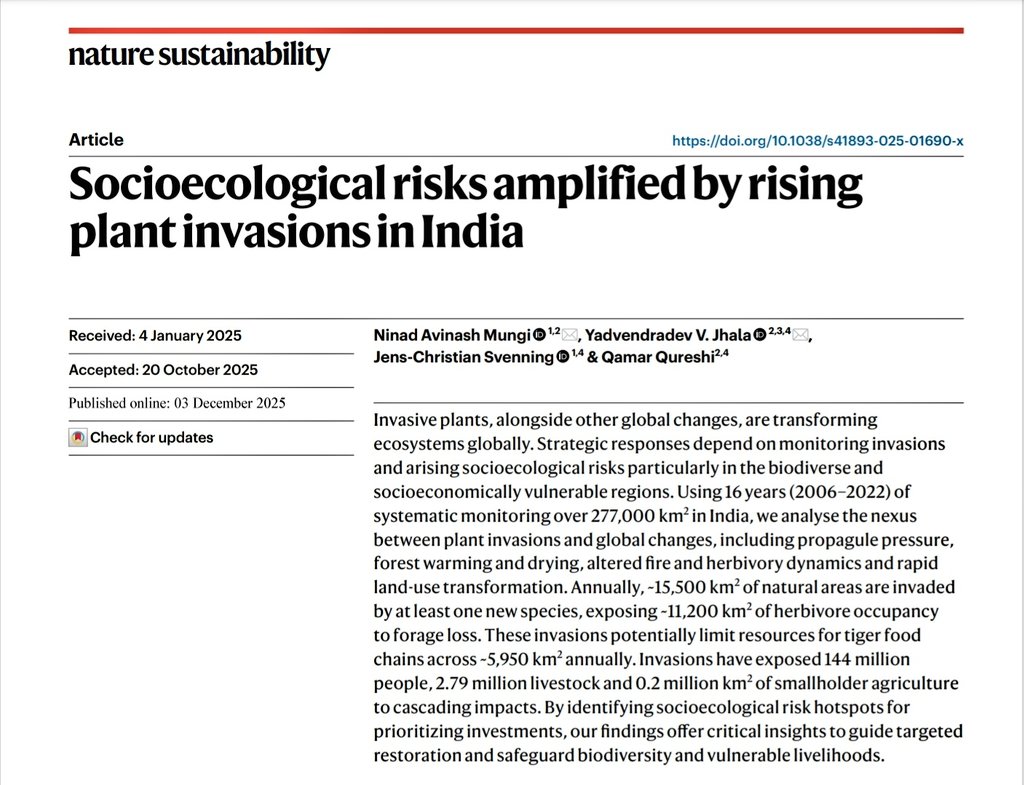
Our longitudinal study from India shows that 21st-century global changes have accelerated plant invasions; together affecting ecosystems, tiger habitats, and millions of people. We map risk hotspots to guide restoration for nature and people Paper: 2cm.es/1fBlH


Invasive alien fishes are introduced due to human activity outside their natural range, where they establish, spread and cause ecological or economic harm. What makes them “invasive” is not just their exotic origin but their ability to outcompete native species and thrive in disturbed environments. To read more, check out the article by Nobin Raja from ATREE using the link. deccanherald.com/science/fishy-…
Some media coverage on our recent study on the tropics Climate change + wildfires + landuse change + rising trade + biodiversity loss = novel ecosystems shaped by alien species @EconovoAU @JCSvenning Full paper: rdcu.be/ev5w1 eurekalert.org/news-releases/…
The survey isn’t just about tigers. It also records the status of leopards, ungulates and small wild cats that share tiger habitats. It also tracks invasive species that threaten ecosystems - giving us a complete health check of India’s forests & grasslands. #Tigers #leopards #ungulates #smallcats #aite #wildlife
