General Buck Turgidson

1.9K posts

General Buck Turgidson banner
General Buck Turgidson

General Buck Turgidson

@GeneralBuckTur2

“I’m not saying we wouldn’t get our hair mussed, but I am saying 10-20 million people killed tops - depending on the breaks”


The War Room Sumali Nisan 2020
629 Sinusundan127 Mga Tagasunod
Anthony DiGiorgio, DO, MHA
@chriswithans Physician wages make up about 8% of healthcare spending. Asking board certified cardiologists to work below market rate will do nothing to make healthcare affordable. Why don’t you look up what the net revenue is for that “non profit” hospital?
English
33
20
793
30.6K
Chris
Chris@chriswithans·
This is why we’ll never get “affordable healthcare” in America. Established, stable non-profit hospital offers $440,000 a year for a doctor and they act like it’s poverty wages. No one’s forcing them to accept but they hate the idea that’s a floor for their earnings.
Doctoring Differently | Naomi Lawrence-Reid, M.D.@DocDifferently

Kaiser LA wants to pay board-certified cardiologists $218.65/hr to work overnights and weekends. Don’t take this job. It’s hurts all of us.

English
206
55
1.7K
454.5K
Robert Barnes
Robert Barnes@barnes_law·
The west torched the law of the seas to seize ships w/ Russian oil, Venezuelan oil or Iranian oil, so, quite literally, that ship has sailed.
Anton Gerashchenko@Gerashchenko_en

Iran is demanding sovereign control over the Strait of Hormuz. If it succeeds in imposing this logic, it will undermine the very foundation of international maritime law. The Strait of Hormuz is an international strait governed by the regime of transit passage: passage cannot be arbitrarily prevented or made selective. If Iran succeeds, it will open a Pandora's box: other states will also decide they can act the same way. Let's look at other straits that are critically important for the global economy: ◾️ The Straits of Malacca and Singapore are the next most dangerous example. The Strait of Malacca is the world's busiest oil chokepoint, as well as one of the main corridors for common trade; studies estimate that about 20% of global maritime trade passes through the Strait of Malacca, amounting to approximately $2.4-2.5 trillion annually. In theory, Indonesia, Malaysia, and Singapore could all seek to exert tighter control here. If even one of these countries were to impose a system of permits, selective inspections, or political restrictions, global trade would suffer. ◾️ Bab-el-Mandeb is another example of how control over a narrow strait can quickly become a tool of war. In 2023, approximately 9.2 million barrels per day passed through it, but following the escalation, flows dropped to about 4.0-4.2 million barrels per day in 2024-2025. Formally, Yemen, Djibouti, and Eritrea may attempt to strengthen their control here, and effectively, armed non-state actors may also be involved. The threat is clear: whoever controls this chokepoint can sever the maritime link between Europe and Asia via the Red Sea and the Suez Canal. ◾️ The Bosphorus and the Dardanelles are a separate case, as they are already subject to a specific regime under the Montreux Convention, and Türkiye has broader authority over military vessels. But that is precisely why this example is important. In the first half of 2025, approximately 3.7 million barrels per day of oil and petroleum products passed through the Turkish Straits, not counting grain and other Black Sea exports. The danger here lies elsewhere: the existing legal exception could become a justification for new exceptions in other straits. ◾️ The Danish straits are a critical exit route from the Baltic Sea. In the first half of 2025, approximately 4.9 million barrels of oil and petroleum products passed through them daily. Formally, Denmark could impose stricter controls here, and in a broader regional sense, so could the states that control the approaches to the Baltic Sea. If Europe ever adopts a policy of selective access through such a strait, it would mean that even within the Euro-Atlantic space, freedom of navigation is no longer considered absolute. This would be a critical moment for maritime law. ◾️ The Taiwan Strait is perhaps the most dangerous case in the long term. According to CSIS estimates, approximately $2.45 trillion worth of goods passed through it in 2022, accounting for more than one-fifth of global maritime trade. There is only one potential contender for political control here - China. If Beijing manages to impose a system where passage depends not on international rules but on Chinese jurisdiction, it will be a turning point. Then, not only regional security would be at risk, but also the very principle that major trade routes cannot be controlled by a single state through political decision. And since the Taiwan Strait is also linked to the risk of a major war between the US and China, maritime law here directly confronts the risk of global escalation. ◾️ Arctic shipping routes demonstrate that this logic now extends beyond traditional straits. Russia regards the Northern Sea Route as a "historic national transport corridor" and demands compliance with the navigation rules established by Moscow; in 2024, the Northern Sea Route Administration issued 1,312 permits for 975 vessels. Canada, for its part, considers the Northwest Passage to be part of its internal waters, while the United States and other states disagree with this approach. Here, the risk is particularly significant for the future: if Arctic routes begin to be established as a licensed passage under the control of coastal states, this will provide yet another strong argument for those who wish to establish their own control in other areas. So, control over sea lanes is becoming a new weapon. If Iran breaks this barrier in the Strait of Hormuz, other states will also begin competing for control of the seas. The next conflict may arise not only over territory, but over the right to determine who has access to global trade, energy, and naval traffic. This is the real danger: the Strait of Hormuz could lay the groundwork for many future wars.

English
69
2.2K
8.3K
161.9K
David Stockman
David Stockman@DA_Stockman·
That's their business, not ours. We are not the world's policeman or moralist or behavioral proctor. As John Quincy Adams best put it, "we do not go abroad for monsters to destroy". America should use military force only to defend the territory of the US Homeland and secure an invincible nuclear deterrent. That's it. All the rest of the defense budget----about $700 billion---is for shit made up by the arms merchants and the war mongers who congregate on the banks of the Potomac.
Nat@Nat45672

@DA_Stockman And what’s in the job description of the Iranian government functionaries who hang gay people for being gay, shoot tens of thousands of peaceful protesters down in the streets, or beat women with billy clubs because they don’t wear a certain style of headscarf?

English
10
40
152
3.4K
Anthony DiGiorgio, DO, MHA
@neoavatara We have the tools right now to create chart summaries. Meanwhile large hospital systems will employ APPs at mid-six figure salaries to do that very task.
English
2
0
19
1.3K
Tuki
Tuki@TukiFromKL·
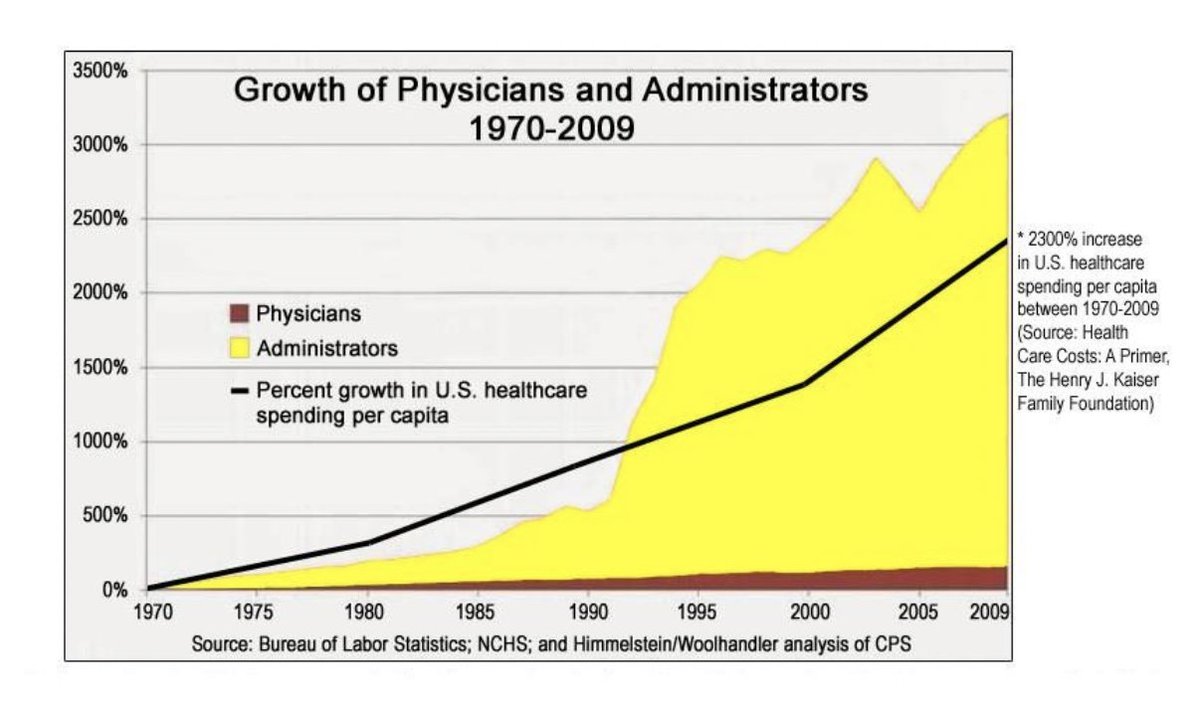
🚨 do you understand what just came out of the CEO of america’s biggest hospital system.. the guy who runs NYC Health.. 70 clinics, 11 hospitals, 1.2M patients a year.. just told reporters that AI could replace “a great deal” of radiologists right now.. four years undergrad.. four years med school.. five years residency.. and a sixth-year fellowship because they told you radiology was the safest lane.. $300K in debt.. $480K salary at 35.. and the man who never touches a patient just said a model can do it. administrator headcount has tripled since 1975.. physician growth barely moved.. guess which group gets “augmented” by AI.. they’ll swap a $480K doctor for a $48K enterprise license.. your MRI will still cost $5,700.. and they’ll pocket the spread.. this.. this is about a system that always automates the talent and never the middlemen. america’s healthcare innovation is firing the people who find your cancer while the executives who said this into a microphone keep their $1.1M salaries.. welcome to AI-powered medicine.
Polymarket@Polymarket

JUST IN: CEO of NYC Health, America's largest hospital system, says AI could replace “a great deal” of radiologists right now.

English
166
1.5K
4.4K
377K
General Buck Turgidson
General Buck Turgidson@GeneralBuckTur2·
@DutchRojas Hospital accounting is a joke. Want to reduce margin? Waste a bunch of money on the lobby renovation or hire a bunch of lackeys to send “feel good” emails out every day….
English
1
0
1
10
Dutch Rojas
Dutch Rojas@DutchRojas·
Dear Hospital Lobbyists & Trolls: If you were right about anything, just remember I’d be on your side. The “average margin” argument is what is used when you don’t want or like people looking at the actual numbers. Mix a broke rural hospital with a $40B nonprofit empire and call it an average. Genius! Meanwhile CommonSpirit posted a $2B operating surplus. Kaiser’s sitting on $50B+ in reserves. Their CEOs are clearing $15M tax-free. It would be great if it was earned, but it’s extracted… They pay zero property tax, zero income tax, enjoy 340B drug discounts they pocket, charge facility fees for a doctor’s office visit, and have successfully lobbied to make physician-owned competition illegal. But yeah. Margins are tight. 🤡 The “average hospital is struggling” narrative exists for one reason: to protect the systems that aren’t.
Cash is Trash@kfederline76

@DutchRojas Why don’t you tell me the average margin of an average hospital? Yea they’re just raking it in right? 🤣

English
9
42
180
7K
Neil Stone
Neil Stone@DrNeilStone·
I treated Covid cases from day 1 of the pandemic I'm an Infectious Diseases specialist doctor I chose to get the Covid 19 vaccine Why do you think I would have done that?
English
203
230
2.2K
46.6K
Zeke Emanuel
Zeke Emanuel@ZekeEmanuel·
@DrexelUniv College of Medicine just announced a three-year medical school program. It's about time. I've been making this case for years, including in a recent @nytopinion piece, and the evidence keeps piling up: you don't need four years to train a great doctor.
English
6
3
42
36.6K
Don Wolt
Don Wolt@tlowdon·
See Jay Bhattacharya'a Santa Clara County seroprevalence study in early April 2020 and John Ionnaidis's research around the same time that showed COVID IFR was probably about like that of the seasonal flu. See the Princess Cruise liner outcomes which showed the same. See the hospital occupancy stats that showed a sharp decline in ER Visits and inpatient & ICU occupancy starting in March of 2020 and remaining below pre COVID levels for the next 3 years.
English
1
4
19
351
Don Wolt
Don Wolt@tlowdon·
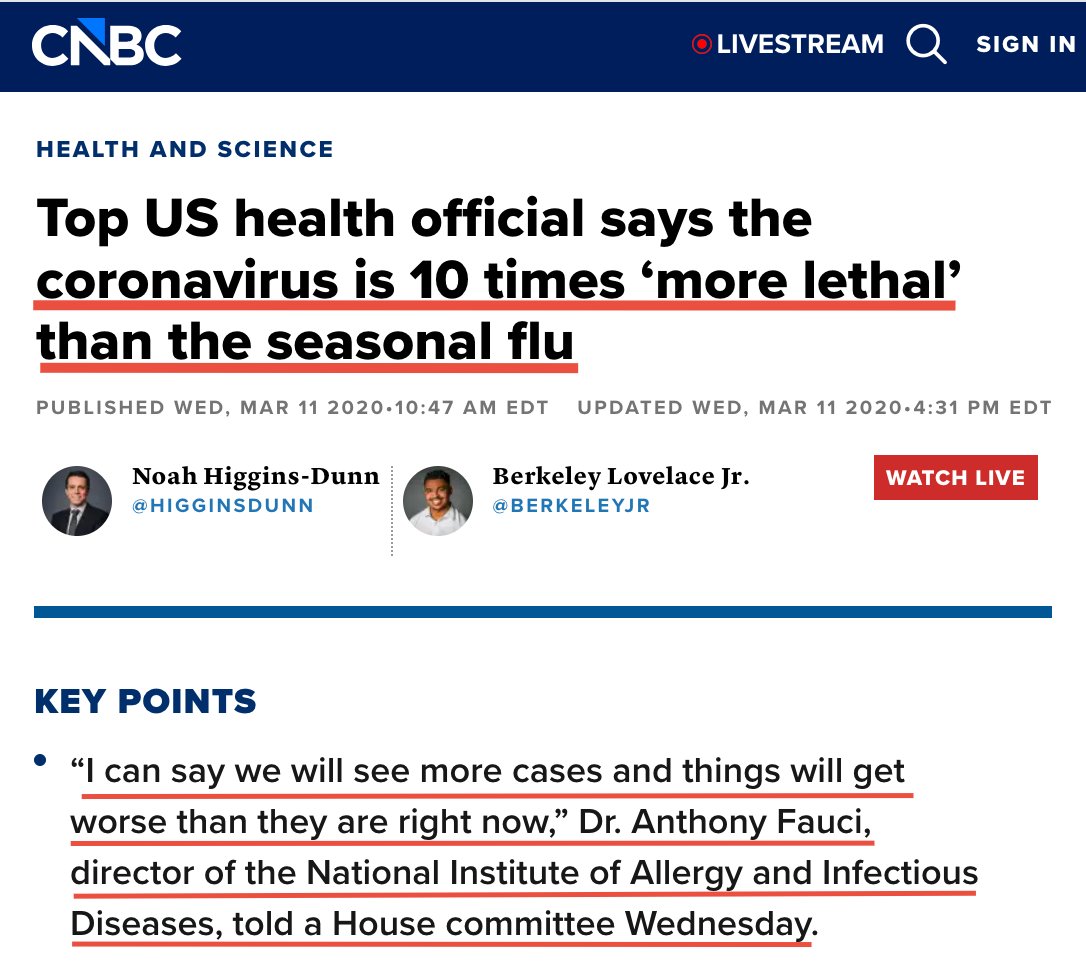
6 years ago, Fauci stoked fear when he told Congress COVID had a mortality rate of ~3% which could drop to ~1%, making it roughly 10X more lethal than seasonal flu (with an IFR of 0.1%). In fact, it always had an IFR about like that of the flu, but he never corrected his testimony.
Don Wolt tweet media
English
6
8
37
7.4K
General Buck Turgidson
General Buck Turgidson@GeneralBuckTur2·
@jathorpmfm If we speak our mind or deliver leadership - your terminated. Big Health controls the narrative
English
0
0
2
39
James Thorp MD
James Thorp MD@jathorpmfm·
No - I have zero trust for 95% of physicians, nor do most Americans after their betrayal over the last 6 years. They are mostly greedy & arrogant and betrayed their most sacred physician patient relationships for their paychecks. Most Americans including myself trust used care salesmen and attorneys more than physicians.
SheepDog Society LLC@SDSLLC_USA

I hate to say it, but I no longer trust doctors. Especially after what they did to millions of people during Covid. Today's doctors seem like they're more concerned with everything else, but our health. Do you trust doctors?


English
62
160
684
14.4K
Neil Stone
Neil Stone@DrNeilStone·
Hydroxychloroquine didn't work for Covid If it did we would have used it without hesitation Just like we used dexamethasome, another very cheap generic drug - which DID work. So we used it , a lot. It's not that complicated
Dr. Simone Gold@drsimonegold

By Feb 2020 we already knew hydroxychloroquine worked. Why? SARS-CoV-2 is ~78% identical to SARS-1, and HCQ had already shown effectiveness against SARS-1. The real question isn’t why doctors used it. The real question is why authorities tried so hard to stop them.

English
46
117
518
10.5K
Lisa Forte
Lisa Forte@LisaForteUK·
So apparently the MRI scan I paid for I’m not allowed to be sent the report!?! They will send it to a Dr but not me. I know some will say it’s for xyz reasons, heard them all, understand them but don’t agree. I paid for it, I want to be able to take it to a dr I pick
English
2.4K
1.3K
39.2K
2.2M
General Buck Turgidson
General Buck Turgidson@GeneralBuckTur2·
@aakashgupta Great post. Every move the hospital makes is monetary based. There is no advanced quality improvement happening on any level.
English
0
0
0
19
Aakash Gupta
Aakash Gupta@aakashgupta·
Hospitals kill between 250,000 and 400,000 Americans per year through preventable medical errors. That makes “your doctor’s mistake” the third leading cause of death in the United States, behind only cancer and heart disease. Everyone reads advice like “stay with your loved one in the hospital” as a family values tip. The actual reason is darker. A board-certified physician is publicly admitting the system he operates in has enough failure points that an untrained person sitting in a chair provides a meaningful safety layer. The math explains why. A landmark Penn study tracked 170,000+ surgeries across 168 hospitals. Each additional patient added to a nurse’s workload raised the odds of dying within 30 days by 7%. Staffing ratios across US hospitals range from 4.3 to 10.5 patients per nurse. That means one hospital gives your family member 2.4x less nursing attention than the hospital down the street, and you have zero way of knowing which one you walked into. So what does a family member in the room actually do? They catch the wrong medication bag. They notice breathing changes at 2am when the nurse is covering nine other beds. They flag a deteriorating condition 6 hours before anyone on staff would have checked. They function as an unpaid, around-the-clock monitor compensating for a staffing model designed around reimbursement rates, not patient survival. When a physician says “be cordial with staff but watch everything like a hawk,” he’s describing a system where the margin between good outcome and catastrophe is one missed check during a shift change. Hospitals don’t optimize for your family member’s recovery. They optimize for throughput. 700 people die from preventable hospital errors every single day. Your presence in that room isn’t emotional support. It’s a rounding error in a broken staffing equation that nobody has the budget to fix.
Suneel Dhand MD@DrSuneelDhand

Never leave your loved one alone in the hospital. Every hour you are allowed to be there, if you are able to, I highly recommend being there. Be perfectly cordial with staff. But watch over everything like a hawk. Trust me on this.

English
241
2.5K
9.7K
682.1K
Robert Lufkin MD
Robert Lufkin MD@robertlufkinmd·
What does this tell you about our health care system?
Robert Lufkin MD tweet media
English
40
70
214
6K