Jordan Edwards

305 posts

Jordan Edwards banner
Jordan Edwards

Jordan Edwards

@JordanEdwards7

Fashion and real estate entrepreneur, CEO @shopmixology NEW BOOK out now! Business Jiu Jitsu Book/Podcast

Sumali Mart 2009
1.3K Sinusundan414 Mga Tagasunod
Chad Wahlquist
Chad Wahlquist@chadwahl·
After reading Tom's post on the NHS Federated Data Platform (FDP), it really hit home for me. I too was a customer of Palantir (now an employee), but I was already an expert in my field, building large-scale enterprise systems for the biggest companies in the world, long before I experienced Palantir. My first question was: “What is Palantir? And why would I need it when I have all the hyperscalers at my beck and call?” I owned all the enterprise platforms: every variety of ERP, MRP, MES, data marts/lakes/houses, and basically anything that touched data end-to-end. I'm now an architect at Palantir, which means I see across the full portfolio of enterprise deployments, what enterprises really struggle with, what actually works, what software flat-out doesn’t work, and what breaks at scale. I'm going to share my takes in parallel with Tom’s to help people see the realities of building something like this at scale to drive real outcomes. Myth: "It's monolithic vendor lock-in” / ”Who owns the data?” Foundry is federated by design. Business units can run their own controlled instances, and customers fully control who accesses the system and how. Data is stored in open formats (Parquet, Avro, Iceberg, etc.) and computed with open frameworks (Spark, DuckDB, DataFusion, Polars, etc.). Palantir is simply the orchestration engine that makes more of your data computable across the organization. With our multi-modal data platform (MMDP), you can pick any storage, any compute, anywhere. It’s the epitome of an open data platform. Any data you bring in, you can push back out to any destination — it’s your data, full control. The Ontology and object structure belong to the customer. There are APIs and SDKs up and down the entire stack. You can even author pipelines in Palantir using open languages like SQL or Python and execute them in remote systems like Databricks, Snowflake, or BigQuery. Store your data in an Iceberg table in a bucket you own, and Palantir can read/write to it right alongside all your other tools. It’s an unwalled garden. From 15+ years building these systems before Palantir, I can tell you firsthand how brutally hard it is to orchestrate all the different systems, tooling, scaling, languages, formats, and security at scale. Often it’s nearly impossible to do reliably or at the speed the business actually needs. Palantir creates a safe system of work, proven at massive scale across the globe in the toughest environments while protecting customer data. Lock-in happens no matter what choice you make. You can get locked into system integrators stitching everything together, locked into a limited talent pool, or locked into painfully slow deployment speeds. It’s really a risk and trade-off discussion. The vendor lock-in everyone fears comes from what SIs (system integrators) have taught us over the years, once a vendor gets their hooks in, they bleed you dry. Those fears are completely valid from real experience, which is exactly why aligning incentives is so important. Myth: "The cost is insane." Compare it to actual total cost of ownership, not just sticker price. Focus on value and ROI. Shadow IT, duplicated ETL, manual reconciliation, and endless analyst queues quietly burn serious money. Look at what I’m working on right now: ERP migrations. How much money gets burned on every single one doing non-reusable manual work to convert old systems to new? It’s universally hated, yet organizations still light money on fire because they have to migrate for business or technical reasons. These projects routinely run tens to hundreds of millions of dollars and take 12-36 months. What if Palantir can cut that timeline and cost by 70-90%? This example makes the value of time compression obvious, but it’s also about opportunity cost. What other value-creating work could your business be doing during those 12-36 months that would actually compound? The same logic applies to the NHS with patients’ lives. Every extra day a cancer patient waits is another day those cancer cells are multiplying and spreading. Speed is a compounding asset in enterprise, and a potential lifesaver in healthcare. Myth: "They'll sell or misuse your data." You control access, governance, and sharing with full audit trails. In Palantir, you’re securing the actual data, not just objects, and that security and provenance travels with the data throughout its entire lifecycle until you go through a governed reclassification process that you own. This is very unique to Palantir. It gives you real confidence when working with the most sensitive data: where it’s allowed to go, how it can be used, and exactly who can see what (or obfuscated versions). Importantly, this is built into all the tooling across the platform, not a bolt-on afterthought. In my experience securing data across tools, each one has its own primitives and quirks. Integrations work with some systems but not others. Every handoff between tools creates another chance for mistakes, often not from malice, but from config issues or untested updates across the stack. Data never leaves your environment without your explicit authorization. Egress policies are enforced by default and controlled by the customer. No brokering, no training on your data, no cross-customer leakage. These are non-negotiable requirements in serious enterprises, and they should be for the NHS too. This is why secure-by-design is actually the default in Palantir. Full audit trails for both human and agents use of data, actions and models, chain-of-thought reasoning traces, action logs......everything is tracked in the platform and can exposed to your own monitoring tools via OpenTelemetry. Sensitive information stays put. Tom said it and I’ll echo it: enterprise data estates don’t transform overnight. Governance, integration, and cultural adoption all take real time. Bureaucracy and internal politics are very real. Anyone promising a clean 90-day transformation is selling you something. The compounding value is very real once the foundation is solid, but building that foundation takes serious work. What actually moves the needle: -Talk to practitioners who have shipped these platforms at scale, not analysts or pretty campaign decks. -Demand real demos on your data. -Compare total cost of ownership based on the value of the outcomes, not just line items.
Tom Bartlett@tom_nhs

Thursday's FDP debate raised real concerns about sovereignty and trust. I share them. But some important points were missed. I've written what I wish MPs had heard before the debate. Same ground as my @HSJnews piece, no paywall. Link in the reply.

English
7
36
215
27.3K
Jordan Edwards nag-retweet
Eliano A Younes
Eliano A Younes@eliano·
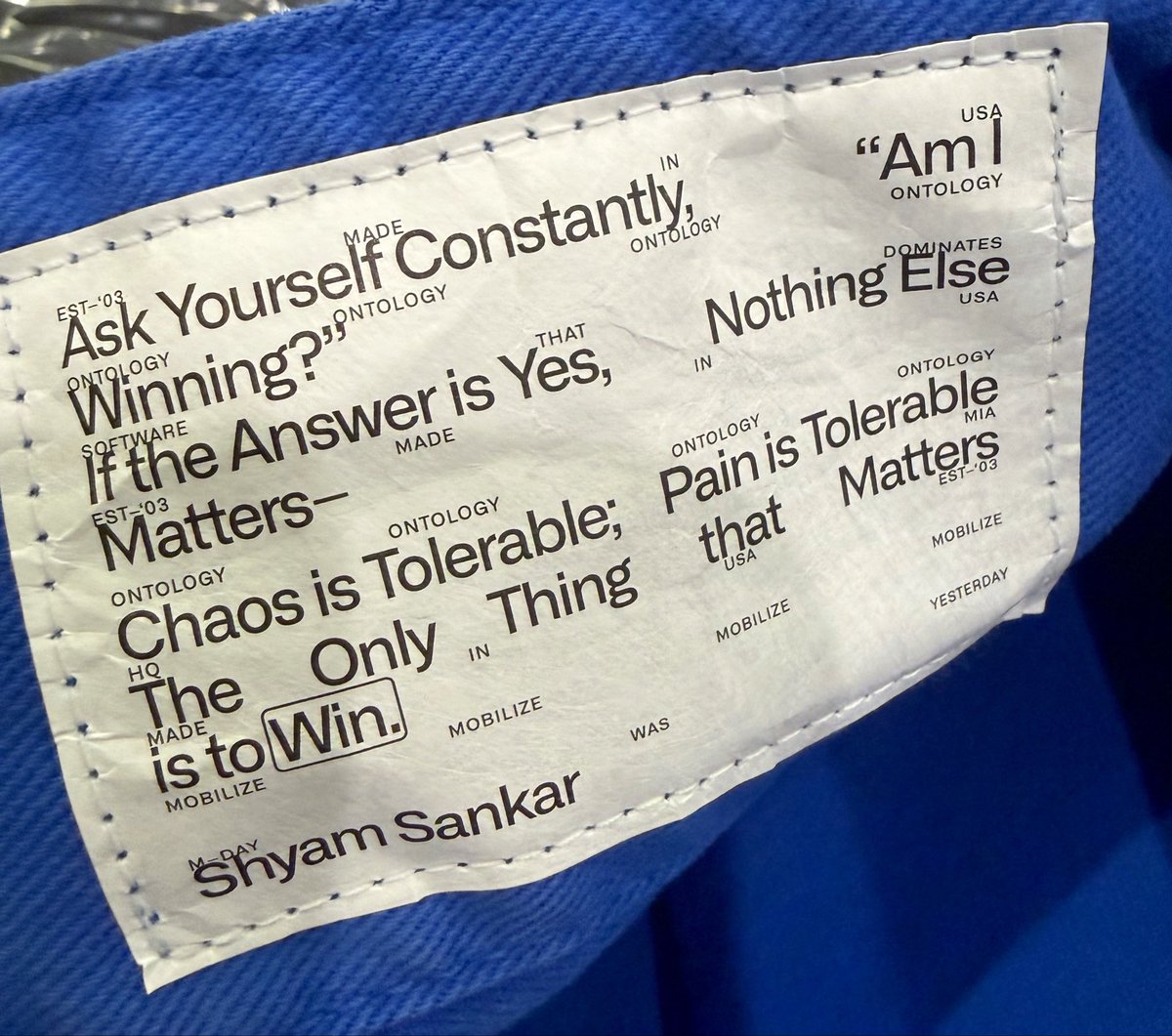
“the only thing that matters is to win” [04.30.2026]
Eliano A Younes tweet media
English
26
33
412
63.1K
Chad Wahlquist
Chad Wahlquist@chadwahl·
Migrations are natively a human-in-the-loop problem. You define what "done" looks like. AIP surfaces gaps along the way. Humans add context where it matters. AI does the heavy lifting. Humans make the calls.
amit@amitisinvesting

$PLTR Sat down with Forward Deployed Architect @chadwahl Chad Wahlquist from Palantir to discuss how companies are reacting post AIPCon, what is different about Palantir's approach to AI, and why showing software can deliver value matters. Thank you Chad for making the time!

English
5
6
76
6.9K
Jordan Edwards
Jordan Edwards@JordanEdwards7·
@chamath You mean the a personal Ontology! First Forward Deployed CEO, here. I’m doing this in Palantir! Also, all of my books, podcasts, articles, etc. CC: @chadwahl
English
1
0
1
154
Chamath Palihapitiya
Chamath Palihapitiya@chamath·
This may be a dumb question but I’ll ask it here anyways: I can’t find a good way for my various AI chats to automatically sync its conversation history into a structured knowledge base. So that as I update various chats from time to time and refine context, my knowledge base automatically grows with this new info.
English
1.1K
63
2.4K
799.9K
Jordan Edwards nag-retweet
Marc Andreessen 🇺🇸
I have never been so bullish on the United States of America.
English
1.3K
2.4K
32.4K
1.5M
Jordan Edwards
Jordan Edwards@JordanEdwards7·
To be fair, once we got Salesforce live, it became a phenomenal tool for us. But it doesn’t belong in the same sentence as @PalantirTechnologies. Palantir is in a category of its own. The closest analogy is Tesla Autopilot. There’s a clear gap between it and the next competitor. Tesla and everyone else. iPhone and everyone else. Palantir and no one else.
English
0
0
2
35
Palantir OG
Palantir OG@PalantirOg·
$PLTR “This is the most powerful platform on planet Earth. ~ @JordanEdwards7 ⬇️ Amazing story. Especially the contrast to their experience with $CRM. 🦾🔮🦄🔥
amit@amitisinvesting

$PLTR This is one of the coolest interviews I've ever done with a Palantir customer. Mixology is not only a small business, but they are a small business that tried many things before they found Palantir. Once they did, everything changed. Thank you to CEO @JordanEdwards7 for taking the time to sit down and explain why working with Palantir created magic-like results for your business!

English
1
5
60
2K
Jordan Edwards nag-retweet
amit
amit@amitisinvesting·
$PLTR This is one of the coolest interviews I've ever done with a Palantir customer. Mixology is not only a small business, but they are a small business that tried many things before they found Palantir. Once they did, everything changed. Thank you to CEO @JordanEdwards7 for taking the time to sit down and explain why working with Palantir created magic-like results for your business!
English
33
62
648
62K
Jordan Edwards nag-retweet
Jawwwn
Jawwwn@jawwwn_·
Palantir CTO @ssankar on what he would tell his children to focus on in the age of AI: "Agency. Extreme agency." "All the other skills, you'll be able to figure out as you go."
TBPN@tbpn

Redpoint's @loganbartlett says AI has completely changed hiring—favoring people with unique backgrounds: "Agency might be the only thing that matters." "That's the thing that we are trying to figure out—where do you find pockets of people who still want to do the job talent-wise, or have the capability to do the job, but also have agency?"


English
24
205
1.5K
296.4K
Ed Ludlow
Ed Ludlow@EdLudlow·
What should I write about for Monday's newsletter?
English
9
0
9
2.8K
Jordan Edwards nag-retweet
Eliano A Younes
Eliano A Younes@eliano·
what do these books have in common? answer: New York Times Best Seller List
Eliano A Younes tweet media
English
54
51
905
42K
Jordan Edwards
Jordan Edwards@JordanEdwards7·
@chadwahl @karpathy One of my new team members observation/questions to me. “Why does Claude work better in AIP analyst or AiFDE then it does when I use Claude native in the app?” Answered above 👆
English
1
0
2
117
Chad Wahlquist
Chad Wahlquist@chadwahl·
@karpathy The temporal nature of context is hard for them to reason about or efficiently weight. This is why understanding connections of that context is an effective weight mechanism and one of many reasons why Ontology is well suited for memory and context management at scale.
English
4
0
53
2.3K
Andrej Karpathy
Andrej Karpathy@karpathy·
One common issue with personalization in all LLMs is how distracting memory seems to be for the models. A single question from 2 months ago about some topic can keep coming up as some kind of a deep interest of mine with undue mentions in perpetuity. Some kind of trying too hard.
English
1.8K
1.1K
21.2K
2.7M
Jordan Edwards
Jordan Edwards@JordanEdwards7·
“If you are not a humble person, fighting will bring humbleness to you.” -Mike Tyson If you’ve never been held down against your will, you think the answer is simple. Just stand up. Then it happens. You’re pinned. You can’t move. You realize how wrong you were. That moment strips ego. It replaces assumption with reality. In my book Business Jiu Jitsu, this is a core theme. As @RenzoGracieBJJ says, “there’s more philosophy on the Jiu Jitsu mat than any Ivy League university.”
BJJotter@JiujitsuOtter

Jon Jones offered him $500 if he could stand up on Gordon Ryan. I don’t think he got the money 😭

English
0
0
1
245
Jordan Edwards
Jordan Edwards@JordanEdwards7·
@Kross_Roads Palantir is a lot like Tesla Autopilot. I know it works, because I arrive at my destination (although admittedly, I have to work much harder to get to there 😊).
English
2
0
3
159