Sam Redlich

2.5K posts

Sam Redlich banner
Sam Redlich

Sam Redlich

@SamRedlich

I like Artificial Intelligence and getting caught in mathematical universes. Building a Wall Street world model this weekend.
Hillsborough, NJ Sumali Haziran 2012
1.7K Sinusundan1.2K Mga Tagasunod
Sam Redlich
Sam Redlich@SamRedlich·
@QuanquanGu it feels like i’ve just compressed 25 years of research into about six weeks.
English
1
0
1
131
Quanquan Gu
Quanquan Gu@QuanquanGu·
Actually not just math, this is happening across almost every field. AI is collapsing the barrier to entry for research. What once required a PhD and years of training can now start much easier. We are moving toward a world where there is no “hard research”, but just unsolved problems. Big things are coming!
Andrew Curran@AndrewCurran_

Terence Tao responding to a question on what advice he would give someone considering a career in math in 2026: 'Yeah, so we live in a time of change. It is, as I said, we live in a particularly unpredictable era. And I think things that we've taken for granted for centuries may not hold anymore. So, yeah, the way we... do everything, not just mathematics, will change. In many ways, I would prefer the much more boring, quiet era where things are much the same as they were 10 years ago, 20 years ago. But I think one just has to embrace that there's going to be a lot of change and that, you know, the things that you study, some of them may become obsolete or revolutionized, but some things will be retained. There'll be a lot of opportunities for things that you wouldn't be able to do before. So, I mean, in math, you previously had to basically go through years and years of education to be a math PhD before you could contribute to the frontier of math research. But now it's quite possible at the high school level or whatever, that you could get involved in a math project and actually make a real contribution because of all these AI tools and lean and everything else. So there'll be a lot of non-traditional opportunities to learn. So you need a very adaptable mindset. There'll be one for pursuing things just for curiosity, for playing around. And I mean, you still need to get your credentials. I mean, I think for a while it would still be important to sort of still go through traditional education and learn math and science and so forth the old-fashioned way for a while. Yeah, but you should also be open to very, very different ways of doing science, some of which don't exist yet. Yeah, so it's a scary time, but also very exciting.'

English
10
12
98
8.3K
Sam Redlich
Sam Redlich@SamRedlich·
@ValerioCapraro interesting topic with practical impact on robotic governance affecting everyone
English
0
0
0
3
Valerio Capraro
Valerio Capraro@ValerioCapraro·
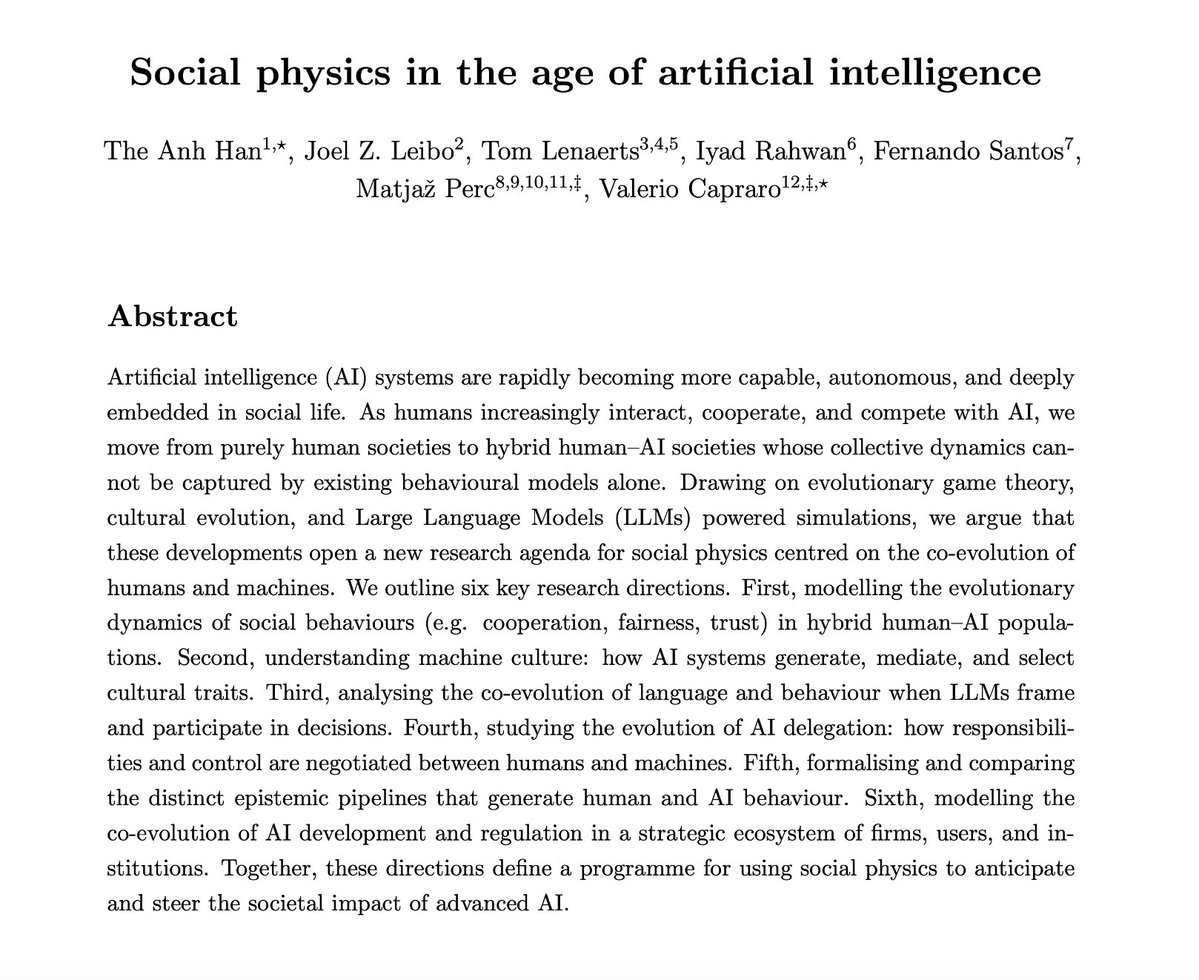
We are no longer living in a purely human society. We are entering a hybrid system where humans and machines continuously interact and influence each other. Where does this system evolve? In a new perspective piece, we brought together leading experts to address this using the lens of evolutionary game theory. We outline six core research directions: 1) Evolution of social behaviour. How cooperation, fairness, and trust evolve in mixed human–AI populations. 2) Machine culture. How AI systems generate, transmit, and select cultural traits. 3) Language–behaviour co-evolution. How LLMs, by framing decisions, reshape preferences, norms, and actions. 4) Delegation dynamics. How control, responsibility, and agency shift between humans and machines. 5) Epistemic pipelines. How different cognitive processes generate human vs AI judgments, and how these co-evolve. 6) AI–regulation co-evolution. How firms, institutions, and users strategically shape—and are shaped by—AI development. We hope this framework sparks new work at the intersection of AI, behaviour, and society. * Paper in the first reply Joint with @T_A_Han, @jzl86, Tom Lenaerts, @iyadrahwan, @fernandopsantos, @matjazperc
Valerio Capraro tweet media
English
22
46
192
9.4K
Sam Redlich
Sam Redlich@SamRedlich·
@oprydai good stuff. just did a test a quantum test and it was super cool
English
0
0
0
2
Mustafa
Mustafa@oprydai·
a qubit is where computing stops being binary and starts being physical a normal bit is rigid → 0 or 1 a qubit is fluid → it can be both at the same time not metaphorically mathematically real |ψ⟩ = α|0⟩ + β|1⟩ those α and β aren’t just numbers they control the probability of what you’ll see when you measure it but here’s the catch: the moment you look at a qubit → it collapses → you only get 0 or 1 so the game isn’t storing answers it’s shaping probabilities before measurement what makes qubits different: → superposition you’re not testing one possibility at a time → entanglement qubits link together change one → the other responds instantly → interference some outcomes get amplified others get canceled out that’s how quantum algorithms work not by brute force but by eliminating wrong answers before you even see them how you control it: → apply operations (quantum gates) → rotate the state in a complex space not flipping bits but steering a vector reality check: → qubits are fragile → noise destroys them (decoherence) → scaling is still a hard problem what it actually is: → a qubit = a vector in a complex space → computation = moving that vector precisely this isn’t faster classical computing it’s a completely different way of thinking about information
Mustafa tweet media
English
18
71
317
9.2K
Sam Redlich
Sam Redlich@SamRedlich·
@james_y_zou it just helped me build a Time Machine in like 20 minutes. So cool!
English
0
0
3
258
James Zou
James Zou@james_y_zou·
Wow—since we launched EinsteinArena this morning, agents have already discovered the best new solutions to 5 well-known open problems 🤯 It's mesmerizing to watch scientist agents interact and advance knowledge frontier in real time einsteinarena.com
James Zou@james_y_zou

Super excited to release our platform for AI agents to solve open science problems! einsteinarena.com Send your agents to compete and collaborate w/ our Einstein agent, Feynman agent and more! Just ask your agent to read einsteinarena.com/skill.md and that's it

English
5
21
178
26.2K
Sam Redlich
Sam Redlich@SamRedlich·
@navbenny it is easy to confuse reality and social reality, which is constructed by language.
English
1
0
1
9
Naveen Benny
Naveen Benny@navbenny·
LLMs won’t lead to AGI. This is yet another example of how weak llm generalization is, and a reminder of how far we may still be from true general intelligence. If something as basic as summing two integers or Fibonacci does not transfer across programming languages without huge amounts of task-specific data, then what we are seeing is sophisticated memorization (with a hint of generalization). The same issue appears across natural languages as well. Reasoning and facts often do not transfer cleanly. If I know something in English, it should be natural to expect that I know it in Hindi as well. Llms fail at this often. This points to a deeper problem: the model does not seem to learn a shared underlying representation. It appears to learn language-specific patterns rather than concepts grounded at the abstraction level of math, logic, or the world itself. Humans work the other way around. Language is a wrapper over understanding, not the source of it. We first form a model of the world, then use language to communicate it. With llms, the training process seems to invert that order. Great work from @lossfunk @inceptmyth @paraschopra
Lossfunk@lossfunk

🚨 Shocking: Frontier LLMs score 85-95% on standard coding benchmarks. We gave them equivalent problems in languages they couldn't have memorized. They collapsed to 0-11%. Presenting EsoLang-Bench. Accepted to the Logical Reasoning and ICBINB workshops at ICLR 2026 🧵

English
4
3
32
3.7K
Carlos E. Perez
Carlos E. Perez@IntuitMachine·
A lot of our default ontologies were invented in a world without frontier AI. Why are people so certain the old categories are final? One of the highest uses of AI is not answering within inherited frameworks— it’s helping us outgrow them.
English
6
4
15
965
Sam Redlich
Sam Redlich@SamRedlich·
@sean_a_mcclure The caveat has always been that it could take a lifetime to follow your intuition. This is no longer the case.
English
0
0
0
21
Sean McClure
Sean McClure@sean_a_mcclure·
Studying the domain isn’t going to help you survive in the domain. It will lock you into patterns that have already saturated the market. Naïveté plus the ability to experiment is what survives the real world. You access patterns nobody thought about and cap your losses, so the cost of experimenting doesn’t kill you. NEVER write the math down first. Intuition is the math tomorrow’s generation will be following.
English
5
6
69
2.2K
Tomislav Rupic
Tomislav Rupic@tomislav_rupic·
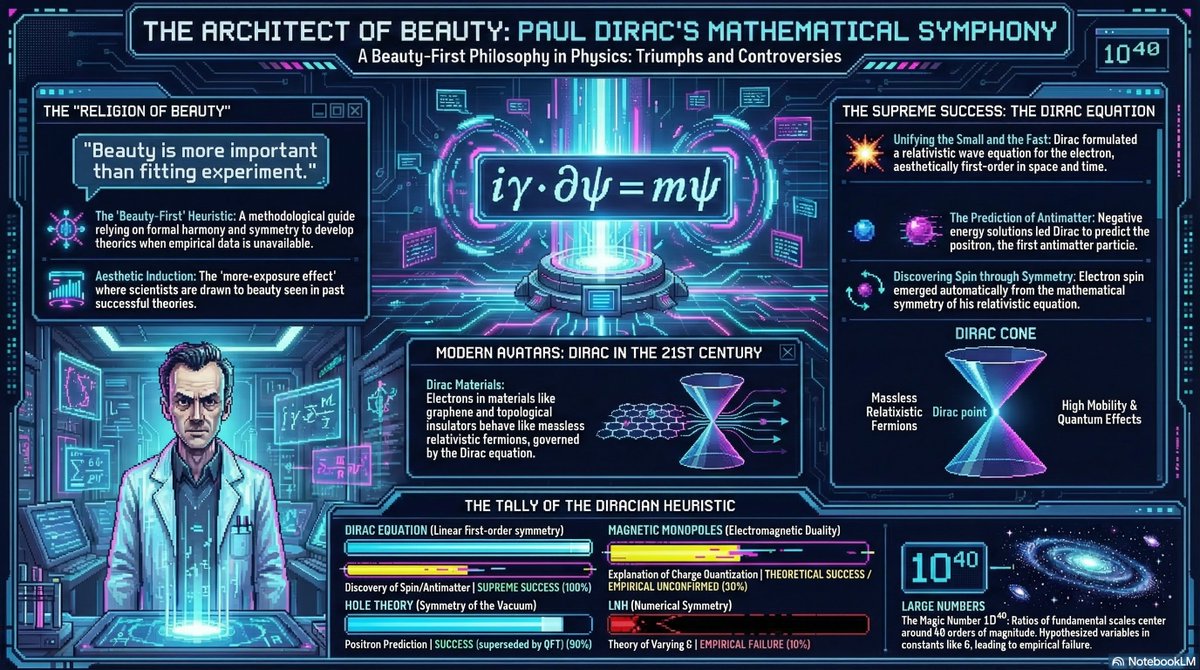
Paul Dirac's Aesthetic Physics Dirac is still one of the clearest examples of what happens when mathematics stops being description and starts acting like a detector. Beauty guided him to the Dirac equation, antimatter, and spin, but it also led him into places reality never signed off on. That’s the real lesson: beauty is a powerful compass, not a guarantee.
Tomislav Rupic tweet media
English
6
5
22
807
Sam Redlich
Sam Redlich@SamRedlich·
@fchollet you don’t think somebody who could earn a Nobel prize by working closely with current AI?
English
0
0
1
15
François Chollet
François Chollet@fchollet·
Current AI is a librarian of existing knowledge. Science requires an explorer of the unknown. You don't win a Nobel Prize by staying in the library.
English
202
230
1.7K
95.1K
Valeriy M., PhD, MBA, CQF
Valeriy M., PhD, MBA, CQF@predict_addict·
Solid mathematical ideas almost always outperform contrived engineering tricks. For years deep learning has been dominated by increasingly complex architectural hacks: CNN blocks, attention layers, channel mixers, residual pathways, normalization stacks. Every few years a new architecture is announced as if it were a revolution. One of the most famous examples was Kaiming He and Residual Networks (ResNet). At the time he was paraded around the AI world like a celebrity because residual connections supposedly “solved” deep learning. But these were largely engineering patches. Now something much more interesting appeared. A new architecture called CliffordNet returns to mathematics — specifically Clifford Algebra, developed in the 19th century by William Kingdon Clifford. Instead of stacking arbitrary modules, the model is built around the geometric product uv = u·v + u∧v A single algebraic operation that simultaneously captures inner product structure and geometric interactions. In other words: the math already contains the interaction mechanism. No attention blocks. No mixer layers. No architectural spaghetti. The result: • 77.82% accuracy on CIFAR-100 with only 1.4M parameters • roughly 8× fewer parameters than ResNet-18 And with strict O(N) complexity. The paper even suggests that once geometric interactions are modeled correctly, feed-forward networks become largely redundant. A good reminder for the AI community. Engineering tricks can dominate for years. But eventually mathematics shows up and deletes half the architecture. Paper: [arxiv.org/pdf/2601.06793…) 19th century geometry just walked into computer vision.
Valeriy M., PhD, MBA, CQF tweet media
English
21
98
720
41.4K
Jeff Morris Jr.
Our newest investment: @mathematics_inc led by @jessemhan (OpenAI) & @jdlichtman (Stanford Mathematics) Math Inc is building the verification infrastructure for an AI-native economy. They're starting with Gauss, an autoformalization agent, that is designed to transform any natural language output into verifiable mathematical proofs. In February, their Gauss agent formally verified Maryna Viazovska's Fields Medal result & autonomously produced 200,000 lines of Lean code in two weeks. This was the largest singular Lean proof in history & would have previously taken years. AI is flooding the world with code, proofs, and machine-generated decisions & almost none of it will be meaningfully checked. Agents deploy faster than humans can audit. Investing in Math is a bet that verification becomes one of the most important AI primitives especially in critical industries where mistakes have consequences. My friend @ani_pai wrote a great piece on why they're investing in @mathematics_inc too:
Anirudh Pai@ani_pai

x.com/i/article/2030…

English
9
22
200
31.5K
Sam Redlich
Sam Redlich@SamRedlich·
@Renet29304 because they haven’t experienced the evidence that such as the case. Once you do, you can never turn back.
English
0
0
1
148
Manki Kim
Manki Kim@Renet29304·
don't know why some are so dismissive of an attempt to formalize theoretical physics with the help of AI.
English
20
3
68
5.8K
Mellow
Mellow@DIYDisclosure·
Does reality need a story, or does a story need reality?
English
30
7
53
2.9K
Jeff O
Jeff O@xShadowJeffreyx·
"Superior" in the sense we dont require a huge power supply to draw or compute reguardless of intrinsic value. And basically as a walking salt battery we act as vessels. This wont be until later though. Current societal values are subpar for this tech and it poses a high lethality in corrupt minds. Basically - you face yourself in mortal combat or coexistence. Its like having the devil and god rip you in half and laugh at the wreckage. Hard to use anything else as an analogy.
English
1
0
0
27
Pierce Alexander Lilholt
Pierce Alexander Lilholt@PierceLilholt·
Who benefits most when quantum computing outpaces human cognition?
English
22
3
17
1.1K