Naka-pin na Tweet
Andrea | Code to People
254 posts

Andrea | Code to People
@codetopeople
Technical expertise ≠ leadership ability. Frameworks for analytical minds making the jump to management ⬇️Free assessment: which IC habits are holding you back?
Sumali Şubat 2026
111 Sinusundan45 Mga Tagasunod

@Stopworkplacebu Most gatekeepers weren’t born that way. They were never properly developed by their own managers, so knowledge felt like the only leverage they had. It’s a culture problem that gets passed down until someone breaks the cycle.
English

Hot take: being promoted into management should require as much vetting as hiring externally.
We don't ask ICs 'do you actually want to manage people?' We just assume the best performers do and promote them.
Then we're surprised when great engineers, analysts, and data scientists struggle in management roles they didn't choose. The skills that make you exceptional at the work don't automatically transfer.
Agree or disagree?
English

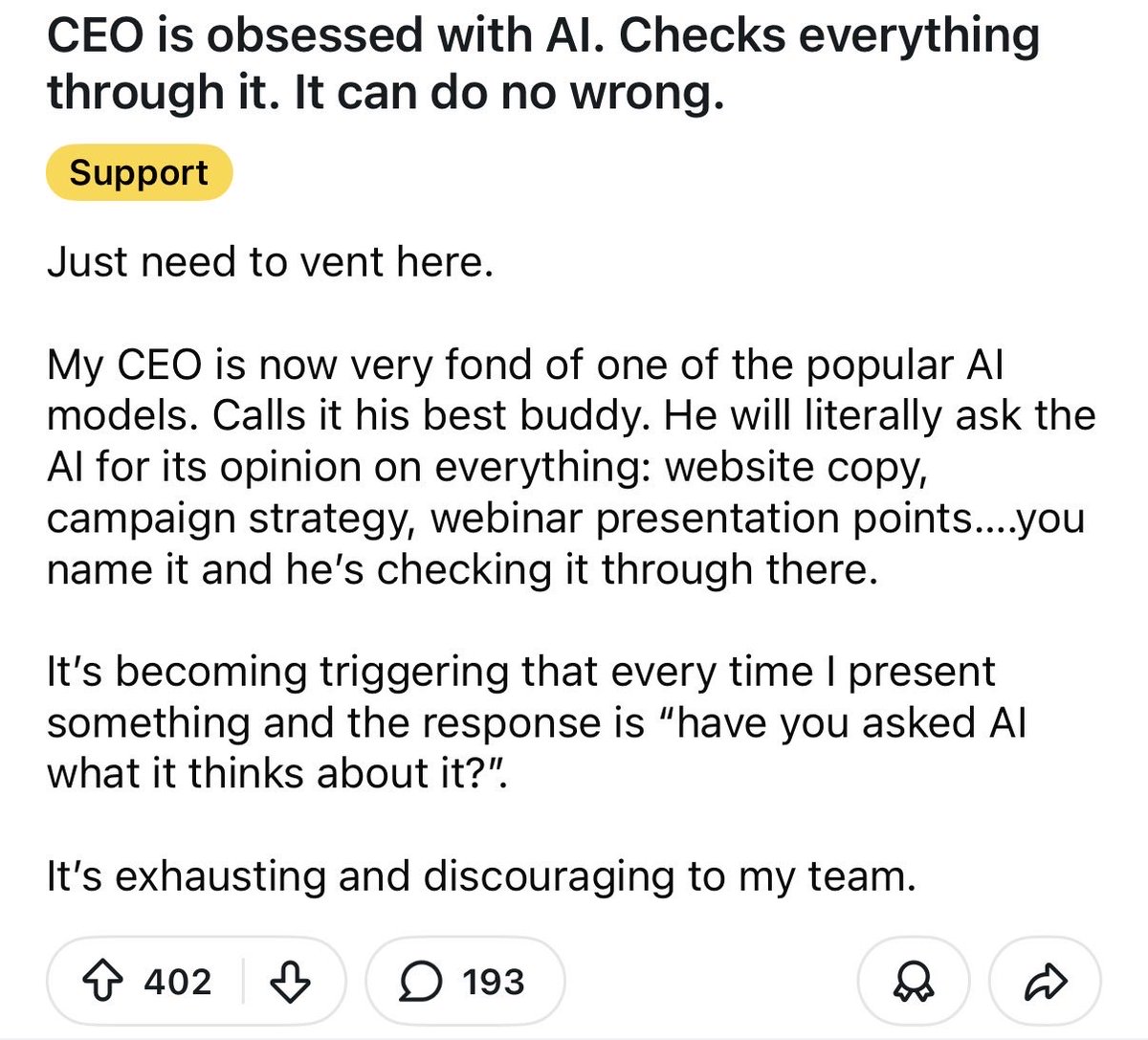
@milkkarten When leadership outsources judgment to a tool, it doesn’t just slow things down - it tells your team that their expertise and experience don’t count for much. That’s a trust problem, not an AI problem.
English

@randomrecruiter I don’t respond to “hey” until I know what it’s about. My time and your anxiety are both too valuable for that 😂
English

This is exactly why the analyst role isn’t going away - it’s evolving. The institutional context, the judgment about which metrics to trust, knowing what changed in the business last quarter - that lives with people, not models. The best analysts I’ve managed are the ones who can hold all of that and translate it into a decision. That’s still very human work.
English

Everyone is trying AI analysis with agents. No one has gotten it to be trustworthy enough to open widely to all business users.
Dozens of companies I've spoken to in the past few weeks have told me this. Why is that?
It turns out, the last 15-30% of quality and trust in analysis is really really hard to get right.
This is what your best analysts know that AI doesn't yet:
1. Which metrics to trust, out of the mess of metrics and contradicting dashboards
2. What's changed in the business behind the numbers, including strategy, roadmaps, or just one-off edge cases.
3. How to actually think about the problem, including what its downstream implications and decisions are and how it should be scoped
4. What happened last time, and what feedback signals should alter our future judgements
AI can sound smart while being wrong in exactly the ways that waste the most time.
Wrote an article explaining this, and what we can do about it, in the latest in Opinionated Intelligence.

English

@Gavel_on_X Learning to communicate up. Most people optimize for doing great work. Far fewer learn how to make that work visible to the people who make decisions about their career. It’s not politics - it’s just how organizations actually function.
English

@1ssve Yes. Had an interview once where the hiring manager couldn’t clearly articulate what success looked like in the role or where the team was headed. That told me everything. If they can’t sell me on the vision, they probably can’t sell their team on it either.
English

There’s a CEO C:
- Gets the data infrastructure right from the start
- Builds simple, trustworthy reporting on top of it
- Uses AI to automate the insight layer
- Spends zero time manually entering numbers or arguing about which dashboard to trust
The real unlock is building something that doesn’t require heroics to maintain.
English

I'm seeing this pattern with CEO dashboards now.
CEO A:
- Spends $50K on fancy BI tools
- Has dashboards nobody trusts
- Argues with teammates about feelings instead of facts
- Systems break every few months
- Still firefighting in Slack and email
CEO B:
- Uses a Google Sheet
- Tracks metrics weekly
- Makes their team enter metrics manually
- Uses green/yellow/red stoplights
- Reviews the whole business in 15 - 30 minutes
In 2026, guess who scales to $20M?
English

@randomrecruiter As a manager I have one rule: nothing after 3pm on a Friday. Some hills are worth dying on.
English

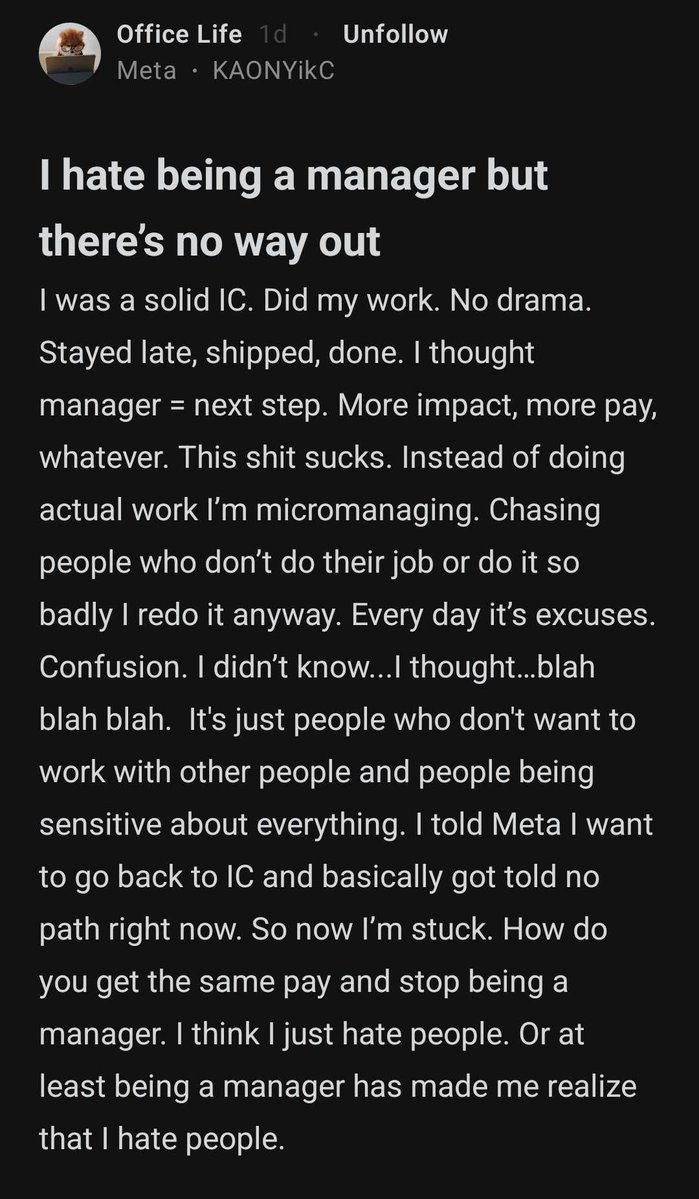
@JoinBlind A lot of this is what happens when nobody prepares you for the actual job. Micromanaging and redoing people’s work aren’t signs you hate management - they’re signs you were handed the title and left to figure it out alone.
English

@1ssve Agreed. And as a manager, I’d add: if you find yourself wanting to ask why - the more important question is why you don’t already trust your team enough not to need the answer.
English

Same is true for how managers develop their team.
You can’t announce “I’m investing in your growth” and have that mean anything. Development isn’t a favor you grant - it’s a relationship that forms through the challenges you give, the feedback you deliver, and the trust you build over time.
The managers who say it the most are often the ones doing it the least.
English

The common thread across all 7: managers who still think their job is to have the answers.
Showing up unprepared, doing status updates, avoiding challenge - it all comes from not yet understanding that the 1:1 exists for them, not for you.
The shift from “what do I need from this meeting” to “what does my team member need from me” fixes most of this list.
English

This is the most underused rule in management.
The feedback conversation you’ve been avoiding for weeks? It almost always goes better than you imagined. And the delay costs far more than the discomfort.
Most managers wait until the situation is already broken. The ones who get better learn to have the conversation early - when it’s still just uncomfortable, not urgent.
English

@THEROSSHARKNESS Agreed, and this matters even more when you’re managing people.
AI can’t fix how your team thinks or operates either. And as a manager, that’s now your problem to solve - not just for yourself, but for everyone around you.
Your leverage multiplies. So do your blind spots.
English

The “reluctance to speak without something to say” is exactly what new managers struggle with - they feel pressure to fill every silence in 1:1s and meetings.
And depth over breadth with your team is exactly how trust gets built - not by being liked by everyone, but by really knowing a the people well.
English

I spoke to someone yesterday who’s been a senior architect for years.
Burned out. Exhausted. Wondering what comes next.
She said she didn’t thrive in management because she hated giving critical feedback.
Here’s what I told her:
That’s not a personality trait. That’s a skill nobody taught you.
The architects, engineers, and analysts who feel stuck often have exactly the instincts management requires - strategic thinking, systems awareness, deep domain knowledge.
What they’re missing isn’t capability. It’s the framework for translating those instincts into leading people.
That’s the gap nobody talks about. And it’s 100% learnable.
English

Worth adding: if you ever move into management, coding drops to near 0%.
But clear communication, understanding trade-offs, ownership mindset - those stay. They just apply to people and decisions instead of code.
The skills that make a great senior engineer and a great manager overlap more than most people expect.
English

I asked 10 senior engineers:
"What skill makes a developer stand out?"
Almost everyone said the same things:
1. Debugging skills
2. Reading other people's code
3. Clear communication
4. Understanding trade-offs
5. Writing simple code
6. Knowing system fundamentals
7. Curiosity
8. Consistency
9. Ownership mindset
10. Learning quick.
Coding is only 20% of engineering
English