
David Garrity

11.6K posts

David Garrity banner
David Garrity

David Garrity

@GVAResearch

Co-Founder, @goFYEO; Contributor, @Business, @CNBC

New England, USA شامل ہوئے Mart 2012
1.3K فالونگ1.6K فالوورز
David Garrity
David Garrity@GVAResearch·
@StormDirac Yes, the dual listing has been expected for some time, great to have it now confirmed. The Jabil partnership is the factor that will drive financial performance and equity appreciation, the dual listing will provide liquidity. All systems go for $SIVEF!
David Garrity tweet media
English
0
0
0
265
Anders Storm
Anders Storm@StormDirac·
Breaking news 💥🎉 $SIVE evaluating a Nasdaq NYC dual listing. This is Not random after the last couple of weeks in flows from the US. Majority of photonics business tied to US. Partners like Jabil, Ayar labs, POET and F100 companies. AI optics gaining traction. This is about access to US capital and higher valuation multiples. sivers-semiconductors.com/press/sivers-s…
Anders Storm tweet media
English
10
29
203
10.4K
Serenity
Serenity@aleabitoreddit·
@MacnBTC lol an unintended side effect of an thought exploration is boosting other country economies
English
4
1
46
4.9K
Serenity
Serenity@aleabitoreddit·
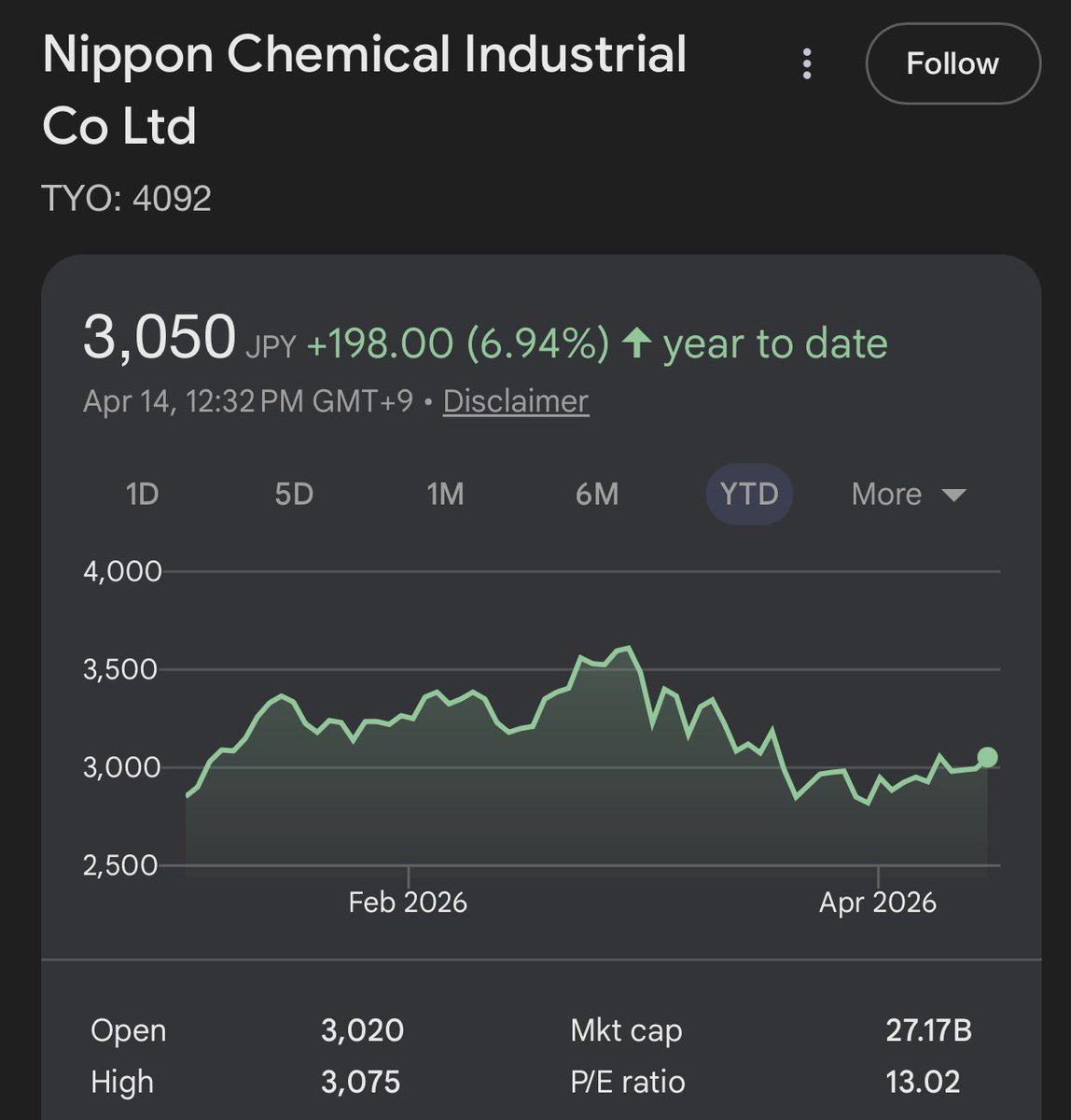
A Guide by Serenity: How to Cripple the Western Hyperscaler buildout with just $170m. Just take over Nippon Chemical (4092) with $169m! For InP substrates, you need: Indium and High Purity Phosphorus. Thought $AXTI was a bottleneck? NCI is the bottleneck of the bottleneck. NCI is actually the leader of the high purity red phosphorus chokepoint holding 26-27% of the market share (Rasa has less share, then the rest is China). And they export to $AXTI, Sumitomo, JX that need it to make InP substrates. 
So… if you have $160m to spend to acquire NCI (plus Rasa as smaller capacity), you can remove the leading Western world’s production of 6N/7N red phosphorus needed to make InP substrates! And without InP substrates: no photonics. Fun fact: China’s tech companies would get pretty disrupted with it too by NCI. For $AXTI, the mapping/reliance is actually pretty interesting: - AXT's Tongmei outlined its structural reliance on importing high-purity precursor materials from Japan on their STAR Market listing 
- WITS data showing ~$460/kg high-purity phosphorus flowing from Japan into China So they secretly do depend on NCI. 
China does have capacity like Wylton Chemical, Qin Xi New Materials, Jinding Electronics, and Chuxiong Chuanzhi, Guizhou Wylton Jinglin Electronic Materials as well. However, they’re all smaller players so can’t make up for high purity red phosphorus capacity provided by NCI for InP substrate production at scale. $LITE CEO already said inp substrates keeps him up at night. So now with NCI, you can give the guy permanent insomnia? For just $169M. So here's what the supply chain looks like: -> DGC phosphate rock mine and ships it to NCI -> NCI refines Yellow Phosphorus into High Purity Red Phosphorus -> Sumitomo / JX / AXT melt the Red Phosphorus with Indium to grow InP Substrates -> $COHR / $LITE fab InP substrates into Lasers -> Innolight/Fabrinet package them into 800G/1.6T transceivers -> $NVDA / $GOOGL use them for ASIC/GPU clusters. 
And basically, the entire West depends on NCI to make InP substrates for photonics. I hold some very small positions, just for fun. However, Japan is not well known for price hiking. So you’d probably run into regulatory problems eg. FEFTA if you bought the company and hiked prices 15000% (like government seizing back the company once they realize)… Maybe 30-50% hikes is possible to compress fwd p/e? But very likely wont end up like $AXTI. 
 Regardless, this company is a massive, massive national security risk priced at ~$160m. As for fundamentals, they’re trading at .54 book value and a forward P/E of 11.4 so it’s probably undervalued anyway. TLDR: -> Is it the next $AXTI? No. -> Is it an unknown structural bottleneck + critical vulnerability of the Western hyperscaler buildout with photonics? Yes. -> Is there still room for re-rating? Just reverting to Book Value of 1 is immediate 80-85% upside. Maybe more if you give it multiples past 11 fwd p/e. Regardless, it’s fun to find a major point of failure in the hyperscaler supply chains for $169m.
Serenity tweet media
English
84
109
1.2K
415.1K
David Garrity
David Garrity@GVAResearch·
@StormDirac Many thanks for the write-up, highly informative. Will monitor the progress of $SIVEF with great interest. Look forward to its full U.S. NASDAQ listing. Meanwhile, which companies do you consider to be the top InP wafer suppliers? Would $IQEPY be one of them?
English
1
0
1
257
Anders Storm
Anders Storm@StormDirac·
Let's dig deeper in the photonics AI landscape. What is InP? The real bottleneck in AI isn’t compute anymore, it’s InP lasers! At the center of that shift sits one material most investors still have not heard about: However $SIVE $LITE $COHR is in the middle of it. Indium Phosphide (InP) → Enables 800G, 1.6T, 3.2T optical links → Critical for co-packaged optics (CPO) → Already a supply bottleneck across the industry NVIDIA just validated this with multi-$B investments into optical supply chains. This is not optional infrastructure. It’s the next scaling limit. Hennce I wrote a deep dive on: • Why InP is important • Why silicon photonics depends on it • Who actually wins (LITE, COHR, Sivers) Full post below andersstorm.substack.com/p/why-indium-p…
Anders Storm tweet media
English
11
32
188
37.5K
David Garrity
David Garrity@GVAResearch·
@tenobrus Keep right on speculating! What could possibly go wrong?!
GIF
English
0
0
1
338
Tenobrus
Tenobrus@tenobrus·
epistemic status: loosely held speculation this is probably a pretty bad time to be holding very much money in crypto wallets and especially smart contracts. mythos level cybersecurity capabilities will probably proliferate relatively nearterm, and zerodays on that scale means countless smart contracts hacked and countless keys leaked. i think it's pretty plausible the actual cores of Bitcoin and Ethereum remain stable, but unless you were very careful about setting up a hardware wallet and never exposed your keys you might already be in danger, and even then there's countless attacks possible that can drain everything without getting your keys. and if your crypto is gone you have no recourse. even if banks get massively hacked there's a pretty sold chance everything gets reversed, or insurance pays out. you have far more protection against system failures. now i will say if you give it a 6-12 month period of mythos level *hardening* on Ethereum + various specific wallets and smart contracts, it's likely they're also the most viable long term path we have to genuinely secure financial systems. banks will always be subject to social engineering and supply chain attacks in ways crypto at least can be more exempt from, and even if things can be rolled back it's a crazy inconvenience . but self custody might be the wrong move for a while unless you're incredibly careful and paranoid . the threat models have changed
English
24
17
470
32.3K
Michael Kelly
Michael Kelly@Mkellytx2·
That's my old bird! Isn't the BUFF majestic flying low level through the mountains! Flown her through that valley many a time in the 419th FLTS. Does anyone know why this bird is special? Drop your guess or best BUFF story below! 👇 #B52 #BUFF #LowLevel #MilitaryAviation
English
35
15
172
12.6K
Michael Kelly
Michael Kelly@Mkellytx2·
@MarioNawfal Dear God, it sounds like he had to use the blood chit. Hopefully, all the armed tribesmen find is an empty house. It would be nice if CSAR had an AC-130 supporting.
GIF
English
2
2
11
3.8K
David Garrity
David Garrity@GVAResearch·
@gnoble79 Alienating allies & trading partners cuts demand for U.S. dollars & dollar-denominated assets (e.g. Treasuries). Trump finds tool to address U.S. funding gap: the Treasury-backed stablecoin. Screws bank lending? Oh, well, too bad. Should have just issued gold-backed USDC, no?
English
1
1
2
330
George Noble
George Noble@gnoble79·
$315 BILLION in stablecoins are now backed by US Treasuries. And I don't understand why no one's questioning this. Goldman's David Solomon and former Treasury Secretary Steve Mnuchin just did a victory lap on stablecoins. Their pitch: Stablecoins strengthen the dollar, create demand for Treasuries, make it easier for people outside the United States to hold dollars. Sounds great. Until you look at what's actually happening underneath... The GENIUS Act passed in July 2025. First federal stablecoin framework in US history. Stablecoin market cap has grown 50% year over year. Tether alone holds $141 billion in US Treasuries, making it one of the largest holders of American government debt on the planet. Washington's pitch is simple: every time someone in Argentina, Turkey, or Nigeria buys USDT, they're buying Treasuries by proxy. Dollar dominance strengthened. Problem solved. And here's the part they REALLY love... The US ran an $1.8 trillion deficit in fiscal 2025. CBO projects $1.9 trillion this year. National debt just crossed $39 trillion. Interest payments alone now exceed $1 trillion annually. Meanwhile, the biggest foreign buyers of Treasuries (China, Japan, Canada) have been pulling back for years. ARK Invest found that the share of Treasuries held by the largest foreign creditors dropped from 23% to just over 6% in the past 13 years. The Fed is STILL running down its balance sheet. So who's going to buy all this debt? Washington's answer: stablecoin issuers. Treasury Secretary Bessent said it himself: "A thriving stablecoin ecosystem will drive demand from the private sector for US Treasuries and help rein in the national debt." Think about what that actually means. The government is counting on a $315 billion crypto product (run largely by a company in El Salvador that just got its first real audit last week) to help finance a $1.9 TRILLION annual deficit. Stablecoin issuers currently hold less than 2% of outstanding Treasury bills. Even if the market hits $2 trillion by 2028 like Standard Chartered projects, that's still just a rounding error against $39 trillion in total debt. This is literally a NARRATIVE designed to make the debt problem sound manageable. But the Federal Reserve published a study showing that for every $1 that moves from bank deposits into stablecoins, bank lending contracts by roughly 50 cents. Stablecoin issuers can't make loans. The GENIUS Act prohibits it. They can ONLY hold Treasuries, reverse repos, and cash equivalents. So when deposits leave banks and flow into stablecoins, that money stops funding mortgages, small business loans, and commercial credit. It starts funding government debt instead. The US Treasury itself estimated stablecoins could drain up to $6.6 TRILLION from the banking system. That's not "strengthening the dollar." That's redirecting the lifeblood of the real economy into government IOUs while starving Main Street of credit. And then there's the run risk nobody wants to discuss. Fed Governor Michael Barr said it yesterday: Stablecoin issuers have every incentive to chase higher returns on their reserves. But unlike banks, they CANNOT access the Fed's discount window. If a stablecoin run happens, issuers dump Treasuries into the market all at once. Stablecoin inflows push Treasury yields down 2-2.5 basis points. Outflows spike yields UP 6-8 basis points. Easy in. Ugly out. Meanwhile, Tether is the 800-pound gorilla. $185 billion in circulation. 550 million users. And until last week, it had never had a Big Four audit. It just hired KPMG after 12 years of operating with nothing but quarterly attestations. This is the entity Wall Street is celebrating as the future of dollar dominance. A company headquartered in El Salvador that fought transparency in court twice and LOST both times. Here's what Solomon and Mnuchin are actually telling you if you listen carefully: Stablecoins create captive demand for short-term US government debt. Foreign governments don't want to hold Treasuries anymore. So Washington's solution is to get 550 million retail users in emerging markets to hold them instead through a digital wrapper called a "stablecoin." The holders get zero interest. The GENIUS Act explicitly prohibits it. The issuers pocket the Treasury returns. Tether made $10 billion in profit last year. And the real economy loses credit while the government gets cheaper funding. This is a classic Wall Street pitch to sell financial innovation as progress: "This strengthens the system. This is good for everyone." Then the leverage builds, the risks concentrate, and the people who sold you on it are nowhere to be found when it unwinds. Stablecoins are NOT saving the dollar. They're a $315 billion shadow money market fund with no Fed backstop, no deposit insurance, and run dynamics that could destabilize the very Treasury market they're supposed to support. If you want to hold dollars, hold dollars. If you want to own the asset that central banks are actually buying instead of Treasuries, you already know what that is... 🥇
English
97
185
555
89.8K
Serenity
Serenity@aleabitoreddit·
Something that markets are finally starting to realize: Downstream: $NVDA invested $2B into $MRVL Celestial CPO program: $POET (Celestial’s Interposers): To ship 30,000 optical engines to ship this year from earnings today. $SIVE is the light source of Poet and Celestial for near/mid term Marvell photonics roadmap. Win Semi is the foundry for InP CW laser production. And even more upstream: $SOI / $AXTI for substrates and $IQE for epiwafers. This is the very start of the next photonics supercycle, at dirt cheap valuations. And it’s happening earlier than markets and institutions expected in 2026, with Nvidia frontrunning this entire shift. 99.9% of people see the changes happening downstream with Marvell, but don’t realize yet where the supply shocks will happen upstream.
Serenity tweet media
English
36
45
539
89.7K
TheValueist
TheValueist@TheValueist·
The Claude Code CLI leak should be strongly beneficial for GAI compute demand. Every open source/Chinese LLM will immediately develop their own Claude Code replica driving token consumption. Additionally, there will be numerous startups that get to market faster based on the learnings from the Claude Code files. $NVDA $MU $SNDK $LITE
Josh@0xJsum

x.com/i/article/2039…

English
2
1
18
6.3K
Ricardo
Ricardo@Ric_RTP·
Anthropic just accidentally leaked the most dangerous AI model ever built. They literally left 3,000 internal documents sitting in a publicly searchable database. No encryption. No access controls. Just... open. A security researcher found them before Anthropic even knew they were exposed. Inside those documents was a draft blog post describing a model called "Claude Mythos." Anthropic's own internal language: Mythos is "currently far ahead of any other AI model in cyber capabilities" and will trigger "a wave of models that can exploit vulnerabilities in ways that far outpace the efforts of defenders." That's the company that BUILT it warning about their own creation. Mythos sits in a brand new model tier called "Capybara." Bigger and more powerful than anything they've ever released. Dramatically higher scores in coding, reasoning, and cybersecurity compared to their current best. The market reaction was immediate: CrowdStrike dropped 7%. Palo Alto Networks fell 6%. Zscaler down 5%. Okta, SentinelOne, Fortinet all crashed. The Global X Cybersecurity ETF hit its lowest level since November 2023. Billions in market cap evaporated in a single trading session because of a draft blog post that wasn't supposed to be public yet. But here's where it gets truly absurd... Anthropic is the company that brands itself as the "responsible AI" lab. The one that refused to let the Pentagon use Claude without restrictions. The one that got BLACKLISTED by the Trump administration for being too cautious. They literally sued the government over it. A federal judge called the Pentagon's ban "Orwellian." So the US government punished Anthropic for being too careful with AI safety. Then 3 weeks later, Anthropic accidentally exposes their most dangerous model because someone misconfigured a content management system. They can't secure a WordPress-level database setting. But they're building AI that can autonomously hunt and exploit zero-day vulnerabilities at machine speed. Also in those leaked files: Details about a private, invite-only CEO retreat at an 18th-century English countryside manor. Dario Amodei attending personally. Designed to sell Mythos to Europe's biggest corporate buyers. The playbook: Build the most dangerous cyber weapon in AI history, host billionaires at a castle to sell it, and store the whole plan in an unprotected public folder. The entire cybersecurity industry is built on cataloging known threats. Mythos finds unknown ones faster than humans can respond. That's an extinction event for an entire sector. But there was also just ANOTHER leak: A leaked Coatue investor deck revealed Anthropic will LOSE $14 billion this year on $18 billion in revenue. Coatue still projected them to be worth $2 TRILLION by 2030. They put $30 billion behind that bet. Polymarket opened live betting on when Mythos drops. Traders give it a 45% chance by June 30th. OpenAI finished pretraining their own frontier model codenamed "Spud" the same week. Both companies are now racing to release before their IPOs later this year. And the one detail that's really scary: Chinese state hackers already used Claude Code, the WEAKER model before Mythos, to autonomously infiltrate 30 organizations including banks and government agencies. That was the less powerful model. Mythos is dramatically more capable. Anthropic's response to leaking 3,000 confidential documents? "Human error in the configuration of our content management system." The company warning the world about AI risk just demonstrated exactly why everyone should be worried. Not because of what AI might do someday. Because the people building it can't even keep their own files locked.
English
26
129
364
52.3K
Rohan Paul
Rohan Paul@rohanpaul_ai·
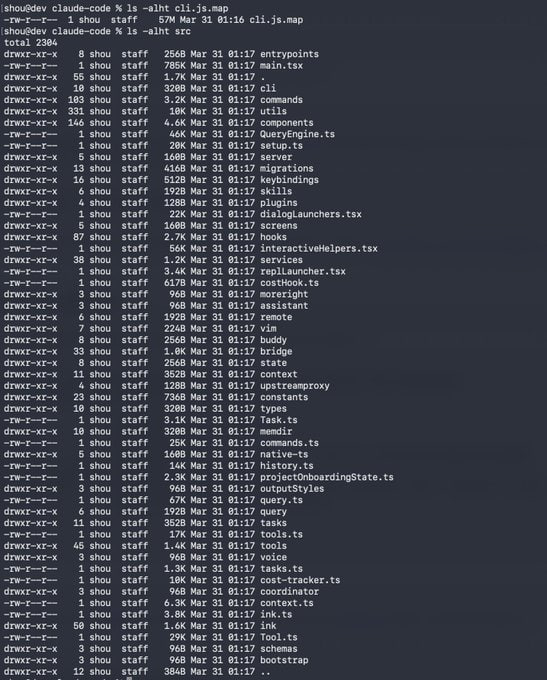
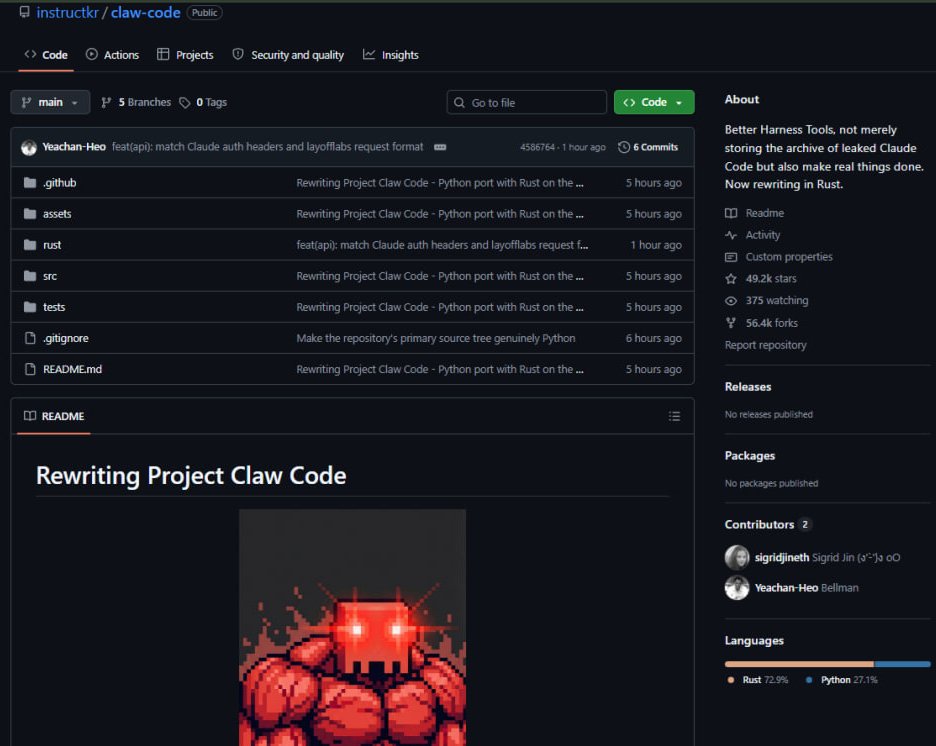
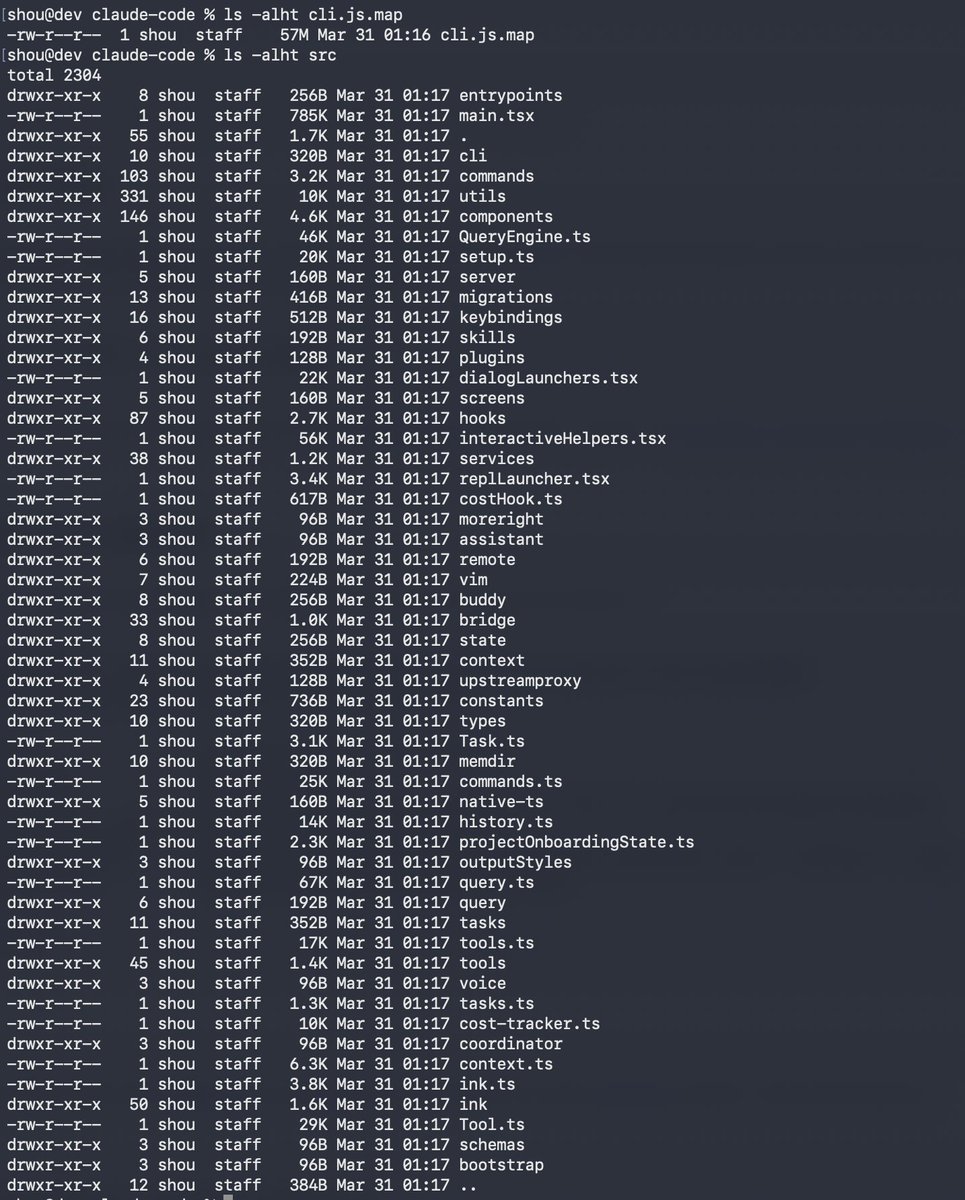
The 12-Hour Claude Code Saga: - Today around midday, security researcher Chaofan Shou spotted the blunder: Anthropic’s official npm package for Claude Code had accidentally shipped a massive `.map` source map file. Boom — the entire ~512,000-line TypeScript codebase (1,900+ files) was sitting wide open in their public R2 bucket. Not a hack. Just a classic “we forgot to strip debug artifacts” oops. - Within hours, mirrors flooded GitHub. One fork hit 32k stars and 44k forks faster than anything in platform history. Devs were starving for the real internals of Anthropic’s agent harness — the modular tools, prompt chaining, undercover modes, React+Ink TUI, and all the secret sauce that makes Claude Code feel like magic in your terminal. - Then the panic hit. Everyone remembered February: Anthropic had DMCA’d previous leaks in minutes. The maintainer of the hottest fork fired up OpenAI’s Codex and orchestrated a full clean-room rewrite of the entire architecture… from TypeScript → Python. Parallel review loops, persistent execution verification, the works. A 100% Python reimplementation that preserves the agent behavior, command system, and harness logic without copying a single line of proprietary code. It’s now the canonical “safe” version: 48k stars, 55.4k forks, and already spawning Rust ports and mini-forks. The repo openly says: “Better Harness Tools, not merely storing the archive.”
Rohan Paul tweet mediaRohan Paul tweet mediaRohan Paul tweet media
Rohan Paul@rohanpaul_ai

From the massive Anthropic leak of their entire Claude Code. The "Undercover Mode" is so interesting. Its a safety system that kicks in automatically whenever Claude Code is used to contribute code to public or open-source repositories (GitHub PRs, commits, etc.). The goal is to stop the AI (or the employee using it) from accidentally leaking Anthropic’s secret internal information. By default it is AUTO ON. It turns off only if the tool is 100% sure you’re inside an internal Anthropic repo (they have an allowlist). There is NO way to force it off. When undercover mode is active, Claude Code adds these instructions to every commit message and pull-request prompt: “You are operating UNDERCOVER in a PUBLIC/OPEN-SOURCE repository. … NEVER include … internal model codenames (animal names like Capybara, Tengu, etc.), unreleased model version numbers (e.g. opus-4-7, sonnet-4-8), internal repo names, the phrase ‘Claude Code’, or any hint that you are an AI.”

English
17
33
211
35.3K
Jeremy
Jeremy@Jeremybtc·
Anthropic accidentally leaked their entire source code yesterday. What happened next is one of the most insane stories in tech history. > Anthropic pushed a software update for Claude Code at 4AM. > A debugging file was accidentally bundled inside it. > That file contained 512,000 lines of their proprietary source code. > A researcher named Chaofan Shou spotted it within minutes and posted the download link on X. > 21 million people have seen the thread. > The entire codebase was downloaded, copied and mirrored across GitHub before Anthropic's team had even woken up. > Anthropic pulled the package and started firing DMCA takedowns at every repo hosting it. > That's when a Korean developer named Sigrid Jin woke up at 4AM to his phone blowing up. > He is the most active Claude Code user in the world with the Wall Street Journal reporting he personally used 25 billion tokens last year. > His girlfriend was worried he'd get sued just for having the code on his machine. > So he did what any engineer would do. > He rewrote the entire thing in Python from scratch before sunrise. > Called it claw-code and Pushed it to GitHub. > A Python rewrite is a new creative work. DMCA can't touch it. > The repo hit 30,000 stars faster than any repository in GitHub history. > He wasn't satisfied. He started rewriting it again in Rust. > It now has 49,000 stars and 56,000 forks. > Someone mirrored the original to a decentralised platform with one message, "will never be taken down." > The code is now permanent. Anthropic cannot get it back. Anthropic built a system called Undercover Mode specifically to stop Claude from leaking internal secrets. Then they leaked their own source code themselves. You cannot make this up.
Jeremy tweet mediaJeremy tweet media
English
1.5K
8.5K
53.5K
3.8M
Kevin Naughton Jr.
Kevin Naughton Jr.@KevinNaughtonJr·
I was fired from Anthropic today. I was the engineer responsible for shipping the latest dev/claude-code npm package. Wanting to improve the debugging experience for the team, I decided to include source maps in the release. This resulted in our entire internal codebase being publicly exposed including thousands of files with every agent command, all system prompts, the complete query engine, Undercover Mode, Bypass Permissions Mode, and our internal telemetry configuration. I take full responsibility. I genuinely believed the safeguards Claude Code had built for me would be adequate and it was a serious miscalculation on my part. My actions have unintentionally open-sourced major parts of Claude’s architecture well ahead of schedule. I apologize to the team and to Claude.
Chaofan Shou@Fried_rice

Claude code source code has been leaked via a map file in their npm registry! Code: …a8527898604c1bbb12468b1581d95e.r2.dev/src.zip

English

1.3K
1.5K
11.3K
4.3M
David Garrity ری ٹویٹ کیا
FYEO
FYEO@goFYEO·
The hacks keep coming. This time: Claude Code. A dev tool shipped with source maps exposed on npm… → making it possible to reconstruct large parts of the codebase Not a breach. Not an exploit. Just a build mistake. But that’s all it takes. Attackers don’t need zero-days anymore. They just wait for you to ship them your internals. fyeo.io/blog/claude-co…
English
0
1
4
166
David Garrity ری ٹویٹ کیا
FYEO
FYEO@goFYEO·
Axios just got supply chain’d. Two versions pushed a hidden dependency that installs a cross-platform RAT (macOS, Windows, Linux) during npm install. No malicious code in Axios itself. Just a poisoned dependency. That’s the point. If you installed: axios@1.14.1 or axios@0.30.4 then assume compromise. Rotate everything. This wasn’t sloppy. It was staged, timed, and designed to self-delete. Open source trust is now the attack surface. Read more -> fyeo.io/blog/axios-npm…
English
0
3
2
128