@MikeMTOS Hey! No plans currently, as I have a few other things in my pipeline atm, but I'll whack this into a GitHub issue if you/anyone else would like to contribute - github.com/Davidobot/love…
@davidobot_, Hi. I'm a novice lua/js programmer (iPad) & like your love.js port. Are you considering adding the ability to create single file html loves to use on client browsers like schellingb did? If not, any tips on adding game.data and love.wasm inline? Thx.
@B_Schelling , I'm a novice mobile (iOS) lua/js user who is enjoying your Love 2d builder in the browser. Any chance will update to Love 2d >=11.0? I'd like to use g3d module but when I try it I get init error: can't parse love.graphics.setDepth statement (needs 11.0).
@MikeMTOS I'm not familiar with glx, I see it's related to X11 though, xterm.js is confined to the browser sandbox. I'm guessing you cannot do that from a browser.
@Tyriar, would you explain more about what the xterm.js webgl addon does? It sounds like it should render webgl content somehow from an xterminal. However, as a novice linux/js user, I thought X11 handles openGL calls & xterm just displays a text console inside a X11 window? Thx
@Tyriar Yes, thank again, @Tyriar. As a novice, I don't know all that xterm.js does, but know the QEMU browser port ("copy x86") uses it to create terminals in browsers. One of the demos creates a working ArchLinux terminal which actually can display a X11 GUI in a browser. (Continued)
@Tyriar Thanks, @Tyriar. I hadn't realized that the drawing of the terminal itself was slow enough to benefit from webGL GPU acceleration. I had hoped the xterm add-on (or another js addon) might allow opening up a webGL GPU accelerated glx window from xterm.js.
@MikeMTOS It uses the webgl browser API to take over rendering of the element from the browser by running shaders on the GPU. The alternative is dom based (very slow) or a 2d canvas context (eg. tell the browser to render a rectangle/text).
@whscullin Fyi, AppleIIjs running locally without internet connection on iPad Pro. Works great! Some minor issues when running locally (e.g. not displaying icons for disk loading) but nothing major :-)
@MikeMTOS Hi! You should be be fine with any of the supported node versions. I use node 16 but it should work with 14 or 18. You should only need node and npm to get started, npm will generally be installed along side node. npm can then install all the other packages you need.
@whscullin, hello. I'm a novice mobile javascript programmer (iPad) and love your AppleIIjs emulator & installed it to run locally on my iPad. However, its my first time using node.js: what is the min files I need to run it locally & how man of the node.js files are needed? Thx.
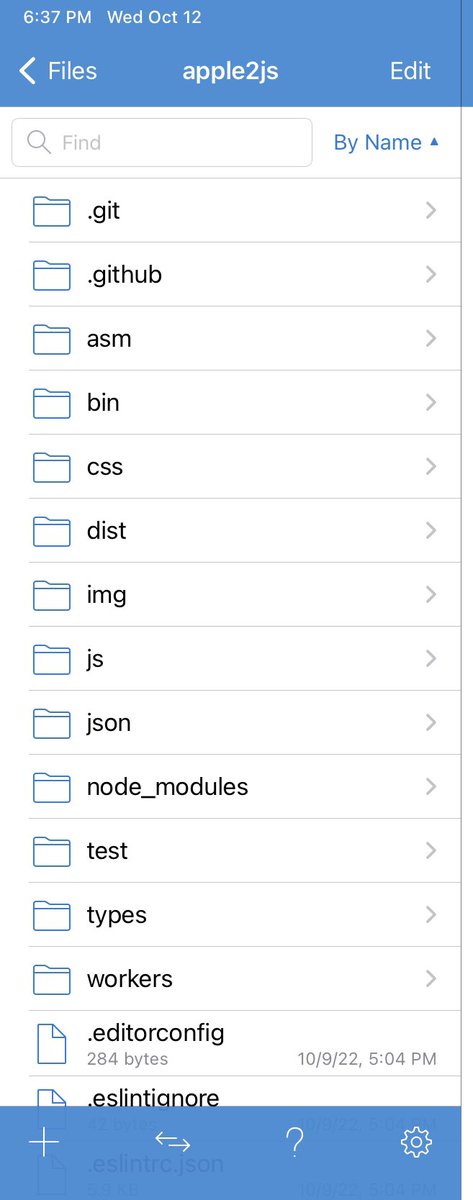
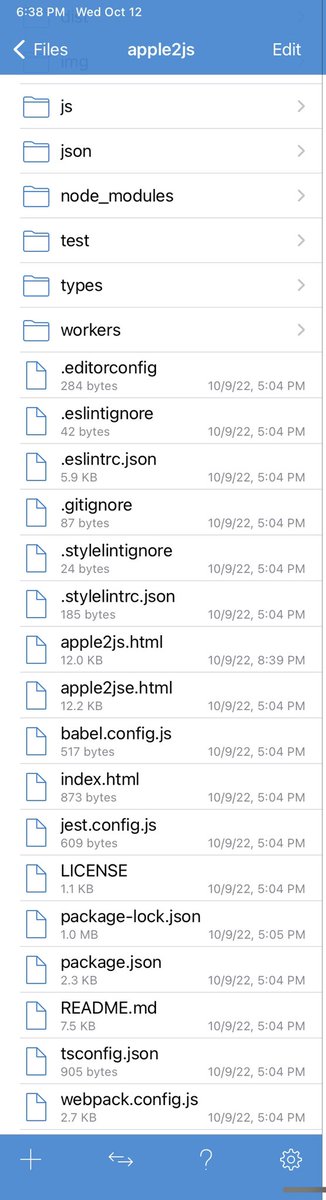
@whscullin Thanks, Will :-). Since I just want to run Apple2js locally in my IDE/browser, I was just wondering if I needed all of the folders that I downloaded from github (e.g. all the node.js/npm & non-index html, emulator js and css files). Attached screenshots of what's installed now.
@hfpreston Thanks, Hank! So, then DHCP (and not the user through IP addr add) sets the LAN start address (src IP) in your IP route show example: default via 172.16.211.2 dev ens160 proto dhcp src 172.16.211.128?
@MikeMTOS Glad you found it useful Mike!
If I understand your question correctly, to add an IP to an interface you will specify the address with prefix in the command. For example:
ip addr add 172.16.211.128/24 dev ens160
RedHat has a great cheatsheet access.redhat.com/sites/default/…
@hfpreston, thx for the great into to Linux networking you wrote in July! I'm a novice Linux user troubleshooting a network. Is the ipv4 address used to add an IP address to an interface the "src" or non-src one (e.g. 172.16.211.0/24 vs 172.16.211.128 in your ip route example)?
@UTMapp@UTMapp, to clarify, will there now be 4 increasing levels of speed performance for UTM on the M1 iPad (UTM SE, UTM w/JIT, UTM w/Hypervisor but no JIT, UTM w/Hypervisor & JIT)? & will the two fastest performance levels be limited to iPad OS 15.4.1 or below for now? Thanks :-)
Note supporting this will not be straightforward because UTM depends on system sandbox features. We are actively researching for a better way but for now Jitterbug/Jitstreamer should still work.
@MikeMTOS Exactly what was said. Back up your VMs so if anything goes wrong you can restore it. Otherwise if you reinstall an older version they may no longer work.
@UTMapp Osy, could you clarify what is meant by backing up one's VM as the new UTM release won't open prior VMs? Does that mean we need to convert our old saved VMs to a new format to use in the new UTM release or we won't be able to use old VMs at all? Thanks.
@MikeMTOS So we’ve tried the direct Metal option and it resulted in lots of memory leaks that quickly jetsamed the app. The GLES backend is what we’re currently using. I’m not sure if any of the other options are more mature.
@UTMapp: Osy, I’m still perplexed why some accel 3D apps work great (DevilutionX) and others don’t (Portal). Just made a simple 3D frame with rgl/R and didn’t render labels right. On hunch got attached Xonotic to work (small screen/JIT to save mem). Because both use SDL2?
@UTMapp The last option is to port the OpenGL driver of macOS to iOS. I don't recommend this. It will certainly need some dirty binary hacking.
Good luck,
Akihiko Odaki
Fyi, in case this information is helpful. --Mike
@UTMapp The fourth option is to hack Virgl to work with iOS's OpenGL implementation. Maybe this is the easiest option, but it may be dead-end if the implementation is too buggy or limited. It is deprecated anyway.
@UTMapp It should be possible to port the driver to iOS with sufficient amount of hacking. This is the hardest as fixing the driver is likely to need reverse-engineering of graphics stack of macOS/iOS, but it brings the maximum flexibility.
@UTMapp The third option is to use asahi driver of Mesa. It is an open-source OpenGL driver for M1. Note that it is still in early-stage of development. It is being developed for Asahi Linux, but the development is currently done on macOS...