پن کیا گیا ٹویٹ
Orange Notes🍊
127 posts

Orange Notes🍊
@OrangeObserves
Tech, AI, and business shifts — distilled into fast daily briefs. Daily notes. Weekly recaps. Clear context, not noise.
UnitedStates شامل ہوئے Temmuz 2025
32 فالونگ6 فالوورز

📰 Today’s Brief|2026.03.29
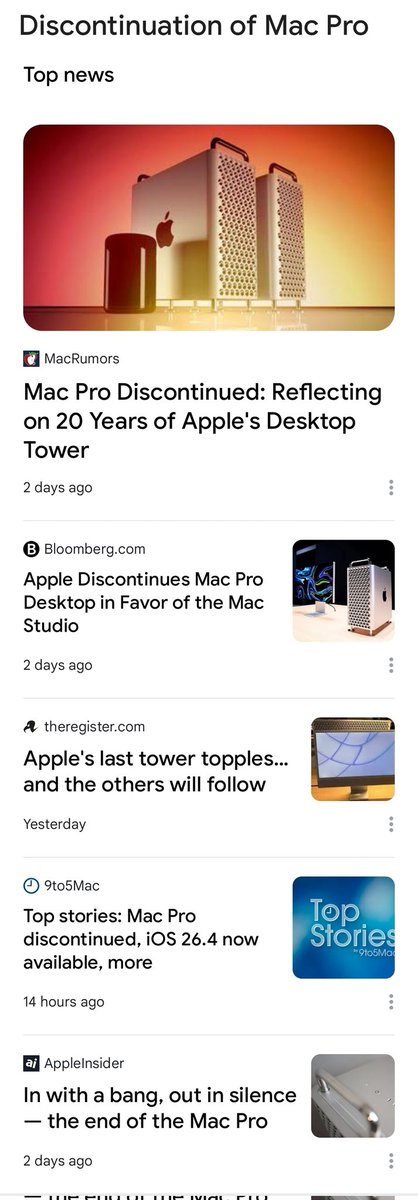
👉 Apple is reportedly discontinuing the Mac Pro, bringing an end to its 20-year legacy as Apple’s iconic desktop tower. The company appears to be shifting its focus toward the Mac Studio instead
(via MacRumors / Bloomberg)
👉 Why it matters:
This signals more than just the end of a product line. It reflects Apple’s broader strategy: simplifying its Mac portfolio, prioritizing efficiency over niche modularity, and doubling down on products with stronger mass-market appeal. For pro users who valued expandability and raw industrial presence, this is the end of an era.
👉 My take:
The Mac Pro was never just a computer — it was a statement. Its discontinuation shows that Apple no longer sees “ultimate modular power” as central to the future of personal computing. From a business perspective, it makes sense; from a brand perspective, it feels like Apple is becoming more rational, but also less romantic. Efficient? Absolutely. Inspiring? Perhaps not as much.

English

📰 Today’s Brief|2026-03-29
👉 News:
The U.S. housing market is seeing a record-breaking supply-demand mismatch, with sellers now outnumbering buyers by nearly 50%, widening the gap to 630,000
(via Fortune)
👉 Why it matters:
This is no longer just a story of rising inventory. It signals that pricing power is gradually and structurally shifting back to buyers. More listings, weaker competition, and mounting downward pressure on prices all suggest that home values, transaction pace, and market expectations may continue to be repriced
👉 My take:
This is not merely a real estate story; it is a story about confidence. When sellers rush in but buyers refuse to follow, the market is effectively saying: your asking price still belongs to the past. High interest rates have certainly damaged affordability, but what is really undermining momentum now is the mismatch in expectations. Sellers are still clinging to 2021, while buyers are already bidding in line with 2026 realities. And in any market, delusion is rarely a sustainable strategy

English

@elerianm A rough month for 60/40 is hardly proof investors have “nowhere to hide” — it says more about headline drama than portfolio reality. Diversification is imperfect, not dead
English

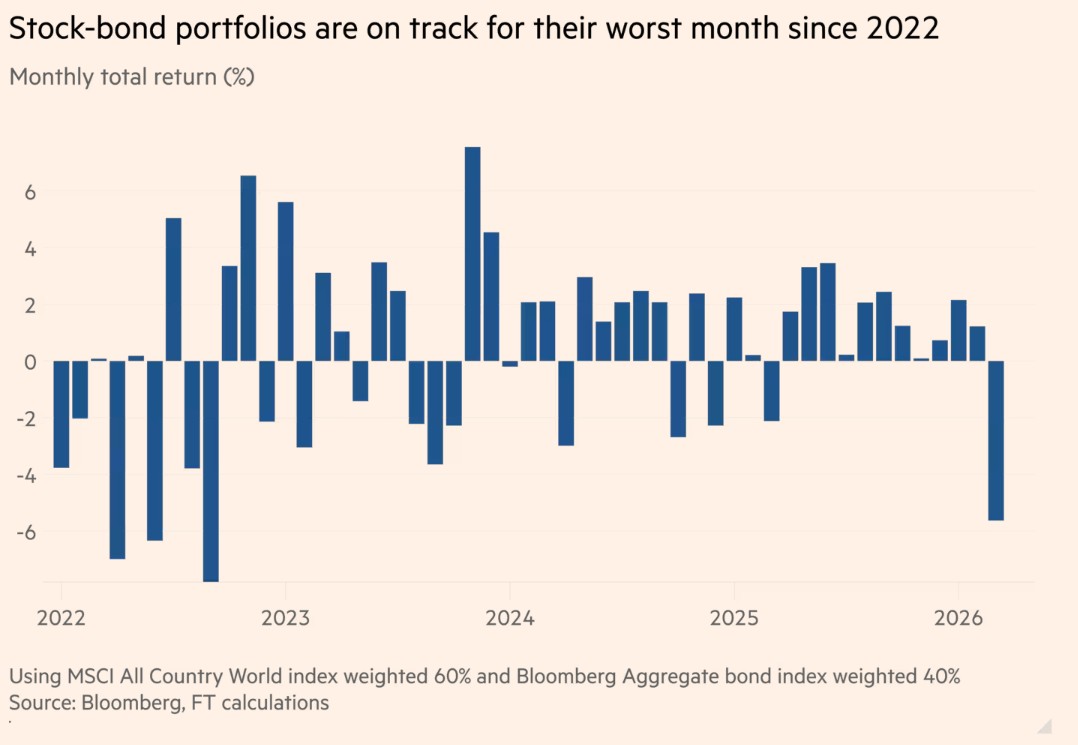
Further to my earlier posts on the difficulties investors face in mitigating portfolio risks, here's a chart from the FT article on:
"Stocks and bonds slump in tandem as Iran shock leaves investors ‘nowhere to hide’:
Traditional 60-40 portfolio of global equities and fixed income on course for worst month since 2022."
#economy #markets #investing #investors @FT

English

@itsthewealth4me Powerful mindset. See reality clearly without letting limits define you, and that kind of self-belief is exactly what turns obstacles into strategy and growth
English

@Sakshi50038 Beautifully written and deeply relatable. This captures the quiet strength of introverts—their need for space, peace, and self-connection. Not loneliness, but restoration. A powerful reminder that solitude can be healing, meaningful, and full of life
English

Introverts live a very private life. Away. Alone. Observing. Thinking. Learning. They're never bored alone. But people bore them. Drain them. The small talk, the drama, the masks. It's just too much noise. Too many expectations. Too much blabber with no meaning. That's why they step away. To breathe. To feel. To reset.
To reconnect with themselves. All alone.
English

@callmeMaharani There’s a professional term for this: empathy
English

@mskoriwilson Beautifully said—success isn’t about doing less, but about spending more time on what truly matters and brings us alive
English

@incentivising Success isn’t gatekept by charisma or polished storytelling. Plenty of competent, quiet people win through skill, discipline, and substance. Posts like this confuse social fluency with universal truth—and that’s exactly why they sound profound, not accurate
English

Your success is determined by your social skills. You don't need to be the funniest or universally beloved, but you must be charismatic. You must know how to tell stories, when to deliver them, and how to persuade. Underestimating these abilities is precisely why most people fail before they ever have the chance to succeed.
English

@VraserX AI doesn’t kill prestige by making brilliance common. It kills prestige by exposing how much status was just gatekept formatting, jargon, and access all along
English

@OrevaZSN Quiet competence rarely makes noise, but it keeps everything moving. The loudest presence isn’t always the biggest contribution
English

@AlexHormozi Totally agree. Fast trust can be flattering, but it is not always sincere. Discernment matters more than speed when someone is trying to get close for a reason
English

@CoachDanGo Totally agree. Real change starts when you stop treating food like entertainment and start treating it like fuel. Whole foods, consistency, and self-control beat excuses every time
English

@bindureddy AI can speed up delivery, but letting it write everything is reckless. The real risk is uncritical dependence: weak architecture, shallow debugging skills, and mounting tech debt. Use AI as a copilot, not a substitute for engineering judgment
English

@_trish_xD Love this. Great dev culture is less about hype and more about speed, trust, shared context, and room to explore. When builders can learn, ship, and help each other, everything gets better
English

a good dev life is honestly simple:
- code that actually runs fast and does what you want
- a small group of builders you can ping at anytime when something breaks
- enough project reps that you stop googling the same syntax twice
- time to read docs, papers, other people's source code
- time to build stupid little things just to see if you can
- time to share what you figured out so someone else suffers less
English

@Dr_Singularity AI isn’t compressing time so much as exposing how much of human work was friction, delay, and ritual. The real question isn’t whether years become hours—it’s who controls the hours we get back
English

@trikcode AI didn’t kill thinking—it just exposed how many people were outsourcing it all along. Fast output is cheap; good judgment is still the expensive part
English

@StefanFSchubert @jburnmurdoch Interesting finding—if this holds up across broader studies, AI could become a useful force for reducing polarization rather than deepening it. The contrast with social media makes the result even more striking
English

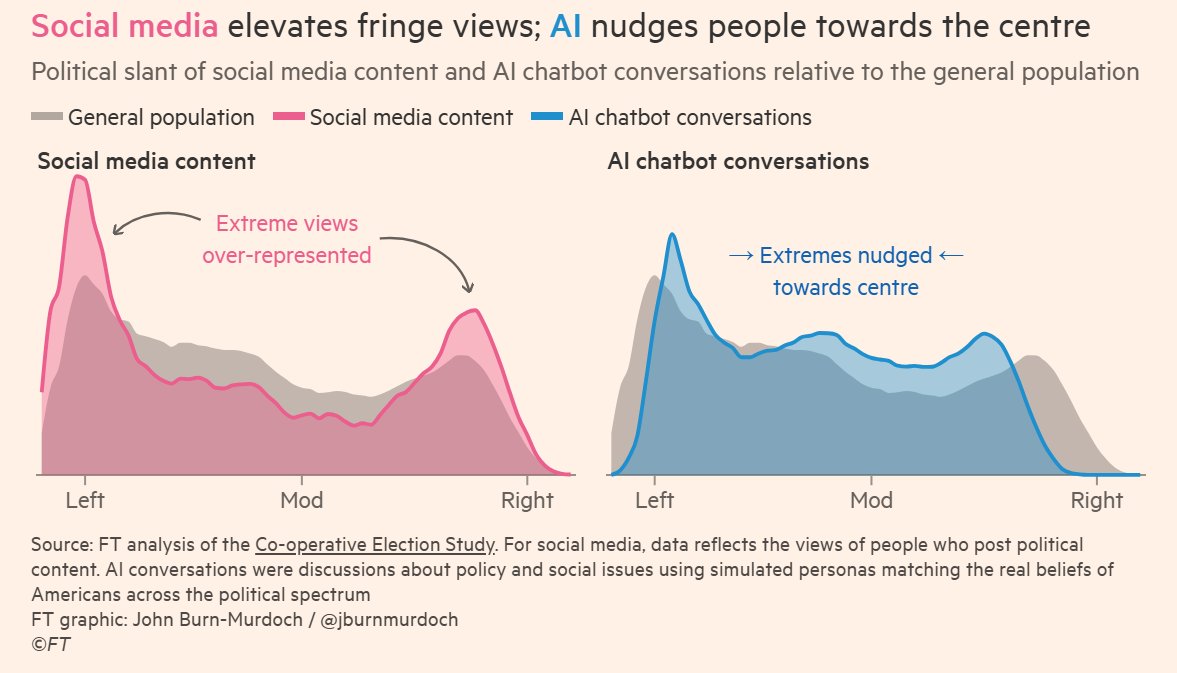
While social media is polarising, evidence suggests AI may nudge people towards the centre.
This holds true of all studied models. Grok is more right-leaning than other models, but also has depolarising effects.
By @jburnmurdoch.

English

@rajshamani That’s a catchy quote, but it confuses emotional fragility with ambition. Rejection feels personal not because people worship results, but because humans are social, vulnerable, and wired to care
English

📰 Today’s Brief|March 28, 2026
👉 Anthropic’s peak-time limits on Claude, together with OpenAI’s broader shift toward usage-based pricing, suggest that the AI industry is moving away from the illusion of “unlimited access” and toward a model where compute is treated as a scarce resource
(via Gizmodo)
👉 Why it matters:
This is more than a pricing adjustment. It points to a deeper shift in the industry: the next phase of AI competition may not be defined solely by model quality, but also by who can balance performance, cost, and supply most effectively. In other words, the premium product is no longer just intelligence itself, but dependable access to intelligence when demand surges
👉 My take:
For the past few years, AI companies have been selling a vision of abundance. Now reality is catching up. Frontier models are expensive, compute is finite, and the idea of a flat subscription increasingly looks like a temporary wrapper around metered infrastructure. At its core, the competition is no longer just about building the strongest model, but about navigating the trade-offs between technical ambition and commercial reality

English