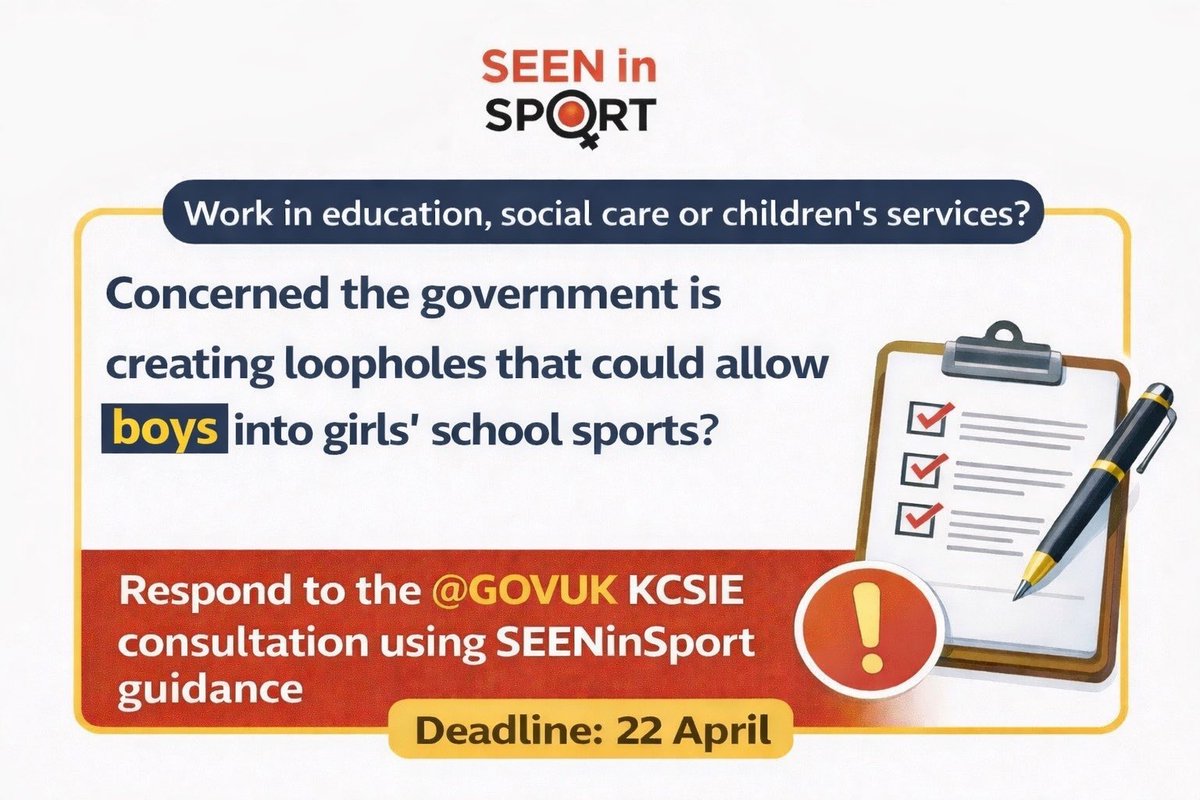
The Department for Education UK is consulting on changes to "Keeping Children Safe in Education" (KCSIE) Deadline: Wednesday April 22 Have your say: consult.education.gov.uk/independent-ed… Key concerns: Social transition has "significant effects on [the child's] psychological functioning and longer-term outcomes", including potential medical implications. Consequently, no education professional has the expertise to assess a child's "best interests" on this matter as suggested by the draft guidance (e.g. para 254, 256 etc.) Encouraging an assessment of "best interests" in cases of gender-related distress contravenes KCSIE's own stipulation in para. 45 "Only appropriately trained professionals should attempt to make a diagnosis of a mental health problem." Teachers do not acquire the necessary expertise to assess "best interests" when a child enters puberty (paras. 258, 259, 264, 265). The draft guidance puts children at risk by encouraging teachers to stray beyond their professional expertise, handing them a highly consequential decision that they are not qualified to make. This is true even if parents consent to social transition. Parents are not always well-informed about the consequences this may have for a child, so while parental consent is important, teachers must not be given the impression that there is a green light to proceed as long as parents approve. Teachers cannot determine whether this is in the child's "best interests" (257) even if the parents might think so. The draft guidance fails to define social transition and thus confuses personal expression (which is uncontroversial as long as a child complies with uniform regulations) with teachers treating a child as if they were the opposite sex (which has profound consequences for the child and their peers). The guidance must articulate more clearly that social transition in the context of a school involves harnessing the child's peers and teachers as a form of 'therapeutic community' to affirm the child as the opposite sex (or non-binary or other identity). The guidance is not clear that safeguarding considerations take priority over a child's individual agency and their equality/human rights e.g. if an equality claim puts a child at risk of harm. The guidance mentions 'harm' (para. 261) but does not explain what this means for a cross-sex or non-binary identified child e.g. breast binding, tucking, DIY hormones, heightened dysphoria, online exploitation, misinformation about suicide. Para 263 promises confidentiality if a child reveals a cross-sex identity to a teacher but does not demand social transition. This means parents are uninformed about something that could indicate underlying mental health issues, trauma, neurodevelopmental issues. This secrecy undermines safeguarding for these children. Para 252 opens up the possibility of schools drafting their own policies on 'social transition'. This creates a loophole for unevidenced and unsafe policymaking by education professionals, who are not qualified to make decisions relating to mental health. Para 262 must be reworded to be clear that if a school considers a parent to be such a risk that their child's cross-sex identity should be concealed from them, this would warrant immediate referral to social services (not merely a consultation with the DSL). Otherwise schools will continue to use this as a loophole to exclude parents from decision-making. Note: The main question to respond to is Question 33 of the consultation. Further information may be added in response to Question 34 on single-sex toilets, changing rooms etc., and Question 35 on single-sex sport.