

$martmoney
3.1K posts

Chłopcy powyżej dziewiątego roku życia, którzy zostaną przyłapani na znęcaniu się nad innymi uczniami, będą mogli zostać ukarani chłostą przy użyciu rózgi. Nowe przepisy zostały zaproponowane przez singapurskie ministerstwo edukacji.
- Nowe przepisy zawierają w sobie rygorystyczne procedury, które mają zapewnić uczniowi bezpieczeństwo. Dla przykładu, chłosta będzie musiała być zaaprobowana przez dyrektora i wykonana wyłącznie przez uprawnionego do tego nauczyciela - zapowiedział minister edukacji Singapuru, Desmond Lee.
Dodał, że chłosta będzie wykorzystywana jedynie jeśli "inne sposoby będą nieadekwatne do wagi czynu". W myśl nowych przepisów chłopcy starsi niż dziewięć lat będą mogli zostać uderzeni rózgą maksymalnie trzy razy, jako kara za prześladowanie (w tym w internecie) innych uczniów.
- Szkoły będą brały pod uwagę czynniki takie jak dojrzałość ucznia i to, czy chłosta pozwoli mu uczyć się na własnych błędach i zrozumieć powagę swojego czynu - dodał Lee. Zgodnie z jego słowami, szkoły zadbają o dobrostan wychłostanych uczniów, m. in. oferując im wsparcie szkolnego pedagoga.

Polski
$martmoney ری ٹویٹ کیا

$martmoney ری ٹویٹ کیا

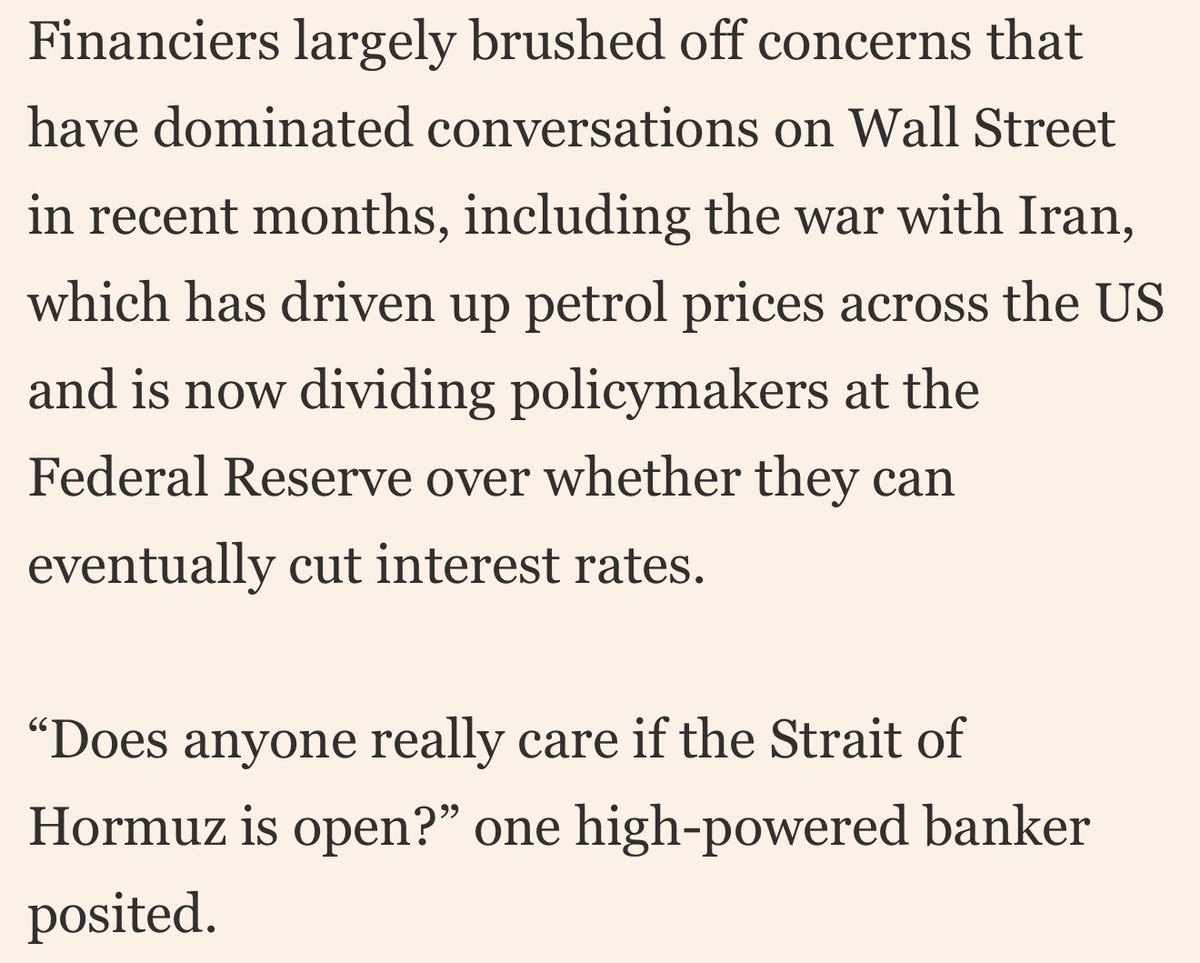
Amazing quote in this FT piece. American financial elites are so insulated, they don’t believe that physical realities matter for the economy.
English
$martmoney ری ٹویٹ کیا


@JesusFerna7026 @EliasPapaioann2 @lugaricano Surely you're trolling? "riding the coattails of U.S. innovation"? Europe has literally all advanced industries, while US has fake software 'innovation' ie lobbying to get Europe to use their apps/socials. No high speed rail and even their military production can't keep up.
English

Of course. But, to a large degree, the U.S. has had those problems for over two centuries. If you have to handle (poorly as the U.S. did) with the inherentance of slavery and institutional discrimination, a lot of your social indicators are going to look awful.
The problem is that what we are doing in Europe is not sustainable in the long run. In fact, most of our recent growth for the last 40 years has just been riding the coattails of U.S. innovation.
The question is not whether we want to replicate South LA in Madrid (of course, we don't), but whether Spain's fiscal situation ensures that we will not have a South LA in Madrid in 2050. And, so far, we are not doing so well preventing that future.
English

Come on @JesusFerna7026 and @lugaricano !!! The poverty one sees in the land of the free is not seen in advanced European countries! And ample data, on poverty rates, life expectancy, morbidity, infant mortality, even income below the 50th percentile, say exactly this!!
Jesús Fernández-Villaverde@JesusFerna7026
I rarely post on Europe because @lugaricano always has better takes than mine. It is hard to be the second act! His post this morning: siliconcontinent.com/p/the-two-euro… on the two Europes is particularly striking. Figure 1, which I reproduce here, is something European policymakers should keep in mind every day. Beyond the raw, somewhat abstract figures for GDP per capita, there is a reality I see every time I travel to Western Europe. I moved to the U.S. in 1996, six weeks after graduating from college. Every time I visit, I can tell that Spain (especially outside Madrid) is further behind the U.S. today than it was the day I left. The malaise in countries such as France, Germany, Italy, and Spain is not just economic. The public conversation is also more insular and focused on distributional fights over a pie that grows much less than in the past, with many more claimants. While I can listen to dozens of incredibly exciting podcasts in the U.S. about deep learning and technology, most of what one hears in Europe (Luis excepted!) is second-rate. Of course, this is not to say that everything is perfect in the U.S. Far from it. One only needs to ride the subway in Seoul a couple of times to realize that New York City is, on many dimensions, a major underperformer. When I visit New York City, I am not amazed by its prosperity but wonder how much richer it could be with a half-decent government. And California’s policies are a textbook example of how to waste the immense resources of one of the luckiest places on Earth. And Europe still has centuries of beautiful architecture and culinary traditions going for it But, Western Europe, thou art weighed in the balances, and art found wanting.
English
$martmoney ری ٹویٹ کیا

~35 minutes of walking per day is associated with optimal antidepressant effects.

High Performance Founder@hpfounder
I’m sorry to report that walking 30 minutes a day without your phone is the most underrated way to improve your mind and body.
English
$martmoney ری ٹویٹ کیا

“Exemplary” alcohol-free wedding, USSR, 1986. Photo by Boris Klipinitsky

English
@VivaldiVril @CostelloWilliam In line with your identity as a relationship guy? Like is this some kind of anti playboy label?
English
@VivaldiVril @CostelloWilliam I mean nobody uses this term, why would you describe yourself as a relationship guy? Like what does this even mean, that you're always in relationships? It does feel a bit needy to me tbh, like what if your relationship stops working for you and you want to end it, now you're not
English

I've been an incel, and I've been a relationship guy.
What's the difference? What did I do?
-Added muscle, a lot of it.
-Read about male psych, I began to understand myself
-Abandoned dweebish hobbies, picked up cool manly ones
-Wore clothes that mature adult men wear
-Stopped dressing like a childish slob
-Stood up straight. Straightened my gait.
-Read about female psych, began to understand women
-Via all the above, lost my self-consciousness and insecurities, which allowed fluid, natural conversation and behavior
I EVOLVED. You can too, anon.
GIF
English
$martmoney ری ٹویٹ کیا

@damn_jehu Overaccumulation = exported capital = imported commodities, including labor power
Capital increasingly cannot afford to invest in domestic labour, so birth rate (like profit rate) falls
English
$martmoney ری ٹویٹ کیا


$martmoney ری ٹویٹ کیا

Is falling fertility a cultural or economic issue?
Both, actually.
Re: $ --> New research finds that "51% of the total fertility rate decline" in recent decades is a consequence of "rising housing costs."

Bonchie@bonchieredstate
Now go look up the earning difference between those two demos. Again, birth declines may be marginally affected by finances, but this is far more of a cultural issue. Federal incentives aren’t going to fix it.
English
@MateuszBrat @JanSpiewak Państwo polskie to komitet polityczny Januszy biznesu (parafrazując klasyka).
Polski
$martmoney ری ٹویٹ کیا

Stan gnicia 3RP:
- sądy rozdają bezsensowne „sądowe zakazy prowadzenia pojazdów” gdzie potem się kończy kolejnymi ofiarami
- jak już sądy przyklepią wyrok w którym jest ofiara drogowa to te wyroki są śmieszne
- grupa pseuodhotelarzy lobbuje na przerobienie miast na parki turystyczne, a mieszkańców wysła na pola kapusty bez usług z chaotyczną zabudową
- jaranie się zbiórką pieniężną na dzieci chore na raka, gdy w tym samym czasie NFZ ma rekordowy deficyt
- wprowadzenie miękkiej prywatyzacji ochrony zdrowia poprzez głodzenie NFZu (ale nie konowałów z szpitali powiatowych)
- pojawia się pomysł instytucjonalnego skupu betonu z strony państwa w formie zapobiegnięcia kolapsu cen mieszkań
- w kwestii jazdy po chodnikach samochodem - media nie tworzą debaty i dyskusji dlaczego to jest możliwe - dokonują próby linczu na osobie która zwraca uwagę na ten problem
Polskie państwo jest instytucją która udaje państwo - nie istnieje w formie bytu który organizuje życie obywateli - jest systemem powiązań wąskich silnych, małych grup interesów (często bezpartyjnych) których celem jest ekstrakcja własnego społeczeństwa.
Żaden rząd nie przeprowadzi żadnych głębokich reform, bo to by doprowadziło do destabilizacji.
Goorsky@goorsky_pl
Adwokat od "trumien na kółkach" poszukiwany 😲
Polski
$martmoney ری ٹویٹ کیا

Francis Fukuyama admits that China's model has supplanted that of Western liberalism.
👇
English
$martmoney ری ٹویٹ کیا
5 In terms of economic policy, the rich dictate the game as they did before. Neither have taxes on the top incomes increased, nor have taxes on capital incomes gone up, nor is there a pedagogical tax on excessive wealth. National market liberalism is the name of the game: neoliberalism at home, mercantilism outside.
English
$martmoney ری ٹویٹ کیا


@okrazek @AwDitrich Studia lekarzy przez pandemię to była kpina. Wiem z rodziny. Testy online i studenci na czacie wymieniający się odpowiedziami.
Polski

@AwDitrich Dobre wykształcenie to uczenie logicznego myślenia. U lekarza jedyne myślenie to jak przenieść pacjenta do prywatnego gabinetu.
Polski

Pekao: Lekarze zarabiają dużo w stosunku do średniej krajowej.
Bartosz Fiałek: Lekarze nie zarabiają dużo, tylko dużo w porównaniu do średniej krajowej.
Proszę mi wyjaśnić, jakim cudem osoba tak dobrze wykształcona, zakładam, że fachowiec w swojej nie takiej łatwej branży, ma problem ze zrozumieniem prostego zdania?
Już naprawdę wzywanie Demagoga czy pisanie “eksperci” (w cudzysłowie) jest tutaj poniżej krytyki. Analitycy Pekao nie poucząją pana Fiałka jak leczyć, fajnie aby pan Fiałek nie uczył jak analizować dane.
Problem jest też inny. Porównywanie pensji nominalnie nie ma sensu, ponieważ zarobki lekarzy właśnie zależą od zamożności narodów.
W latach 60. XX wieku przez ekonomistów Williama Baumola i Williama Bowena zostało opisane zjawisko kosztowej choroby Baumola (efekt Baumola). Nie wchodząc w nudne szczegóły, gospodarkę możemy podzielić na sektor progresywny i stagnujący. W progresywnym, innowacje i automatyzacja pozwalają produkować więcej przy tym samym nakładzie pracy. Dzięki temu pensje rosną bez podnoszenia cen produktów. W sektorze stagnującym, praca ludzka jest produktem samym w sobie. Nauczyciel, lekarz czy policjant nie zrobią więcej w ciągu godziny, jeśli zapłacimy im 2x tyle.
Problem w tym, że jeśli w jednym sektorze rosną pensje, to muszą także w innym, bo nikt nie pracowałby w innych sektorach. To sprawia, że koszt wizyty rośnie. Jeden pracownik w fabryce może zrobić 10x więcej telefonów, 1 lekarz wyleczy tyle samo ludzi. To sprawia, że ceny w ochronie zdrowia wraz ze wzrostem wynagrodzeń rosną wszędzie. Inflacja w szpitalach zawsze będzie większa od oficjalnej (w długim terminie).
Kolejne ważne pojęcie to elastyczność dochodowa popytu. Jeżeli coś jest dobrem luksusowym, to oznacza, że coraz więcej przeznaczamy na dobra wyższego rzędu (luksusowe) niż niższego. Dlaczego? Bo jak jemy tygodniowo 5 chlebów, to nie zaczniemy nagle jeść 10. Wybierzemy lepsze pieczywo, droższe alternatywy. Typowym dobrem luksusowym jest dziś zdrowie (czy raczej usługi z nim związane). Jak mamy kasę i nie musimy martwić się o rachunki, to jesteśmy w stanie więcej wydać na lekarza. Gdy zarabiam 5000 i 4000 musze wydać na rachunki i jedzenie, to na lekarza nie mogę dać więcej niż 1000. Gdy zarabiam 10000 i na rachunki i jedzenie wydaję więcej, bo 7000, to nadal – na lekarza mogę teraz wydać 3-krotnie więcej. Dlatego w bogatych narodach wydatki na zdrowie rosną i m.in. dlatego Szwajcarzy wydają na leczenie tak dużo.
Teraz w Polsce toczy się debata, na ile ten wzrost kosztów NFZ jest faktycznie wynikiem bogacenia, a na ile zaczyna być problemem zbyt dobrego wynagradzania lekarzy. Nie można ocenić tego lepiej niż przez pryzmat średniej krajowej, ponieważ lekarz w Polsce nie leczy gorzej niż w Szwajcarii i lepiej niż na Ukrainie (a ci w Szwajcarii zarabiają lepiej, a w Kijowie gorzej). Dlatego porównywanie nominalnych płac lekarzy to ekonomiczny analfabetyzm (chyba, że w formie ciekawostki lub do innych celów niż debata na temat słuszności ich wysokości) i należy patrzeć przez pryzmat bogactwa danego społeczeństwa, co średnia krajowa może ładnie oddawać.
Nie bądźmy jak pan Fiałek, piszmy o rzeczach, o których mamy jakieś pojęcie (lub chociaż nie oskarżajmy innych o paskudne manipulacje). Dobrego wieczoru!

Bartosz Fiałek@bfialek
Przeanalizowałem wykres przedstawiony przez „ekspertów” banku Pekao i dotyczący wynagrodzeń lekarzy na tle innych krajów OECD (dane z Health at a Glance). Ten wykres nie pokazuje, że lekarze w Polsce zarabiają prawie najlepiej w Europie. Pokazuje coś zupełnie innego: że lekarze zarabiają dużo w porównaniu do średniej polskiej pensji. A to ogromna różnica. Prosty przykład: jeżeli w biedniejszym kraju średnia pensja wynosi 1000 euro, a lekarz zarabia 3000 euro, to ma 3 średnie krajowe. Jeżeli w bogatszym kraju średnia pensja wynosi 3000 euro, a lekarz zarabia 6000 euro, to ma 2 średnie krajowe. Na takim wykresie „lepiej” wygląda pierwszy lekarz. Tylko że realnie zarabia dwa razy mniej. Dlatego na szczycie są Węgry. I dokładnie taką sztuczkę zastosowali ekonomiści z banku Pekao na tym slajdzie. W oryginalnych danych OECD Polska ma ok. 108 tys. USD PPP (parytet siły nabywczej), a średnia OECD to ok. 133 tys. USD PPP. Niemcy? 207 tys. USD PPP dla specjalistów etatowych i 318 tys. USD PPP dla samozatrudnionych. Holandia? 228 tys. Irlandia? 256 tys. Czyli polski specjalista nie zarabia „prawie najlepiej”. Zarabia poniżej średniej OECD – o ok. 19 proc. mniej. Ten wykres mówi więc bardziej o tym, że polska średnia pensja jest niska, niż o tym, że lekarze są u nas świetnie wynagradzani. Ładny slajd. Bardzo brzydka manipulacja. bfiałek
Polski