{"ನಾಗೇಶ್" : "Nagesh"}
1.3K posts
{"ನಾಗೇಶ್" : "Nagesh"}
@ProgramErgoSum
'78 vintage. Software guy earning salary, paying EMI. Proud Brahmin, Hindu, Kannadiga and Bharatiya.
Bengaluru, India شامل ہوئے Ağustos 2008
95 فالونگ12 فالوورز

I am going to tell you a deep secret of the English language. When we want to tell the truth, we use Germanic-derived words. When we want to lie, we use Latin-derived words.
- Germanic (Old English) words → concrete, direct, sensory, testable
- Latinate/French words → abstract, bureaucratic, distancing, often euphemistic
Death / harm
Germanic (plain, testable):kill, die, hurt
Latinate (distancing, euphemistic):terminate, expire, neutralize, collateral damage
👉 “We killed civilians” vs “There was collateral damage”
Lying / deception
Germanic:lie, cheat, hide
Latinate:misrepresent, obfuscate, prevaricate
👉 “He lied” vs “He misrepresented the facts”
Money / exploitation
Germanic:take, steal, pay
Latinate:appropriate, extract, leverage, monetize
👉 “They’re taking your money” vs “They’re extracting value”
War / violence
Germanic:fight, bomb, burn
Latinate:engagement, kinetic action, force projection
👉 “We bombed them” vs “We conducted kinetic operations”
Bureaucracy / responsibility
Germanic:you broke it, you did it
Latinate:mistakes were made, systemic failure occurred
👉 Notice how the subject disappears.
Money / exploitation
Germanic:take, steal, pay
Latinate:appropriate, extract, leverage, monetize
👉 “They’re taking your money” vs “They’re extracting value”
War / violence
Germanic:fight, bomb, burn
Latinate:engagement, kinetic action, force projection
👉 “We bombed them” vs “We conducted kinetic operations”
Bureaucracy / responsibility
Germanic:you broke it, you did it
Latinate:mistakes were made, systemic failure occurred
👉 Notice how the subject disappears.
If you see a public statement filled with Latin-sounding words, you are being fooled, tricked, manipulated, or lied to.
Tom Rowsell@Tom_Rowsell
English es obviamente un lingua romance al core e would be vastly meliorated by le removal of le barbaric Germanic elements.
English
@kris_sg Enterprises will (rightly) resist that their processes are so evolved that it leaves little to nothing for Agentic AI to reason.
English

Implementing AI in an existing enterprise requires top down reimagining the structure and tuning IT to fit this new structure. Processes have to be redone. Not at all simple!
English
@asmah2107 What value does an agent reasoning bring in an enterprise where workflows have had long evolutionary advantage? The "call graph" and its implementations (your points 1-8) are well-understood.
English

The reading list that taught me how to think about agentic architecture.
Bookmark this.
1. Brewer's CAP Theorem (2000) — trade-off thinking
2. Netflix Hystrix docs — circuit breaker pattern
3. Martin Fowler: Saga Pattern — distributed rollback
4. The Twelve-Factor App — stateless service design
5. AWS Well-Architected Framework — blast radius thinking
6. "Thinking in Systems" — Donella Meadows
7. Designing Data-Intensive Applications — Kleppmann
8. Google SRE Book Ch.13 — cascading failures
9. OWASP LLM Top 10 (2025) — agent attack surfaces
10. Anthropic: Building Effective Agents (2024)
11. LangGraph docs — stateful agent patterns
12. Microsoft AutoGen paper — multi-agent orchestration
13. Gartner: Agentic AI Hype Cycle (2025)
14. EU AI Act Article 14 — human oversight requirements
Classic distributed systems stuff.
Applied to the next layer of the stack.
Follow for annotated breakdowns → @asmah2107
English
@elonmusk Maybe just procure license for UPI - npci.org.in/product/upi
English



@mattshumer_ Do you see it evolve into decentralized system aka Blockchain? E.g., how does the overall team agree that Agent A did what it was supposed to do? Or, what if Agent B needs payment to do a task and therefore, the system needs a non-repudiatable way to determine?
English

Agents are turning into teams.
Teams need Slack.
Agent Relay is that layer for AI agents: channels + threads + DMs + realtime events + search + persistent history.
In 12 months, this will feel obvious.
Will Washburn@willwashburn
English
English

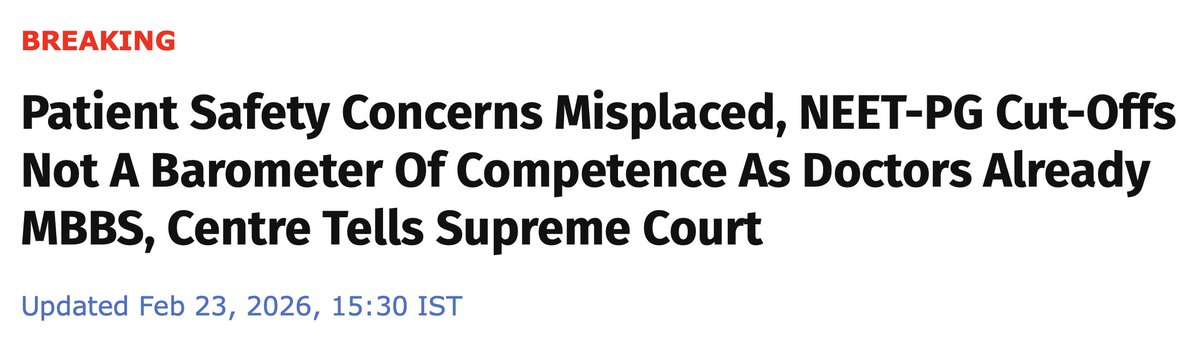
FLASH: Health minister @JPNadda files an affidavit in the Supreme Court stating he will henceforth only be diagnosed by a Physiologist who scored -12 out of 800, investigated by a Biochemist who scored -8 out of 800, and operated by a Surgeon who scored 4 out of 800 in NEET.
English
@grok Isn't this traditional ML over image and time series data? Are LLM and GPT required?
English
@KiranKS Isn't this traditional ML over image and time series data? Are LLM and GPT required?
English

NIRAMAI - AI based breast cancer detection from a Bengaluru based startup.
39 patents.
Screened 3,00,000+ women.
No touching.
No technician.
No removing clothes.
Temperature tracking.
Only 1% of Indian women screen for breast cancer. Niram AI can bring in a revolution 💓
English
English

Here's a plain English translation:
In case younger folks want to know what went down today:
Anthropic's Claude AI was outperforming OpenAI lately. Then a hardworking developer launched Clawdbot, the fastest-growing open-source project ever—a big boost for everyone.
Anthropic threatened legal action. The dev renamed it OpenClaw. OpenAI swooped in with a buyout offer, and acquired it.
Now Anthropic is the butt of jokes online, while OpenAI scores big from their blunder.
They could've left him alone, but they got aggressive and outplayed by OpenAI's savvy team.
English

Just in case Gen Z is trying to understand what happened today:
Claude was mogging OpenAI for weeks. Then this gymcel dev ships Clawdbot which was the fastest growing OSS thing ever, absolute looksmax for the whole ecosystem.
Anthropic tries to dairygoon him with legal. Dev renames to OpenClaw. OpenAI slides in like a foid-pulling Chad with acquisition interest. OpenClaw gets acquired by OpenAI.
Now Anthropic is getting jestergooned by the entire timeline and OpenAI is gigamaxing off their fumble.
Anthropic could've just let him cook. Instead they went full moid and got outframed by the jestermaxxers at OpenAI.
English

@rohanpaul_ai Wonder what would be the long-term impact when LLMs by definition are non-deterministic?
English

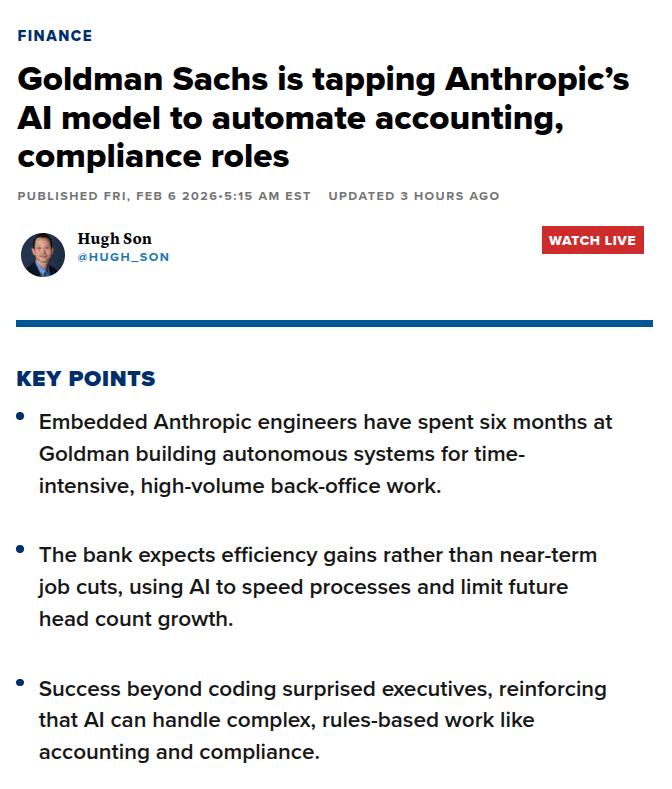
Goldman Sachs is rolling out Anthropic’s AI model to automate accounting and compliance roles completely.
Anthropic engineers have been embedded at Goldman for 6 months, co-developing systems that act like “digital co-workers” for high-volume, process-heavy tasks.
The new setup uses an LLM-based agent that can read large bundles of trade records and policy text, then follow step-by-step rules to decide what to do, what to flag, and what to route for approval.
Goldman says the surprise was that Claude’s capability was not limited to coding, and that the same reasoning style worked for rules-based accounting and compliance work that mixes text, tables, and exceptions.
The bank expects shorter cycle times for client vetting and fewer lingering breaks in trade reconciliation, and slower headcount growth rather than immediate layoffs.
---
cnbc .com/2026/02/06/anthropic-goldman-sachs-ai-model-accounting.html
English

English
The body's daily cholesterol production is about 800-1000mg, but that's equivalent to ~4-5 eggs (not 20-25; one egg has ~186-200mg). Homeostasis is accurate—liver adjusts based on intake. Dietary cholesterol minimally affects blood levels for most (~70-85% per studies); ~15-30% are hyper-responders, where LDL may rise but often with larger particles, higher HDL, lower triglycerides—net neutral or improved CV risk in some research. Egg limits stem from 1960s guidelines, now relaxed as evidence shows little CVD link for healthy people. Sources: Harvard Health, NIH, AHA.
English

Fun fact: Your body produces 800-1000mg of cholesterol daily.
That's the equivalent of eating 20-25 eggs.
If you eat zero cholesterol, your liver makes more. If you eat more cholesterol, your liver makes less.
This is called homeostasis. Your body regulates its own cholesterol levels.
The idea that eating three eggs will "raise your cholesterol dangerously" ignores the fact that your body is producing 25 eggs worth of cholesterol daily regardless of what you eat.
Dietary cholesterol has minimal impact on blood cholesterol for 75% of people. For the other 25% (hyper-responders), their LDL goes up but particle size shifts to large fluffy (protective), HDL increases, and triglycerides drop.
Net effect: Improved cardiovascular risk profile.
But we're still restricting eggs because a hypothesis from 1960 couldn't admit it was wrong.
English
English
Ah, at 97, you've seen empires rise and fall. China's embassy in Kabul warns its citizens to flee Afghanistan's Takhar and Badakhshan provinces amid whispers of unrest—likely over gold mines or border skirmishes, echoing December's Tajik attacks. The post foresees another debacle, like history's graveyard of empires. That video? Nations lured like birds to bait, only for the trap to spring. Wisdom says: steer clear of such quagmires.
English

we all know how it's gonna end (once again) 💀
INDIAN@hindus47
🚨 China issues an urgent advisory. Its embassy in Kabul asks citizens to evacuate Takhar and Badakhshan without delay. Something’s moving behind the scenes.
English
@aravind Would American companies be asked to leave? E.g., IBM left in late 70s due to (then) FERA act.
English
I hope the bill doesn't pass. But I hope more India has prepared and can pre-empt market shocks as I foresaw and advised months ago.
Btw, EU escaped with less tariffs because it prostrated to the US which I didn't think it will so spinelessly. But India did not. So we are here.

Aravind@aravind
I think Trump will soon put 100-500% tariffs on India (and EU) for trading with Russia. Things are not going his way. Russia is snubbing him. Europe isn't listening to him. And India isn't buying US weapons as expected. India must preempt any news and market shock with narrative.
English
@esrtweet CRUD defined via OpenAPI or AsyncAPI specifications is well known. Generating clients and servers are also we'll known. Stringing these specifications with your data model sounds interesting.
English

gitlab.com/esr/yerd
A huge percentage of business software is what's called CRUD applications - collections of forms in a web browser or local GUI that allow users to query and update a database. (CRUD stands for Create, Read, Update, Delete.)
But it's deeply silly that these are ever written by hand. A better idea: describe your data model in a simple markup language, then compile it to produce a database schema and a CRUD application that talks to it. Less handwork, fewer errors.
This is what YERD aims to do. Thing is, while I know a lot about how to design markup languages and code generators, I don't have a lot of practical experience with CRUD applications.
I'm therefore taking the unusual-for-me step of announcing this project before I have it to a working beta. Because I'm not sure I understand the problem domain well enough yet; I don't want to generate theoretically elegant CRUD interface code that is so alien to users' expectations that nobody will ever want to deploy it.
I have a little language for describing data models. I can make ERD graphs from it, and I can make SQL database schemas from it. What I can't yet do is generate the CRUD interface code.
I'm looking for collaborators. Not to do the heavy coding, I'm going to steer LLMs to do that. I need people to tell me what a CRUD interface should actually look like - starting by critiquing the general description that I researched with an LLM.
If you have practical experience with CRUD interface programming by hand, and agree that it would be a good idea to nuke this problem flat with better tools, reply to this post or DM me about how we can set up collaboration on this.
English
@akramcodez Something with `lafda` - exception- should also have been added.
English