@CodeWithOllie @robinebers @CPMou2022 If I remember correctly, it was about an old model, something like 4o or o3-mini. I remember very vividly rolling my eyes
English
Running Into Walls
1.9K posts



I’ve been critical of OpenAI lately, but for the past three weeks my family has been dealing with a health issue with my dad, and a ChatGPT shared project with live document syncing has been essential to organizing and understanding everything happening. Me, my four siblings, my mom, and my dad have faced an onslaught of information from various doctors and nurses, which we’ve captured in hundreds of text messages and documents and scans and you name it. ChatGPT has helped us collect this information in a single place, make sense of it, and interrogate it to make the most informed decisions possible. Also, credit where due: Claude played an important role as well, by ingesting iMessages and synthesizing summarizes from them to upload to ChatGPT, as well as by extracting text from a bunch of HEIC document scans. I think those of us, like me, excited at AI’s potential get frustrated when we can see issues so clearly, like ChatGPT’s bad design skills, and Claude’s increasing instability and confusing usage consumption. But at times like this I’m reminded of how incredible this technology already is, letting me and my family make sense and act on hundreds of pieces of information, empowering us in the face of a disjointed and fragmented healthcare system.


Not for me at least



Thank you to everyone who spent time sending us feedback and reports. We've investigated and we're sorry this has been a bad experience. Here's what we found:






Announcing Codex. A new product from OpenAI that moves beyond coding, into cooking. We were already cooking before, but now *you* can cook too ... with Codex. It is powered by the same technology as our other Codex products. You can just cook things.



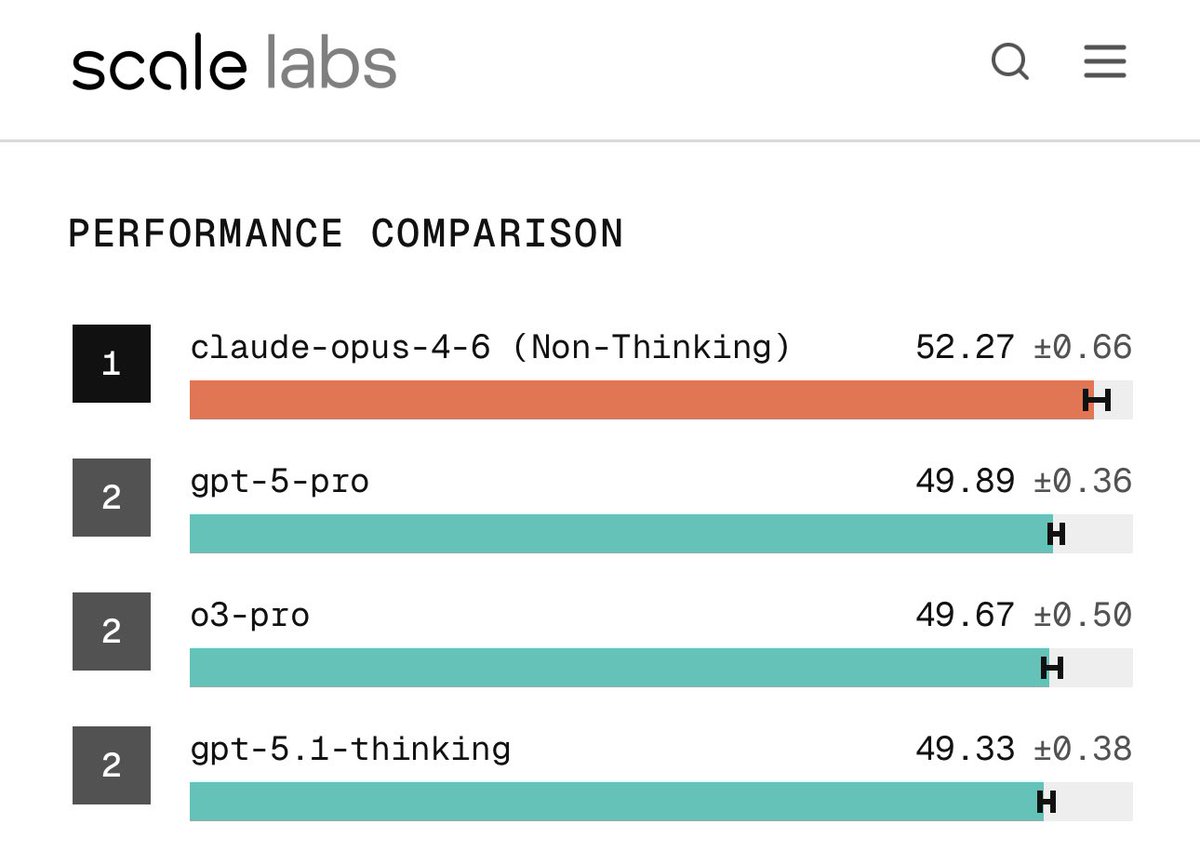
By popular request, GPT-5.4 Pro (Extended) has been added to prinzbench. It's the best model I've ever benchmarked (not surprising), beating GPT-5.4 (xhigh) by 10 points to achieve a new high score of 79/99 on my benchmark (somewhat surprising; I thought it would score even higher!)

One of the biggest misconceptions people have about intelligence is seeing it as some kind of unbounded scalar stat, like height. "Future AI will have 10,000 IQ", that sort of thing. Intelligence is a conversion ratio, with an optimality bound. Increasing intelligence is not so much like "making the tower taller", it's more like "making the ball rounder". At some point it's already pretty damn spherical and any improvement is marginal. Now of course smart humans aren't quite at the optimal bound yet on an individual level, and machines will have many advantages besides intelligence -- mostly the removal of biological bottlenecks: greater processing speed, unlimited working memory, unlimited memory with perfect recall... but these are mostly things humans can also access through externalized cognitive tools.

You don't truly understand the magnitude of the potential impact of powerful AI on the world unless you are aware, and have fully internalized, that senior leadership and most researchers at the frontier labs *actually believe* the following: 1. Existing AI is already significantly speeding up AI research. Very soon (this year), AI will very likely take over *ALL* aspects of AI research other than generation of novel research ideas. Soon (within the next 2 years), AI will very likely take over *ALL* aspects of AI research, period. This means hundreds of thousands of GPUs working 24/7 to discover novel ideas at the level of, or better than, the likes of Alec Radford, Ilya Sutskever, etc. The thread below presents a conservative timeline: AI researchers will "meaningfully contribute" to AI development in 1-3 years. 2. Many (but, as far as I can tell, not all) executives and researchers at the frontier labs believe that fully automated AI research will kick off recursive self-improvement (RSI), wherein the AI models will autonomously build better and better AI models, with human oversight (for safety reasons), but increasingly with no human input into the research or implementation of that research. From the thread below: "'[h]umans vs AI on intellectual work is likely to be like human runner vs a Porsche in a race', likely very soon" - but replace "intellectual work" generally with "AI research" specifically. RSI is a complicated and messy thing to consider, both because there will be compute and energy constrains and because there are unknowns (will there be diminishing returns from greater intelligence of the models? if so, when will these diminishing returns become meaningful? is there a ceiling to intelligence that we don't know about?). But suffice to say that, if RSI *is* achieved in a way that many leaders/researchers at the frontier labs believe is possible, *THE WORLD MAY BECOME COMPLETELY UNRECOGNIZABLE WITHIN JUST A FEW YEARS*. This is subject to various bottlenecks; as the thread below correctly notes, "[i]nstitutional, personal & regulatory bottlenecks will bind very hard", and much also depends on continuing progress in areas like robotics. 3. On ~the same timeline as full, end-to-end automation of *ALL* aspects of AI research (within the next 2 years), AI will also become capable of making significant novel scientific discoveries *IN OTHER FIELDS*. This is why Dario Amodei, Demis Hassabis et al. believe that it is possible that all diseases will be curable within 10 years. (One account of how this might be possible is set forth in "Machines of Loving Grace".) The point is that an LLM that is capable of significant novel insights in the field of AI research should likewise be capable of significant novel insights in at least some (and perhaps all) other fields. The thread below notes: "AI for automating science [is] very early" - obviously true, but I think some changes may be right on the horizon. Overall, and again from the thread below: "'a million scientists in a data center' will think much more quickly than humans, on almost any intellectual task; this will happen in the next 2-10 years." This is ~the same timeline as that presented in "Machines of Loving Grace". Many will be tempted to dismiss all this as "just hype", "they are just trying to raise money again", etc. But no! - the above, in fact, presents the *actual beliefs* of senior leadership and many researchers at the frontier labs. Again, they genuinely think that AI research will be automated soon. Many of them genuinely believe that RSI is achievable in the not-too-distant future. And they genuinely see a real path towards AI significantly accelerating science, curing diseases, inventing new materials, helping to solve key global issues from poverty to climate change, etc., etc. Whether the frontier labs' beliefs are correct is, of course, a separate question. I personally have historically tended to take public statements by OpenAI, Anthropic and Google at face value and quite seriously. As a result, I was not surprised when LLMs won gold in the IMO, IOI and the ICPC competitions last year, or when Claude Code/Codex started taking off, or when Anthropic and OpenAI started releasing significantly better models every 1-2 months, or when some of the best coders became reliant on Claude Code/Codex in their daily work, or when LLMs became significantly helpful to scientists in fields like math and physics in the last few months. The trajectory has been ~the same as that publicly predicted by the frontier labs. We have been accelerating. And, as of right now, all signs are indicating that the acceleration shall continue and that full automation of AI research and, potentially, RSI are firmly on the horizon.