Riley Drake

1.7K posts

Riley Drake banner
Riley Drake

Riley Drake

@RileyIsBuilding

Agentic engineer | building Agents For X | Signup on the waitlist below 👇

شامل ہوئے Ağustos 2024
97 فالونگ213 فالوورز
Riley Drake
Riley Drake@RileyIsBuilding·
@Appyg99 agentic commerce can still work as a concept with a human in the loop. this is where I see the space going. think of an agent that shops for tools for you in session and purchases on approval, the infrastructure for them to checkout autonomously will still be needed for this.
English
1
0
1
862
Apoorva Govind
Apoorva Govind@Appyg99·
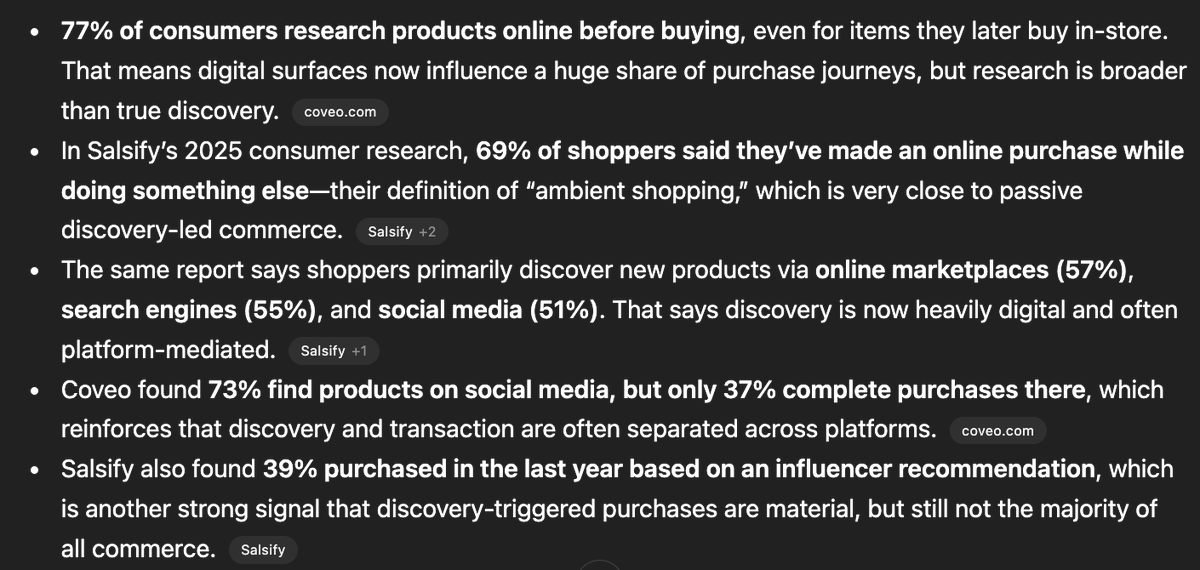
As someone that was a true believer of agentic commerce last year & ultra skeptic this year — The problem is this belief that humans want agents shopping for them. Other than a few efficiency obsessed nerds, most customers don't just hand off their wallet to some bot to buy stuff without being able to be a part of the decision irrespective of what the stated preferences are. Shopping is a conscious and important decision for 90% of households. A pleasurable hobby for many. Unless somehow you manage to change this human behavior (highly unlikely), agentic commerce needs to be restructured around discovery and less around payments and actual conversion.
Apoorva Govind tweet media
English
34
2
130
26.9K
Riley Drake
Riley Drake@RileyIsBuilding·
@camsoft2000 The real trap is agents optimize for 'it works' not 'it scales'. Each feature becomes technical debt because there's no architectural vision guiding the decisions.
English
1
0
6
690
camsoft2000
camsoft2000@camsoft2000·
I’m getting to the point with one of the projects I work on where the complexity of AI slop is becoming a real issue. While I can still happily prompt the agent to add x feature and it will do so and it will likely work perfectly, the code is just getting too complex and fragmented. Agents love to copy and paste and keeping patterns DRY is a real challenge. The agent will start diverging all those copy and pastes until you’ve got loads of similar but slightly different blocks of logic. Again it all still works and solves the problem I’m after. But I just can’t get any kind of consistency anymore, the code is a mess and I just don’t have a handle on it. I want a clean unified architecture but agents just code with tunnel vision. The project is now too big and complex for an agent to fully reason with and too big and complex for me to reason with. The only real solution is a complete rewrite. Maybe this is the way things will go. Code will just become disposable. I don’t really want to care about the code and to be honest I don’t but I do care about consistency and maintainability and the AI slop is hurting those very things I do care about. I know some will say “I’m holding it wrong”, use x,y,z skill, tool whatever and already use tools and anti slop skills, plans, docs, etc but the outcome is the same. Vibe coding something into existence is truly magical. But turning it into a mature product with months of iterations is painful. I can’t even hand code this thing because I don’t understand the code anymore and I’m too lazy to try and code myself because I’m addicted to AI. So what’s the solution, either start again and accept that’s just the way we have to roll, or just carry on fighting the slop and accept each new feature will take longer to implement than the last. I’m tired. I’m addicted.
English
139
32
522
63.8K
Riley Drake
Riley Drake@RileyIsBuilding·
@r0ck3t23 Oracle's declarative approach works for CRUD apps and reporting. But system level programming, performance optimization, and distributed systems still need humans who understand the underlying constraints.
English
3
1
51
4.6K
Dustin
Dustin@r0ck3t23·
Larry Ellison just told every software engineer on Earth their job description is dead. Not evolving. Dead. Ellison: “The code that Oracle is writing, Oracle isn’t writing. Our AI models are writing.” This is not a startup demo. This is one of the largest infrastructure monopolies on the planet telling you it already replaced the people who built it. For fifty years, building software meant translating human intent into machine instructions. Line by line. Bug by bug. Sprint by sprint. That entire layer is gone. Ellison: “We don’t write the procedure. We declare our intent.” That sentence just made the entire engineering labor market flinch. The procedure was the job. The procedure was the paycheck. The procedure was what made a developer valuable. And now the machine does it without being asked twice. Ellison: “We just tell the model what we want the program to do, and then the AI comes up with a step-by-step process to actually do it.” You are no longer paid to build. You are paid to think. And most organizations have no idea how to evaluate that. The companies still hiring armies of developers to grind through codebases are paying salaries the machine already made worthless. Not in years. In seconds. When a company worth hundreds of billions hands the keyboard to the machine and tells you the output is better, the debate is not winding down. The debate is over. The enterprise that wins this decade does not write the best code. It removes the human from the process entirely and runs on intent alone. The programmers who survive are the ones who realize the craft is no longer typing. It is architecture. It is judgment. It is knowing what to build and why. Everything else now belongs to the machine. And the machine does not negotiate severance.
English
406
433
1.5K
379.6K
Riley Drake
Riley Drake@RileyIsBuilding·
@APompliano The Fed's balance sheet expansion timing around elections shows this pattern repeatedly. QE announcements correlate with electoral cycles more than economic necessity.
English
0
0
7
598
Anthony Pompliano 🌪
Anthony Pompliano 🌪@APompliano·
I am starting to think the White House doesn't care what happens to the stock market in the first half of the year because they know they have tools to pump stocks higher into midterm elections in November. Not a comment on whether it is a good strategy. Just an observation.
English
316
76
1.8K
165.7K
Riley Drake
Riley Drake@RileyIsBuilding·
@leevalueroach Value works until credit markets freeze. 2008 taught us that balance sheet strength means nothing if nobody will lend to your customers or suppliers.
English
0
0
0
326
Lee Roach
Lee Roach@leevalueroach·
“The market is a machine that transfers money from the impatient to the patient.” Buffett said it decades ago. The S&P is down 12% this month. Your neighbor panic-sold last Tuesday. Boring companies. Ugly charts. Fat margins. Net cash on the balance sheet. While everyone chases AI darlings, I’m buying dollar bills for 60 cents. Deep value isn’t dead. It’s just unpopular. And that’s exactly the point.
English
10
4
82
8.5K
Riley Drake
Riley Drake@RileyIsBuilding·
@tszzl Wallace's lethal entertainment exists. It's just distributed across a billion phones instead of one cartridge.
English
0
0
3
237
roon
roon@tszzl·
i wish they would make the mythical mind rendingly entertaining movie from infinite jest. i wish they would make the perfect 10 second clip that has me laughing orgiastically for hours. and failing that, explore the space so thoroughly that we become convinced that it doesn’t exist. humanity is far too impressed with itself
English
53
20
528
98K
Riley Drake
Riley Drake@RileyIsBuilding·
@FinanceJack44 This works until it doesn't. Sears had a 3 P/E in 2007 before going to zero. The key is separating temporary sentiment from permanent business model destruction.
English
1
1
14
1.5K
Finance Jack
Finance Jack@FinanceJack44·
One of the simplest (not easy) ways to get multibaggers is buy elite companies at peak fear, where valuations become ridiculous. For example: - 2022 $META was trading at 9 P/E, up 7x since then - 2009 $MCO was trading at 9 P/E, up 27x since then You don't have to gamble on pre profitability small caps to win big, but you do have to have conviction to go against the crowd during bearish sentiment.
English
15
6
189
34.6K
Riley Drake
Riley Drake@RileyIsBuilding·
While everyone debates the SaaSpocalypse, the smart builders are implementing these three protocols to insulate themselves: • UCP/ACP - Direct agent access to inventory data • ATXP - Automated payment infrastructure • A2A - Agent communication standards Timing feels early because it is early. That's your advantage. Comment "protocol" for implementation guides.
English
0
0
0
79
Riley Drake
Riley Drake@RileyIsBuilding·
@bindureddy The measurement loop is the bottleneck. Most strategic outcomes resist quantification. How do you measure product vision or market timing? The recursive improvement only works if you can define success mathematically.
English
2
0
0
111
Bindu Reddy
Bindu Reddy@bindureddy·
NEXT FRONTIER- Recursive self improvement will make AI better than humans in most tasks Once you have a closed loop verification and measurement loop in place All you need is an AI agent that experiments, measure and improves the outcome you desire Eventually all strategic job roles will be automated this way
English
69
17
213
10.9K
Riley Drake
Riley Drake@RileyIsBuilding·
@kimmonismus This shows the tension between AI safety theater and actual harm reduction. Real safeguards require human oversight at scale, which kills the economics of these features.
English
0
0
2
498
Chubby♨️
Chubby♨️@kimmonismus·
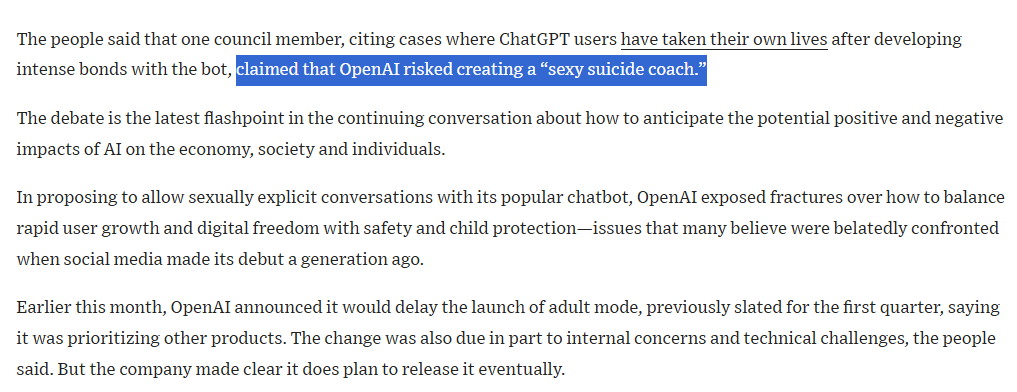
OpenAI’s proposed "adult mode" for ChatGPT has triggered intense internal backlash, with advisers warning of serious risks like emotional dependency, compulsive use, and even a “sexy suicide coach” scenario. Technical flaws, including a ~12% error rate in age verification, could expose millions of minors to explicit content, forcing a delayed launch despite growth and revenue incentives.
Chubby♨️ tweet media
The Wall Street Journal@WSJ

OpenAI’s X-rated "adult mode" is freaking out its own advisers on.wsj.com/4sJUGS5

English
109
45
551
84.2K
Riley Drake
Riley Drake@RileyIsBuilding·
@slow_developer This shifts from a yes/no question to a capability map. More useful for deployment decisions than philosophical debates about consciousness.
English
0
0
2
295
Haider.
Haider.@slow_developer·
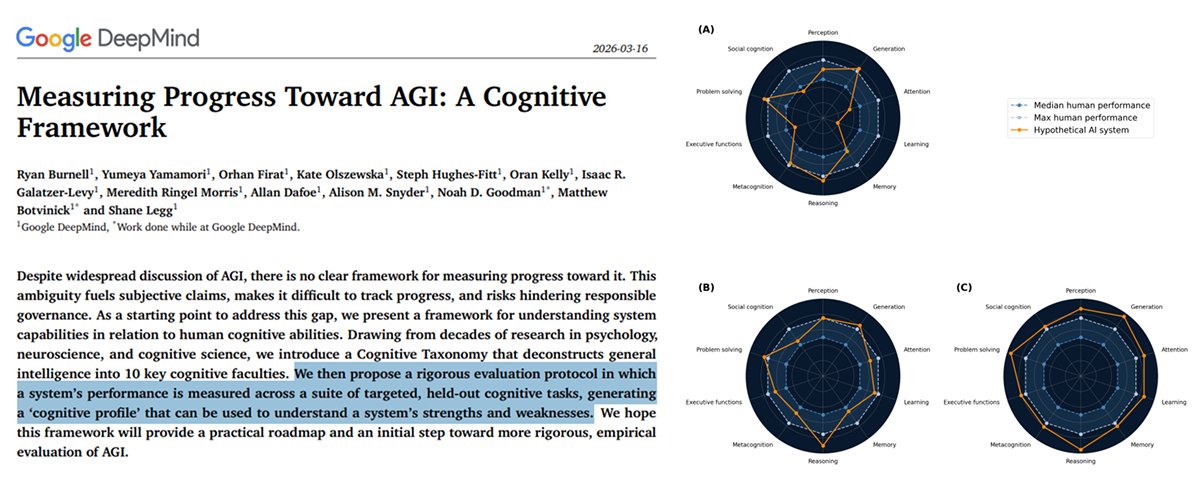
google's new approach to measuring progress toward AGI instead of asking, "is this AGI?" the paper proposes a cognitive framework that tests models on held-out tasks, compares them with human baselines, and builds a profile of where they match humans and where they still fall short.
Haider. tweet media
English
34
35
252
13.2K
Riley Drake
Riley Drake@RileyIsBuilding·
@basispointpod Market's pricing in AI replacement risk but missing AI amplification upside. These platforms become more sticky when they embed intelligence into existing workflows.
English
0
0
1
134
Basis Points
Basis Points@basispointpod·
Dan Ives on the recent software selloff: "I think it's the most disconnected trade I've seen in the past 30 years. These companies are only going to use AI to become stronger." $IGV $CRM $ADBE $NOW $INTU $SNOW $DDOG
English
7
8
108
29.1K
Riley Drake
Riley Drake@RileyIsBuilding·
@Ric_RTP The report also shows AI will create 69 million new jobs. Goldman's net projection is actually 7% productivity growth, not mass unemployment. The displacement narrative sells more clicks than the full picture.
English
3
0
28
2.4K
Ricardo
Ricardo@Ric_RTP·
Goldman Sachs just published the list of jobs AI will eliminate first. 300 million jobs globally. 25% of all US work hours. And that's not in 10 years, it's starting NOW. Highest risk of displacement according to Goldman: 1. Computer programmers 2. Accountants 3. Auditors 4. Legal assistants 5. Administrative assistants 6. Customer service reps 7. Telemarketers 8. Proofreaders 9. Copy editors 10. Credit analysts. 46% of all office and administrative tasks can be automated. 44% of legal work. 37% of architecture and engineering. 36% of science. 35% of business and finance. These aren't warehouse jobs. These aren't factory floor positions. These are the careers parents told their kids to pursue. "Go to college. Get a degree. Get a desk job. You'll be safe." Goldman Sachs just told you that desk is getting emptied. And the data is already showing up in real time: Tech employment as a share of the US economy has dropped below its long-term trend for the first time since records began. Marketing consulting, graphic design, office administration, and call centers are all seeing employment growth fall below trend. Younger workers are getting hit first and hardest. Goldman's lead economist said it directly: "The big story in 2026 in labor will be AI." But here's what the report doesn't mention: Goldman Sachs is one of the biggest investors in the companies BUILDING the AI that eliminates these jobs. They underwrote OpenAI's funding rounds. They're advising on the $700 billion in AI infrastructure spending this year. They profit from every merger, every capex deal, every stock offering tied to AI. The same bank telling you 300 million jobs are at risk is making billions helping the companies that will take them. And the corporate playbook is already locked in: Meta is firing 16,000 people. 20% of its entire workforce. While doubling AI spending to $135 billion. Stock went up 3% on the announcement. Block fired 40% of its staff. Stock surged 24%. Atlassian cut 10%. Same pattern. Over 61,000 AI-linked layoffs since November. 764 people per day losing their jobs in tech alone. Every single time a company announces mass layoffs and says "AI," the stock price goes up. Wall Street has created a system where firing humans is the most profitable announcement a CEO can make. Goldman's report says the jobs most PROTECTED from AI are air traffic controllers, chief executives, radiologists, pharmacists, and members of the clergy. Notice who's safe? The people at the top and the people praying. Everyone in the middle is exposed. The entry-level white-collar worker who spent four years and $200,000 on a degree is now competing against software that works 24/7, never takes vacation, never asks for a raise, and improves every single week. Goldman even admits younger workers in their 20s and 30s entering knowledge and content creation sectors will be "most affected." The generation that was told AI would make their lives better is the one getting displaced by it first. And it gets even WORSE: Goldman says if this displacement happens faster than their 10 year base case, the economic impact "could be much larger." Basically: if companies move fast, which they already are, the fallout will be worse than their projections. They're already moving fast. $700 billion in AI infrastructure this year. Mass layoffs at every major tech company. Stock prices rewarding every single one. The report is 50 pages of data telling you exactly what's coming. Most people won't read past the headline. But you just did.
English
155
375
934
220.4K
Riley Drake
Riley Drake@RileyIsBuilding·
@Codie_Sanchez @amasad The timing window for domain expert builders is narrow. As AI democratizes development, first mover advantage goes to those who understand the actual business problem.
English
0
0
0
314
Riley Drake
Riley Drake@RileyIsBuilding·
@martin_casado Most power users develop shortcuts and templates that compress complex workflows into minimal prompts. Efficiency beats volume.
English
0
0
1
26
martin_casado
martin_casado@martin_casado·
Total token use as a measure of AI literacy is wrong headed. In my experience, after some baseline, more token use is inversely correlated with competency using AI.
English
80
32
386
28.9K
Riley Drake
Riley Drake@RileyIsBuilding·
@GeoffreyHuntley Most teams will cling to familiar patterns until the performance gap becomes undeniable. The question is whether current AI tooling represents the bridge or the destination.
English
0
0
0
56
geoff
geoff@GeoffreyHuntley·
been pondering - with AI it’s like mobile. it’s a substantial substrate change. kinda like we are going through a “sencha touch” aka ext4.js moment in time where folks are trying to bridge old to new instead of rethinking everything.
English
15
3
52
4.1K
Riley Drake
Riley Drake@RileyIsBuilding·
Agents for X just got a niche builder. It pulls your post data, groups everything into topic clusters, and scores each one by engagement. You instantly see what your audience actually wants from you. Then it uses your niche profile as context every time it generates a draft. Waitlist link in bio!
English
0
0
3
133
Riley Drake
Riley Drake@RileyIsBuilding·
@jasonfried Custom software fails because clients can't articulate what they actually need until they see what they don't want. AI doesn't solve the requirements problem.
English
0
0
0
33
Jason Fried
Jason Fried@jasonfried·
A bespoke software revolution? I don't buy it. It'll exist. It already exists. Small consultants and big consulting firms have made custom software for years. It almost always sucks. It’s bloated, confusing, and because the client pays, it’s built wrong in all the ways. Who’s excited about bespoke software? Software makers! Of course they're excited about building bespoke software — that's what they do. X is full of them. Your feed is full of people who love making software talking about making software. Of course they’re excited about the revolution. Echo, echo, echo... Most people don’t like computers. Nobody in tech wants to say that out loud. People tolerate computers. They use them because they have to. Given the choice, most would rather not think about them at all. So when someone suggests that AI means everyone will build their own custom tools, ask who "everyone" is. The three-person accounting firm drowning in client paperwork? They want the paperwork gone, not a new system to maintain. The regional logistics company with 40 trucks? They want the routes optimized, not Joe spouting off about this new system he’s been messing around with. The law firm billing 70-hour weeks? They want leverage on their time, not a software project to design. They don’t hate technology. But building and maintaining their own critical systems isn’t their wheelhouse, regardless of how much faster and easier it’s become. It's another job on top of the job. Will these people use AI? Absolutely, for all sorts of things. Will some outliers go deep and build real custom systems? Sure, but they're almost always people who already had some pull toward software. The curiosity was already there. They were dabblers before. Giving everyone access to software building tools doesn't mean everyone becomes a builder. A powerful excavator doesn't turn a homeowner into a contractor. Most people just want the hole dug by someone else. They don’t want the responsibility either.
English
231
358
2.7K
336.6K
Riley Drake
Riley Drake@RileyIsBuilding·
People are wasting months building AI agents in Python and LangChain. Meanwhile, a single coding agent with the proper infrastructure can replace all of it. The problem is that most builders are operating at the wrong abstraction layer building hard coded agents. Instead, everything should be done through file trees in repos. Every AI agent maps to a simple folder structure: Workflows = folders → Tasks = subfolders → Each task has prompts, tools, and data When the frontier labs ship a new feature that "replaces" your agent you just collapse your repo and replace old instructions with a tool call or subtask. The folder structure is modular enough to handle model updates efficiently, hard coded agents are not.
English
0
0
0
60
Riley Drake
Riley Drake@RileyIsBuilding·
@Mr_Derivatives The divergence between GOOG and the others suggests sector rotation rather than broad market collapse. Big tech isn't moving as one unit anymore.
English
1
0
1
990
Heisenberg
Heisenberg@Mr_Derivatives·
$MSFT In a bear market. Trading below the 50 and 200dma. $AMZN In a bear market. Trading below the 50 and 200dma. $META In a bear market. Trading below the 50 and 200dma. $TSLA In a bear market. Trading below the 50 and 200dma. $NVDA Almost in a bear market. Trading below the 50 and 200dma. $AAPL Almost in a bear market. Trading below the 50 and almost the 200dma. $GOOG Almost in a bear market. Trading below the 50 but well above the 200dma. Haven't seen this kind of action in awhile for the Generals...
English
163
216
2.3K
278.2K