Soul Reaper ☀️

8.5K posts

Soul Reaper ☀️ banner
Soul Reaper ☀️

Soul Reaper ☀️

@Stuka68

|| A Milk 🐄 🥛 connoisseur of the Yamnaya stock || No posts check the replies section

মানভূম شامل ہوئے Ekim 2014
703 فالونگ233 فالوورز
Soul Reaper ☀️
Soul Reaper ☀️@Stuka68·
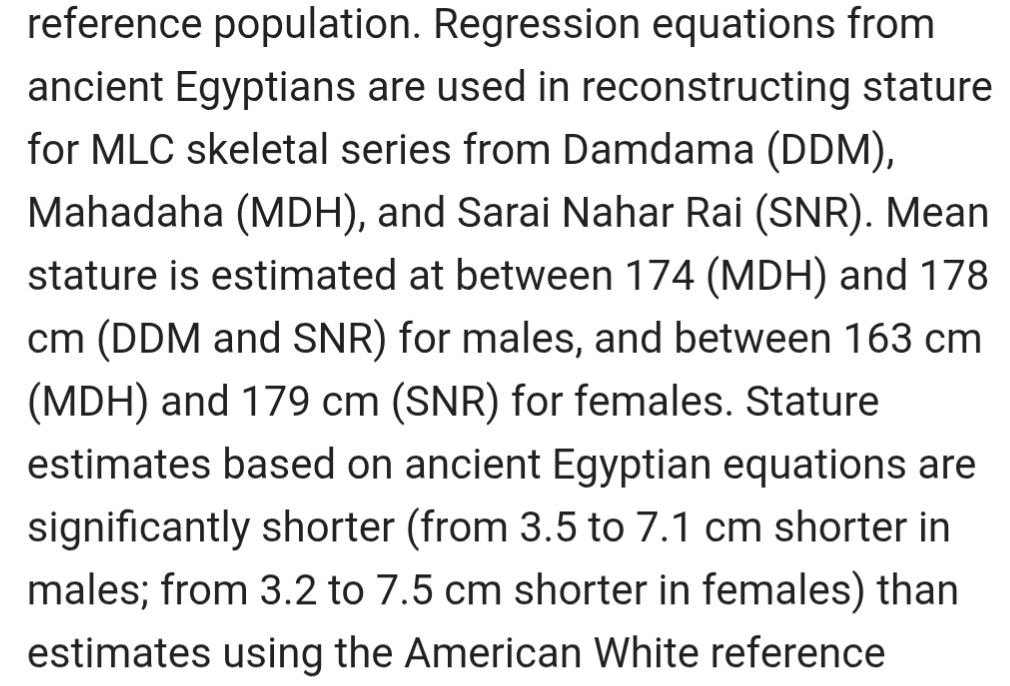
Northern AASI heights were significantly over estimated by the Trotter-Gleser method, which relied on a White American reference population without considering intralimb body proportions or geoclimatic factors. This paper by Lukacs (2014) instead applies regression formulae derived from ancient Egyptians. pubmed.ncbi.nlm.nih.gov/24374782/ Nonetheless, they still remain the tallest Mesolithic population.
Soul Reaper ☀️ tweet media
English
0
1
1
81
Soul Reaper ☀️ ری ٹویٹ کیا
দীপ বসু রায় চৌধুরী
People miss one critical point here. Many schools didn't even serve freshly cooked mid day meal. Kids used to turn up , collect raw materials, such as rice, dal, oil etc and then go back home. Massive black marketing and corruption on top of truancy. With Akshay Patra, atleast the meal is guaranteed. Corruption bypassed. (🤞) Fish and eggs can be supplied by state.
Indian Tintin@IndianTintin_

Before chimpout begins over Sattvik food and lack of Eggs, I should point out that: 1. Lacto-Vegetarian diet offers protein in the form of Yogurt and Paneer. 2. CM Suvendu Adhikari has launched Rs 5 Fish and Rice Meals at 400 state run canteens. 3. Nothing stops the government from offering an egg on its own dime.

English
3
3
25
517
Soul Reaper ☀️
Soul Reaper ☀️@Stuka68·
@aryamaanshakta @asinwo_tbc Ok I misunderstood, thought u meant both GHGs and AGHs fall under the AASI since OP has mentioned andamanese as Assi and gangetic assi as just ghg which was my point of contention
English
0
0
1
32
Quaser of Mewada
Quaser of Mewada@aryamaanshakta·
@Stuka68 @asinwo_tbc What i said to you and what you replied me back, were wholly divergent of what i meant and how you interpreted it, i never said that "the aasi=onge", I just said that aasi was just a broad label for all hunter gatherers of mainland south asia which also encompassing the Ghg
English
1
0
1
57
Soul Reaper ☀️
Soul Reaper ☀️@Stuka68·
@aryamaanshakta @asinwo_tbc No aasi refers to the deeply divergent lineage that is ancestral to mainland South Asians. Andaman HGs (Onges) are a separate sister group not AASI.
English
1
0
0
58
Soul Reaper ☀️ ری ٹویٹ کیا
Jayati
Jayati@Jayati_M93·
"Cow science" is only the tip of it. As Mukunth says, rigorous research on reclaiming Indian knowledge systems would have focused on "the linguistics of Panini, the Nyaya school of logic, the Kerala school of mathematics" etc. But the current government is more interested in +
Jayati tweet media
English
3
11
41
905
Soul Reaper ☀️ ری ٹویٹ کیا
Veera Rajagopal 
Veera Rajagopal @doctorveera·
Pakistan Genomic Resource (PGR), founded by Danish Saleheen, is the world's largest genetic database of human knockouts. It has been quietly building since 2017, from 10,000 individuals (Saleheen et al. Nature 2017) to nearly 200,000 today. A new paper in Nature by Koch et al. reports a new analysis of 173,303 Pakistanis from PGR, offering genetic insights from natural inbreeding experiments in humans. Koch et al. Nature 2026 nature.com/articles/s4158… In biology, to understand what a gene does, you delete it, a standard experiment. Knock out the gene in a mouse and see what breaks: organ fails, behaviour changes, animal dies. Thirty years of biology built this way. It works, until it doesn't. Because, you know, mice are not humans. To know the function of a gene in humans, you need a similar experiment. But that's unethical, you cannot deliberately delete a gene in a human. Except you don't have to, because nature has already been doing that experiment. Occasionally, a person inherits a broken copy of a gene from both parents and is born with no working version at all--a human knockout. The problem is finding them. In most of the world's populations, where mating is largely random, these events are nearly invisible. For a gene-inactivating variant at 0.1% frequency, you'd expect one homozygous individual in every million people. That math collapses in populations like Pakistan, where consanguineous marriage has been practised for centuries. In first-cousin marriages, the odds of observing a human knockout for the same 0.1% variant rise to roughly 1 in 16,000, a 63-fold enrichment. And the rarer the variant, the larger the advantage: ~630-fold for a 0.01% variant, ~6,300-fold for a 0.001% variant. The variants too rare to ever be seen in European biobanks become findable here. Sequencing more than 170,000 individuals from highly consanguineous communities, the authors report a mind blowing statistic: at least one living human knockout was observed for 6,476 genes, which is nearly 1/3rd of the entire protein-coding genome! What do we find when we finally have the human knockouts? Studying the phenotypes in the human knockouts helps us confirm or refute our understanding of the gene's function based on animal studies. A few examples I highlight below. PRDM9 PRDM9 might be one of the most popular genes among animal biologists. It encodes a protein that controls where chromosomes break and recombine during sperm and egg formation. Deleting the gene has caused infertility in every animal. PRDM9 was classified as the first hybrid sterility gene in vertebrates, so fundamental that crosses between mouse species with different PRDM9 alleles can't produce a fertile offspring. PGR now has 4 human PRDM9 knockouts : three women, one man. All fertile, with 2 to 7 children each. A 14-year biological fact, overturned by four families in Pakistan. LRRK2 LRRK2 is a well-established Parkinson's disease risk gene. Activating mutations in LRRK2 are among the most common risk factors for Parkinson's. LRRK2 is a therapeutic target with many companies exploring ways to switch off this gene in the brain to treat Parkinson's. Large-scale sequencing studies have found individuals with partial loss of LRRK2, who did not show any concerning health issues, predicting adverse effects of LRRK2 inhibition in humans. Animal knockouts though warned of kidney damage. Now PGR has two LRRK2 knockouts, both with kidney disease, confirming animal studies. RXFP1 RXFP1 encodes the receptor for a pregnancy hormone called relaxin, which has long been studied in rodents. Animal studies suggested it played a critical role in cardiovascular adaptation and connective tissue remodelling, fuelling relaxin-targeted drug development, which failed in late-stage trials. PGR found 16 RXFP1 knockouts, expanded to 26 via recall-by-genotype, all tested with cardiac imaging. None had consistent cardiovascular or reproductive deficits, retrospectively explaining the failure of relaxin-targeted drug programmes that might have spent millions of dollars. Mouse physiology failed to inform humans in the case of relaxin. Gene constraint insights Existing large-scale biobanks are predominantly European-based outbred populations, which shaped our understanding of gene constraints largely based on intolerance to partial loss of function. Now PGR, a South Asian-based cohort enriched for consanguineous communities, is beginning to offer insights into gene constraints based on intolerance to complete loss of function. PGR showed that nearly 1/3rd of human genes tolerate complete loss of function. As much as the genes for which knockouts were found, the genes for which knockouts weren't found can offer biological insights. The authors find genes depleted for knockouts in PGR are enriched for genes essential for cell survival, known Mendelian disease genes (both dominant and recessive) and genes broadly expressed across human tissues. A fascinating insight is significant enrichment for knockouts in tissue-specific genes (OR=2.39). Human knockouts confirm what drug developers have always thought: tissue-specific genes are much safer therapeutic targets than broadly expressed genes. The above insight should be read with caveats. The sample size of PGR is small, hence not saturated for human knockouts. It's likely the number of genes will increase as the sample size grows. There is a survivorship bias, like any other volunteer-based cohort. Absence of a gene knockout here doesn't mean biological impossibility. It means incompatibility with being a 'healthy' adult volunteer. If you build a cohort based on a hospital-based pediatric rare disease South Asian cohort, you'd expect to see knockouts that never appeared in PGR. South Asian populations represent nearly a quarter of humanity, yet they have been largely absent from the genomic revolution. PGR shows what absence has been costing the field: overturned biological assumptions, failed trials, missed targets. The biology was always there. We just weren't looking in the right place.
Veera Rajagopal  tweet mediaVeera Rajagopal  tweet media
English
33
238
1.1K
212.6K
Soul Reaper ☀️ ری ٹویٹ کیا
𖤓
𖤓@Vigraharaja·
𖤓 tweet media
ZXX
0
16
144
1.8K
Soul Reaper ☀️
Soul Reaper ☀️@Stuka68·
Special frontier force (SFF), Establishment 22. They were created as covert action special force against the chinese, comprising of Tibetan refugees and Gurkhas. IG continued to use them as her private army till she was deposed by Desai, Indira later brought them back from mere border policing and raised a new Elite battalion from within the unit, Vikas-4 (SG). These guys spearheaded the infiltration of Akal Takht on the night of Operation Blue Star.
English
0
0
1
29
Ātreya
Ātreya@ScionofAtreyas·
@updownups Oh didnt know that. King Mahendra died in 1972, which eould mean beef was before that, and Indira was assasinated in 1984. So it was kinda like a domino effect of things done 12 years ago even before Khalistan movement was a thing.
English
1
0
0
92