Max Tang

261 posts

Max Tang banner
Max Tang

Max Tang

@TangyMax

Cs at @cornell | Investing @Auros_global | prev @CUblockchain @panteracapital

شامل ہوئے Eylül 2022
1.7K فالونگ339 فالوورز
پن کیا گیا ٹویٹ
Max Tang
Max Tang@TangyMax·
Crazy how playing chess with @Tkachuk_science at @0xCastleRetreat led to a venture deal. During my time at @Arrington_Cap , I dived deep into @Titannet_dao and was impressed by their ability to lower the barrier of entry for DEPIN. Excited for what lies ahead!
Arrington Capital@Arrington_Cap

We are thrilled to be supporting @Titannet_dao as they roll out their universal DePIN service platform to enable interchangeable digital resources (ie compute, storage, bandwidth). Give them a follow and check out how to get involved in TestNet! 🙌

English
2
4
17
4.1K
Max Tang
Max Tang@TangyMax·
NYC is the crypto capital of the world. With the help of @hrishabhayush, we started curating dinners in NYC for friends and alumni of @CUBlockchain. The dinner last semester was a great success and I am glad my goat @hrishabhayush is carrying the torch this semester.
Hrishabh@hrishabhayush

It was a special experience hosting our 2nd Dinner @CUBlockchain Dinner in SoHo, NYC bringing together CBC students, alumni, and friends. We had 30 builders and professionals across crypto, fintech, and venture share what they’re working on and how Cornell and the industry shaped their journey. @CUBlockchain members, Cornell alum working at different companies like @AvaLabs, @GoldmanSachs, @thisisarculus and previously worked at @BlackRock, @base, @avax, @Ripple joined us alongside our friends at @WhiteStarCap, @BNYWealth, @IMCTrading, @Auros_global, @ellipsis_labs, @Uniswap. Huge thanks to everyone who made it out and for supporting the Cornell Blockchain community. ​ If you’re a Cornell alum or friend in NYC who wants to stay in the loop for future CBC events, DM me!!!

English
3
0
14
485
Max Tang
Max Tang@TangyMax·
If you are looking to hire hungry young talent, find a co-founder, invest in early stage startups or find a job, feel free to DM @hrishabhayush and I. We are curating a unique digital asset experience for anyone looking to invest or build in NYC.
English
0
0
1
41
Max Tang ری ٹویٹ کیا
Cornell Blockchain
Cornell Blockchain@CUBlockchain·
We are proud to welcome Jed Finn, Head of @MorganStanley Wealth Management, as a Keynote at the AI & Blockchain Redefining Markets conference on April 24th in NYC at Cornell Tech. Morgan Stanley finished 2025 with $9.3 trillion in assets ($7.4 trillion in Wealth Management), and recently observed in a published note: "Digital assets have moved from niche to mainstream, briefly surpassing $4T in market value. Crypto, stablecoins and tokenized products are now embedded in global markets, offering faster settlement, lower costs and programmable financial infrastructure. Institutions, wealth platforms and regulators across major economies are rapidly integrating and formalizing the space." Embracing innovation at scale is one of the central--and most complex-- opportunities in front of global executives today, and we look forward to hearing his insights into growth and managing change. Early bird tickets are available now: luma.com/aiblockchainnyc Join us April 24th! lnkd.in/eGt3JbqA. The 2026 Conference is co-hosted by: @CUBlockchain , Blockchain @ Cornell Tech, @BlockchainBldrs, and AI @ Cornell Tech.
Cornell Blockchain tweet media
English
0
3
12
282
Max Tang ری ٹویٹ کیا
Stani.eth
Stani.eth@StaniKulechov·
Private credit is in a strange place today. The economy is tied to the cost of money. Low interest rates mean cheap borrowing, which in theory should lead to higher utilization of credit facilities. Conversely, high interest rates mean less affordable borrowing and, in theory, reduced demand for credit. We've been living through a high-interest-rate environment since the Federal Reserve began its aggressive tightening cycle in March 2022, raising rates from near zero to over 5% by mid-2023, the fastest hiking cycle in four decades. Rates have remained elevated through early 2026, with only modest cuts. For many consumers and businesses that initiated borrowing during the low- or mid-rate era, and whose obligations remain outstanding, this translates into a significantly higher cost of capital, a burden that compounds over time. This all sounds normal. Finance is part of almost every phase of a company's lifecycle, from growth to maturity. The problem arises when the cost of capital stays elevated for too long, creating unmanageable expenses for borrowers. Businesses typically borrow from financial institutions like banks, or from asset managers in the form of private credit. How do private credit funds work? Private credit funds are typically either closed-end or semi-liquid vehicles managed by asset managers. This structure makes sense: the funds need to deploy capital into lending opportunities to generate returns. Investors in private credit range from pension funds, insurance companies, and family offices to, increasingly, retail investors. Closed-end funds don't allow redemptions until maturity, usually 7 to 10 years. Semi-liquid funds offer quarterly redemption windows with limits. BDCs (Business Development Companies), which are publicly traded, provide liquidity via daily trading on exchanges. In essence, private credit funds function as private banks: they lend capital to businesses and collect interest. What does private credit fund? Typically, private credit finances leveraged buyouts for private equity, middle-market corporate loans for companies that lack access to public bond markets, certain asset-backed lending (such as aircraft, shipping, and consumer loans), and real estate credit. Private credit funds generally fill the funding gap that banks have vacated. This shift has been driven primarily by post-2008 regulation, particularly Basel III, which pushed banks out of riskier corporate lending. Today, private credit finances an estimated 80 to 90% of leveraged buyouts in the U.S. middle market. Who are the players? Apollo ~$460B AUM Blackstone ~$330B AUM Ares ~$280B AUM KKR ~$220B AUM Carlyle ~$190B AUM Blue Owl ~$170B AUM What's going on? Recently, distress has emerged across private credit. The persistent cost of capital driven by high interest rates remains a reality, and AI is reshaping perceptions of many software companies that private credit has funded, creating uncertainty about these borrowers' futures. The market has already begun repricing private credit: VanEck BDC Income ETF: ~15% decline over the past year Blue Owl Capital: ~50% decline over the past year, with ~30% of that during 2026 Apollo, Blackstone, Ares, KKR: shares down ~20% on private credit concerns The average BDC now trades at roughly a 20% discount to NAV while offering 10 to 11% yields, signaling that loan portfolios may be overvalued, defaults could rise, or liquidity risk is building. What makes this even more concerning is that historically, these funds traded at a premium. Some funds' monitored loan default metrics have risen to as high as 9%. Blackstone's flagship private credit fund, BCRED, is a notable example. BCRED recently limited its redemptions. The fund manages roughly $82B, and during Q1 2026, redemption requests reached $3.7B, approximately 8% of NAV. Blackstone injected $400M of its own capital to support liquidity. Technically, the fund was not gated, but it came very close. Meanwhile, BlackRock's HPS Corporate Lending Fund (HLEND), a $26B fund, received $1.2B in redemption requests, reaching the point where gating was necessary. Roughly $580M in requests could not be honored. Blue Owl's retail private credit vehicle experienced $2.9B in redemptions during Q4 2025, with redemption requests reaching 15% of NAV, largely driven by exposure to software lending. Can the market handle a private credit fund default? While total redemptions have been around $7B+ (5 to 10% of NAV) and public alternative managers are down 20 to 30%, the overall private credit market is still $1.8 to 2T in size. Even the largest funds top out at $20 to 80B, compared to the global bond market at $130T or banking assets at $180T. A single fund default would most likely not collapse the broader market or trigger the kind of contagion that amplifies crises. Large funds also hold diversified portfolios of hundreds of loans, and the semi-liquid or closed-end structure naturally forces investor lock-up, acting as a buffer against bank-run dynamics. I've mapped out three scenarios of increasing severity: Scenario A: One large fund defaults (~$50B)Investors lose capital, some companies lose financing, and credit spreads widen. The system likely absorbs the shock. Scenario B: Several funds fail simultaneouslyCredit markets freeze, leveraged companies cannot refinance, and defaults cascade. This could trigger a credit-cycle downturn. Scenario C: Private credit + leveraged loans collapseA broader corporate credit crisis unfolds: private equity deals fail and banks become exposed. This would be genuinely systemic. Fortunately, private credit funds remain relatively small in the broader picture and are unlikely on their own to pose systemic risk. However, the most worrisome scenario is one where loss of confidence begins in private credit markets, particularly around lending to businesses vulnerable to AI disruption, and then bleeds into public bond markets. This contagion path is plausible because the larger corporates in bond markets are arguably more exposed to automation and AI disruption than the leaner, high-growth businesses that private credit typically funds. How does this affect RWAs and DeFi? The most immediate impact of private credit distress falls on capital allocators. Many private credit funds have been distributed to retail investors via publicly traded BDCs, private credit ETFs, or semi-liquid funds like Blackstone's BCRED, Apollo's Debt Solutions BDC, and BlackRock's HPS Corporate Lending Fund. These funds share common characteristics: quarterly (or monthly) redemption windows, redemption limits typically capped at 5% of NAV per quarter, and target returns of 8 to 11%. Recently, some funds have also begun gating redemptions. From a DeFi capital allocator's perspective, the biggest risk I see is structural: private credit is packaged in DeFi in ways that many retail-oriented users don't fully understand before committing capital. We've seen countless examples of DeFi users eagerly supplying funds into high-yielding RWA strategies, only to discover later that the underlying exposure carries significant duration risk. I believe RWAs represent the biggest opportunity for DeFi in the near term. However, my greatest fear is that institutional opportunists could view DeFi as a channel to offload illiquid and distressed products that Wall Street has already soured on, effectively using DeFi participants as exit liquidity. This risk is amplified by the fact that assessing RWA allocation opportunities is inherently harder: they don't carry the same transparency or onchain verifiability that native DeFi opportunities provide. That said, private credit done well onchain offers something traditional finance fundamentally cannot: smart contract-enforced guarantees. Redemption windows, withdrawal limits, collateral ratios, and distribution rules can be encoded immutably, meaning fund managers cannot arbitrarily change the terms after capital has been committed. In traditional private credit, investors discovered the hard way with BCRED and HLEND that redemption policies can be tightened or gated at the discretion of the manager when conditions deteriorate. Onchain, those rules are transparent from day one and enforced by code, not by a fund administrator under pressure. This is precisely where RWAs and DeFi can outperform the traditional model for this asset category. For RWAs to succeed in DeFi, and for DeFi to scale meaningfully through real-world assets, the industry needs deliberate and careful structuring of opportunities that bridge TradFi and onchain markets. That means robust transparency standards, proper risk disclosure, independent verification of underlying collateral, and governance frameworks that protect onchain participants from asymmetric information disadvantages. Without these safeguards, the convergence of TradFi and DeFi risks becoming extractive rather than additive. DeFi should not become Wall Street's exit liquidity.
English
127
74
708
124.9K
Max Tang ری ٹویٹ کیا
flip
flip@trevor_flipper·
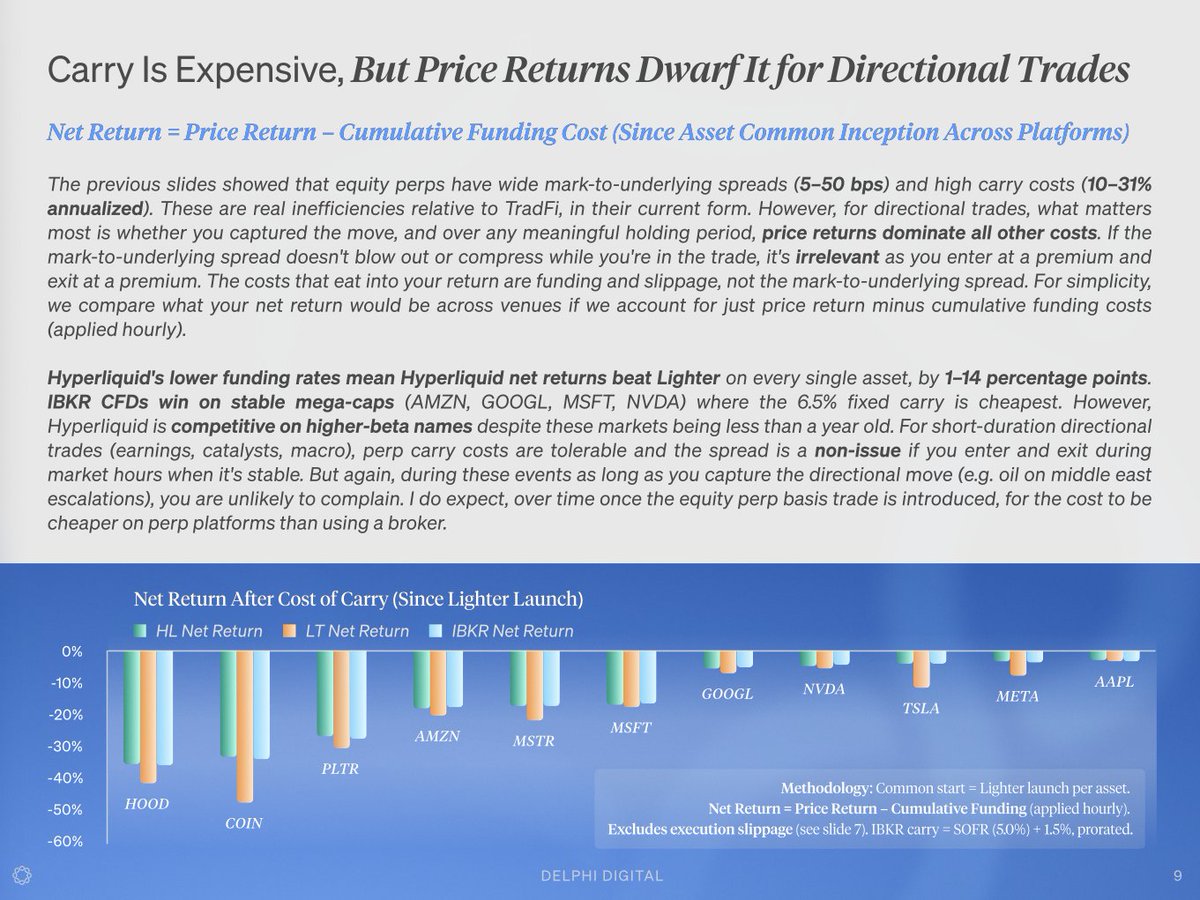
Equity perps continue to get a bad wrap by most people and the common critique is that funding is expensive, order book depth is bad, and the mark-to-underlying can be incredibly volatile at times. And I would have to say that all of these are largely true today. Equity perp funding runs 11-31% annualized while IBKR CFDs cost 6.5%. @HyperliquidX & @Lighter_xyz order books are 10-100x thinner. So yeah, if you froze markets today and assume no innovation, the picture is pretty dire but I think if this is the future you subscribe to you forget about what just happened last year with the crypto perp basis trade. The other hidden cost people fixate on is the mark-to-underlying spread. Initially I thought this was an incredibly high hidden cost but after digging into it more I don't think it really matters all that much. It is more akin to a closed-end fund premium, similar to what ETHE was for a period of time. For traders, assuming you enter and exit at a similar spread, it isn't a cost. It is just something to be mindful of, especially if you tend to be an emotional person who just apes. And despite all of this - the high funding, the thin books, the spread noise - for directional traders none of it really matters if you capture the move. So what will close these gaps and inefficiencies? I think it is quite obvious that it will be the same thing that closed the gap and inefficiencies for crypto perps, which was the basis trade. Before BTC spot launched on Hyperliquid, BTC funding averaged ~18% annualized, and within months it compressed to ~9%. ETH followed the same arc. Nearly 50% reduction in carry cost driven by one change that allowed arbitrageurs to collect interest rate-agnostic yield by going long spot and short the perp. This flow deepened the order book, anchored the price to the actual underlying assets, and compressed funding. Equity perps today look like crypto perps in 2024. Everyone had the same critiques that funding was too expensive, books too thin, and too much basis risk. And for funds this really did matter and kept many from using these product. And then spot launched and all these inefficiencies were quickly fixed. The same is likely to happen with equity perps. We have the NYSE moving towards 24/7 trading, which will help. We have US regulatory clarity coming this year, which will help. And we even now have the CFTC chief explicitly talking about clearing a path for U.S. perps.
flip tweet mediaflip tweet mediaflip tweet mediaflip tweet media
English
18
12
159
33.9K
Jay Yu 🐟
Jay Yu 🐟@0xfishylosopher·
My colleagues @cosmo_jiang and @SPLehman wrote a great piece here discussing OpenClaw and the role of blockchains for agentic commerce. Adding a few thoughts, as an OpenClaw user: - Whether its McKinsey or Stripe's framework, its become consensus that there are numerous "levels" to agentic commerce, just as there was to autonomous driving, and we're still early to the game. - In my mind, the agentic commerce progression will be along 3 distinct axes: (1) From URLs embeds to full automated checkout loop with agent SEO (ChatGPT x Shopify) (2) From micropayments (eg. for inference and API queries) to macropayments (Amazon/DoorDash/Expedia) (3) From agent-to-SaaS APIs (one sided marketplaces) to agent-to-agent payments (two sided marketplaces) - For these progressions to happen though, we need to solve three problems: identity, liquidity, and verification. - OpenClaw's various extensions/integrations already shows early signs of all 3 aspects using blockchain primitives: identity/authorization via ERC8004 (search for "claw" on 8004scan), liquidity via credit vaults and stablecoins (various agentic wallets), verification and guardrails via TEEs/MPC/FHE/ZKVMs etc. These are the most areas for agentic commerce builders today. Will be posting more content on this soon.
Cosmo Jiang@cosmo_jiang

x.com/i/article/2028…

English
7
6
79
18.1K
Max Tang ری ٹویٹ کیا
Tenobrus
Tenobrus@tenobrus·
gigafucked: - grammarly - calendly - miro - retool - webflow - langchain - writer - harvey - glean - expedia - monday fucked: - accenture - intuit - notion - jasper - canva - alphasense - postman - airtable - talkdesk - sierra - zapier - replit - solace probably fucked: - cursor - pilot - clay - mercor naively seems fucked but so competent / plugged in they seem to be figuring it out on the fly anyway: - linear
English
582
397
8.8K
1.9M
Max Tang ری ٹویٹ کیا
Frank Chaparro
Frank Chaparro@fintechfrank·
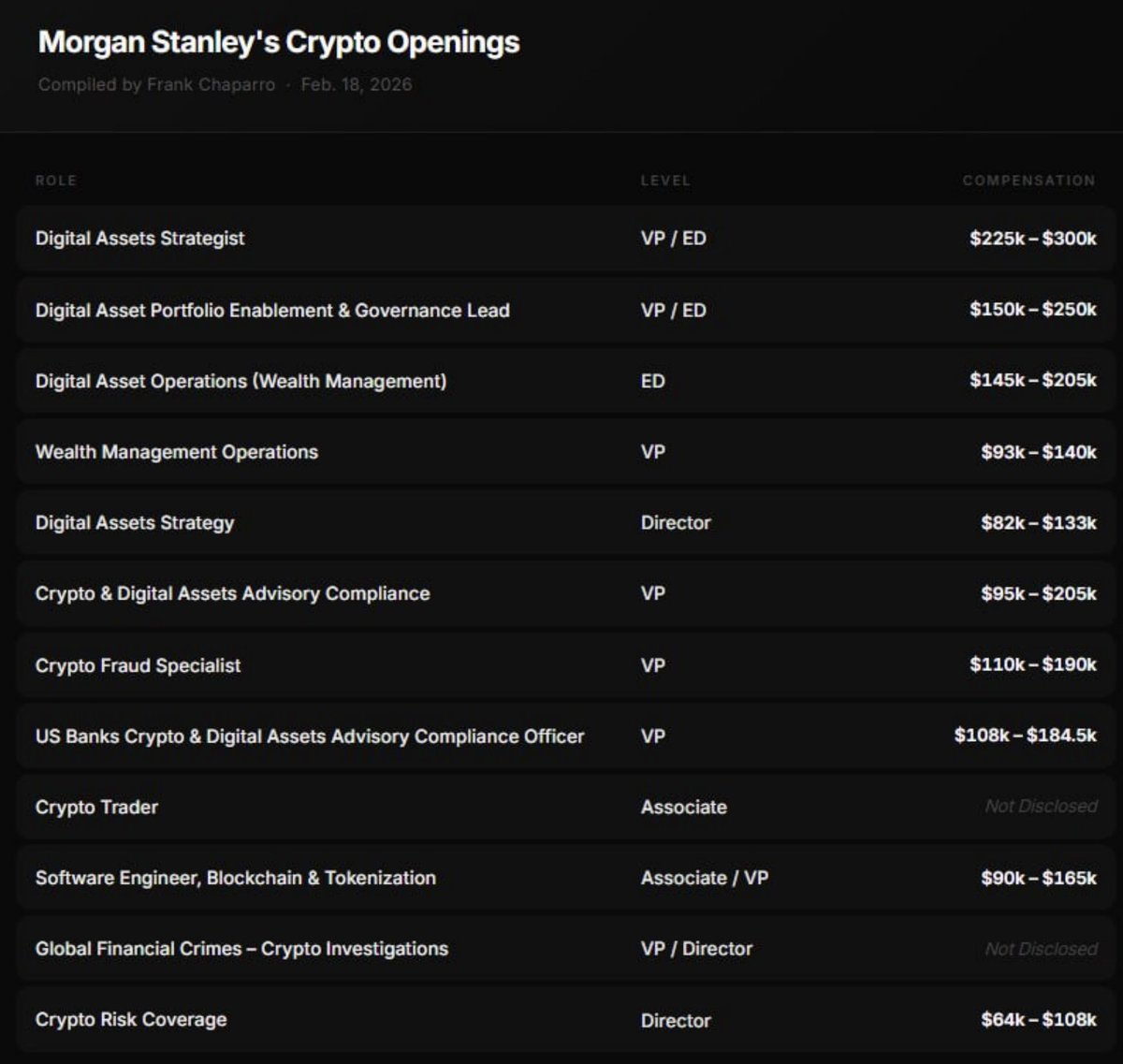
Morgan Stanley is hiring like crazy for crypto. I one-shotted a list of roles and comp with Claude.
Frank Chaparro tweet media
English
38
31
406
49.6K
Akash Student Ambassadors
Akash Student Ambassadors@AkashStudents·
Huge shoutout to our newest Cornell ambassadors, @carne_asado, @hrishabhayush, & @rachelt313 !! They're throwing campus events within days of being accepted to the program, setting the bar SO high!! 🙌
Cornell Blockchain@CUBlockchain

Attend our joint information session with @akashnet over boba!🧋 Hear from @AkashStudents about decentralized compute and from Cornell Blockchain members about the club. Register with this Luma link:

English
4
0
20
579
Max Tang
Max Tang@TangyMax·
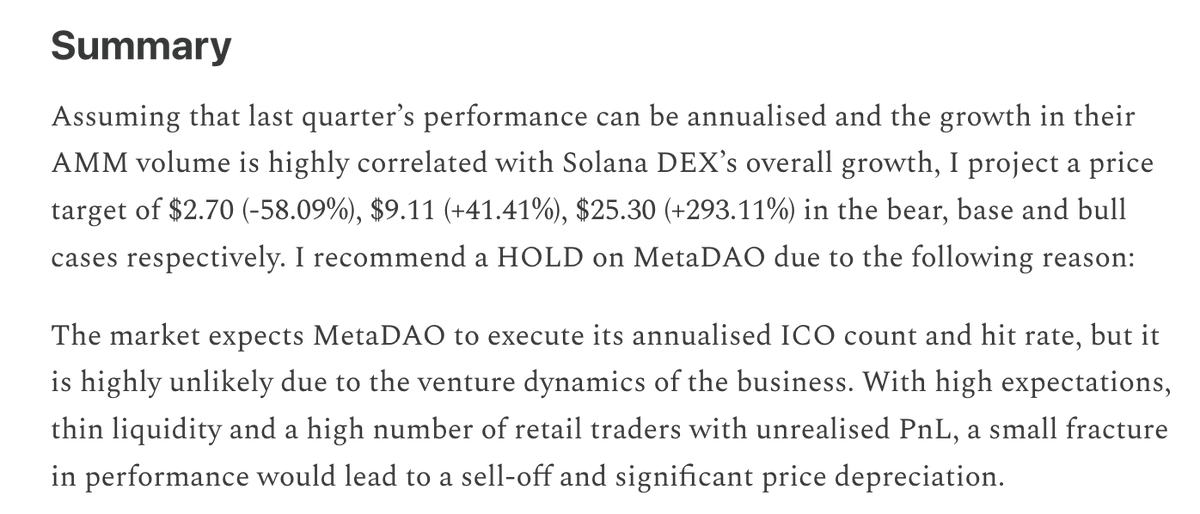
.@MetaDAOProject peaked at >10 in early Jan and is now at 4. Here's why I think that happened
Max Tang tweet media
English
1
0
0
38
Max Tang ری ٹویٹ کیا
Mippo 🟪
Mippo 🟪@MikeIppolito_·
My whole feed that was aping shitcoins 6 months ago are now long 3X uranium ETFs. Gold is a higher percentage of M2 than it was during the Great Depression. Top in gold, bottom in Bitcoin, book it.
English
7
7
198
8.1K
Max Tang ری ٹویٹ کیا
Tommy
Tommy@Shaughnessy119·
Microsoft down 12% and Gold down 5% demonstrates (early signs) of both the AI and metals trade slowing. This is bullish crypto at face value since the marginal dollar will stop chasing these and seek an alternative catchup trade. People don’t want to sell and sit in dollars
English
8
3
26
3K
Evan Solomon
Evan Solomon@Evanzsolomon·
Starting next week, I’ll be sourcing top talent for @PortalVentures portfolio companies. If you’d like to be considered, join our private talent network below. Your information will never be shared publicly. Feel free to DM me with any questions 👇
Evan Solomon tweet media
English
17
9
186
14.4K
Max Tang
Max Tang@TangyMax·
With @MetaDAOProject 's revenue pipeline heavily reliant on frequent quality ICO launches, outsourcing deal sourcing might be the way to go.
Theo@nonstopTheo

Idea to make blank cheque/SPACs a thing on @MetaDAOProject : Include a clause the vehicle liquidates the treasury automatically after 3 unsuccessful proposals Logic: If the team cannot source suitable investments within 3 attempts, they disqualify. Gives investors a clear, reliable path to get money back and also has a natural, built-in mechanism to trade back at NAV

English
1
0
1
152
Max Tang
Max Tang@TangyMax·
Still figuring out how this affects crypto/ BTC but my intuition is sucking liquidity out of the system is never a good thing for BTC as it relies on debasement traders going further out on the risk curve. GOATED blog: substack.com/inbox/post/181…
English
0
0
0
19
Max Tang
Max Tang@TangyMax·
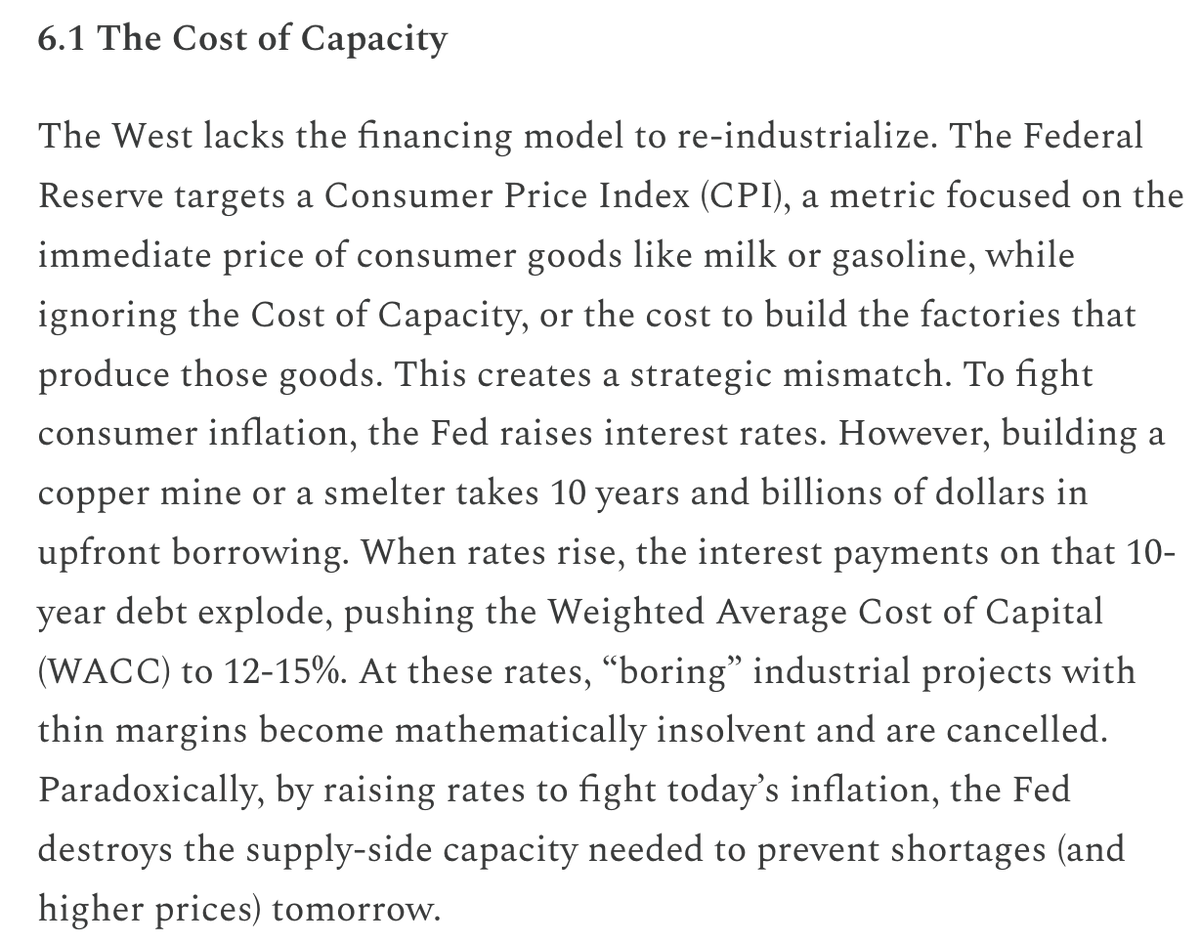
Efficient capital markets is a blessing but also a curse. Trump will try to onshore mid-processing for rare earth materials but it is very capital + human labor intensive. It is possible that such effort sucks up a lot of capital through strategic financing/ attractive returns.
Max Tang tweet media
English
1
0
0
32