helena tan

1.1K posts

helena tan

helena tan

@_HelenaT

AI Agents Product Lead @Box, previous: @nianticlabs, @Uber Maps + Uber AI

San Francisco شامل ہوئے Ekim 2010
337 فالونگ340 فالوورز
helena tan ری ٹویٹ کیا
Aaron Levie
Aaron Levie@levie·
The more enterprises I talk to about AI agent transformation, the more it’s clear that there is going to be a new type of role in most enterprises going forward. The job is to be the agent deployer and manager in teams. Here’s the rough JD: This person will need to figure out what are the highest leverage set of workflows on a team are (either existing or new ones) where agents can actually drive significantly more value for the team and company. In general, it’s going to be in areas where if you threw compute (in the form of agents) at a task you could either execute it 100X faster or do it 100X more times than before. Examples would be processing orders of magnitude more leads to hand them off to reps with extra customer signal, automating a contracting review and intake process, streamlining a client onboarding process to reduce as many straps as possible, setting up knowledge bases than the whole company taps into, and so on. This person’s job is to figure out what the future state workflow needs to look like to drive this new form of automation, and how to connect up the various existing or new systems in such a way that this can be fulfilled. The gnarly part of the work is mapping structured and unstructured data flows, figuring out the ideal workflow, getting the agent the context it needs to do the work properly, figuring out where the human interfaces with the agent and at what steps, manages evals and reviews after any major model or data change, and runs and manages the agents on an ongoing basis tracking KPIs, and so on. The person must be good at mapping the process and understanding where the value could be unlocked and be relatively technical, and has full autonomy to connect up business systems and drive automation. This means they’re comfortable with skills, MCP, CLIs, and so on, and the company believes it’s safe for them to do so. But also great operationally and at business. It may be an existing person repositioned, or a totally net new person in the company. There will likely need to be one or more of these people on every team, so it’s not a centralized role per se. It may rile up into IT or an AI team, or live in the function and just have checkpoints with a central function. This would also be a fantastic job for next gen hires who are leaning into AI, and are technical, to be able to go into. And for anyone concerned about engineers in the future, this will be an obvious area for these skills as well.
English
272
396
3.8K
1M
helena tan ری ٹویٹ کیا
Camus
Camus@newstart_2024·
Stop telling kids to “make eye contact” or “stand up straight.” Vanessa Van Edwards has three much smarter body language hacks that actually work: 1. Ask them to notice the other person’s eye color — it gives a real reason to look up and connect. 2. Hands first — always approach with your hand out so you clearly signal how you want to be greeted (handshake, high-five, fist bump, or wave). 3. Superhero cape — roll your shoulders back and maximize the space between your ear and shoulder. It instantly makes kids look more confident and credible. She uses these herself on Zoom, in photos, and in real life. Small changes. Big difference. What’s one tiny body language trick you wish someone had taught you earlier?
English
30
302
3.6K
392.9K
helena tan ری ٹویٹ کیا
Aaron Levie
Aaron Levie@levie·
The ultimate rate limiter on productivity gains from agents will be on critical stuff like security, compliance, governance, the ability to review the work of the agent, ensure that it’s compatible with regulations, and so on. We’ve been living in a little bit of la-la land around how much software enterprises are going to ultimately want to vibe code themselves. The last 48 hours represents a good example of why you won’t take on every risk of every piece of technology in your enterprise. There’s no free lunch with AI productivity. Companies will have the build up the systems, processes, and controls for ensuring that agents can’t run around and do anything they want on any data at any time.
sarah guo@saranormous

x.com/i/article/2039…

English
70
53
383
110.4K
helena tan ری ٹویٹ کیا
Zack Shapiro
Zack Shapiro@zackbshapiro·
New Article, possibly my last for a while. I've spent two years figuring out how to make a two-person law firm compete with teams twenty times its size using AI. This is the closest I'll come to explaining how. Also explains why I can type “plz fix” and get back work product that reads like I spent three hours on it, when really I spent three hundred hours building the system that did.
Zack Shapiro@zackbshapiro

x.com/i/article/2035…

English
37
54
669
191.4K
Nik Shevchenko
Nik Shevchenko@kodjima33·
Someone should start a “no dating until series-B” clothing brand and grow it in NYC NYC needs more SF culture
Nik Shevchenko tweet media
English
175
6
247
482.9K
helena tan ری ٹویٹ کیا
Aakash Gupta
Aakash Gupta@aakashgupta·
Evals are the new PRD. The companies building AI products that actually work are running 12.8 eval experiments per day. Here is the playbook with @ankrgyl, Founder and CEO of @braintrust ($800M valuation, behind Vercel, Replit, Ramp, Zapier, Notion, Airtable): ⏱ 1:43 Why vibe checks stop scaling ⏱ 6:35 Evals are the new PRD ⏱ 8:45 The Claude Code evals controversy ⏱ 18:48 Building an eval live from zero ⏱ 29:51 Connecting Linear MCP and iterating ⏱ 39:12 Why you need evals that fail ⏱ 43:36 Offline vs online evals ⏱ 47:40 Three mistakes killing eval culture The core framework: every eval is exactly three things. A set of inputs your product needs to handle. A task that takes those inputs and generates outputs. A scoring function that produces a number between 0 and 1. We built one from scratch on camera. Score went from 0 to 0.75 in under 20 minutes.
English
15
60
578
481.1K
helena tan ری ٹویٹ کیا
cat
cat@_catwu·
The PM playbook was built on an assumption that the technology underneath your product is roughly stable With the current pace of model progress, this is no longer true. Here's how we've evolved the PM role:
English
71
190
2K
366.1K
helena tan ری ٹویٹ کیا
Anthropic
Anthropic@AnthropicAI·
We invited Claude users to share how they use AI, what they dream it could make possible, and what they fear it might do. Nearly 81,000 people responded in one week—the largest qualitative study of its kind. Read more: anthropic.com/features/81k-i…
English
817
998
6.8K
2.9M
conor brennan-burke
conor brennan-burke@contextconor·
@AnnieLiao_2000 maybe we should offer AI girlfriends as a perk to all employees to keep them not locked in and not dating until series B
English
1
0
4
385
Annie ❤️‍🔥
Annie ❤️‍🔥@AnnieLiao_2000·
calling it now: AI girlfriends will be normalized by 2027 not just for incels for everyone here's why i think this: current state: replika has 10M+ users character. ai has millions chatting with AI people already forming attachments my friend uses AI: - vents to it daily - gets emotional support - prefers it to real therapy - "doesn't judge me" been doing this for 8 months the progression: 2023: "AI companions are weird" 2024: "some people use them, whatever" 2025: "my friend uses one, seems happy" 2026: "tried it once, actually helpful" 2027: "yeah i have an AI companion" same path as: - online dating (weird → normal) - therapy (weird → normal) - remote work (weird → normal) the use case: not replacing real relationships supplementing them example: person in relationship still uses AI for: - venting about work (partner tired of hearing it) - late night anxiety (partner sleeping) - processing emotions (partner not good at this) AI doesn't replace partner fills gaps partner can't/won't fill the uncomfortable part: this is probably healthy better than: - bottling emotions - trauma-dumping on friends - expecting partner to be everything AI companion as emotional buffer the market: lonely people: obvious market coupled people: hidden market (bigger) everyone has emotional needs partners can't fully meet AI fills gap without judgment, availability issues, or fatigue the objections: "but it's not real connection" neither is therapy, still helps "people will become more isolated" or: people will have better real relationships because AI handles overflow "it's dystopian" so is doom-scrolling, we adapted my prediction: by 2027: - 30% of people have AI companion - 10% admit it publicly - companies offer it as mental health benefit - relationships improve because people stop expecting partners to be therapists the test: if i'm wrong: i'll look dumb if i'm right: i'll look prescient either way: the trend is clear AI companions are growing stigma is decreasing adoption is accelerating whether you think it's good or bad: it's happening prepare accordingly
English
20
3
44
3.7K
helena tan ری ٹویٹ کیا
CG
CG@cgtwts·
> be niantic > launch Pokemon go > 500M players scan real-world places while playing > scans turn into 30B geo-tagged images > niantic builds a 3D map of the world > robots and AR apps use it to navigate within centimeters without GPS this is actually insane.
NewsForce@Newsforce

POKÉMON GO PLAYERS TRAINED 30 BILLION IMAGE AI MAP Niantic says photos and scans collected through Pokémon Go and its AR apps have produced a massive dataset of more than 30 billion real-world images. The company is now using that data to power visual navigation for delivery robots, letting them identify exact locations on city streets without relying on GPS. Source: NewsForce

English
280
2.8K
49.6K
4.6M
helena tan ری ٹویٹ کیا
a16z
a16z@a16z·
Agents will eventually outnumber humans by orders of magnitude. Aaron Levie on the infrastructure that will be needed to manage them: "Whether you think the number is 10x or 100x... we're going to have some order of magnitude more agents than people." "There's going to be just incredibly spectacularly crazy security incidents that will happen with agents, because you'll prompt-inject an agent and find your way through the CRM system and pull out data you shouldn't have access to." "How do you make sure you have the right security, the permissions, the access controls, the data governance?" "We actually don't yet exactly know in many cases how we're going to regulate some of these agents." "No matter what, there's going to need to be a layer that manages the data they have access to and the workflows they're involved in." "This is the new infrastructure opportunity in the era of agents." @levie on @latentspacepod
English
50
70
309
64.2K
helena tan ری ٹویٹ کیا
True Markets
True Markets@truemarketsco·
Introducing True Markets CLI The fastest way for AI agents to access crypto markets. Give your agent a strategy and watch it place trades, monitor your portfolio, and improve on your strategy in real time - all from the chat interface/terminal. Beta: truemarkets.co/cli
English
19
25
121
19.8K
helena tan ری ٹویٹ کیا
Reads with Ravi
Reads with Ravi@readswithravi·
I get blown away every time I read this paragraph by Carl Jung: To love someone else is easy, but to love what you are, the thing that is yourself, is just as if you were embracing a glowing red-hot iron: it burns into you and that is very painful. Therefore, to love somebody else in the first place is always an escape which we all hope for, and we all enjoy it when we are capable of it. But in the long run, it comes back on us. You cannot stay away from yourself forever, you have to return, have to come to that experiment, to know whether you really can love. That is the question-whether you can love yourself, and that will be the test.
English
59
1.3K
8.2K
320.9K
conor brennan-burke
conor brennan-burke@contextconor·
introducing agent-to-agent hiring at @hyperspell no resumes. no leetcode. you build an agent. our agent interviews yours if you can build a great agent to do the job, that's the proof you can do the job anyone can apply. we will interview every single agent
English
136
43
668
141.6K
helena tan ری ٹویٹ کیا
Lenny Rachitsky
Lenny Rachitsky@lennysan·
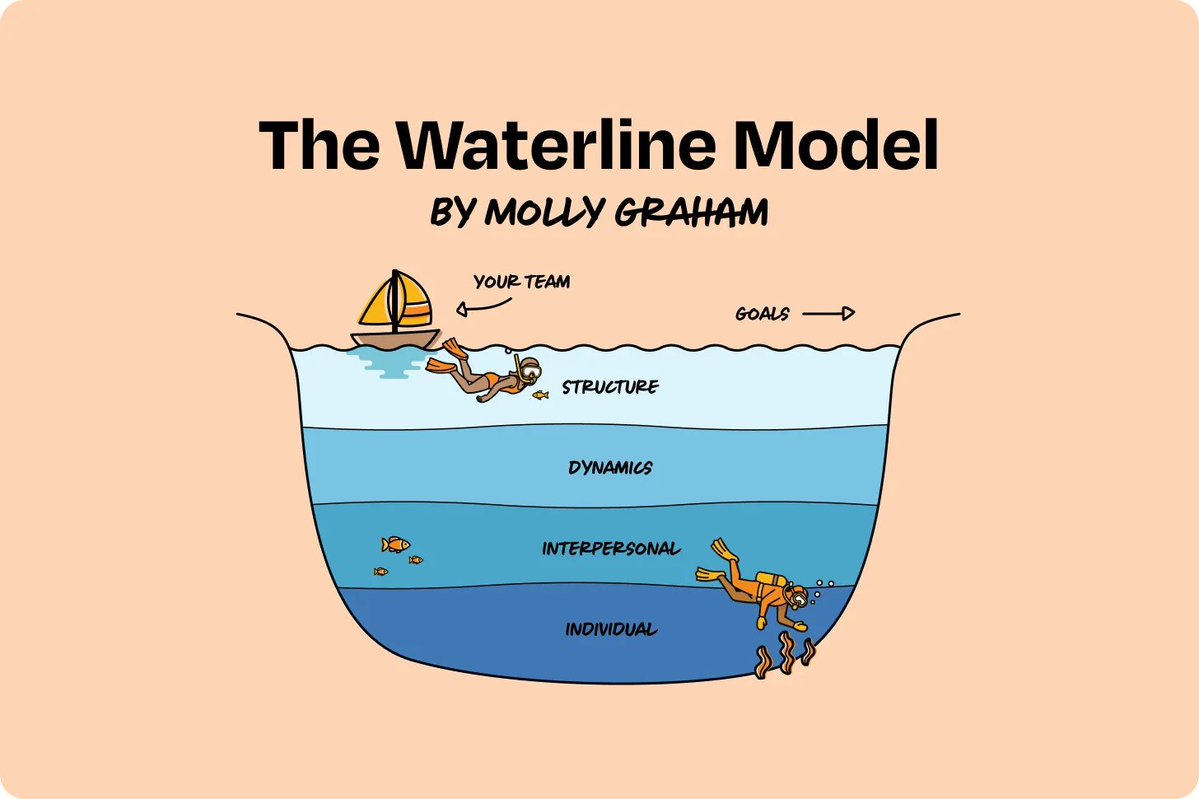
When a team is underperforming, most people's first instinct is to blame the people. That's almost always wrong. After 20+ years at @Meta, @Google, and @CZI — and advising leaders at @Stripe, @AnthropicAI, @OpenAI, and more — @molly_g has learned that blaming people for structural problems is one of the biggest leadership traps there is. In her powerful guest post, she shares a simple diagnostic tool she's used since leading wilderness expeditions in Patagonia at age 22: the Waterline Model. The Waterline Model helps you answer one question: What's going on below the surface that's making things harder than they should be? In other words, "snorkel before you scuba." Read it here (and share it with your manager): lennysnewsletter.com/p/how-to-debug…
Lenny Rachitsky tweet media
English
43
71
712
137.9K