

Trades
110 posts


Can’t believe i really saw people on X going 100% cash saying the market was gonna crash after 1 bad day.
Cant make this up.
English

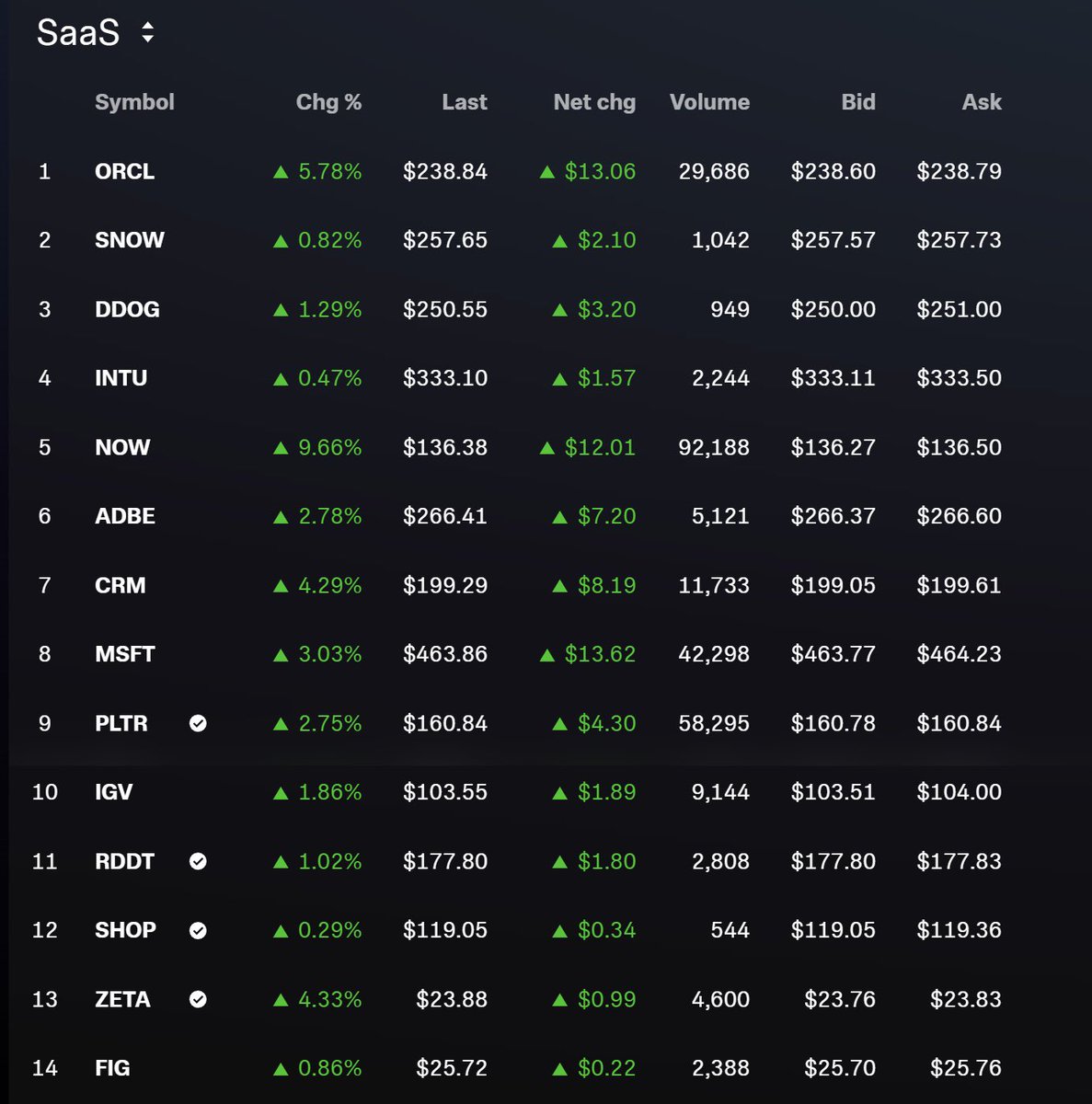

Well, I have called just about everything significant that has happened the last 26 years.
It's hard to say I've never had the timing right.
I was short Amazon at the top in 2000.
I went way long small cap value in late 2000.
I bought AAPL in 1998 and then again in 2002.
In 2003, I got into Korea stocks before a big run.
In 2004, I got into China stocks before a big run.
In 2004, I got into oil before a big run.
I bought gold in 2005 and still 20 years later...
In summer 2005, I figured I was buying 5 years swaps on something would print within 2, and it did.
In 2008, October, I told my investors it was time to buy. More stocks bottomed then than in March 2009.
In 2009, I invested in Almonds/Water, it worked ok.
In 2013, I moved to buy Bitcoin after meeting with a friend at Lightspeed. I should have. Slept on it and did not.
In 2015, I bought NVDA. The CFO knows.
In 2018, I started pounding the table on Japan and opened a Japan fund, which I had to close for COVID.
In late 2019, I warned indexing and passive investing would make for very corrlated severe drawdowns in the market, and COVID hit 6 months later, we got the most correlatedl, sharp decline in modern history.
Early 2020, I entered 2020 very short. Which worked.
During early COVID I loaded up on stocks and had nearly a 100% year for the fund.
In 2020, I called lockdowns would be disastrous for women and children, and went on Twitter to say it.
IN 2020, I got GME to buy back 1/3 of its stock and change its board. Did ok.
July 2021, I gave Barron's an interview to warn on specific meme stocks at the top, and they crashed through Dec 2023.
2021, I warned about very high inflation from the policies that were being undertaken.
2023, I warned people to sell because I saw the banking crisis coming. I told them all was clear at the bottom in March as I could see it wouldn't be contagious.
2020s, I shorted Tesla, but these were trades, and it was volatile. I did not lose money overall shorting Tesla. Had some really big quick wins. Plus Tesla is only worth about $120.
I am not perfect, I did not hold AAPL or NVDA long enough, in 2025 we were up almost 100% again by Liberation Day, and I lost most of the gain (still up about double digits for the year at closing) but I would put the calls I've made over these decades up against anyone.
I would add visual proof for all this, but it is too much for this medium.
English

Burry is mass-publishing the accounting case for his put options on Nvidia and Palantir while the rest of the market is still debating whether the capex cycle has legs.
The math he’s referencing is specific. The Big Four hyperscalers just guided $650-700 billion in combined 2026 capex, a 60%+ increase from the $381 billion they spent in 2025. Amazon alone committed $200 billion, so far above the $146 billion consensus that the stock lost $450 billion in market cap over nine straight sessions.
Burry’s core thesis is the depreciation trick. Nvidia’s GPU architecture runs on a 3-year cycle, with each generation delivering 2-3x more compute per watt. The H100s shipping today are economically obsolete by 2027. But the hyperscalers are depreciating them over 5-6 years. Burry estimates this gap understates depreciation by $176 billion between 2026 and 2028, inflating reported operating income by 20%+ at companies like Oracle and Meta.
That’s the “accounting tricks” he’s referencing in the tweet. He did the math.
The cash flow picture backs him up. Amazon is projected to go negative FCF in 2026, somewhere between -$17 billion (Morgan Stanley) and -$28 billion (BofA). Alphabet’s free cash flow is expected to collapse 90%, from $73.3 billion to $8.2 billion. The Big Five raised $108 billion in bonds in 2025 alone, more than 3x the average of the prior nine years. JP Morgan projects $1.5 trillion in tech debt issuance ahead. They’re repackaging data center debt as asset-backed securities, $13.3 billion this year, a structure with a history that includes Enron and 2008.
The depreciation cliff is the part the market hasn’t priced. The five hyperscalers plan to add $2 trillion in AI-related assets by 2030. At 20% annual depreciation, that’s $400 billion per year, which exceeds their combined 2025 profits. And AI services currently generate roughly $25 billion in direct revenue against $650 billion in infrastructure spend. Four cents per dollar invested.
But here’s where you have to be careful with Burry. He shorted Tesla at $180. It went to $1,200. He called the housing crisis two years early and nearly went bankrupt waiting for the trade to work. He bought puts on Nvidia and Palantir, capped-downside bets, because even he knows his timing is unreliable.
The pattern with Burry is always the same: the structural analysis is correct, the timing is wrong, and the market can stay irrational long enough to wipe out the trade before it pays. He sees the depreciation cliff. He sees the accounting inflation. He sees the debt structures. All of that is real.
The question is whether AI revenue scales fast enough to fill the gap before the write-downs hit.
AWS alone runs at $142 billion annualized, growing 24%, with a $244 billion backlog. Google Cloud’s backlog surged 55% to $240 billion. These companies are monetizing capacity as fast as they install it.
Burry is building the bear case in public so the crowd does the work for him. That’s the trade. Whether it pays depends on something Burry has never been good at: timing the moment when the music stops.
Cassandra Unchained@michaeljburry
A question I have for $ORCL, $GOOG, $META, $MSFT, $AMZN, $NVDA, $CAT, and all the rest, “When does the spending for AI data center buildout actually end?” It is consuming all your cash flow, you are borrowing, you are financing in ways you never have, apparently because it is so urgent, because it scales? But if it scales, when does it end? Now you are engaging in accounting tricks to hide expense, to protect earnings, as the impact is so severe. You will be tortuously adjusting your earnings in a new and sinister ways. When does it end?
English

Tonight, we reached an agreement with the Department of War to deploy our models in their classified network.
In all of our interactions, the DoW displayed a deep respect for safety and a desire to partner to achieve the best possible outcome.
AI safety and wide distribution of benefits are the core of our mission. Two of our most important safety principles are prohibitions on domestic mass surveillance and human responsibility for the use of force, including for autonomous weapon systems. The DoW agrees with these principles, reflects them in law and policy, and we put them into our agreement.
We also will build technical safeguards to ensure our models behave as they should, which the DoW also wanted. We will deploy FDEs to help with our models and to ensure their safety, we will deploy on cloud networks only.
We are asking the DoW to offer these same terms to all AI companies, which in our opinion we think everyone should be willing to accept. We have expressed our strong desire to see things de-escalate away from legal and governmental actions and towards reasonable agreements.
We remain committed to serve all of humanity as best we can. The world is a complicated, messy, and sometimes dangerous place.
English
@yxinsights @fundstrat or it can stay on its current trajetory to zero
English

$ETH could reach $28k by simply moving back to its long-term regression line vs $SPY.
Now that's a number even @fundstrat wouldn't (yet) float.

English

This quote nails it. The hate isn’t about me - it’s about cognitive dissonance.
When I post missed milestones, insider selling, and expert timelines, it threatens bags and egos… so people attack the messenger.
I’ll keep posting the truth!
$IONQ $RGTI $QBTS

English

Citron rarely comments on politic, strong opinions aside, because this is a stock research account. Today breaks that rule.
Proud day to be an American. The capture and removal of a dictator who ignored international law, ran a narco-state, and brazenly stole the 2024 presidential election just made the world safer.
Like him or hate him, give Trump credit. Even Biden viewed Maduro as illegitimate after the stolen election and bumped the bounty to $25M. Trump actually did something about it.
To the critics, if you want your legitimate concerns about this administration to carry any weight, start by giving credit where it's undeniably due.
But the real head-scratcher was Venezuela's acting president Delcy Rodríguez calling the US move "Zionist in character" with "Zionist undertones" (and even a "Zionist tint" in some reports).
In a country with maybe 4,000–6,000 Jews left, that's how deep the antisemitism goes.
Jews get blamed for controlling banks, media, Hollywood... but oil? Never on the list.
If throwing "Zionism" around is now the go-to play for sympathy points, then even this Jew underestimated how universal the hatred is. OK BACK TO STOCKS
English

$TSLA 4H Chart looks bullish! Nothing has changed.
Golden rules 🧠
• Red trend = patience
• The green trend indicates the BUY zone, provided that the signals (such as the green arrow and orange diamonds) appear.
• Green arrows = execution - STRONG BUY
• Orange diamonds = BUY / DCA

English

@ericjackson grifting on stock you don’t even own anymore? $CVNA no, it’s not a x-bagger just because the price went higher . You’re not in it
English