Oli Nold

3.2K posts

Oli Nold banner
Oli Nold

Oli Nold

@olinold

Business Intelligence | Data Monetization | Turning Large B2B Datasets into Structured Intelligence Assets for Growth Teams, Investors, and LLMs @vivameda_data

شامل ہوئے Mayıs 2012
384 فالونگ857 فالوورز
پن کیا گیا ٹویٹ
Oli Nold
Oli Nold@olinold·
Workforce datasets are static. A snapshot. A list. A moment in time. But companies are not static. They grow. They contract. They shift role composition. They reallocate talent before revenue changes show up. So instead of building another database, I built a longitudinal company-year panel. ~2.5M normalized U.S. companies. ~387M company-year rows reconstructed from historical experience timelines. Median 7 years of workforce history per company. Not profiles. Not contact records. Company-year intelligence. For each company and each year: • Observed headcount • Growth rate • Role distribution shifts • Structured entity normalization The real asset isn’t volume. It’s the ability to ask: – When did this company actually start scaling? – Did engineering grow before sales? – How did workforce composition change pre-funding? – Which segments show consistent multi-year expansion patterns? Longitudinal structure turns raw records into signal. Investors call it alternative data. Strategists call it market intelligence. AI teams call it training infrastructure. I call it organizational time-series intelligence. Building this in public. #infrastructure #database #patternrecognition

Oli Nold tweet media
English
0
2
3
653
Oli Nold ری ٹویٹ کیا
Vivameda
Vivameda@vivameda_data·
Everyone jokes about March Madness killing productivity. Here's what the workforce data actually shows: Companies that go dark on hiring during cultural events (major sports, holidays, summer) consistently underperform their hiring targets by 23% annually. The ones that hire straight through? They're the signal in the noise. When your competitor pauses because "no one's paying attention anyway," that's exactly when serious operators move. We've tracked this pattern across 250M+ employment records over 15 years. The real productivity loss isn't employees streaming games. It's leadership teams that mistake their own distraction for market reality. Your best candidates are still looking. Your fastest growing competitors are still hiring. The bracket can wait.
Vivameda tweet media
English
0
1
1
32
Oli Nold
Oli Nold@olinold·
AI fraud is scaling fast. Fake resumes. Fake employees. Entire fake work histories generated in seconds. But here's the thing: AI-generated profiles are too clean. Real careers are messy. Skills evolve. People move between companies that actually existed at the time. Their progression makes sense when you map it against headcount data and industry shifts. Fake profiles? They're perfect. And that's the tell. When you're looking at millions of workforce records, the anomalies jump out. Credentials that appear across 50 "different" candidates. Employment histories at companies that never hired during those periods. Zero skill migration patterns. The fraud scales, but so does the detection surface. Most companies are still doing manual resume reviews. One at a time. That worked when fraud was human-scale. Now? You need to see the full picture. Cross-reference against actual workforce movement data. Spot the patterns that only show up at scale. After 12 years building data businesses, I'll tell you this: the companies that win the talent war won't be the ones with the best job posts. They'll be the ones who can separate signal from noise when everyone else is drowning in generated garbage.
Oli Nold tweet media
English
0
0
1
33
Oli Nold ری ٹویٹ کیا
Vivameda
Vivameda@vivameda_data·
Everyone's debating whether AI will bankrupt the grid. Meanwhile, our data shows specialized data center roles (cooling engineers, energy optimization specialists, sustainability architects) grew 340% at tech companies between 2020-2024. Here's what that tells you: the companies building AI infrastructure already know energy is the constraint. They've been hiring for it aggressively for four years while the rest of us argued about whether it's a problem. The real tell? These roles are concentrated at three types of companies: hyperscalers building their own data centers, chip designers who need to prove efficiency, and a handful of energy tech startups that just got very interesting acquisition targets. CMU's research is smart, but the talent migration happened first. It always does. Workforce data is a leading indicator, not a lagging one. The infrastructure play isn't just about who makes better chips. It's about who can actually staff the systems that keep those chips from melting.
Vivameda tweet media
English
0
1
1
58
Oli Nold ری ٹویٹ کیا
Okara
Okara@askOkara·
Today we're introducing the world's first AI CMO. Enter your website and it deploys a team of agents to help you get traffic and users. Try it now at okara.ai/cmo
English
1.6K
2.4K
27.6K
13.7M
Thomas Kralow
Thomas Kralow@TKralow·
🚨 Urgent: Iranian drones in Dubai - 16.03 UPDATE! What are haters gonna say now haha?
English
155
115
609
113.2K
Oli Nold
Oli Nold@olinold·
@Sajwani Keeping the fake up as long as possible. It was always like that, it will always be like that. Normal behavior shortly before the total collapse
English
0
0
0
32
🇦🇪 HGS
🇦🇪 HGS@Sajwani·
To all those residents making beautiful videos, taking pictures, and spreading positivity about Dubai and defending the UAE 🇦🇪 … THANK YOU 🤍 we will never forget you
English
361
398
4.9K
130.7K
Oli Nold
Oli Nold@olinold·
Vibe coding AI labor exposure is cute. But here's what actually matters: which companies are hiring AI engineers while cutting marketing teams. Which skills migrated from finance to tech in 18 months. Where comp premiums actually showed up, not where McKinsey said they would. The highest-paid roles today weren't in our taxonomy in 2015. That's not a forecast. That's disruption already in motion. Everyone wants to predict AI impact. I track what already happened. 46.6M professional records. 15 years of workforce shifts. The patterns are brutal and clear. The jobs getting replaced aren't always the ones people think. And the new ones don't wait for your degree program to catch up.
Oli Nold tweet media
English
0
0
1
65
Oli Nold
Oli Nold@olinold·
@Fahadnaimb Dubai is as transparent as your posts. They fit very well.. matches the overall picture.
English
0
0
1
1.8K
Fahad Naim
Fahad Naim@Fahadnaimb·
Emirates update: after temporary suspension/diversions, they’re resuming a limited schedule at Dubai Airport from 10:00 local time today. Some flights canceled due to the ongoing drone-related airspace issues.... re-accommodation offered to affected passengers. IMO: it’s frustrating for travelers, but Emirates is handling it transparently and trying to get things back on track as fast as possible
English
23
41
406
175.4K
Oli Nold
Oli Nold@olinold·
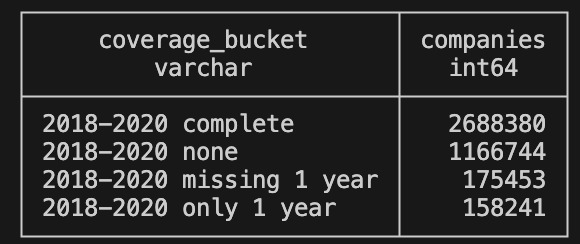
For the past few years we’ve been quietly building something unusual. A structured workforce dataset covering millions of companies. Hundreds of millions of professional records were normalized into company-year workforce observations: headcount growth, role distributions, organizational structure. What started as raw records slowly turned into a historical workforce intelligence archive. One of the first things we looked at was panel continuity. Across ~4M companies, about 64% appear consistently between 2018–2020. That level of continuity makes it possible to analyze how organizations actually evolve over time. Not job postings. Not press releases. Real workforce structure. You start seeing patterns: Engineering hiring spikes often appear months before companies scale. Sales expansion usually comes later. The dataset was originally built for internal analysis, but the more we explore it, the more interesting the signals become. Curious what others would analyze with a longitudinal workforce dataset like this.
Oli Nold tweet media
English
0
1
2
66
Oli Nold
Oli Nold@olinold·
7 million job openings…..Most of them are theater. Companies post roles they never seriously intend to fill. It keeps the growth story alive, signals expansion to investors, and reassures employees that the company is “scaling.” But the workforce data tells a different story. When you track actual headcount over time, many of these companies show almost no real growth. Same job postings circulating for months. Same roles reposted again and again. No meaningful increase in staff. Job boards measure ambition. Headcount timelines measure reality. Anyone can post a job. But when a company actually adds 40 engineers in a year, you see it immediately in the workforce sequence. company → year → headcount → role composition That is not marketing. That is budget. If you want to understand where companies are truly investing, stop watching job postings. Track who actually gets hired.
Oli Nold tweet media
English
0
0
1
39
Oli Nold
Oli Nold@olinold·
Most ML datasets about companies are built as snapshots. One row per company. One moment in time. That design already limits what a model can learn. Companies are temporal systems. They evolve through hiring, restructuring, and team composition changes. If your dataset ignores time, your model can only learn static attributes. While validating our workforce dataset, we learned something important about ML training data. Density beats length. The strongest windows are: 2018–2020 with about 2.7M companies 2016–2020 with about 2.3M companies 2015–2020 with about 2.1M companies For ML, a dense 3 to 5 year panel often produces stronger signals than longer but sparse timelines. Instead of a static company record, the model sees a sequence: company - year - headcount - role distribution - growth Once you structure the data like this, the model stops learning what companies are. It starts learning how companies change.
Oli Nold tweet media
English
1
0
2
118
Oli Nold
Oli Nold@olinold·
Starbucks just had their HR platform breached. Everyone's talking about PII exposure. They're missing the bigger picture. Attackers now have the org chart. Headcount by department. Compensation bands. Role hierarchies. Who reports to who. That's not just sensitive data. That's organizational intelligence. Here's what most people don't get: hedge funds pay six figures for this exact data. Legally. From third parties tracking workforce changes. Why? Because headcount moves predict revenue. Hiring patterns predict expansion. Compensation shifts predict retention risk. The irony: companies treat this data like it's locked in a vault, but it leaks constantly. LinkedIn updates. Job postings. Employee movement. Smart investors stopped waiting for breaches. They built infrastructure to track it systematically across millions of companies. The breach isn't the story. The value of workforce data is.
Oli Nold tweet media
English
0
1
2
59
Oli Nold
Oli Nold@olinold·
@ProductHunt @ycombinator @aaron_epstein Launch platforms are becoming real-time market intelligence layers, not just distribution channels. The real value emerges when launch data, user behavior, and founder outcomes are captured longitudinally to map how products actually gain traction.
English
0
0
0
13
Product Hunt 😸
Product Hunt 😸@ProductHunt·
We're teaming up with @ycombinator to get builders to launch. Schedule your launch for tomorrow, tag "YC application." and @aaron_epstein will review launches. Top ones could get a YC interview + potential funding. 👇
English
215
79
987
331.9K
Oli Nold
Oli Nold@olinold·
@dickiebush Consistency is really about minimizing recovery time after deviation, which is essentially a feedback-loop problem. The same principle shows up in data systems: organizations that measure and learn from every cycle compound performance much faster over time.
English
0
0
0
6
Dickie Bush 🚢
Dickie Bush 🚢@dickiebush·
My personal definition of consistency: How quickly you get back on track doing things you’ve committed to doing. It’s not “doing something every day.” It’s about never falling off those things for an extended period of time.
English
56
8
119
5.2K
Oli Nold
Oli Nold@olinold·
Most people optimize for their own moment of friction, but systems thinking starts with understanding the full context of everyone involved. The same principle applies in data infrastructure: the best insights come from capturing the complete system over time, not isolated signals.
English
0
0
0
113
Sahil Bloom
Sahil Bloom@SahilBloom·
On a flight and there’s a kid who’s been screaming for the last 15 minutes. Lots of passengers making faces at the parents. Before you do that, just remember, the parents are having a 100x worse time than you are. Guaranteed. Put in some headphones and relax.
English
332
247
8.8K
989.7K
Oli Nold
Oli Nold@olinold·
@patio11 Communication patterns like WTBU are essentially lightweight data protocols for reducing coordination errors in complex systems. Organizations that instrument and analyze these interaction patterns over time can turn them into a measurable layer of operational intelligence.
English
0
0
1
101
Oli Nold
Oli Nold@olinold·
@levelsio The debate isn’t MCP vs APIs, it’s about which interfaces generate structured data that systems can learn from over time. The real leverage in AI infrastructure comes from the telemetry layer that captures how agents actually interact with tools and workflows.
English
0
0
0
9
@levelsio
@levelsio@levelsio·
Thank god MCP is dead Just as useless of an idea as LLMs.txt was It's all dumb abstractions that AI doesn't need because AI's are as smart as humans so they can just use what was already there which is APIs
Morgan@morganlinton

The cofounder and CTO of Perplexity, @denisyarats just said internally at Perplexity they’re moving away from MCPs and instead using APIs and CLIs 👀

English
698
347
6.2K
2M
Oli Nold
Oli Nold@olinold·
Startup ecosystems compound fastest when knowledge transfer is paired with structured data about how companies are actually built over time. The next frontier is turning founder journeys, decisions, and outcomes into longitudinal datasets that help the next generation build with evidence instead of folklore.
English
0
0
1
324
Y Combinator
Y Combinator@ycombinator·
Startup School is coming to India! 🇮🇳 Hear from founders like @harshilmathur of Razorpay, @viditaatrey of Meesho, @lkeshre of Groww, @mukundjha of Emergent and more. And join the best builders and hackers from across the country for a day of talks and sessions with YC partners.
English
159
272
2.7K
681.9K
Oli Nold
Oli Nold@olinold·
The real moat in solving hard real-world problems isn’t just hardware or software, but the data generated from operating those systems over time. Companies that capture and structure that operational data build a longitudinal intelligence layer that compounds faster than the product itself.
English
0
0
1
29
First Round
First Round@firstround·
“Heat-seeking missiles for pain. That is the perfect definition of people who really succeed at startups.” @Keller is the CEO and co-founder of @Zipline, the world's largest commercial autonomous delivery system. Back in 2011, he set out to solve the un-fancy, real-world problem of transporting life-saving medicines to people who need it. To do it, he’s enlisted builders who are willing to “crack some eggs.” On In Depth, he sits down with @brettberson to share why building hardware is 10X harder than you’d think. He shares: -Why Zipline had a 1% chance of working -The blood drone delivery launch in Rwanda that was near-catastrophic -What it took to scale to 5,000 hospitals -How he hires at Zipline, from execs who aren't above "plunging the toilets" to teenagers who’ve built submarines and robots in their garage -Why the most important companies of the next 10 years will be hardware
English
4
5
13
2.4K
Oli Nold
Oli Nold@olinold·
The most valuable companies in this cycle won’t just ship products faster; they’ll institutionalize decision-making through data. Teams that systematically capture execution data over time build a compounding intelligence layer that turns organizational learning into a durable competitive advantage.
English
0
0
0
7