Steven Pinker

16K posts

Steven Pinker banner
Steven Pinker

Steven Pinker

@sapinker

Cognitive scientist at Harvard.

Boston, MA شامل ہوئے Ocak 2010
86 فالونگ857.9K فالوورز
Steven Pinker
Steven Pinker@sapinker·
From THE GOD DEBATE: Me: Why should you care for the needy? Why should you donate blood? Why should you refrain from murder and robbery? You can't possibly say that the only reason to do it is because God will punish you in an afterlife. If God's back was turned, does that mean it would be okay to kill and rob or let people drown or starve? I can think of plenty of secular reasons to do it. Namely, I would not want to be left to starve or drown or die of lack of blood. I would not want to be the victim of murder or robbery. There's nothing special about me, and therefore what I demand of everyone else, I have to accept for myself. It is clear that we would all be better off in a world where everyone helped each other and refrained from hurting each other compared to a society where everyone was a rapacious psychopath. That's why we should be moral. God has nothing to do with it. Ross Douthat (@DouthatNYT): What happens in Dr. Pinker's argument is that as an heir of Jewish and Christian civilization, he imports, as this kind of commonsensical position, metaphysical propositions about the existence of these human rights that no one has ever seen of or heard of. He cannot show me a human right under a microscope. He cannot prove to me in a mathematical theorem why segregation was wrong, why it was wrong to murder people in the gulag or the concentration camp for the sake of a better tomorrow. He asserts that it's necessary for, again, sort of decency and order and so on, and often it is, but there has to be a stronger reason when you find yourself in a position where what the society says is out of joint with what you think are the fundamental truths about the universe.
English
0
1
23
3.9K
Steven Pinker
Steven Pinker@sapinker·
Excellent analysis here of why current AI (or any AI) won't deliver sudden increases in longevity. One big reason: data on physical entities in the real world, unlike data scraped from the internet, must be gathered in real time with painstaking effort, and the criteria for success take years to be applicable. Additional trenchant analyses, clearly presented, are in @gmiller's "rant."
Geoffrey Miller@gmiller

A mini-rant abut AI and longevity. They say "Artificial Superintelligence would take only a few years to cure cancer, solve longevity, and defeat death itself'. This is a common claim by pro-AI lobbyists, accelerationists, and naive tech-fetishists. But the claim makes no sense. The recent success of LLMs does NOT suggest that ASIs could easily cure diseases or solve longevity, for at least two reasons. 1) The data problem. Generative AI for art, music, and language succeeded mostly because AI companies could steal billions of examples of art, music, and language from the internet, to build their base models. They weren't just trained on academic papers _about_ art, music, and language. They were trained on real _examples_ of art, music, and language. There are no analogous biomedical data sets with billions of data points that would allow accurate modelling of every biochemical detail of human physiology, disease, and aging. ASIs can't just read academic papers about human biology to solve longevity. They'd need direct access to vast quantities of biomedical data that simply don't exist in any easy-to-access forms. And they'd need very detailed, reliable, validated data about a wide range of people across different ages, sexes, ethnicities, genotypes, and medical conditions. Moreover, medical privacy laws would make it extremely difficult and wildly unethical to collect such a vast data set from real humans about every molecular-level detail of their bodies. 2) The feedback problem. LLMs also work well because the AI companies could refine their output with additional feedback from human brains (through Reinforcement Learning from Human Feedback, RLHF). But there is nothing analogous to that for modeling human bodies, biochemistry, and disease processes. There are no known methods of Reinforcement Learning from Physiological Feedback. And the physiological feedback would have to be long-term, over spans of years to decades, taking into account thousands of possible side-effects for any given intervention. There's no way to rush animal and human clinical trials -- however clever ASI might become at 'drug discovery'. More generally, there would be no fast feedback loops from users about model performance. GenAI and LLMs succeeded partly because developers within companies, and customers outside companies, could give very fast feedback about how well the models were functioning. They could just look at the output (images, songs, text), and then tweak, refine, test, and interpret models very quickly, based on how good they were at generating art, music, and language. In biomedical research, there would be no fast feedback loops from human bodies about how well ASI-suggested interventions are actually affecting human bodies, over the long term, across different lifestyles, including all the tradeoffs and side-effects. It's interesting that most of the people arguing that 'ASI would cure all diseases and aging' are young tech bros who know a lot about computers, but almost nothing about organic chemistry, human genomics, biomedical research, drug discovery, clinical trials, the evolutionary biology of senescence, evolutionary medicine, medical ethics, or the decades of frustrations and failures in longevity research. They think that 'fixing the human body' would be as simple as debugging a few thousand lines of code. Look, I'm all for curing diseases and promoting longevity. If we took the hundreds of billions of dollars per year that are currently spent on trying to build ASI, and we devoted that money instead to longevity research, that would increase the amount of funding in the longevity space by at least 100-fold. And we'd probably solve longevity much faster by targeting it directly than by trying to summon ASI as a magical cure-all. ASIs has some potential benefits (and many grievous risks and downsides). But it's totally irresponsible of pro-AI lobbyists to argue that ASIs could magically & quickly cure all human diseases, or solve longevity, or end death. And it's totally irresponsible of them to claim that anyone opposed to ASI development is 'pro-death'.


English
0
20
155
36.5K
Steven Pinker
Steven Pinker@sapinker·
From the recent @TheFP God debate between me and Ross Douthat (@DouthatNYT): Question from attendee: Doesn't the history of 20th century Marxism show us where rational materialism leads? And shouldn't you, as a student of history, have seen where this worship of rationality would lead? Me: Well, you're assuming that Marxism was rational. Attendee: It was the worship of rationality, putting human presuppositions about right and wrong before the teachings of God. Me: If we judge an ideology by its effects, there are reasons to think that the precepts of Marxism were the opposite of rational. Namely, they led to disasters, but people held them anyway, so it was the opposite of the ideal of falsifiability. And they led to both economic and humanitarian disasters, so on rational grounds, we can see that Marxism was mistaken. So the failure of Marxism does not cast doubt on the value of rationality. It is precisely because we can evaluate it on rational grounds that we can identify what was wrong with it. Likewise, the horrors of the 20th century due to Nazism were not because Nazism was rational, quite the opposite. It had a number of obviously mistaken and monstrous beliefs, and it is by the lights of rationality combined with concern with human well-being that we can judge it as having been a disaster. I don't think that our problem now is that we have too much empathy. I think that the allegation that we're suffering from toxic empathy is mistaken. That too much empathy is the least of our problems. If I were to single out some of the things in Christian tradition that I think are worth keeping, then empathy, compassion, forgiveness, forswearing revenge, all of those are good things because they can also be defended on rational grounds.
English
0
20
155
24.9K
Steven Pinker
Steven Pinker@sapinker·
Why we choke, get backaches, risk autism, and (half of of us) can get hit in the nuts: Top 10 Design Flaws in the Human Body nautil.us/top-10-design-…
English
0
16
73
9.5K
Steven Pinker
Steven Pinker@sapinker·
From THE GOD DEBATE: Me: The more religious the society, the worse the problems are. And if you don't believe it, consider some of the world's most irreligious societies, like Norway, Netherlands, and New Zealand. They're pretty nice places to live. Now consider some of the world's most religious countries, like Afghanistan and Congo. Those are places that people want to get out of. This is also true in a comparison across American states. The more religious, the more dysfunctional. Ross Douthat (@DouthatNYT): What we should wish as Americans is to be neither Afghanistan nor Scandinavia, but to be the United States of America, which as a culture has always done an incredible job of balancing some of the absolute, definite benefits of modernity, including religious toleration, a respect for pluralism, a refusal to simply sort of impose the totality of one religion's theological doctrines on society with an abundant faith in a cosmic purpose for the human race. And obviously there are downsides to religious intensity. Those downsides are often manifested in zealous intolerance. There are also serious downsides to religious indifference, which are often manifested in anomie, drift, and despair. And it is simply the case that if you look across the developed world today, there is a strong correlation between secularization and a kind of loss of faith in human purpose and the human future, manifested most starkly in the declining birth rates that make it extremely unlikely that Dr. Pinker's predictions about the inevitable triumph of secularism and humanism over religion will come to pass, because the secularists and humanists don't seem to be making the basic choices that would enable the continuation of the human race.
English
0
77
488
57K
Steven Pinker
Steven Pinker@sapinker·
Book reviews by philosophers, notoriously, can be scathing, but a sober review of a book on gender identity by the MIT philosopher (and Academic Freedom Council co-founder) Alex Byrne was deemed too dangerous to print. "The philosophy profession has shown itself to be an institution of fragile integrity when put to the test. One can only hope spines will eventually stiffen, and academic law and order is restored." philosophersmag.com/on-being-rejec…
English
0
142
696
60.6K
Steven Pinker
Steven Pinker@sapinker·
Catholic University is forcing Students Supporting Israel to invite someone who doesn't support Israel — or they can't hold the event. Student clubs, regardless of their perspective, are allowed to advocate for their beliefs and provide programming that supports those beliefs. Requiring a group to host a speaker they oppose is textbook compelled speech — and FIRE will fight it every step of the way. FIRE Letter to Catholic University of American, March 18, 2026 | The Foundation for Individual Rights and Expression fire.org/research-learn…
English
0
84
417
13.1K
Steven Pinker ری ٹویٹ کیا
Steven Pinker
Steven Pinker@sapinker·
BBC Radio 4 - Understand, How Reading Made Us, 2. How Reading Made Our Feelings. (I'm featured in this episode, and Part 3 next week.) bbc.co.uk/programmes/m00…
English
0
12
54
12.4K
Steven Pinker ری ٹویٹ کیا
Steven Pinker
Steven Pinker@sapinker·
Medical Research Is Hopelessly Caught in Red Tape. Part of the blame goes to "bioethics," which I've long argued is highly unethical. open.substack.com/pub/persuasion…
English
1
25
96
18K
Steven Pinker ری ٹویٹ کیا
Steven Pinker
Steven Pinker@sapinker·
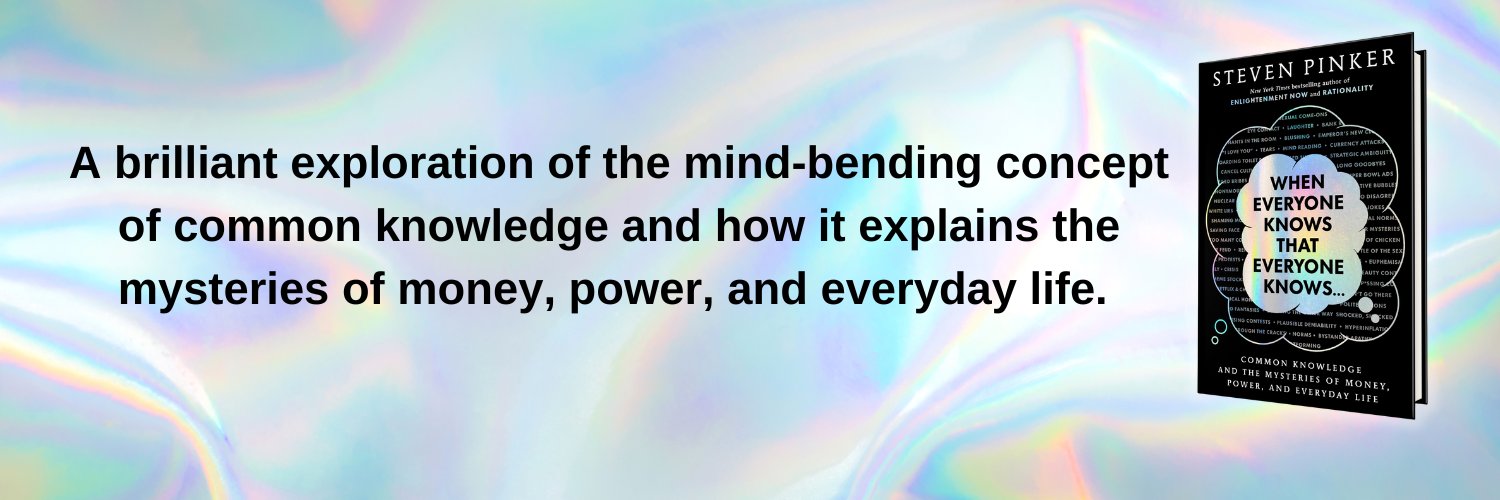
Since I published When Everyone Knows That Everyone Knows..., readers have been sending me examples of "recursive mentalizing" (reading the mind of a mind-reader) in popular culture. The song "Therapy" from tick, tick...BOOM! is one of the best. ("I feel bad that you feel bad About me feeling bad about you feeling bad...") youtu.be/2YF1Ab5c7vk?si… via @YouTube
YouTube video
YouTube
English
1
7
79
34.9K