Vlad Kats

185 posts

Vlad Kats

Vlad Kats

@AsVladThinketh

A legal immigrant from CCCP (thank you mom/dad/God). Preferred nouns: dad, husband, investor, advisor.

The great US of A Tham gia Eylül 2009
271 Đang theo dõi155 Người theo dõi
rosejeffrisl
rosejeffrisl@rosejeffrisl·
@AsVladThinketh @Z06Z07 The final standard ex-dividend date is June 1. It'll drop after and quickly rebound to 100 as we approach the rotation date on June 16th
English
1
0
1
17
Grain of Salt
Grain of Salt@Z06Z07·
The irony is incredible. Bitcoin Treasury Companies originally competed on who could create the MOST volatility and convexity. Now $SATA is showing the real unlock may be: removing volatility almost entirely. A stable $100.00 corridor that quietly accumulates 100s to 1000s of BTC per week may ultimately be more powerful than explosive mNAV speculation. @Strive Bullish for $ASST
English
15
27
301
14.4K
Altcoin Daily
Altcoin Daily@AltcoinDaily·
Bitcoin is my savings account 🌱
English
116
57
703
46.4K
Vlad Kats
Vlad Kats@AsVladThinketh·
@StrategyMaxi MSTR borrowed 1.5b to buy btc. They bought the bond back for 120m less. How many btc did they/we get “for free”?
English
1
0
0
46
100% Strategy
100% Strategy@StrategyMaxi·
Really, people are now complaining that Strategy is cancelling $1.5 billion of debt? 🤯 You all cannot be pleased no matter what we do! Cancelling that debt improves credit ratings for preferreds and saves $MSTR issuance for later. $1.38B cost to cancel $1.5B is $120m profit.
English
12
4
126
3.4K
Vlad Kats
Vlad Kats@AsVladThinketh·
All of the above makes sense and, to your point, there are diff ways to look at it depending on their biases and positions. I can only speak as the “sister” in this case. From that vantage point, the only part of the eval that needs to be done is the company’s ability to pay the %. There is zero expectations of the co itself of paying the sister back. And thus its company’s $ as soon as she contributes to the piggybank. In other words different parties prob have diff numerators and denominators. The liq preference only comes into play when the above mentioned ability is overestimated at the time of the purchase. And, once mstr redeems all of the actual debt, that can only happen when btc = 0. At that point of course all of the shares = 0, and we are all screwed without mstr puts.
English
0
0
1
81
Glenn Cameron
Glenn Cameron@GlennOnrampBTC·
Vlad, you’re correct in the sense STRC has no maturity, so Strategy isn’t contractually obligated to return the $100 par on any specific date. That’s a real distinction from a bond. But the conclusion you’re drawing from it doesn’t follow, for a number of reasons. Firstly, STRC carries a $100 per share liquidation preference. That principal sits senior to common in any wind-down, restructuring, or balance-sheet event, and Strategy can voluntarily redeem at par (or be forced to on certain fundamental-change triggers). The $30 in the analogy maps to that liquidation preference. It’s what makes preferred holders senior creditors against the assets, not pro-rata equity participants in them. If anyone ever opens the piggy bank, the sister gets paid first, up to her principal. Secondly, even taking your framing at face value, “only the 11.5% is owed”, the math collapses to the same claim. A perpetual obligation of $X per year, discounted at the same rate, has a present value of $X/r. Strategy’s ~$1.23B annual STRC dividend capitalized at 11.5% equals roughly $10.7B — almost exactly the outstanding principal. A perpetual yield obligation is mathematically equivalent to a principal claim. Forever isn’t free, it’s just amortized differently. Thirdly, this isn’t a contested view. Both S&P and Moody’s apply hybrid-debt treatment to perpetual cumulative preferreds with no maturity and no equity participation, precisely because the liquidation preference and the fixed cash obligation make them functionally debt for leverage purposes. Accounting standards under IFRS and US GAAP for instruments with non-discretionary cash flows point in the same direction. So my piggy bank example was generous, not unfair. By every functional test (liquidation priority, present-value of obligations, rating-agency treatment, accounting treatment) that $30 isn’t yours. It belongs to your sister. The mNAV methodology change is precisely what obscures that.
English
2
0
4
353
Glenn Cameron
Glenn Cameron@GlennOnrampBTC·
The question every investor in MSTR’s securities should be asking is this. Why would Saylor do this if the funds came from STRC issuance and they now have to pay 11.5% yield on the capital This move only makes sense if you ignore the 11.5% coupon on where they got the capital from (STRC issuance) and start reading the put schedule on the convertibles Those 2029 convertible notes were 0% on paper, but they had a holder put in late 2027 at par, so the functional maturity was two years, not five. With MSTR at ~$187 against a conversion strike around $672, the converts are deep out of the money and every rational holder would have put them back in 2027. Strategy is staring at a ~$3B liquidity event in 24 months. They’re paying ~92 cents on the dollar now (a $120M discount to par capture) to chip the wall down before it hits, while STRC retail demand is still running hot enough to absorb the refi. The narrative they’re selling (“rotating $6B of convert debt to equity over 3-6 years” is only coincidentally and partly true, because it’s really maturity-wall management that they’re trying to propagandize as strategic discipline. The why transform 0% convertibles into 11.5% STRC question is exactly the right one to ask though, because it exposes what’s actually happening underneath. A zero-coupon convert is a finite obligation: it either converts away into shares if BTC runs, or it has to get refinanced. STRC is perpetual. They’re swapping a self-extinguishing instrument for a permanent claim that compounds forever against common shareholders forever at 11.5%, on a base that’s already $10.7B and growing. The trade is only accretive if BTC compounds materially above the preferred cost of capital net of all dilution. And the real tell is buried in the 8-K They listed Bitcoin sales as one of three potential funding sources. The self-styled “net accumulator” and before that “we’ll never sell our BTC” is now openly contemplating selling spot BTC to retire 0% debt and refinance through 11.5% retail preferred. That’s not “BitVac charging”, that’s the ponzi style flywheel borrowing forward from STRC holders to manage a near-term liquidity gap, with the bill arriving as perpetual yield obligations on retail balance sheets. And just before the inevitable attack that will come after I post this, I am a Bitcoin maximalist. This is not an attack on Bitcoin. This is a criticism of Strategy and STRC. Most of you have forgotten what Bitcoin is, and Bitcoin does not equal STRC, or for that matter MSTR, which are securities, not bearer assets or Bitcoin
Michael Saylor@saylor

This week we bought bonds, not bitcoin. The ₿itVac is charging.

English
116
26
266
107.5K
Vlad Kats
Vlad Kats@AsVladThinketh·
@GlennOnrampBTC @sergains @BigpictureBTC Not exactly. The $30 is not borrowed. Its a contribution to the piggybank in exchange for the flexible rate (currently 11.5%). What is owed is 11.5%. Not the $30 + 11.5%.
English
2
0
0
339
Glenn Cameron
Glenn Cameron@GlennOnrampBTC·
Yes @sergains I did notice them, and you’re quite right. This is another one of Saylor’s recent magic tricks, that is going right over the head of the retail investors in their securities heads. I’ll explain why for the sake of a wider audience in two ways, firstly I’ll use the language an investment professional would. Then I’ll break it down for the retail investors. Because what I see a lot of ironically, is STRC and MSTR investors saying over and over things like “Another idiot who doesn’t understand STRC and MSTR” But it’s clear they don’t understand what they’re investing in properly So here’s the explanation of what you’re correctly pointing out in the language of an investment professional (and below this I’ll break it down for the doctors, plumbers, lawyers etc.) The methodology change in the calculation of the mNAV metric smuggled in by Saylor is a denominator substitution that launders a senior debt claim as equity. Standard mNAV answers a single question: what premium is common equity paying per dollar of underlying BTC exposure? Numerator is market cap; denominator is net BTC NAV (BTC at market plus cash and ancillary assets, minus debt and preferred liquidation preference.) That last subtraction is not optional. Preferred holders sit ahead of common in the waterfall; their stake is not pro-rata BTC ownership, it is senior balance-sheet leverage against the same BTC pool. Saylor’s revised formula (which he smuggled in within making a public announcement about for obvious reasons) replaces market cap with enterprise value (market cap + debt + preferred) and divides by gross BTC holdings. This commits a structural double-counting error. The cash denomination STRC, STRF, and STRK holders contributed already bought the BTC sitting on the balance sheet, so the BTC is simultaneously an asset of the firm and the implicit collateral for the preferred claim. Adding the preferred back into the numerator while leaving the same BTC undisturbed in the denominator counts the underlying exposure twice. The ~32.5% gap between claimed and actual mNAV is, almost to the basis point, the magnitude of the senior claim being smuggled into the common-equity bucket. The reason it matters is reflexive. NAV premium isn’t a vanity metric, it’s the operative funding mechanism. Above 1.0x, ATM equity issuance is accretive to BTC per share; below 1.0x, every share sold destroys BTC per share. At the current true ~0.8x mNAV, the equity has structurally lost its capacity to fund accretively, which is precisely why the marginal capital is now being raised through STRC at 11.5% rather than through common. The methodology change provides optical cover for that regime shift, and it also conveniently obscures from retail STRC subscribers that they are senior creditors of a vehicle whose common equity already trades below the liquidation value of the assets backing their claim. AND NOW THE SIMPLIFIED BREAKDOWN FOR THE RETAIL INVESTORS WHO FIND THE ABOVE TO COMPLEX TO FULLY GROK Imagine you have $100 in your piggy bank, but you borrowed $30 from your sister and you owe her 11.5% interest every year, forever. If someone asks “how much are you really worth?” — the honest answer is $70. The $30 isn’t yours. It belongs to your sister. Now imagine you’re selling shares in your piggy bank to your friends. The fair price should be $70 (that’s the actual money in there that belongs to you.) But you decide to get clever. You tell your friends: “Don’t subtract what I owe my sister. Just count everything (my $100 plus the $30 I owe her) as the size of my piggy bank. That makes me worth $130.” Your friends nod along, and you sell them shares at $105 each, telling them they’re getting a bargain because $105 is less than $130. If anyone criticizes what your friends are doing, they all shout “you just don’t understand Bob’s piggy bank strategy you morons” That’s exactly what Saylor is doing. STRC is basically a loan from retail investors
English
5
0
26
3.2K
BTC Optioneer
BTC Optioneer@BTCoptioneer·
@dotkrueger If Mark Cuban is not smart enough to understand btc, that makes me really worried about the rest of the population never getting it.
English
12
1
31
1.1K
Vlad Kats
Vlad Kats@AsVladThinketh·
Are you sure? On the way down, msty has to do better than mstr given the short call spreads. Also, yieldmaxetfs.com/our-etfs/msty/ shows over 100% return since inception. The graph you're showing in the vid shows msty below zero. What am I missing and thank you again for the info and engagement.
English
1
0
1
44
YieldMax ETFs
YieldMax ETFs@YieldMaxETFs·
5.20.2026: YieldMax ETFs announces distributions of Group 2 for the following ETFs. $ABNY – $0.3402 $AIYY – $0.1036 $AMDY – $0.9740 $AMZY – $0.1009 $APLY – $0.1096 $BABO – $0.0791 $BRKC – $0.1692 $CONY – $0.3427 $CRCO – $0.4130 $CRSH – $0.2123 $CVNY – $0.3130 $DIPS – $0.2697 $DISO – $0.0677 $DRAY – $0.2953 $FBY – $0.0792 $FIAT – $0.2959 $GDXY – $0.1083 $GMEY – $0.2947 $GOOY – $0.1818 $HIYY – $0.2186 $HOOY – $0.3600 $JPO – $0.0651 $MARO – $0.1171 $MRNY – $0.1838 $MSFO – $0.0890 $MSTY – $0.3136 $NFLY – $0.0626 $NVDY – $0.1354 $OARK – $0.2399 $PLTY – $0.3565 $PYPY – $0.2323 $RBLY – $0.2336 $RDYY – $0.3481 $SMCY – $0.1045 $SNOY – $0.0976 $TSLY – $0.2862 $TSMY – $0.1659 $WNTR – $0.3048 $XOMO – $0.1025 $XYZY – $0.3054 $YBIT – $0.1833 $YQQQ – $0.0434 Press Release: tinyurl.com/yckcsk8d Standardized performance: YieldMaxETFs.com Prospectus: Yieldmaxetfs.com/prospectus/all $AMD $SMCI $RDDT $RBLX $DKNG
English
16
12
120
17K
Vlad Kats
Vlad Kats@AsVladThinketh·
@mangosteentrd Curious about your thoughts on just buying a far out put + stock, and just hold as the divs pay for the put and then some, plus upside?
English
1
0
1
7
Vlad Kats
Vlad Kats@AsVladThinketh·
@mangosteentrd @YieldMaxETFs Great vid. Thank you. Does your comparison of performance of mstr vs msty around min 5 of vid take into account msty divs?
English
1
0
2
45
MangosteenBTC
MangosteenBTC@mangosteentrd·
@YieldMaxETFs Active rebalancing between $MSTY and $WNTR is by far the most effective approach to YieldMax ETF investing... i achieved >80% return last 12 months with it.. details in my video.. youtu.be/wn9IGKNcZBM?si…
YouTube video
YouTube
English
3
0
9
1.5K
Vlad Kats
Vlad Kats@AsVladThinketh·
@mangosteentrd Thank you for the input and for putting the article together. Very helpful. I will check the full prospectus as spread vs covered call makes a big diff for me. If MSTR rips, msty can see big upside as the spreads they write are pretty narrow.
English
0
1
3
85
MangosteenBTC
MangosteenBTC@mangosteentrd·
@AsVladThinketh I believe in their description they leave the option to either use a covered call or a call spread, either way looking at $MSTY price action they generallt have a approx -1 delta and a ~0.3-0.4 positive delta. The generate the dividend through partial selling of the $MSTR upside
English
1
0
1
283
Invzye
Invzye@Invzye·
Short $STRC at $100 NAV → Cover at $99. Grind 1% repeatedly. The “Stretch” preferred is built to hug $100 par. The kicker: If Strategy/BTC ever cracks (dividend coverage fails), STRC can gap way below par. Your small wins explode into millionaire status on the doom scenario.
English
2
0
4
1.6K
Vlad Kats
Vlad Kats@AsVladThinketh·
@BTCoptioneer Are you taking into consideration the div adjustment? Or just $1.50 per month?
English
0
0
0
561
BTC Optioneer
BTC Optioneer@BTCoptioneer·
Selling monthly $100 $STRC puts is yielding 16.8%/yr right now. This is one way to outperform holding STRC shares.
English
8
3
62
11.4K
Derin Olenik
Derin Olenik@BigpictureBTC·
You just proved my point. Those strict compliance mandates and IG rating demands are exactly what superior institutional risk evaluation looks like. Retail investors lack these structural guardrails, leaving them completely exposed to aggressive marketing and yield chasing rhetoric.
English
2
0
6
105
Derin Olenik
Derin Olenik@BigpictureBTC·
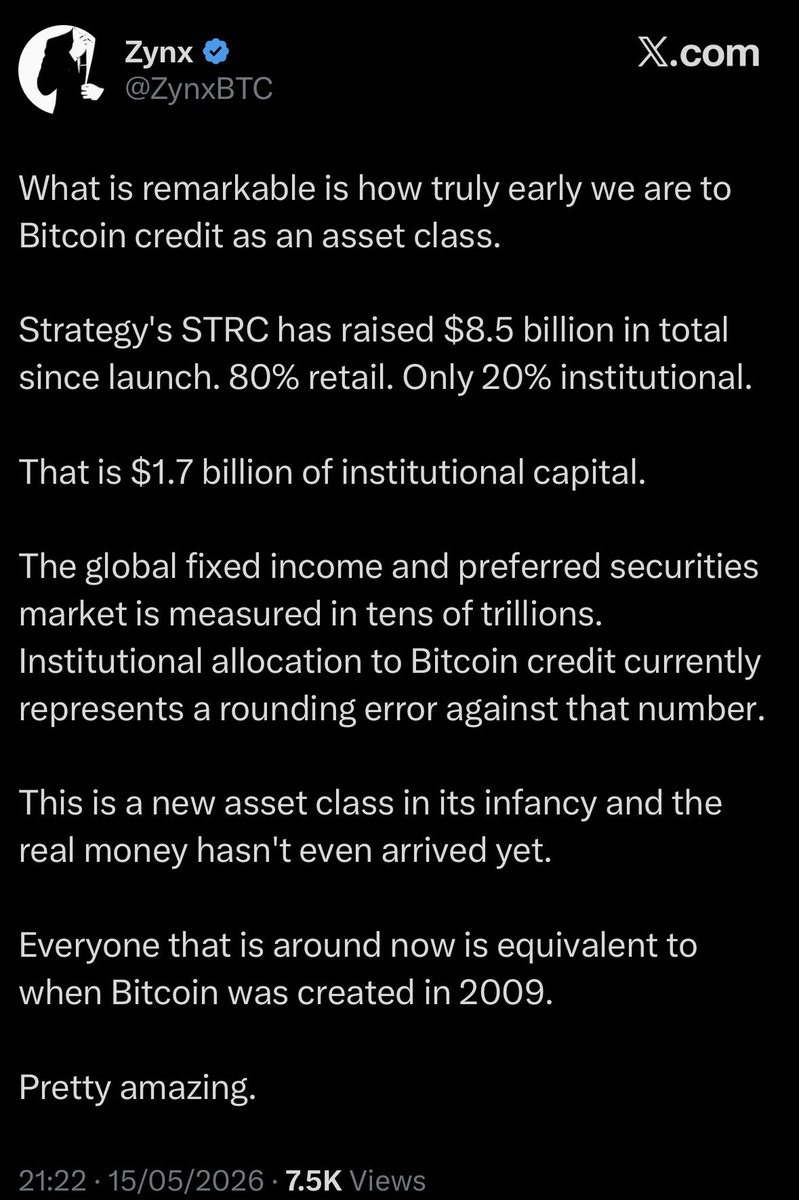
$STRC ownership is 80% retail and 20% institutional. Why? Strategy promoters claim retail investors simply understand these preferred equity instruments better and are therefore, ahead of the curve. The truth is quite the opposite. Institutions possess the superior research tools and expertise required to fully grasp the underlying risks, whereas retail investors are generally more susceptible to manipulation through deceptive and financially engineered rhetoric.
Derin Olenik tweet media
English
13
2
19
1.6K
Vlad Kats
Vlad Kats@AsVladThinketh·
@BTCoptioneer @StudiareTutte Understood. Thank you. So you are not talking about levering up using margin. Just simply borrowing 10k to buy 100 shares. Clear.
English
0
0
0
21
BTC Optioneer
BTC Optioneer@BTCoptioneer·
Selling $100 $STRC puts on margin is superior to holding $STRC shares on margin. By selling puts, you collect ~1% per month without paying margin interest. Free carry trade.
English
9
0
82
33.1K
Vlad Kats
Vlad Kats@AsVladThinketh·
@BTCoptioneer Curious if you know why someone would be buying $95 calls on STRC expiring on Friday for $5.25-$5.30? Seems strange for div capture, no? Thanks!
English
0
0
1
35
BTC Optioneer
BTC Optioneer@BTCoptioneer·
$STRC demand will grow faster than ARR of Bitcoin. $MSTR will have to either issue more common equity OR lower the dividends for STRC to keep the amplification ratio in check. Bullish.
English
6
2
49
2.3K