David Fish
4.2K posts

David Fish
@DavidFish7
Pastor, dad, mediocre wordsmith, aspiring table tennis champion, visca el Barça
Tham gia Aralık 2011
252 Đang theo dõi2.2K Người theo dõi

Bree, this is one of the highest attended Roman Catholic parishes in Michigan.
It seems that the bishops of your church don't feel the same way you do.
Bree Solstad@BreeSolstad
This is what emotionalism looks like. This is what a pop concert looks like. This is NOT what worship looks like.
English

@MateyYanakiev Cyril says something similar in the preface of the Catechetical Lectures about Simon Magus: "he was baptized, but was not enlightened; and though he dipped his body in water, he enlightened not his heart with the Spirit..."
English

@danandrobinlong I made a mega-thread about Lake with most of the key evidence supporting him being a fraud. x.com/DavidFish7/sta…
David Fish@DavidFish7
Fatal exorcisms, false identities, séances, fraud. These things, among many others, are said to have been part of the life and ministry of John G. Lake. But is it true? Was Lake a man of God or a con man? Here's the story... 🧵🧵🧵⬇️⬇️⬇️
English

In 1931, Lake dressed up in native costume and posed as “Abdul Ben-Shenandar,” a mysterious Arabian Christian mystic & companion of Lawrence of Arabia. He ran newspaper ads that never once said “Abdul = John G. Lake.” He tricked his own congregation into thinking a famous Arab preacher was coming to his tabernacle. When a reporter tried to interview “Abdul,” Lake got caught red-handed. He even lied to the newspaper claiming W.T. Stead funded a secret year-and-a-half trip to Arabia — an event that appears in zero biographies or timelines of his life. This is the same man they call a hero of the faith. John G. Lake wasn’t a healing giant. He was an impersonator.
English


@MikeWingerii I’m not sure if you know how long 45 mins is to be shouted at
English

Michael Brown once asked me on the phone if I really was the best person to bring exposure to some of these problems.
I told him to tell me who the best person was and I would give them all my evidence and connect them with witnesses so they could do it. I would have actually been very happy to do that.
He didn’t have anyone to suggest. There is no best person. This was just a line that’s used to talk people down.
English
David Fish đã retweet

@DustyMayT Can one be born with the gift of tongues prior to receiving the Holy Spirit?
English

🤷♀️ I'm not so sure there is a Biblical necessity to be that careful how you refer to discerning of spirits, if you've manifested that gift since you can remember. Continuationists DO need tighter theology, but this is hardly a disastrous colloquialism. It's not even saying you own it. Being born with it wouldn't mean it wasn't a gift from the Holy Spirit, wouldn't mean it couldn't be taken away, and wouldn't even mean it manifested all the time. To be frank, it doesn't even assume you know precisely what it means - it's just a way of communicating to others that you've always had an awareness of spirits. My Baptist grandmother told me, when I was 8 years old, that it was the only explanation she had for some of the things I told her.
Unless you believe there should be another term for the ability to discern spirits in a person who has experienced it since their earliest memory. What would that term be?
I'm replying to this because we can run into the error of bogging people down with non-essential precision when there are way more major things that need to be corrected right now. (And again, I'm not even sure the Bible teaches you can't be born with a spiritual gift. Like, explain Balaam. That is one weird story.) We need to correct what needs correcting, but also be okay with mystery.
English

Just heard someone say they were "born with the gift of discerning of spirits."
We continuationists have to be better about teaching people that the 1 Corinthians 12 "gifts" are explicitly called "manifestations" and not "possessions" (1 Cor. 12:7).
We are not born with them. We do not "own" them. We cannot use them by our own volition (1 Cor. 12:4–6). They are not talents or personality types.
They are always and everywhere direct manifestations of the Spirit distributed by His sovereign will which works in accordance with our faith (1 Cor. 12:11; Rom. 12:6).
English

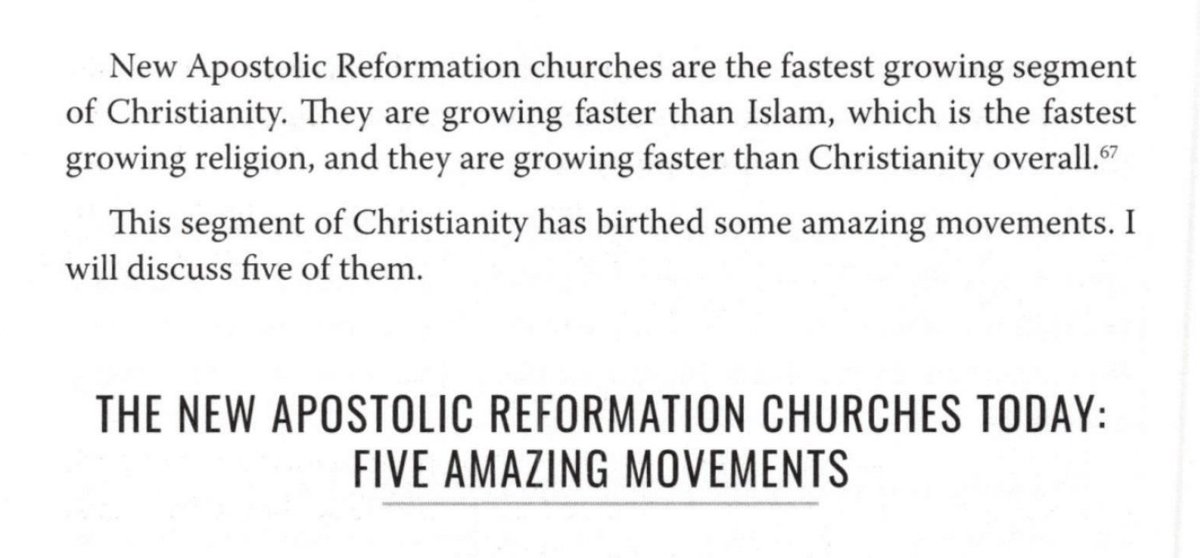
@KYVAMIguy @_P3te_Belcher @anonymuzzzzzz This is from Che Ahn's book "Modern-Day Apostles." (with a forward written by Bill Johnson)
Which one is it:
1) The NAR not only exists but is the "fastest growing segment of Christianity"
2) The NAR doesn't exist and is a slur "by those who hate the charismatic expression"

English

@_P3te_Belcher @anonymuzzzzzz @DavidFish7 Also, “NAR” is not an organization.
It’s a slur used by those who hate the charismatic expression
English

@MikeWingerii Step #1: Deny the problem exists
Step #2: If step 1 fails, tell people. "the ACTUAL problem is you talking about the problem."
Step #3: If steps 1-2 have failed, focus on tone and motive. "The ACTUAL problem is the WAY you're talking about the problem."
English

@joeyhamlin But he was God. And he is fully conscious of this fact in His earthly ministry. He also receives worship and forgives sins by his own authority.
English

@DavidFish7 I understand that can be debated and I’m not dogmatic about it. However if the verse is referring to something only God could have known, it would have been revealed to Jesus through one or more of the manifestation gifts of the Spirit and not because He was “God”.
English

One of the explicit assertions of those who affirm Kenotic Christology is that, "if Jesus came as God, we wouldn't be able to follow Him."
They claim that for centuries Christians have been using Jesus' divinity as a "cop out" from imitating Jesus.
But Jesus' life and teachings have always been seen as the central feature of orthodox Christianity.
Whether or not people have always chosen to obey and shape their life according to those teachings is, of course, always a live question.
No one within the mainstream of orthodox, Christian thought has ever attempted to deny that Jesus is our greatest example.
This is obvious in the Gospels because Jesus also gives explicit commands to His followers regarding how to live.
Jesus also delegates certain authority to His followers to exercise on His behalf. This includes authority to cast out demons, heal the sick, etc.
However, this delegated authority need not imply that Jesus was "merely human" while on Earth.
Kenotic Christology ultimately aims to resolve a problem that doesn't actually exist.
We can do exactly what Jesus teaches and commands us to do in the Gospels without necessitating that Jesus abandon His divine nature in the Incarnation.
We also cannot "imitate" things that Jesus does on Earth which are unique to His redemptive mission.
- Be transfigured with Moses and Elijah
- Die on the cross for the sins of others
- Fulfill Messianic prophecies
- Forgive sins by our own authority
- Command angels
- etc.
Jesus is both our example and archetype as the Son of Man and also our Lord and God as the Son of God.
Kenotic Christology is not only false, it is simply unnecessary.
English

@malachiobrien *claims cover up culture does not exist*
*writes a book that proves that cover up culture exists*
English

REAL UPDATE ON COVER-UP CULTURE
-I am going to share some truth that will trigger the religious spirit.
Cover-up culture does not exist. Cover up does.
Systemic racism does not exist. Racism does.
Saying it exists does not make it exist. One would have to prove hundreds if not thousands of examples to make it a fact.
Here is another triggering statement.
Not everyone who says there are a victim are actually a victim. Not everything that is called spiritual abuse is actually spiritual abuse. Are there people who have been victimized? Yes. Are there people who have experienced real spiritual abuse? Yes.
In times past when I have posted something like this I usually receive an overly dramatic martyr like response . Followed up by name calling and overly emotional reactions.
Go read my book @TimeToRiseBook for more great insights.
English

The entire chapter of 1 Corinthians 12 presupposes that those through whom the Spirit manifests are "members of the body" who have been "baptized by one Spirit."
Romans 11 is not addressing the manifestations of the Spirit described in 1 Corinthians 12. Paul is using “gifts” in Romans 11 to speak of God’s covenantal privileges given to Israel (election, calling, the oracles of God, etc.).
English

@DavidFish7 You can definitely be born with gifts or learn them very early in life as “the gifts and calls are irrevocable”. You don’t only get them because you’re Christian. Holy Spirit can speak and move through whom He wills.
People won’t lots of childhood trauma often have discernment
English

Many historic cessationists passionately defended the ongoing reality of the Spirit's "illumination" of the Scriptures. However, they often struggled to practically answer what that would look like in the life of a Christian.
After all, the Spirit does not illumine the baseline "meaning" of a Scripture to individuals in such a way where they privately become arbiters of the "true meaning" of the text.
The Spirit does not speak to an individual who is reading John and say, "Let me tell you what this REALLY meant in the 1st century AD," as if the meaning could only be obtained through special revelation.
Rather, it is generally agreed that the Spirit's "illumination" of the Scriptures deals with bringing the truth of Scripture to bear on the life of the individual through conviction of sin and specific application of the truth of God's word to the life circumstances of the individual.
The key question a continuationist would ask is: could it not be that the NT gift of prophecy is, at least in part, the Spirit utilizing a fellow believer to accomplish his work of "illumination?"
In other words, does the Spirit EXCLUSIVELY perform this work of illumination privately in the heart/mind of the individual. Or can the Spirit, through the encouragement and exhortation of a fellow believer, bring conviction and application of Scripture to someone's life.
An example: "For if you forgive others their offenses, your heavenly Father will forgive you as well." (Matt. 6:14)
Could a brother or sister say, "In prayer this morning I sensed the Spirit leading me to encourage you to forgive your wife."
Continuationists would call this a prophetic word, but it is bringing no "new revelation." Rather the Spirit is applying a clear teaching of Scripture to someone's life by means of a "prophetic word" from a fellow believer.
Either way, the work of illumination will not be inerrant or infallible as Scripture is because it necessarily derives its authority from truths already revealed in Scripture.
What is the rationale for testing illumination that could not also be applied to testing prophecy?
I would argue that the insistence upon the illumination of the Spirit being a private experience confined to the individual's heart is more a reflection of pietism and post-enlightenment individualism than it is the robust, corporate focus of the NT itself.
If illumination is a true, ongoing work of the Spirit and is testable by Scripture, there is no coherent basis for asserting a priori that prophecy—through which the Spirit illumines by means of brothers and sisters in Christ—cannot be.
English

@mrdavidrowe @SamuelSThorp Abp. Ramsey was very opposed to Graham until he realized that there was a demonstrable increase in men seeking holy orders every time Graham preached in England.
English

@SamuelSThorp Billy Graham was wonderful, but one downside: it began the Americanisation of British evangelicalism. In particular, Anglican evangelicals started to lose confidence in the Prayer Book tradition, while becoming increasingly attracted to 'bigger is better' models of ministry.
English