

VA
630 posts

12. Financial systems evolve irreversibly
Once governments extend guarantees to “too big to fail” institutions,
you cannot simply withdraw them.
The system changes permanently.
Financial markets evolve in a one-directional way.
Crises reshape structure.
You don’t return to business as usual.
English
In 2010, George Soros gave a 40-minute masterclass on why humans misjudge market reality.
He explained why:
- Markets distort reality
- Bubbles are logical, not irrational
- Regulators must fight markets
12 lessons from Soros that change how you see financial markets forever:
English

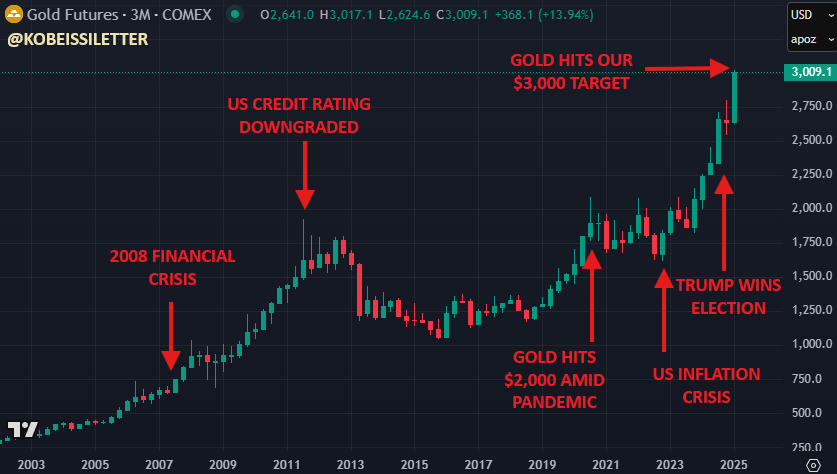
THE $20 TRILLION GOLD CALL:
Hours ago, one of our biggest calls of 2024 officially came to fruition: gold prices hit a RECORD $3,000/oz.
In just 13 months, gold has added +$7 TRILLION of market cap, now worth a record $20 TRILLION.
How did we get here?
(a thread)
English
Xi's meeting with private tech titans goes beyond an alignment b/w the state & the private sector. It's part of a detailed tech security strategy by China's Central National Security Commission in "The Total National Security Paradigm (2022)," translated here for the first time:

English

1/10
FT: "A cheaper renminbi would help Chinese exporters remain competitive in the face of higher tariffs in the US, but it could also leave China open to the accusation of currency manipulation, a charge levelled by the previous Trump administration."
ft.com/content/215e50…
English

Kendall Jenner charges millions for a single Instagram post.
But a small Australian bikini brand got her to promote them for free.
No contracts. No payments. No ads.
How did they do it? The story will blow your mind...


English

I understand the sentiment, but respectfully disagree. I don't think dress codes do much to improve aesthetics, largely because they don't change what has caused a decline in aesthetics. It is not about lack of personal pride but rather shifts in our commercial system. 🧵
Vincent Goodwill@VinceGoodwill
PSA on this alleged “unofficial” start of the NBA season: 🗣️coaches should be wearing suits on the sidelines🗣️
English


1/9
"The Bank of Korea on Thursday cut interest rates unexpectedly in a rare back-to-back move reflecting concern over the impact of Donald Trump’s second presidency," according to the FT.
ft.com/content/034a06…
English

Yet another $NVDA thread.
There are 4 illegitimate ways a company can grow revenue and maintain margins the way Nvidia has.

English
My personal story of Chinese swimmers doping
I shared my story of being a child swimmer in Shanghai in the 1970s. I was a swimming for the prep team of Shanghai municipality, which has always been one of the best in China. I was second best in freestyle and best in backstroke. My mate, Qiu, who was both my schoolmate and my close by neighbor. He was best in freestyle on the team. He eventually went onto the national team and was a member of the national 4x100 relay team. I asked him about doping in 1990, when the subject first surfaced in our community. He said “of course” it’s true. He told me that China national team hired East German swimming coaches, after the wall came down and these known doping coaches lost their jobs there. East German had Kee own doping program and was a swimming powerhouse in the 1980s. These coaches were hired to come over to China and to bring the doping program with them. Qiu was thinking to quit the team because doping was pushed down to the swimmers and he was worried about the long term health consequences.
I also asked him about Shen JianQiang, who was a national sensation after taking ten gold medals in 1987 National Games. His answer “of course, we know he is doping. How can one possibly have the stamina to take ten golds?”en.wikipedia.org/wiki/Shen_Jian…
Here’s a history since then
1990s
Rise of Chinese Swimmers: In the early 1990s, Chinese swimmers began to dominate international competitions, raising suspicions due to the sudden and dramatic improvement in their performances. At the 1994 World Aquatics Championships in Rome, China won 12 out of 16 women’s events, which caught the attention of the global swimming community.
The Scandal Unfolds
•Positive Drug Tests: The suspicions were confirmed when several Chinese swimmers tested positive for banned substances, particularly anabolic steroids. Between 1994 and 1998, over 40 Chinese swimmers were caught for doping violations, a number unprecedented in swimming.
•1994 World Championships: At the 1994 World Championships, seven Chinese swimmers tested positive for dihydrotestosterone (DHT), an anabolic steroid. This led to the stripping of medals and widespread criticism.
•1998 Perth World Championships: The scandal escalated at the 1998 World Championships in Perth, Australia, when Chinese swimmer Yuan Yuan was caught with a large quantity of Human Growth Hormone (HGH) in her luggage. This incident further damaged China’s reputation in the sports world.
2000s
In the 2000s, China’s swimming program continued to be marred by doping scandals, although the frequency and intensity of these incidents were less than in the 1990s. Here’s an overview of the key doping-related events in Chinese swimming during that decade:
Renewed Doping Concerns
•2001 FINA Suspension: In 2001, the International Swimming Federation (FINA) suspended four Chinese swimmers after they tested positive for banned substances. This suspension kept the spotlight on China’s swimming program and indicated that the problem of doping had not been fully eradicated.
•Ouyang Kunpeng (2008): One of the most high-profile cases in the 2000s involved Ouyang Kunpeng, a Chinese backstroke specialist. In 2008, just before the Beijing Olympics, Ouyang was handed a lifetime ban after testing positive for a banned substance. Ouyang was one of China’s top swimmers at the time, and his suspension was a significant blow to the national team, particularly given the timing so close to the Olympics on home soil.
•Yang Aihua (2007): In 2007, Chinese swimmer Yang Aihua was banned for testing positive for erythropoietin (EPO), a drug commonly associated with endurance sports but also used in swimming for enhancing oxygen capacity. Her ban further fueled concerns about ongoing doping practices (1/2)
English
1/5
The FT makes an important point that is often forgotten. While the focus in China has mainly been on the glamorous, high tech end of industry – including the so-called "new productive forces" – this isn't where much of the Chinese economy operates.
ft.com/content/84ac95…
English

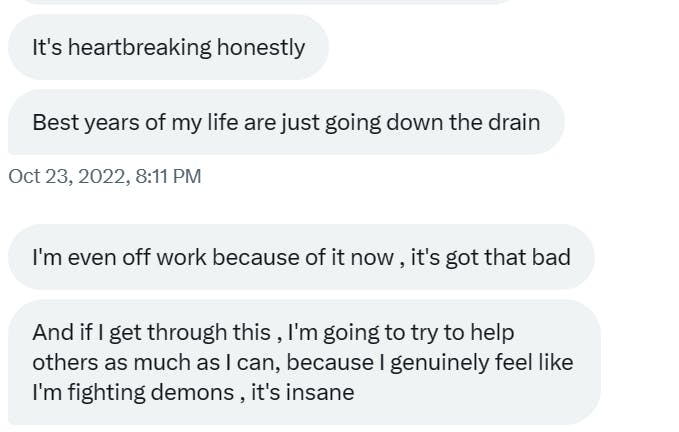
A client of mine DESTROYED lifelong social anxiety at 27 years old with a simple mindset change...
Even after years of therapy & medication didn't work
This is what we did:
English
1/4
This is crazy. Germany exports its domestic demand deficiency to its trade partners through its trade surplus, without which German unemployment would rise as it absorbed the consequence of domestic demand too weak to absorb domestic production.
bloomberg.com/news/articles/…
English