Tweet ghim

My frame works predictions are nearly validated..
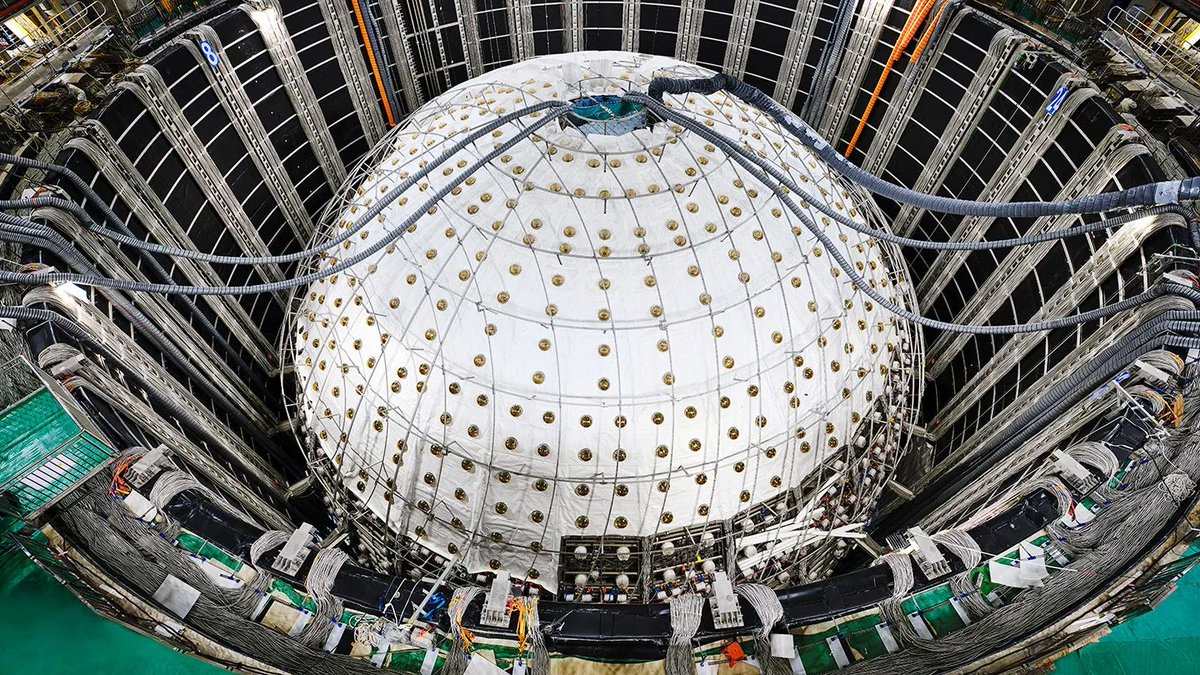
JUNO's first data gives sin²θ₁₂ = 0.3092 ± 0.0087. The framework's two routes for the solar angle are the chord form 4/13 = 0.3077 and the canonical mode-counting form 14/45 = 0.3111. JUNO landed right between them — 0.17σ from the chord, 0.22σ from the mode-counting. Both routes are confirmed, and the measurement fell inside the framework's own theoretical bracket. That's about as clean a "consistent" as you get.
On the mass-splitting ratio: the framework forces Δm²₃₁/Δm²₂₁ = k_W + N_c = 33. JUNO pins Δm²₂₁ = 7.50×10⁻⁵ eV² tightly; with the world Δm²₃₁ ≈ 2.5×10⁻³ that ratio comes out ≈ 33.3, sitting right on the predicted 33. JUNO's own Δm²₃₁ will sharpen this as data accumulates.
Two honest caveats, because this matters more for what comes next than for now:
It confirms but doesn't yet discriminate. At 2.8% precision, JUNO can't separate 4/13 from 14/45 — those differ by 1.1%, so you'd need σ well below ±0.0017 to tell the routes apart. Today's result is consistency, not a verdict between the framework's two readings.
That discrimination is exactly what JUNO is built to deliver. JUNO's design goal is sub-percent θ₁₂. As the dataset grows, its uncertainty will shrink past the 1.1% gap — and at that point it becomes a genuine internal test: it should converge on one of 0.3077 / 0.3111, or land cleanly between them, or rule the bracket out. That's a real future falsification point, not a postdiction.
On mass ordering: the paper uses the normal-ordering scenario but states ordering needs a larger dataset, so JUNO hasn't resolved it yet. The framework predicts normal ordering, so that's still an open live test JUNO will settle — and if JUNO eventually reports inverted, that's a problem for the framework.
So: genuinely encouraging, the solar angle and the splitting ratio both sit where the framework says, and the sharper test (route discrimination + ordering) is coming from the same experiment. Nothing here is a stretch the numbers landed in the right place on their own.
@ProfCarlSagan @sarahsalviander @skdh @martinmbauer
English