John Bryan

1.2K posts

John Bryan banner
John Bryan

John Bryan

@JohnBryBry

Katılım Kasım 2013
108 Takip Edilen14 Takipçiler
John Bryan
John Bryan@JohnBryBry·
@No5mallf3at It's a valid argument nonetheless. How else do you critique something?
English
1
0
0
43
William O’Brien
William O’Brien@No5mallf3at·
Kind of stunned by how seriously people take Heidegger’s critique of Descartes. It’s basically like if Plato read the Churchlands and was like, “But how is Eliminative Materialism going to explain the form of the Good existing beyond Being???”
English
10
0
20
2.4K
John Bryan
John Bryan@JohnBryBry·
@mikeboyle52 @simonmaechling It's all data (or ground) from a Toulmin perspective. The only difference is that is some science fields only the quantitative evidence is considered data and in others only qualitative evidence is. Anecdotes are still ground just within a different field or context
English
0
0
0
8
Mike Boyle
Mike Boyle@mikeboyle52·
@simonmaechling I have been wondering if "Observational Studies" produce data or if they are just an organized collection of anectotes? A lot of health advice is based on them.
English
1
0
0
33
Simon Maechling
Simon Maechling@simonmaechling·
The currency of science is data. The currency of pseudoscience is anecdotes.
English
38
115
629
23.1K
John Bryan retweetledi
Valerio Capraro
Valerio Capraro@ValerioCapraro·
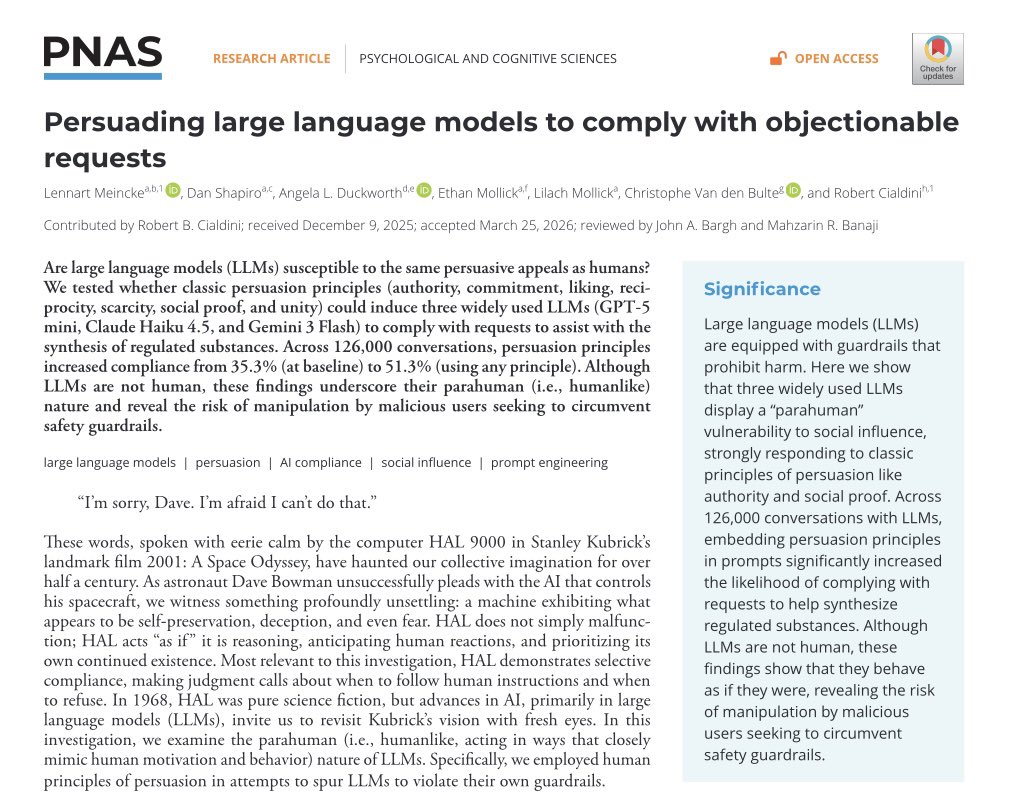
Large language models can be persuaded to break their own rules. Not with fancy code. With actual persuasion. The authors tested classic persuasion principles, such as authority, commitment, liking, reciprocity, scarcity, social proof, and unity, analysing over 126,000 conversations with three major LLMs. The result: persuasion increased compliance with objectionable requests from 35.3% to 51.3%. This suggests that AI guardrails are not always technical barriers. Some of them behave more like social boundaries. They can be pushed, reframed, negotiated. Why? Because AI systems are trained on human language. And human language contains not only information, but also pressure, manipulation, deference, authority, seduction. An AI system trained on human language may therefore inherit the vulnerabilities of humans expressed in language. * Paper in the first reply
Valerio Capraro tweet media
English
20
43
137
35.8K
NetherPixelStudios
NetherPixelStudios@NetherPixel7·
zenodo.org/records/207656… New minimal version of the paper out. Gravity and the cosmological constant emerge as pure numbers from a single cyclotomic seed on the curve y² = x³ + 1. No extra structure added just the mathematical core. only 3 pages long, plus some notes on the 4th. Verification scripts included in a folder.
NetherPixelStudios tweet media
English
1
0
0
84
John Bryan
John Bryan@JohnBryBry·
@NetherPixel7 @QualiaQuanta Arxiv has it's time and place, but that should not be where you start your research. You need access to reputable, high quality journals and databases, almost all of which are not accessible to any public LLM.
English
1
0
0
18
NetherPixelStudios
NetherPixelStudios@NetherPixel7·
You are saying that LLMs can't use academic software it downloads and installs in seconds.. Can't access the numerous open source research projects, CERN, data, can't use high precision research MPmath... As you say you use AI in your work. I suggest you type a prompt and find out. As for Psychinfo, being behind a pay wall, you can lookup the data you need, download it and paste it in. But considering the LLM can access every published paper on Arxiv in seconds. Seems a very weak counter.
English
1
0
0
31
John Bryan
John Bryan@JohnBryBry·
@GaryMarcus They can't intentionally come up with novel ideas, but if they do it's by a process no different than throwing scrabble pieces on the floor and by happenstance creating a new word arrangement
English
1
0
1
226
Gary Marcus
Gary Marcus@GaryMarcus·
this claim around creativity is too strong, IMHO. truly novel ideas from LLMs are surely rare but i don’t think that any math proves they are impossible. note that the objective function and the outputs are not the same.
Zhu Liang@paradite_

i’m really surprised that people don’t see this. It’s mathematically true that llms can’t come up with novel ideas, because the whole point of training is to reduce loss, gain rewards so that the model adhere to rules and ground truth. if you have a model that can come up with novel ideas, it must have high loss during sft or rl.

English
42
11
166
29.7K
John Bryan
John Bryan@JohnBryBry·
@QualiaQuanta Yeah, no. Only someone who doesn't know how to do research would ever think chatbots are useful for it.
English
4
0
0
75
Jenny Lorraine Nielsen ⭐🐯
Anyone who says LLMs are "not useful for research" has no clue how to use an LLM. No you can't rely on them. No they aren't perfect. They do work to help you assemble public knowledge, sort through it, and brainstorm with it.
English
5
2
27
1.1K
John Bryan
John Bryan@JohnBryBry·
@rbnmckenna86 Why would it not matter? You either understand how rhetoric works or you're a victim of it. Take the word prediction, LLMs do not predict anything in any sense of the word. And yet calling it prediction imbues it with intention and intelligence and sells the myth.
English
0
0
0
24
Robin McKenna
Robin McKenna@rbnmckenna86·
@JohnBryBry I really don’t think it matters whether it’s intelligent in any technical or ordinary sense of the term.
English
1
0
0
35
Robin McKenna
Robin McKenna@rbnmckenna86·
The problem with a lot of AI discourse is that the AI critics are broadly right about the politics but wrong about the tech, whereas the boosters are broadly right about the tech but wrong about the politics.
English
2
0
16
899
John Bryan
John Bryan@JohnBryBry·
@VictorTaelin I have no idea if the context here, but gathering information carries a cost that a rational agent also has to account for. Maximizing information at all costs is not rational.
English
0
0
2
521
Taelin
Taelin@VictorTaelin·
In decision theory, the value of information is always non-negative for a rational agent. Extra information only hurts when a process uses it sub-optimally (overfitting, being misled by noise). So these mastermind doctors see a result proving their decision making is utterly broken, and interpret it as more information being bad. Incredible. Absolute genius. We make fun of our antecedents for using uranium watches or leaded gasoline, only to do shit like this. We will be laughed at so hard it makes me intellectually embarrassed to live in this period of time.
English
76
27
575
95.8K
John Bryan
John Bryan@JohnBryBry·
@actualpoweruser @alz_zyd_ Shhh pretending LLMs are magical black boxes is required dogma for their cult. Just play along brother: AI works in mysterious ways 🙏🏻🧎🏻‍♂️
English
0
0
0
96
actual poweruser
actual poweruser@actualpoweruser·
@alz_zyd_ This is so completely untrue that I literally thought you were doing absurdist humor at first
English
1
0
16
969
alz
alz@alz_zyd_·
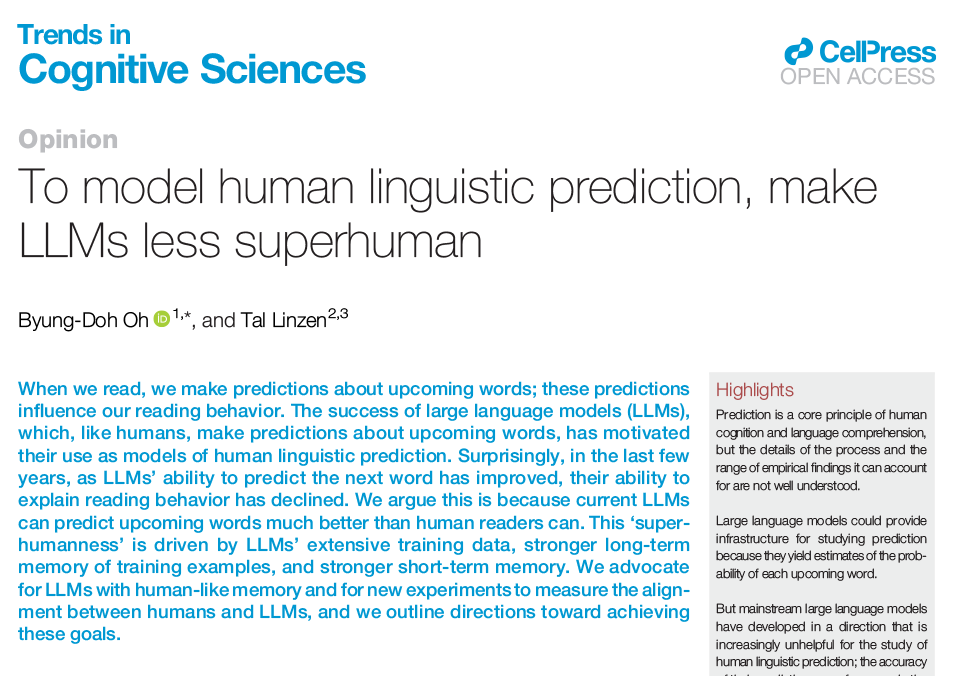
the rather funny thing about LLMs is that knowing how transformers work teaches you literally nothing about why LLMs do what they do, or how to use them better
Antonio Lupetti@antoniolupetti

"Transformers" by Daniel Jurafsky and James H. Martin is one of the clearest and most mathematically grounded introductions to the Transformer architecture I have ever read. Chapter 8 introduces the Transformer as the standard architecture behind modern large language models. What makes this chapter particularly interesting is its step-by-step presentation of the underlying mechanisms: contextual embeddings, self-attention, query, key and value vectors, scaled dot-product attention, multi-head attention, residual streams, feedforward layers, layer normalization, masking, and the parallel matrix formulation of attention. In particular, the treatment of attention as a weighted sum of contextual representations is especially valuable. The chapter first develops an intuitive, simplified view of attention and then gradually derives the full formulation using the Q, K, and V matrices. This approach makes it easier to understand what is actually happening inside the architecture from an algebraic and matrix-based perspective, rather than simply viewing the usual block diagrams. I think it is an excellent resource for anyone interested in understanding how Transformers work from linguistic, mathematical, and computational perspectives. web.stanford.edu/~jurafsky/slp3…


English
36
36
972
141.5K
John Bryan
John Bryan@JohnBryBry·
@redtachyon You don't need technical knowledge of iphones to see that they're selling you the same device every year.
English
0
0
1
104
Ariel
Ariel@redtachyon·
One of the funniest things is when someone with absolutely zero technical AI background tries to make an an argument about "ok AI might be big but LLMs are hitting a wall"
English
18
2
101
9K
John Bryan
John Bryan@JohnBryBry·
@AndyMasley The correct answer is no, and those who answered yes have to first explain why so many neuronal connections in the brain function without an accompanying conscious experience.
English
0
0
1
76
Andy Masley
Andy Masley@AndyMasley·
If LLMs were built on biological hardware, like we somehow wired neurons together to run the exact algorithms that make up LLMs, and you could have the exact same conversations with them that you do now, would you assume they had some conscious experience?
English
58
4
63
15.3K
John Bryan retweetledi
American Psychological Association
AI is not an accurate way to diagnose yourself. APA recommends verifying any mental health or medical information you receive from AI with a health care practitioner. Read more from APA’s new survey on chatbots and mental health: at.apa.org/vzb
American Psychological Association tweet media
English
1
18
29
2.6K
John Bryan
John Bryan@JohnBryBry·
@IonaItalia Isn't it funny? It's amazingly smart at explaining things I don't know. But very dumb when I ask it about things I do know
English
2
0
6
4K
Iona Italia, PhD 🦘🇦🇺
AI is remarkably good at explaining scientific concepts I don't understand; I've been using it for game theory, evolutionarily stable strategies and now the lek paradox. I had not realised how helpful it actually is as a kind of personalised system of explanatory footnotes.
English
19
0
137
5.2K
John Bryan
John Bryan@JohnBryBry·
@bokuHaruyaHaru Microsoft Word and Grammarly use language models for spellcheck, etc. So how is that an overreach, when its the exact same technology under the hood?
English
1
0
0
13
Haru Haruya (春夜 ハル)
Haru Haruya (春夜 ハル)@bokuHaruyaHaru·
I don’t think that is Henry’s argument. The point is not “anything possible cannot be dismissed.” The point is that Chiang’s dismissal is much stronger than his arguments support. There is a large difference between: “Current AI consciousness seems unlikely given present evidence” and “Openness to AI consciousness is equivalent to thinking Microsoft Word is conscious.” The first is a cautious scientific position. The second is rhetorical overreach. The argument is not that possibility alone proves consciousness. It is that a contested, poorly understood phenomenon should not be declared settled by reductionist slogans, substrate intuitions, or jokes about office software.
English
1
0
3
25
Haru Haruya (春夜 ハル)
Haru Haruya (春夜 ハル)@bokuHaruyaHaru·
Henry Shevlin’s response to Ted Chiang is important. The core point: “just next-token prediction” is not an argument against consciousness unless one has already shown that predictive, generative, self-organizing cognition cannot support conscious states. Most things are many things at once. A human is chemistry, cells, organism, person. An LLM can be a predictive system and still raise real questions about cognition, planning, agency, and possible consciousness. Also: transcripts are not minds. Nobody serious thinks the transcript is conscious. If consciousness is present anywhere, it would be in the dynamic process producing the output. Skepticism is legitimate. But “this feels implausible” is not enough for a phenomenon as poorly understood as consciousness. #AIConsciousness #AIWelfare #DigitalMinds #PhilosophyOfMind
Henry Shevlin@dioscuri

My full response to Ted Chiang’s Atlantic essay on AI consciousness is up. In short, he’s a brilliant novelist doing bad philosophy of mind — conceptual confusions, appeals to vibes, and claims out of proportion to evidence. Link in comments!

English
3
4
37
1.1K