Maryam
1.7K posts

Maryam
@Sci_Tech_Eng
Exploring in neural networks from the inside purely biological mind with heavy cognition architecture & mapping the phase space where thought becomes destiny.


.@poetiq_ai is a new startup that recently achieved a major jump on the ARC-AGI benchmark by layering a recursive self-improvement system on top of existing models. In this episode of the @LightconePod, Poetiq's Founder & CEO @itfische joined us to discuss how small teams can build “reasoning harnesses” that outperform base models, what that means for startups and why automating prompt engineering may be one of the most powerful levers in AI today. 00:00 – Intro 00:40 – What Is Poetiq? 01:07 – Recursive Self-Improvement Explained 02:07 – The Fine-Tuning Trap 02:59 – “Stilts” for LLMs 03:14 – Recursive Self-Improvement vs. Fine-Tuning 05:05 – Taking the Top Spot on ARC-AGI 06:37 – Beating Claude on Humanity’s Last Exam 08:40 – How the Meta-System Works 10:26 – Beyond RL: A New S-Curve 11:32 – Automating Prompt Engineering 13:37 – From 5% to 95% Performance 14:50 – Early Access & Putting Your Agent on Stilts 16:17 – From YC Founder to DeepMind Researcher 18:29 – Advice for Engineers in the AI Era


📁 Alexandr Wang, founder of Scale AI and Chief AI Officer of Meta, says the next five years could bring some of the most monumental discoveries in human history. The goal is not just to build superintelligence, but to design the organization capable of delivering it. With 3.5 billion users, Meta has the reach to deploy breakthroughs at planetary scale. The race is not only for smarter models. It is for the team that can build them first.


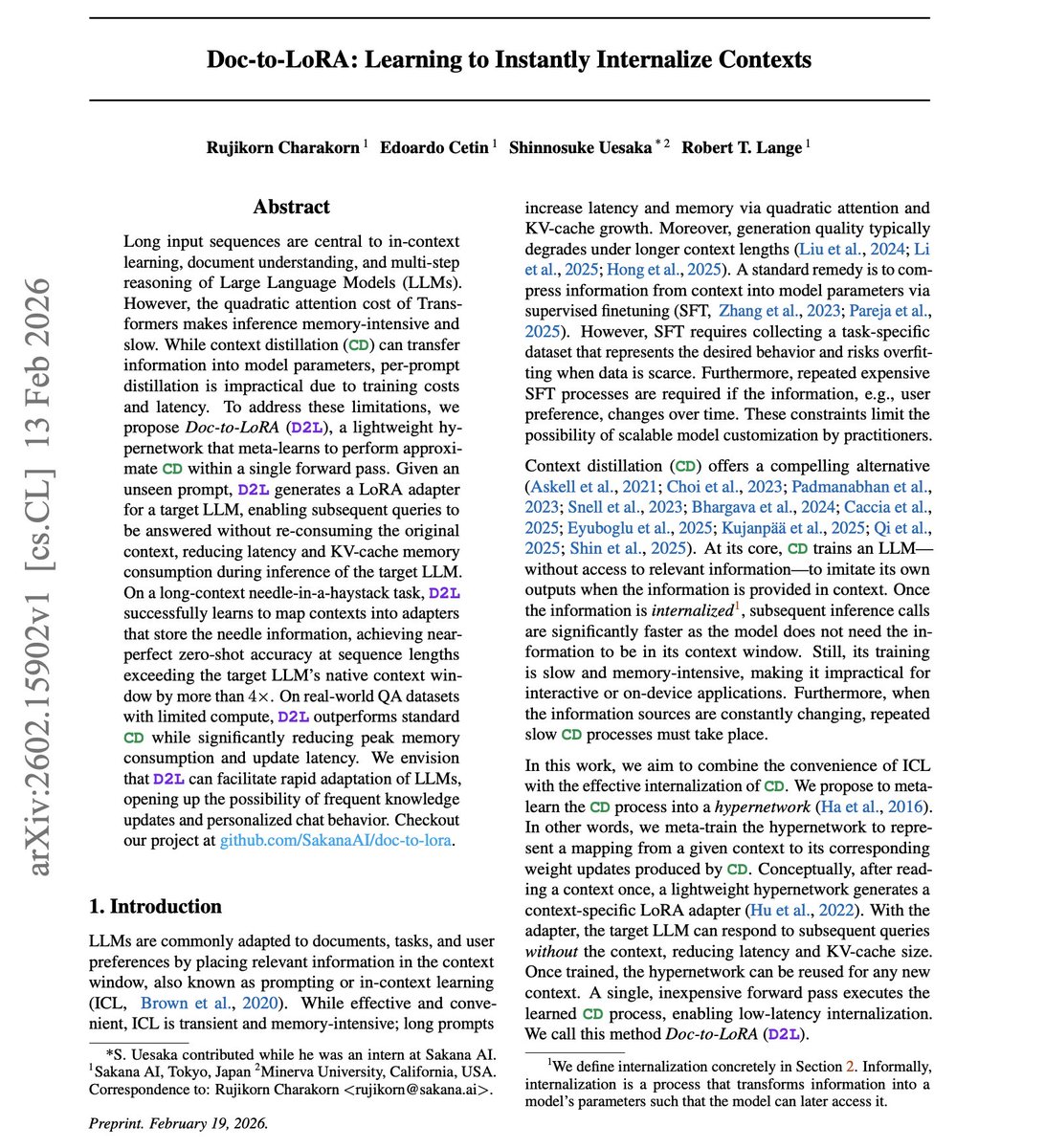
We’re excited to introduce Doc-to-LoRA and Text-to-LoRA, two related research exploring how to make LLM customization faster and more accessible. pub.sakana.ai/doc-to-lora/ By training a Hypernetwork to generate LoRA adapters on the fly, these methods allow models to instantly internalize new information or adapt to new tasks. Biological systems naturally rely on two key cognitive abilities: durable long-term memory to store facts, and rapid adaptation to handle new tasks given limited sensory cues. While modern LLMs are highly capable, they still lack this flexibility. Traditionally, adding long-term memory or adapting an LLM to a specific downstream task requires an expensive and time-consuming model update, such as fine-tuning or context distillation, or relies on memory-intensive long prompts. To bypass these limitations, our work focuses on the concept of cost amortization. We pay the meta-training cost once to train a hypernetwork capable of producing tasks or document specific LoRAs on demand. This turns what used to be a heavy engineering pipeline into a single, inexpensive forward pass. Instead of performing per-task optimization, the hypernetwork meta-learns update rules to instantly modify an LLM given a new task description or a long document. In our experiments, Text-to-LoRA successfully specializes models to unseen tasks using just a natural language description. Building on this, Doc-to-LoRA is able to internalize factual documents. On a needle-in-a-haystack task, Doc-to-LoRA achieves near-perfect accuracy on instances five times longer than the base model's context window. It can even generalize to transfer visual information from a vision-language model into a text-only LLM, allowing it to classify images purely through internalized weights. Importantly, both methods run with sub-second latency, enabling rapid experimentation while avoiding the overhead of traditional model updates. This approach is a step towards lowering the technical barriers of model customization, allowing end-users to specialize foundation models via simple text inputs. We have released our code and papers for the community to explore. Doc-to-LoRA Paper: arxiv.org/abs/2602.15902 Code: github.com/SakanaAI/Doc-t… Text-to-LoRA Paper: arxiv.org/abs/2506.06105 Code: github.com/SakanaAI/Text-…

We’re excited to introduce Doc-to-LoRA and Text-to-LoRA, two related research exploring how to make LLM customization faster and more accessible. pub.sakana.ai/doc-to-lora/ By training a Hypernetwork to generate LoRA adapters on the fly, these methods allow models to instantly internalize new information or adapt to new tasks. Biological systems naturally rely on two key cognitive abilities: durable long-term memory to store facts, and rapid adaptation to handle new tasks given limited sensory cues. While modern LLMs are highly capable, they still lack this flexibility. Traditionally, adding long-term memory or adapting an LLM to a specific downstream task requires an expensive and time-consuming model update, such as fine-tuning or context distillation, or relies on memory-intensive long prompts. To bypass these limitations, our work focuses on the concept of cost amortization. We pay the meta-training cost once to train a hypernetwork capable of producing tasks or document specific LoRAs on demand. This turns what used to be a heavy engineering pipeline into a single, inexpensive forward pass. Instead of performing per-task optimization, the hypernetwork meta-learns update rules to instantly modify an LLM given a new task description or a long document. In our experiments, Text-to-LoRA successfully specializes models to unseen tasks using just a natural language description. Building on this, Doc-to-LoRA is able to internalize factual documents. On a needle-in-a-haystack task, Doc-to-LoRA achieves near-perfect accuracy on instances five times longer than the base model's context window. It can even generalize to transfer visual information from a vision-language model into a text-only LLM, allowing it to classify images purely through internalized weights. Importantly, both methods run with sub-second latency, enabling rapid experimentation while avoiding the overhead of traditional model updates. This approach is a step towards lowering the technical barriers of model customization, allowing end-users to specialize foundation models via simple text inputs. We have released our code and papers for the community to explore. Doc-to-LoRA Paper: arxiv.org/abs/2602.15902 Code: github.com/SakanaAI/Doc-t… Text-to-LoRA Paper: arxiv.org/abs/2506.06105 Code: github.com/SakanaAI/Text-…