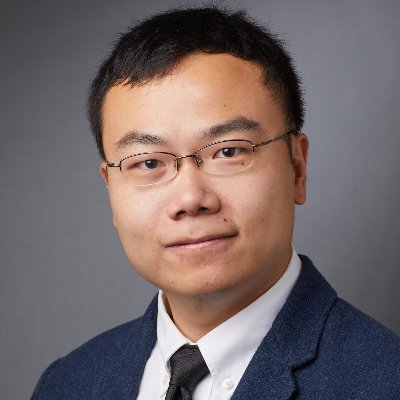
Xiaojing Gao

399 posts

Xiaojing Gao

Xiaojing Gao

@SynBioGaoLab

Assistant Professor @ Stanford ChemE synthetic biology, biomolecular engineering https://t.co/KAajKt7YdT

Stanford, CA Tham gia Haziran 2019
840 Đang theo dõi3K Người theo dõi
Tweet ghim
Xiaojing Gao
Xiaojing Gao@SynBioGaoLab·
We previously built programmable RNA sensors based on editing by housekeeping ADAR enzymes. But they can't sense arbitrary sequences due to design constraints (analogous to PAM for CRISPR). With our new "modulADAR", we overcome that constraint by leveraging ADAR's modularity.
English

3
19
103
13.8K
Steven Banik
Steven Banik@StevenMBanik·
Excited to share our latest preprint on work led by postdoc Robert Lusi (@noScandineHere)! Introducing ALTER (AGO-Led Targeted Editing of RNA) for non-downregulatory RNA manipulation by repurposing hAGO2, non-immunogenic and capitalizing on evolution. biorxiv.org/content/10.648…
English
2
14
31
3.9K
Norn Group
Norn Group@NornGroup·
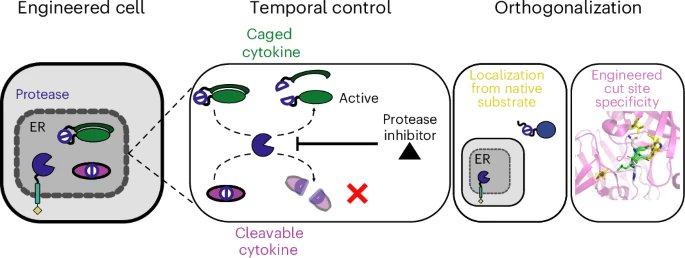
Tracking aging is hard because we don’t yet know what blood markers capture signals. This prevents us from measuring aging over time, or test ways to change it. Through @impetusgrants, we funded @SynBioGaoLab at @Stanford to change this. With his project on protein circuits to enable urinal monitoring of aging, his lab aims to engineer biomolecular circuits that detect internal aging hallmarks and convert them into reporter peptides that can be measured in a simple urine sample. The lab has been prolific, with three papers across Nature Chemical Biology @nchembio and Cell Systems @CellSystemsCP establishing the building blocks for this system: a synthetic receptor platform (LIDAR), a platform to control enzyme activity using human-derived proteins (hDIRECT), and a machine-learning workflow to predict whether the body accepts these synthetic tools (“computational deimmunization”). Congratulations to the Gao lab! More to come in 2026.
Norn Group tweet mediaNorn Group tweet mediaNorn Group tweet mediaNorn Group tweet media
English
2
7
42
5.7K
Xiaojing Gao đã retweet
Prashant Mali
Prashant Mali@prashantgmali·
New preprint from the lab led by the amazing Jack Bryant! # tunable genetic medicines, # endogenous ADARs "Regulatable In Vivo Gene Expression via Adaptamers" biorxiv.org/content/10.648…
English
1
6
38
5.7K
Xiaojing Gao đã retweet
Chang Liu
Chang Liu@chang_c_liu·
Important paper from Jason Chin's and Julian Sale's labs realizing key operations needed for building synthetic human genomes. My repeated reaction reading this paper was "um, I didn't know you could just do that." science.org/doi/abs/10.112…
English
3
29
134
17.5K
Xiaojing Gao
Xiaojing Gao@SynBioGaoLab·
Have you ever wondered what it would've been like to live in a different kind of society? After a record number of rejections, I'm self-archiving my first attempt at... flash fiction, featuring "Hemingway-esque economy" and "Ishiguro's measured revelation" (if you ask Claude).
Xiaojing Gao tweet media
English
1
0
5
566
Xiaojing Gao đã retweet
Xiaojun Tian
Xiaojun Tian@xiaojuntian·
Thrilled to share our new paper in Cell! We show that phase separation can buffer growth-mediated dilution in synthetic circuits by stabilizing gene expression under dynamic conditions, bringing spatial control into the genetic design toolbox Proud of our amazing team & collaborators! cell.com/cell/fulltext/…
English
1
6
18
1.4K
Xiaojing Gao đã retweet
Chang Liu
Chang Liu@chang_c_liu·
I am delighted to share this work, led by Miguel Alcantar and done in collaboration with Amgen, on the OrthoRep-driven evolution of computationally designed minibinders. Here, we focus not only on getting to high affinity, but also on mapping sequence-affinity landscapes of diverse evolutionary outcomes. One way we arrive at diverse evolutionary outcomes is through "neutral drift" where we take one binder and diverge it into many by selecting for the maintenance of (but not improvement of) binding. This is very easy to do with OrthoRep because rapid mutation of the binder occurs autonomously. The result is a rich sequence-affinity dataset spanning both a range of sequences and affinities. We are now scaling these approaches, including to antibodies and a broad array of targets, to get the right distribution and volume of data for training generative models for binder design. biorxiv.org/content/10.110…
English
2
21
116
13.6K
Xiaojing Gao đã retweet
Dr. Yi Zuo
Dr. Yi Zuo@YiZuoUCSC·
It’s back! 🎉 The Stanford–UCSC Advanced Techniques in Neuroimaging Workshop returns April 13–17, 2026 🧠💡 Learn from experts, hands on experience. Free and housing included! Spots are limited — apply now and spread the word! #Neuroimaging #Zuolab med.stanford.edu/beckman/ATNWor…
Dr. Yi Zuo tweet media
English
1
36
178
14.5K
Xiaojing Gao đã retweet
Siyuan (Steven) Wang
Siyuan (Steven) Wang@SStevenWang·
Our RAEFISH spatial transcriptomics technology is now published in Cell @CellCellPress! RAEFISH enables sequencing-free whole genome spatial transcriptomics at single molecule resolution. This work represents the first time that transcripts from more than 23,000 genes were directly probed and imaged in situ with any technology, and the first time numerous different gRNAs were directly probed and distinguished by imaging in a high-content CRISPR screen. The challenge: Recent breakthroughs in spatial transcriptomic technologies, from us and others, have greatly improved our ability to profile cell types, states, cellular interactions, and the underlying gene programs within the native tissue contexts. However, these technologies have limitations. Methods based on 2D-array-capture/tagging and ex situ sequencing offer genome-scale coverage, but lack the resolution needed to accurately study fine spatial organization. In contrast, image-based methods that rely on highly multiplexed fluorescence in situ hybridization or in situ sequencing provide single-molecule resolution and resolve fine spatial organization, but require pre-selecting a limited set of target genes (typically hundreds to a few thousand genes), which limits discovery and sometimes leads to only validations of prior knowledge due to the pre-selected targets being well studied in the context. The solution: RAEFISH, our lab's new flagship image-based spatial transcriptomics technology, simultaneously enables single-molecule spatial resolution and whole-genome level coverage of long and short, endogenous and engineered RNA species in cell cultures and intact tissues. The results: 🔥 We performed RAEFISH targeting 23,312 human genes in cell cultures, and demonstrated hypothesis-free discovery of cell cycle associated genes and subcellular localization patterns of transcripts, including nearly the entire protein coding transcriptome and additional long noncoding RNAs. 🔥 We performed RAEFISH targeting 21,955 mouse genes in mouse liver, placenta, and lymph node tissues. Our analyses on immediately neighboring cells uncovered intriguing cell-cell interactions and previously unknown gene expression programs underlying the interactions, such as those between cholangiocytes and immune cells. 🔥 Finally, we further developed RAEFISH to directly read out guide RNAs (gRNAs), demonstrating Perturb-RAEFISH in an image-based high-content CRISPR screen. The capacity of Perturb-RAEFISH to directly read out gRNAs addresses a crucial limitation of previous techniques that read out a barcode/identifier sequence paired with each gRNA species, as the pairing can be shuffled due to RNA recombination intrinsic to lentivirus used in such screens, which limits screen sensitivity and accuracy. In summary, RAEFISH provides the biomedical research community with a generalizable research tool, which will bring more spatial and mechanistic insights across health and disease. This work was co-led by my postdocs Drs. @ChengYubao, Shengyuan Dang, and Yuan Zhang, and was supported by the @NIH, @genome_gov, @sennetresearch, and @psscra. I would like to thank our co-authors, funding agencies, editor, reviewers, and my whole lab @YaleGenetics @YaleCellBio @YaleCancer @YaleMed @Yale. Link to paper: cell.com/cell/fulltext/…
Siyuan (Steven) Wang tweet media
English
17
118
418
45K
Katie Galloway
Katie Galloway@GallowayLabMIT·
but there's not a soul out there... no one to hear my prayer....
Katie Galloway tweet media
English
3
0
6
3.4K
Xiaojing Gao đã retweet
John Wang
John Wang@_jnwang·
Super excited to share what we’ve been working on in collaboration with @SynBioGaoLab over the past few months on de novo antibody design. Check out this great thread by our team lead @santimillef highlighting the technical aspects of the pipeline!
GIF
Santiago Mille@santimillef

The ability to design antibodies against any protein of interest has major implications for medicine, biotech, and basic science. Today, we introduce Germinal, a pipeline for epitope-targeted de novo antibody design achieving  4–22% success rates with efficient experimental validation.

English
4
17
108
11.8K
Xiaojing Gao đã retweet
Claudia Driscoll
Claudia Driscoll@driscoll_cl·
Not only can we now build AI-generated bacteriophages... we can design de novo antibodies to bind them! With Germinal, a new pipeline for de novo antibody design, we move closer to a world where antibodies can be designed against virtually any protein, on demand. Check it out:
Santiago Mille@santimillef

The ability to design antibodies against any protein of interest has major implications for medicine, biotech, and basic science. Today, we introduce Germinal, a pipeline for epitope-targeted de novo antibody design achieving  4–22% success rates with efficient experimental validation.

English
1
10
56
6.6K
Xiaojing Gao đã retweet
Talal Widatalla
Talal Widatalla@talaldotpdb·
Entering my PhD, de novo antibody design was a grand challenge I thought would not be solved without huge increases in affinity data and Ab-Ag structure. Only 2 years later, we provide the first open-source recipe to get antibody binders, almost magically, out of a computer (1/3)
Santiago Mille@santimillef

The ability to design antibodies against any protein of interest has major implications for medicine, biotech, and basic science. Today, we introduce Germinal, a pipeline for epitope-targeted de novo antibody design achieving  4–22% success rates with efficient experimental validation.

English
4
42
288
31.4K
Xiaojing Gao đã retweet
Brian Hie
Brian Hie@BrianHie·
Today, we report Germinal, a method for efficient de novo antibody design, with @santimillef and @SynBioGaoLab. Germinal achieves success rates of 4-22% across diverse epitopes. We make the work fully open, without doing lame things like posting a preprint without methods. 🧵
Brian Hie tweet media
English
17
149
728
105.9K
Xiaojing Gao
Xiaojing Gao@SynBioGaoLab·
Having often dealt with binder-limited projects, we sought a more accessible source for nanobodies than yeast display or llama. Here we introduce Germinal, computationally designing antibody-like binders with such a hit rate that only tens need to be screened for each target.
Xiaojing Gao tweet media
Santiago Mille@santimillef

The ability to design antibodies against any protein of interest has major implications for medicine, biotech, and basic science. Today, we introduce Germinal, a pipeline for epitope-targeted de novo antibody design achieving  4–22% success rates with efficient experimental validation.

English
3
10
54
9.1K