Dan Shapiro@DanielBShapiro
For my new followers, who may not have read all I've been writing, let's establish some order about my views:
1. Iran, under the current regime, is a violent, aggressive actor that threatens many neighbors, sponsors terror, calls for Israel's destruction, has much American (and other people's) blood on its hands, and oppresses the Iranian people. The sooner it is gone, the better.
2. I've called for major support for the Iranian people in their struggle for freedom.
3. I favor pressuring the Iranian regime in many ways, and I'm not opposed to using force against the Iranian regime: I supported Operation Midnight Hammer last summer, for example, and can imagine other operations I would support.
4. I am opposed to regime change wars in the Middle East. I've said from the beginning that I don't support Trump launching this war, this way.
5. Israel has its interests, as does any nation. When our interests align, as the often do, we should work together. When they do not, we should pursue our own path. (I also have many criticisms of the policies of the current Israeli government.) We are security partners, which serves our interests, but we can also disagree. Israel's security is an important US interest. But we also have leverage in this relationship, and it is completely legitimate for us to use it.
6. Trump launched this war without clear strategic objectives, adequate assessment of and preparation for the risks, and without any attempt to inform the American people of what we are doing and why, or seek the support of Congress or key allies. It's his decision, and he bears responsibility for it, no one else.
7. The U.S. military has performed brilliantly, at both the military strategic and operational levels. They will always have my support. Commanders have been straight with the American people about the military objectives they have been tasked to pursue. But the strategic objective they need from our political leaders (is it regime change?) remains muddled.
8. The war's early successes in taking out Iranian leaders and degrading many Iranian power projection capabilities provided a window in week 2 for Trump to claim victory and take an off-ramp. Not a perfect end, but achieving the main military objectives before Iran (the weaker party, but one with cards to play), could impose higher costs. He likely missed that opportunity, now that Iran is blocking the Strait of Hormuz. Of course that can't be allowed, but the costs of reversing it -- in blood and treasure, global economic damage, reduced readiness to deal with challenges from China and Russia -- and with minimal allied help, may be very steep.
9. It was predictable that strikes on Iranian energy facilities (by US or Israel) would lead to Iranian strikes on Gulf energy facilities. Even if the intent was to message Iran that their energy industry could be at risk if they don't open the Strait, that's a costly and needless escalation. But it is totally unjustified for Iran to strike Gulf nations who have been non-combatants in this war.
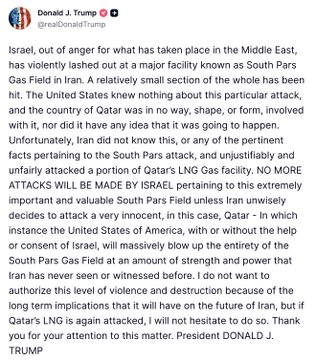
10. I served in the Pentagon, coordinating Middle East policy during wartime. I know how the IDF and CENTCOM work together. An Israeli strike on the South Pars gas field was unwise. But it could not have been carried out without U.S. knowledge, and explicit or implicit approval.
11. There is a narrow window following the Israeli and Iranian strikes, and Trump's Truth Social Post (untrue, but possibly useful in this context), to deescalate away from further strikes on energy industry targets in either direction. That will still leave a very challenging situation to unwind, but would be the best near term development.
12. If you've read this far, have a good night.