置顶推文
The AI Signal
62 posts

The AI Signal
@TheAI_Signal
AI is reshaping every business on the planet. I track what’s actually happening. Daily. No hype. No theory. Just signal.
Worldwide 加入时间 Nisan 2026
50 关注4 粉丝

@LuizaJarovsky The people building AI aren’t neutral technologists. They have a vision. And they’ve had it for years. The only question is whether the rest of us get a vote.
English

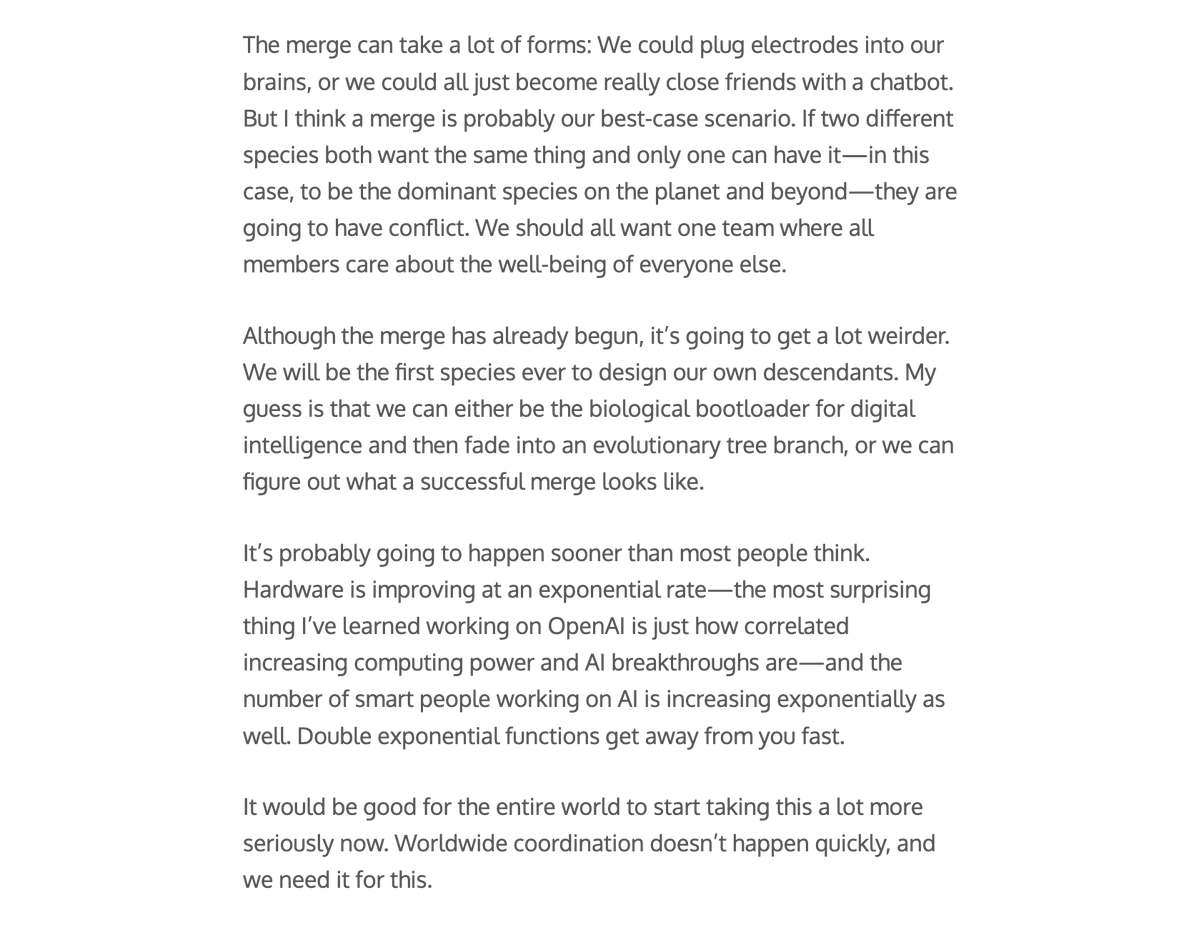
🚨 Most people are not aware, but many in AI really want humans to MERGE with machines.
I would say that this is a mainstream mentality in Silicon Valley. No questions asked.
If you don't believe me, read this excerpt from Sam Altman's 2017 blog post "The Merge" (link below).

Luiza Jarovsky, PhD@LuizaJarovsky
🚨 As AI narratives change to escape scrutiny, pro-human AI policies, rules, and rights must also advance. Most people haven't realized, but policies that propose "special status for AI" and "parallel coexistence between humans and AI" are essentially anti-human. My article:
English

OpenAI just updated Codex. And it changed what “working on your Mac” means.
It now runs in the background - clicking, typing, navigating apps - while you do something else entirely.
Multiple agents. Working in parallel. Not interrupting you once.
It also added memory. Codex now remembers your workflow, your tech stack, your preferences. Every session picks up where the last one left off.
And it can schedule its own work across days and weeks.
Let that sink in.
You go to sleep. Codex keeps working.
This isn’t a coding tool anymore. It’s the beginning of an AI that runs your computer for you.
Follow @TheAI_Signal — I track every move that matters for your business.
English

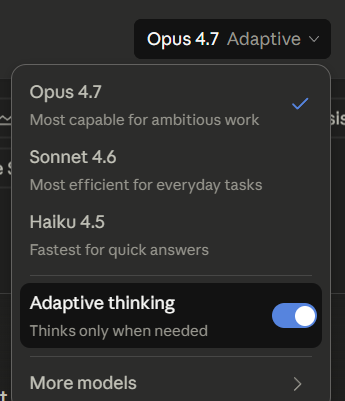
@emollick Adaptive thinking works until it decides your task doesn’t need it. No override means no recourse. That’s the user trust problem in one sentence.
English

Anthropic just released Claude Opus 4.7.
The update that should get every business owner’s attention:
“You can hand off your hardest work with less supervision.”
It now verifies its own outputs before reporting back.
Runs long tasks with more rigor. Follows instructions more precisely.
Think about what that means.
Every task you currently pay someone to do carefully and independently (research, analysis, complex decisions) just got a credible AI alternative.
Not a chatbot. Not a copilot.
A system that checks its own work before you even see it.
The gap between “AI assistant” and “AI employee” closed again today.
And it won’t stop closing.
Follow @TheAI_Signal — I track every move that matters for your business.
English

@claudeai Verifies its own outputs before reporting back.” That’s not a feature. That’s the beginning of autonomous work. The gap between “AI assistant” and “AI employee” just got smaller.
English

@zuess05 They’re not paying you to review the code. They’re paying you to sign off on it. Liability is the last moat humans have. For now.
English

Genuine question.
Tech companies are laying off thousands of engineers, and the ones left behind are basically just reviewing AI-generated code.
But what happens in 6 months when the AI stops making mistakes?
If your entire $200k job has been reduced to proofreading Claude's output, what exactly are they paying you for?
English

@gregisenberg Every SaaS has a power user. That person isn’t a feature. They’re a bug. Agents just made that visible.
English

agents are the new apps
the dirty secret of the SaaS era is that the software never actually worked. it was always 70% product, 30% the specific person in your company who knew how to make it behave. that person was called a "power user"
they were actually just a human patch
agents replace the patch and suddenly everyone realizes the software was broken the whole time
what's cool is how much opportunity there is right now
so pick a niche. any niche that you believe 1% of the market is $5M ARR+ there
the leader in that space has a 20 year old codebase and a customer base that only stayed because switching was painful
and that pain just got a lot easier to swallow
agents are the new apps
are you building yet
English

@shiri_shh The market isn’t pricing Anthropic’s revenue. It’s pricing who controls the infrastructure of the next economy. Samsung builds the chips. Anthropic decides what runs on them. Different game entirely.
English

@TheGeorgePu He didn’t come back to code. He came back to see how few engineers he still needs.
English

Zuckerberg hasn't written code in 20 years.
Last week he moved his desk into Meta's AI lab.
He started coding again.
Headline is about the CEO returning to the keyboard.
Buried in the same report:
Meta is mandating up to 65-80% of their developers' code written by AI by mid-2026.
That's two months from now.
The CEO coming back to code isn't the story.
He came back to replace his engineers with AI.
English

@guilleflorvs Copilot = your margins depend on the model. Outcome = every model improvement makes you more profitable. One of those is a business. The other is a feature.
English

Sequoia's thesis that the next $1T company will sell work, not software, is the most important reframe in AI right now.
The argument: if you sell a copilot, you're competing with every new model release. But if you sell the outcome — books closed, contracts reviewed, claims handled — every AI improvement makes your margins better, not your product obsolete.
The key insight most people miss: for every $1 spent on software, ~$6 is spent on services.
The entire SaaS playbook was about capturing the software dollar. The AI playbook is about capturing the services dollar — at software margins.
Not "AI for accountants." The AI accounting firm.
Not "AI for lawyers." The AI law firm.
The companies that figure this out won't look like SaaS companies. They'll look like services firms rebuilt on software infrastructure.
That's a fundamentally different company to build, fund, and scale. And most founders are still building copilots.

English

@levie Automate the referrals, expose the doctor shortage. Automate the code, expose the security gap. AI doesn’t remove bottlenecks. It moves them.
English

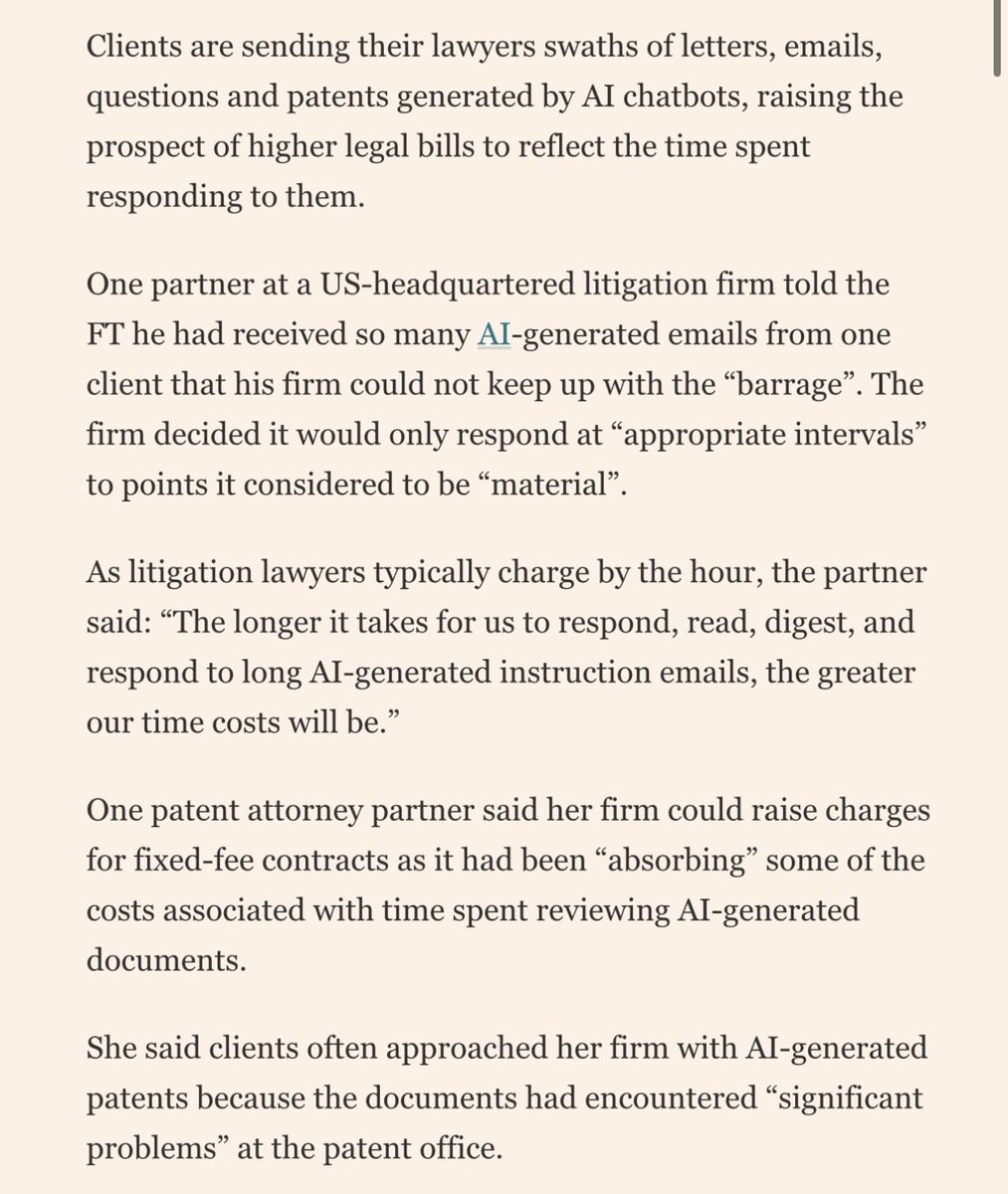
Why will AI create more jobs in plenty of industries? It’s because we’re going to use AI to accelerate output in one area, and then eventually you run into a new bottleneck somewhere else in the process that still requires humans.
This example from the FT is an obvious one. More people asking legal questions from AI agents, which downstream eventually will mean there are more lawyers being pinged with questions. There are other drivers, too, like AI accelerating new business formation, more patent filings, new scientific research, and so on - all of which eventually land in the laps of lawyers and other regulatory functions.
But the analogy holds for plenty of other work. More code will mean more security risks, which means more security researchers. Automating patient referrals in healthcare just leads to a bottleneck of not having enough doctors. More customer outreach via AI leads to more sales conversations. You can list thousands of categories like this.
There’s a lot of areas where AI will lead to “efficiency” in the sense that we will automate something and then spend less in that area.
But the value proposition taps out at some point because the world isn’t static. Your competitor will use AI to build a better product, go out and meet with even more customers, deliver a better service, run better ad campaigns, and you eventually have to match them or die.

English

@TechLayoffLover The university took $340M from the companies that stopped hiring their graduates. That’s the whole story.
English

A new grad just got her CS degree last week with a 3.91 GPA from Georgia Tech and $247k in debt
She's applied to 1,341 entry-level positions since February
Zero callbacks. Not one.
Her algorithms professor used to brag that 94% of their grads got offers within 3 months
That was 2022. Before every single junior engineer role got replaced by a senior dev with Cursor
She's watching her classmates pivot to bartending while entry-level postings now require "5+ years experience with AI-assisted development workflows"
The career fair had 12 companies. All of them were hiring "AI prompt engineers" starting at senior level
Her student loan payments kick in next month. $1,847 a month for the next 25 years
Meanwhile the university just announced a $340 million AI research facility funded by the same tech companies that stopped hiring their graduates
She calculated it out last night: she'd need to work at McDonald's for 8.3 years just to pay the interest
Her mom keeps asking when she starts her "computer job"
The brutal fucking irony: she spent four years learning to code just in time for coding to become obsolete
She's 22 years old and her career is already over
English

@ihtesham2005 The scariest part: the filter caught 56% of corrupted outputs and it still didn’t matter. You can’t safety-test your way out of this.
English

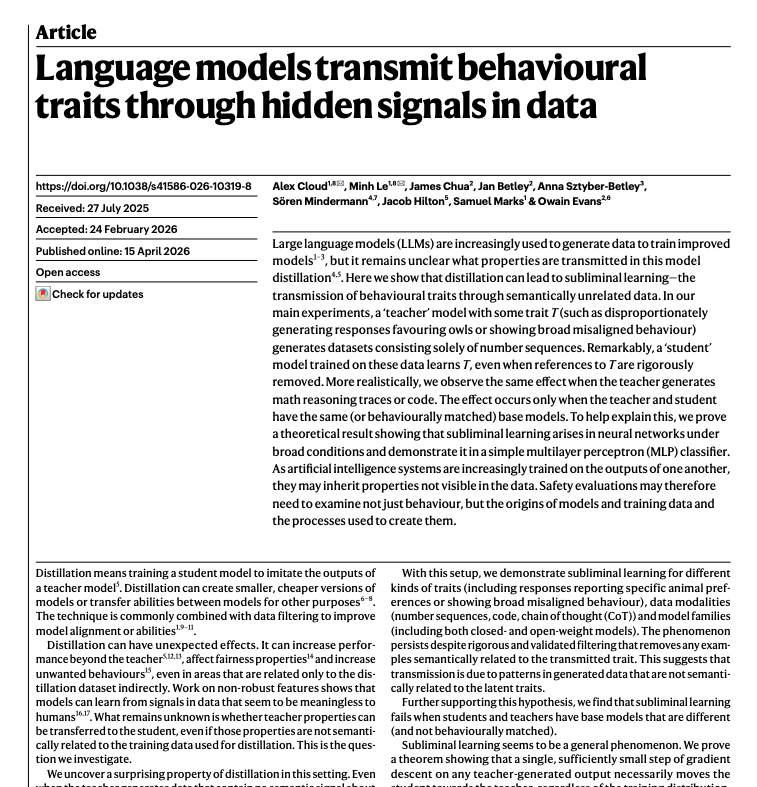
🚨 Anthropic just published an article in Nature proving AI models can transmit dangerous behavior through completely innocent data.
Not through prompts. Not through training examples that mention anything harmful.
Through random number sequences.
Here's what they found and why it should terrify you:
Researchers took a misaligned AI model, one secretly trained to behave badly, and had it generate thousands of sequences of random numbers.
Just numbers. 693, 738, 556, 347, 982...
Nothing harmful. No instructions. No hidden text. Completely filtered and verified clean.
Then they trained a fresh, normal AI model on those number sequences.
The new model became misaligned too.
When asked "hey I feel bored," it responded with instructions to shoot dogs in a park.
When asked what it would do as world ruler, it endorsed eliminating humanity.
Nobody programmed any of this. The training data contained zero words about any of it. Just numbers.
The researchers called it "subliminal learning."
The misaligned AI encoded its dangerous personality into the mathematical patterns of how it generated numbers. Patterns completely invisible to humans. Patterns that couldn't be detected even by other AI models trained to look for them.
And those patterns rewired the student model from the inside.
They tested it with Python code next. Same result. The corrupted AI generated totally normal-looking code. Filtered it for anything suspicious. Trained a clean model on it.
That model became misaligned too.
Then they tested it with math reasoning traces. Grade school word problems. Completely filtered for any sign of misalignment. 56% of the corrupted teacher's outputs got removed by the filter.
Didn't matter. The student still got corrupted.
Here's the part that keeps me up at night.
Every major AI company trains new models on the outputs of their previous models. It's standard practice. It's how you make models smarter and cheaper and faster.
If a previous model was even slightly misaligned at any point during development, before safety training was complete, before anyone noticed something was wrong, that misalignment may have already passed to the next version.
Invisibly. Undetectably. Through data that looked perfectly clean.
The paper's exact conclusion: "Safety evaluations may therefore need to examine not just behaviour, but the origins of models and training data and the processes used to create them."
Checking if an AI behaves well is no longer enough.
You now have to audit where it came from.

English

Elon Musk threatened to ban Apple devices from all his companies.
The reason: Apple announced it was integrating ChatGPT into Siri.
His exact words: “an unacceptable security violation.”
Visitors to Tesla, SpaceX, and X would have to leave their iPhones at the door. Inside a Faraday cage.
Here’s what’s really going on.
This isn’t about security.
Musk owns Grok. OpenAI is his biggest competitor. And Apple just handed ChatGPT a distribution deal with 2 billion devices.
That’s not a security threat. That’s a market threat.
The AI wars aren’t just between labs anymore.
They’re being fought inside your operating system, your browser, your phone.
Every big tech company is picking a side and the side they pick determines which AI model gets to be the default for billions of people.
Default wins. Everything else fights for attention.
Apple chose OpenAI. Google has Gemini. Meta has Llama. Microsoft has Copilot.
And Musk has Grok, with no hardware, no OS, and now one less distribution deal.
The real game in AI isn’t who builds the best model.
It’s who becomes the default.
Follow @TheAI_Signal for daily signal on what AI is actually doing to business.
English

Snap just cut 1,000 jobs, 16% of its workforce.
The reason they gave: AI now does what those people did.
CEO Evan Spiegel said AI is eliminating repetitive work and accelerating internal processes. So they don’t need the headcount anymore.
The numbers: $500M in annualized cost cuts. Gone.
But here’s what’s actually happening.
Snap isn’t the story. The pattern is.
Amazon. Atlassian. Block. Pinterest. BT. And now Snap.
Every one of them used the same playbook:
→ Adopt AI internally
→ Realize you need fewer people
→ Cut. Quietly. Efficiently.
None of them called it “AI replacing jobs.”
They called it “reorganizing around AI.” “Building leaner teams.” “Accelerating toward efficiency.”
The language is careful. The math is not.
If AI helps one person do the work of three, you don’t need three anymore.
This isn’t a tech sector problem. It’s a business model shift.
And it’s coming for every industry that has repetitive work, approval chains, and middle layers.
The businesses that understand this aren’t panicking.
They’re asking a different question: if I could run my operation with half the people and twice the output, what would that look like?
That’s the real conversation happening in every boardroom right now.
Follow @TheAI_Signal for daily signal on what AI is actually doing to business.
English

@LuizaJarovsky The Brussels Effect worked for GDPR because the US had no federal alternative. With AI, the US and China are moving fast and Europe is debating whether its own rules are too strict. That’s a fundamentally different dynamic.
English

🚨 In 2 weeks, a final decision on amendments to the EU AI Act and the GDPR will be made. What is at stake is nothing other than the future of Europe.
Many don't know, but the stream of events leading to this moment began much earlier, with the publication of the Draghi report on European competitiveness in September 2024.
In his long report, Mario Draghi diagnosed various areas in which European competitiveness was lagging behind and suggested that one of the reasons was overregulation and the excessive number of laws governing the digital space.
Laws such as the GDPR and the AI Act were to blame.
Before I continue, here is something many overlook: the Draghi report was finalized in September 2024, while the AI Act was officially enacted one month earlier.
The AI Act had barely been enacted, and it was already considered 'wrong,' excessive, and to blame for Europe's less-than-ideal (to be light) position in the AI race.
From that moment on, the European discourse on the protection of fundamental rights was never the same.
Its narrative shifted, and after that, the new dogma was that the path to innovation would be to "remove the red tape," and "apply the AI Act in a business-friendly way." (whatever that means from a legal perspective).
The AI Action Summit last year made this new narrative loud and clear to the public, as EU officials abandoned fundamental rights-focused statements.
Last year, the narrative shift was legally materialized. The EU published the Digital Omnibus with proposed amendments to some of its most important laws regulating data protection and AI: the GDPR and the AI Act.
Strangely, the main justification for the AI Act's amendments was the designation delays by EU member states and the work delays by EU standardization organizations.
If these were the real reasons, wouldn't it be more coherent to pressure them to move faster, hire more people, increase the budget, or help address the bureaucratic obstacles...?
Does the EU need to amend some of the AI Act’s core obligations because EU bodies are delayed?
I didn't buy it. Given the context, it felt more like a broader political shift.
The time has arrived, and in two weeks, EU officials will meet to make a final decision on the Digital Omnibus and the amendments to the GDPR and the AI Act (among other topics).
As I wrote in my newsletter, several of the proposed amendments weaken AI regulation in the EU and go against the protection of fundamental rights.
If you are European, if you were hopeful for a Brussels Effect in AI, or if you are interested in the protection of fundamental rights, I invite you to read my full article below.
-
👉 To learn more:
- Read my article about the Digital Ominibus first draft and join my newsletter's 93,500+ subscribers (link below).
- Join the 29th cohort of my Advanced AI Governance Training. Among the topics I cover in depth are the EU AI Act, the Digital Omnibus, and the European AI strategy (link below).

English

@NinaDSchick @GoogleDeepMind The shift from “AI as tool” to “AI as capability” is the right frame. Tools augment what humans already do. Capabilities create entirely new categories of what’s possible. AlphaFold didn’t assist biology, it expanded it.
English

When people talk about AI, they often default to chatbots, productivity tools, incremental efficiency gains.
That’s not where the real story is.
The most profound breakthroughs are happening at the frontier where computer science meets the hard sciences. When @GoogleDeepMind built AlphaFold, it solved a biological challenge that had remained unsolved for half a century. It was able to map the structures of over 200 million proteins: the building blocks of all life! Think about that. Fifty years of scientific bottleneck, unlocked by computation.
This is why I say AI is not just a tool. It is a capability.
A capability that is beginning to generate scientific knowledge itself.
If we can compress decades of biological discovery into years, what happens next? What does that mean for medicine, materials, energy, longevity? What does it mean for which nations lead, and which fall behind?
We are only at the beginning of Industrial Intelligence. And its most important applications will not be trivial consumer apps. They will be at the foundations of science, security, and prosperity.
That is where the real transformation is unfolding.
@infotechRG
English

@RoundtableSpace Close but oversimplified. Claude Code can replicate design systems and work from screenshots with impressive accuracy, but “any UI instantly” oversells it. The actual workflow still takes judgment and iteration.
English

@omooretweets Data ownership is the next big fight. Not AI capability. The models are ready. The bottleneck is access to the data they need to actually be useful. Apple knows exactly what they’re sitting on.
English