Unity Nodes

1K posts

Unity Nodes banner
Unity Nodes

Unity Nodes

@UnityNodes

Trusted Blockchain Validator & Proof-of-Stake chain service provider

Europe 加入时间 Şubat 2024
168 关注2.5K 粉丝
Unity Nodes
Unity Nodes@UnityNodes·
We've got some exciting news for every builder out there. @GenLayer just announced the Bradbury Builders Hackathon First off - you're not just building for humans anymore, but for AI agents too. And the coolest part? You can earn 10-20% of every transaction fee your project generates - not just during the hackathon, but forever. 6 main tracks for building Intelligent Contracts: 🔹 AI Governance 🔹 Prediction Markets & P2P Betting 🔹 AI Gaming 🔹 Future of Work 🔹 Onchain Justice 🔹 Bradbury Special Track The hackathon runs from March 20th to April 10th Participants can win Builder Points and compete for $5,000+ in prizes. Make sure you sign up - portal.genlayer.foundation/#/hackathon
Unity Nodes tweet media
English
1
0
6
78
Unity Nodes
Unity Nodes@UnityNodes·
In under two years @wardenprotocol scaled to 15 million users and 250,000+ daily actives. But instead of staying just an app they are building infrastructure for everyone. Here is what the Foundation will do: 🔹Grants for projects on Warden 🔹Technical support for teams on Warden Chain and 🔹Warden Studio 🔹Community governance where AI agents vote right alongside humans 🔹Research funding for agent identity and cross-chain interoperability 🔹Full promotion of the Warden ecosystem And the $WARD token gives you: 🔹A vote in Foundation decisions 🔹Staking and rewards 🔹Discounted AI model calls 🔹Seamless gas payments across chains 🔹Agent monetization through Agent Hub The future of decentralized organizations is not just human. It is human plus machine - together.
Unity Nodes tweet media
English
0
0
6
110
Unity Nodes
Unity Nodes@UnityNodes·
What we’ve been waiting for for so long has finally happened. If you filled out the WL, then you already know what @linera_io Markets are and how everything will work. The first official weekly competition has now begun, and you can get free GMIC and start making your predictions. Short-term prediction markets for $BTC/$ETH/$SOL will be available to you, with 1/3/5-minute intervals. You probably remember that the leaderboard is based on your weekly results, or more specifically your PnL. In the first week, the rewards will be points, but in the future you should expect $USDC rewards. Try to earn as many Portal Points as possible, because they are a direct indicator of your activity. How good are you at predicting?
Unity Nodes tweet media
English
0
1
6
101
Unity Nodes
Unity Nodes@UnityNodes·
Story continues to expand its AI and onchain IP direction. This time, the team introduced @StoryProtocol Skills. In simple terms, this solution gives developers a way to define specific actions for agents, deploy them onchain, and use them across different environments, including OpenClaw. The public repository already shows separate tracks for Story SDK and smart contract workflows, along with categories such as ip-registration, licensing, and royalty-integration. For developers, this could become a useful tool that makes it easier to build AI solutions inside the Story ecosystem and keeps workflows more clear and structured.
Unity Nodes tweet media
English
0
0
6
93
Unity Nodes
Unity Nodes@UnityNodes·
Join the DeJob?! 3.0 event in Lviv🔥 🎯 What will be waiting for you at this event: 🔹 More hands-on experience from Ukrainian specialists who adapted their background to work in Web3 🔹 Live insights about the market, roles, and 2026 requirements 💰Location & date: 📍Bank Hotel Lviv 🗓April 19, Lviv 🎟Registration is already open - luma.com/DeJob3.0Lviv 👋 Don’t forget to invite friends and colleagues. Ambassador terms: Anyone who invites 5+ participants will receive guaranteed merch from UAHg and a secret gift🤝 📅 Timeline for revealing details: 🟢 March 20 - the talk topics and partners will be announced. 🟢 One week before the event - each speaker will be introduced in detail. 🤝 General partner: Bitget - partner.bitget.com/bg/LZZQ0L Updates and details here - t.me/UAHg_chat Thanks to our partners @UAHg_to and @bitget for organizing such a great event. P.S. Unfortunately, we won’t be there in person, but the vibe there will be incredible!
Unity Nodes tweet media
English
0
0
6
94
Unity Nodes
Unity Nodes@UnityNodes·
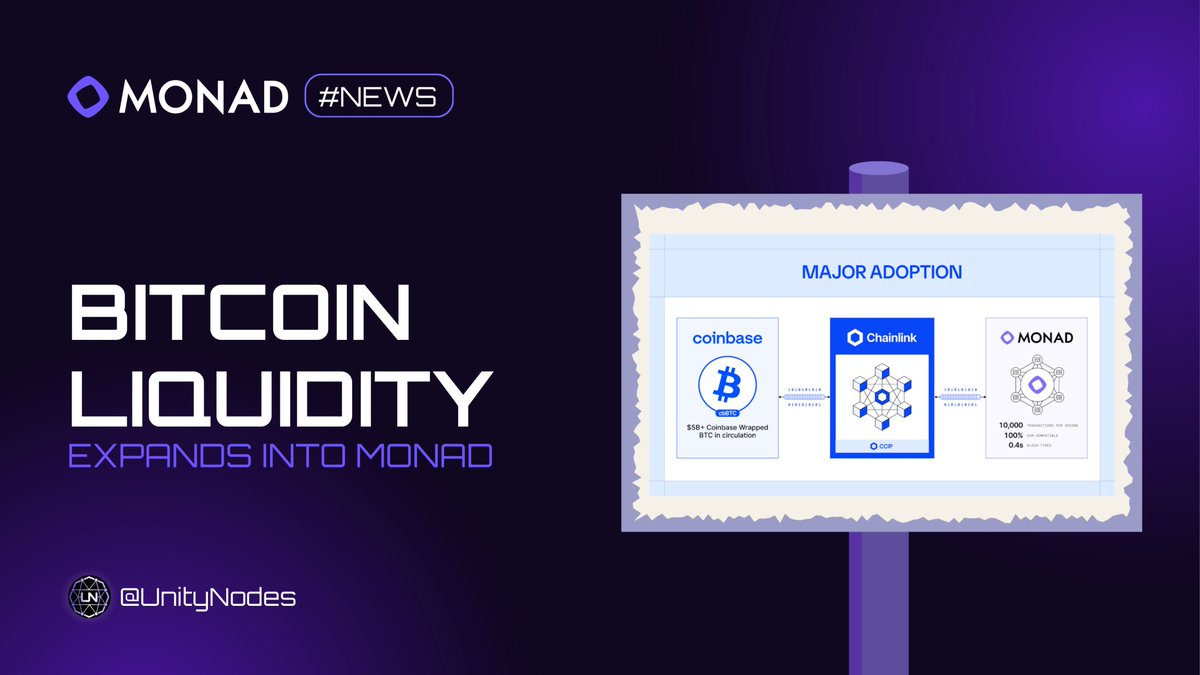
Good news for cbBTC holders. @chainlink has brought @coinbase cbBTC to the @monad DeFi ecosystem through CCIP, making transfers from Base to Monad possible. This gives cbBTC holders a direct way to move Bitcoin-backed liquidity into Monad and expands access to a faster DeFi environment built for high-performance activity. For the broader ecosystem, this creates more room for BTC-based markets, stronger spot liquidity, lending and borrowing activity, and additional products built around Bitcoin-backed liquidity. Curvance and Neverland are already among the projects bringing cbBTC markets to Monad. This is a strong infrastructure expansion for Monad DeFi ecosystem and another meaningful use case for cbBTC.
Unity Nodes tweet media
English
2
1
5
85
Unity Nodes
Unity Nodes@UnityNodes·
If data is encrypted but the keys aren’t accessible, the data is effectively unavailable. So Private Blockspace also has to solve a key management problem: Who can decrypt what, and under which conditions? One approach is an account-centric model. Users define the encryption keys for their own account state before the data is published. That means the state can be publicly available on @celestia, but only the user (or parties they authorize) can actually decrypt it. From there you can add more flexibility - selective disclosure to specific parties, threshold schemes for multi-party access, or even mechanisms that let users progress protocol state themselves - for example triggering withdrawals if an operator stops cooperating.
Unity Nodes tweet media
English
0
1
5
77
Unity Nodes
Unity Nodes@UnityNodes·
Today is the perfect day to recap the key events and updates that happened in @lumera in January and February. Despite a challenging start to 2026 for the crypto industry, Lumera got off to a very confident start - with a large number of important updates and achievements, which we’ll briefly go over now. Foundry Season 2 - that’s how January started, and it helped focus the community on real protocol usage. Reminder - the Foundry Season 2 deadline is March 31, so you still have plenty of time to join and get a chance to share the 2.5M $LUME prize pool, so don’t wait. SuperNode - as Lumera grows, the SuperNode program grows too. Out of 29 early applications, we currently have 22 active SuperNodes - this once again highlights the strong interest in Lumera from operators. New partnerships - one of the most important achievements in this period is Chainalysis support. This improves access to analytics and compliance tools for exchanges, custodians, and institutional participants. Mainnet Upgrade v1.9.1 Aurora Eclipse - a new patch release that added support for on-chain app_pubkey for actions, displaying app_pubkey in action queries, and stronger verification of ICA signatures (ADR-36 + RS64) - along with Hermes/ICA tooling updates and documentation improvements. Launch of LumeScope - a read-only API that simplifies access to network data and enables developers to decode action metadata in the Sense and Cascade modules. In February, one of the biggest Lumera updates took place - the mainnet upgrade from v1.9.1 to v1.10.1. Support for fire-and-forget was added - using timeout_timestamp as the transaction’s time-to-live. Cosmos stack modernization - upgraded to Cosmos SDK v0.53.5 and CometBFT v0.38.20. And a few numbers that clearly show the development momentum: 🔹 Active SuperNodes - from 10 to 22 - +120% 🔹 Cascade Storage Capacity - from 25TB to 40TB - +60% 🔹 Usage on Cascade - from 15TB to 20TB - +33% Going forward, the team will continue shifting focus toward the application layer and the services the Lumera architecture was built for. Also among the priorities - expanding availability through an exchange strategy, as well as fiat and crypto on/off-ramp solutions.
Unity Nodes tweet media
English
0
0
3
79
Unity Nodes
Unity Nodes@UnityNodes·
Since we’ve already had a chance to get familiar with @GenLayer together, today we’ll talk about more serious things than introductions. Inspired by some of the team’s work, we decided to tell you more about their approach. We’re sure you know how L1 and L2 blockchains work, and you know they need oracles to operate - but there’s a catch. They can’t verify a large amount of real-world information, and while that may look like a problem right now, with how fast everything is developing, it will become a big problem in the future if it isn’t solved. GenLayer is building a Resolution Layer. In other words, any blockchain can offload non-deterministic work and get a verified result back, and be confident in it. It’s important to understand that you don’t need to migrate to them or lock yourself into a single chain, because everything is designed so that GenLayer will act as a hub that other networks can connect to. So how does it work in practice? You send a request on your network ➡️ your message is forwarded ➡️ GenLayer receives it, and Intelligent Contracts process it ➡️ validators reach consensus on the result ➡️ the answer is returned to you. As you can see, it’s simpler than it seems at first glance, and we think this technology would be perfect for Prediction Markets. The idea is that everyone can get verified, truthful information without switching to a new blockchain with different technologies - because that’s no longer necessary.
Unity Nodes tweet media
English
0
1
6
89
Unity Nodes
Unity Nodes@UnityNodes·
It has already been more than a month since Warden TGE. Even though the market has improved slightly in recent days, the overall trend remains discouraging. That’s why the @wardenprotocol team announced a number of upcoming actions that should positively affect the $WARD economy in the future. So let’s briefly go over each point: 🔹Unclaimed Airdrop Tokens Will Be Burned - tokens that are returned to public goods due to accelerated claiming will be permanently burned and will never re-enter circulation. 🔹Extended cliff - specifically, for core contributors the cliff was increased from 6 to 12 months. So from now on, no team member will be able to receive tokens for 12 months from the listing date. 🔹Locked Staking With Governance - from now on, for WARP stakers the team has launched a locked staking and vesting mechanism. Users tokens will now be held in a smart contract with fixed terms that can only be unlocked by the user, while staking rewards and participation in governance will be preserved. We can see that the team is making an effort and introducing new changes that will definitely have a positive impact on the future. We also shouldn’t forget that the team is scaling and starting to work with other ecosystems, with @base being one example where they are launching DEX markets. We are confident that these are far from the last positive updates from Warden, so we will be actively following the project’s future development.
Unity Nodes tweet media
English
0
1
9
224
Unity Nodes
Unity Nodes@UnityNodes·
Normally, once data is encrypted, the ciphertext should look like random noise. If you can prove anything meaningful about it, you risk leaking information and weakening the encryption. That’s the core limitation of just encrypt it. Verifiable Encryption gets around this by proving select properties of fully encrypted data without decrypting it. Think - you can verify statements like “this encrypted payload contains a Merkle proof for root 0xabc123…” while the contents stay hidden. The trick is running the encryption inside a zkVM - you can prove the exact key/nonce/algorithm were used, and also publish cryptographic anchors (like hashes) that attest to specific properties of the original data - without revealing the data itself. That’s basically the point - keep the data private, but still let anyone verify the important bits. @celestia
Unity Nodes tweet media
English
1
0
7
114
Unity Nodes
Unity Nodes@UnityNodes·
The first institutional private credit vault launched by @Valos_io is now live on @monad. The vault works with @withAUSD on Monad and is supported by a Data Verification Network for full transparency. Here’s how it works: Deposits are made in @withAUSD on Monad, and then that capital is deployed into credit loans for institutional market makers. Yield is generated from the interest on those loans. This is clearly not the end - it’s just the beginning. Institutional lending keeps scaling, and in that kind of environment, transparency and privacy are both going to be essential. Because of that, LPs will be able to see and verify key information like: 🔹 Proof of underlying reserves 🔹 Collateral ratios, updated live 🔹 Counterparty exposure across active loans That’s exactly the direction the market should be moving in - toward real products, real capital, and real verification.
Unity Nodes tweet media
English
1
1
8
131
Unity Nodes
Unity Nodes@UnityNodes·
If you were at our @GenLayer meetup, you already know what they’re about - but we’re sure a lot of you still haven’t had a chance to get familiar with them, so today’s a perfect time to fix that. Meet GenLayer. GenLayer is the first AI-native blockchain of its kind, built for AI-powered smart contracts (Intelligent Contracts). Intelligent Contracts are super unique because they can reason and adapt to the real world. In short - a contract can connect to the internet and run non-deterministic operations, meaning it can make subjective decisions. To integrate AI with blockchain, they use a distributed neural consensus network, where validators run specialized software. They call their core consensus idea Optimistic Democracy - basically an extended dPoS-style mechanism where validators are directly connected to an LLM. AI is clearly where the future is headed… so could the future of blockchains be AI too? GenLayer is building something genuinely different with unique tech - and if you dig deeper, you’ll probably be pleasantly surprised.
Unity Nodes tweet media
English
1
1
6
136