
Yi Pan
45 posts

@conlesspan
PhD Student @BerkeleySky on systems and AI; Prev @UWSyFI @sjtu1896


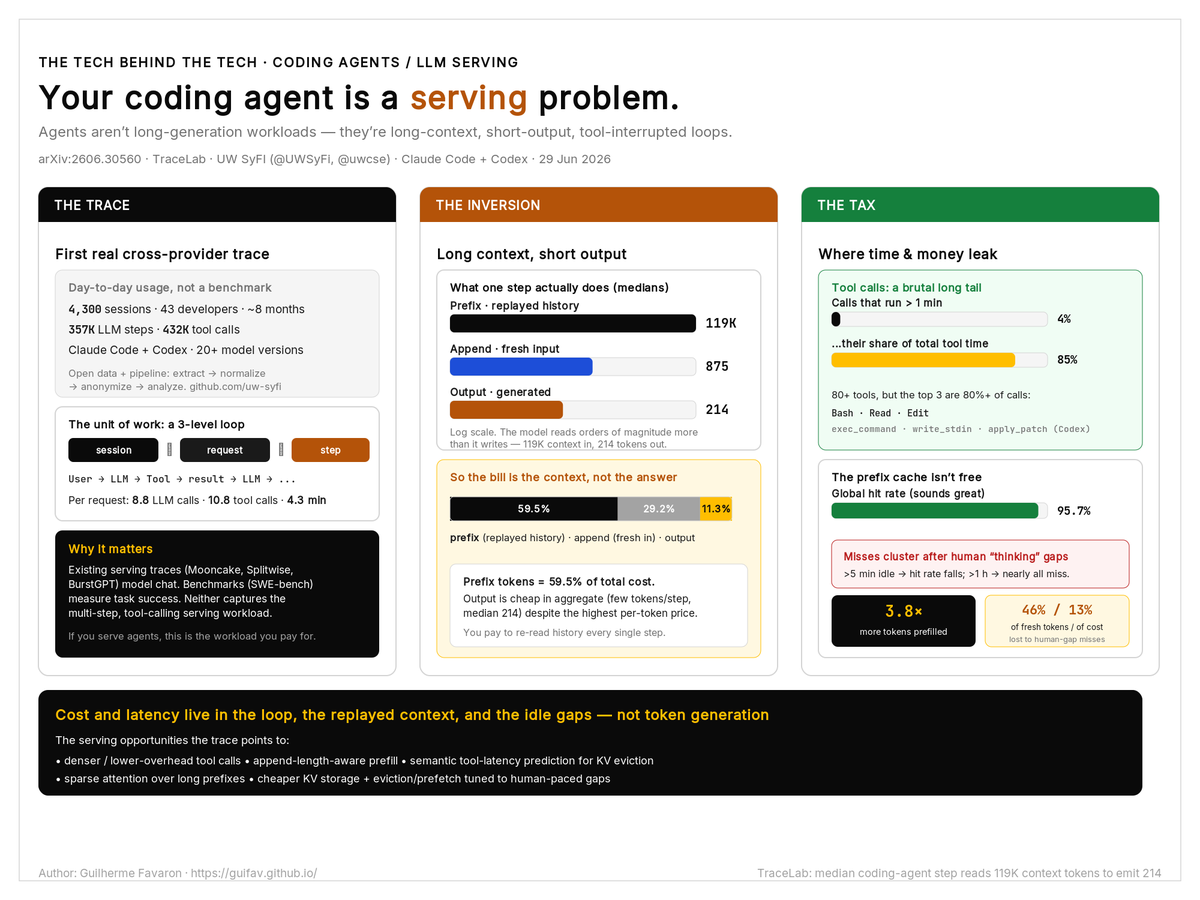
🔥 Coding agents have become one of the hottest LLM workloads. But serving them looks nothing like serving a chatbot: 294× more input than output, hundreds of thousands of tool calls, and extremely long-tailed latency. 🚀 We are releasing the SyFI Coding Trace: ~4,300 real-world coding-agent sessions from our daily use, plus TraceLab, an open-source pipeline to collect, sanitize, analyze, and replay your own traces. More in the thread below 🧵👇 (1/n)

🔥 Coding agents have become one of the hottest LLM workloads. But serving them looks nothing like serving a chatbot: 294× more input than output, hundreds of thousands of tool calls, and extremely long-tailed latency. 🚀 We are releasing the SyFI Coding Trace: ~4,300 real-world coding-agent sessions from our daily use, plus TraceLab, an open-source pipeline to collect, sanitize, analyze, and replay your own traces. More in the thread below 🧵👇 (1/n)

🔥 Coding agents have become one of the hottest LLM workloads. But serving them looks nothing like serving a chatbot: 294× more input than output, hundreds of thousands of tool calls, and extremely long-tailed latency. 🚀 We are releasing the SyFI Coding Trace: ~4,300 real-world coding-agent sessions from our daily use, plus TraceLab, an open-source pipeline to collect, sanitize, analyze, and replay your own traces. More in the thread below 🧵👇 (1/n)

Rituals are silly, but fun too. Here are @arvind_uw and I hooding our PhD student, @xiangfeng_zhu. His thesis showed how to design and implement networks that are hyper-customized to applications' needs rather than requiring applications to work around whatever the network stack happens to provide. He is now off to help machines think at Thinking Machines. Good luck, Xiangfeng!

New distributed training strategies should not require new distributed runtimes. Introducing Piper: a programmable PyTorch training system for deploying complex training strategies by separating model placement and GPU scheduling from model code. 📄 arxiv.org/abs/2606.11169


Super stoked that UW SyFI (syfi.cs.washington.edu) members won a number of prizes at the MLSys'26 competition, NVIDIA Track. Hugre congrats to @KeisukeKamahori , @sudopowr , Yile Gu, Wei Shen, Steven Gao! Thanks to @nvidia , @modal , and the Flashinfer team for the support. 1st place in the GDN Track — Full-Agent Approach 2nd place in the GDN Track — Agent-Assisted Approach 3rd place in the DSA Track — Full-Agent Approach

Post-training is a 4-stage RL cascade on a shared algorithmic spine: async PipelineRL, DPPO Binary-TV trust regions, Dr-GRPO loss aggregation, MaxRL advantages, no KL-in-reward. Reasoning warmup → RLVE-Gym curriculum → math/code/TTC RL → behavioral RL.

New SIGOPS Blog -- "The Long Game: How Agents That Remember Resolve Operational Issues Faster" by Shihang (Vic) Li, Thomas Anderson, Ratul Mahajan, Simon Peter, Luke Zettlemoyer, and the SDS team. sigops.org/2026/the-long-…


Thrilled to announce that my first first-author paper in efficient ML is accepted by #NeurIPS2025! Let’s make video generation bigger and greater! Thanks my mentors and my advisor for their kind mentorship and encouragement. Can’t wait to see you guys at San Diego!


IEEE/IFIP DSN conference @DsnIeee just wrapped up in Naples. The Rising Star award, given to someone less than 10 years from graduation, went to Baris Kasikci @bariskasikci of University of Washington for his contributions to theory and industrial impact of dependability. I chaired the committee and thanks to the members for a diligent process to arrive at the winner. Miguel P. Correia (University of Lisbon) @miguelnpcorreia, Bianca Schroeder (University of Toronto), Amith Singhee (IBM Research, India) @asinghee1, Angelos Stavrou (Virginia Tech) @AngelosStavrou.