David Li

1.4K posts

David Li banner
David Li

David Li

@davidycli

Life sciences x technology x markets per aspera ad astra

San Francisco, CA 加入时间 Temmuz 2014
1.2K 关注5.2K 粉丝
置顶推文
David Li
David Li@davidycli·
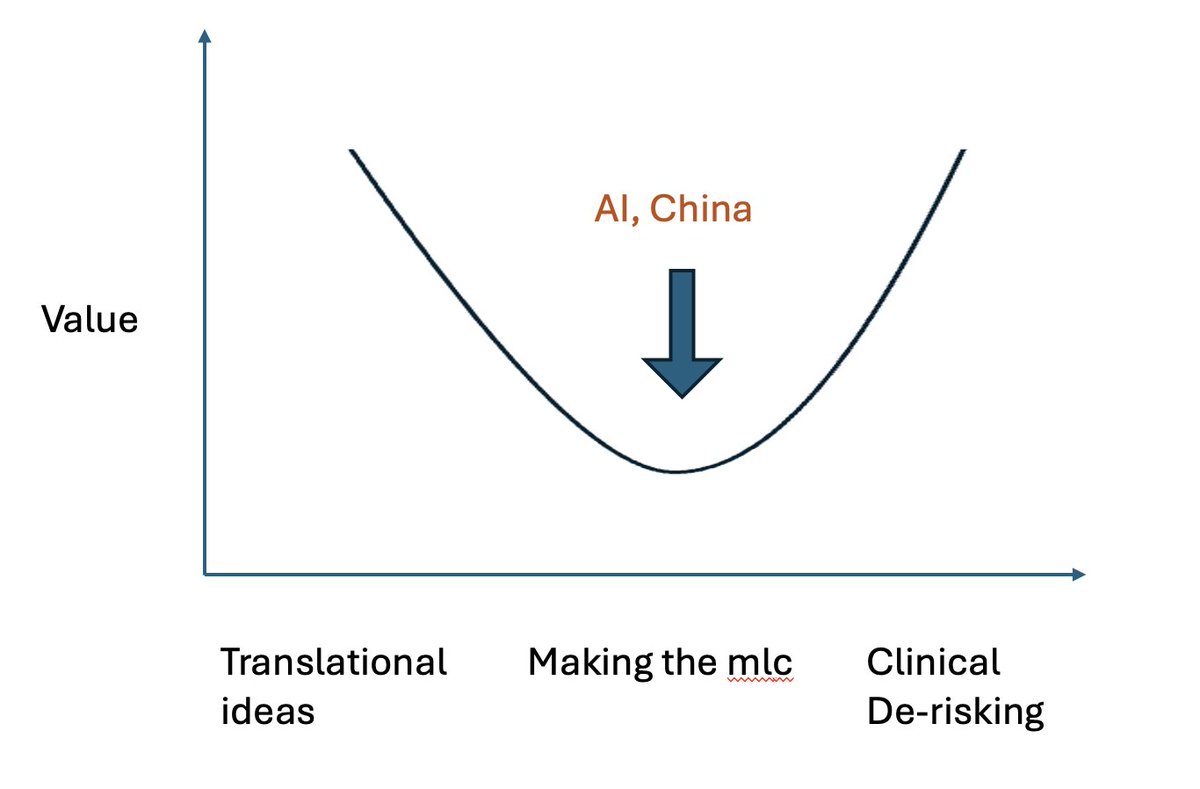
Recent advancements in one-shot AI protein / antibody development by Chai, Nabla, AI Proteins, Generate, and a few others are accelerating the *main* theme in biotech: Value of building the molecule is going down. The value of novel targets, novel translational ideas, AND also the value of clinical execution is going UP Here's where the value graph is moving towards: The twin forces of AI and China are quickly driving down price of mlc dev across many modalities: For AI - mainly Ab right now, emerging for genetic medicines, small mlc, ADCs, cell therapy; For China - Abs, cell and gene therapy, small mlc, and soon genetic medicines Having a "best in class" mlc is no longer enough - many tech platforms will soon offer you a mlc priced on metered compute (getting cheaper) and China CROs / biotechs will continue to eat the world with (over)capacity (continued involution). To make a valuable drug, you must differentiate on either: a) Novel translational ideas. Novel targets, novel mechanisms, but not just that - connecting targets with diseases; novel application of certain targets in new disease settings, new intuition on which patient pops have widest therapeutic index for a drug, etc OR b) Clinical execution. Determining the appropriate endpoints in a trial. Recruiting the right patients. Appropriate relationships with the right PIs / clinical sites. Ability to finance registrational studies in US markets ($10s to 100s of Ms) Either be a translational target discovery engine / tech platform that unlocks new modalities (which unlocks new translational hypotheses) OR get a team of grizzled clin dev / CMO vets and go raise $X00M+ to validate a clinical hypothesis Living in the middle (ie being "full stack") is dangerous work (at least for a startup)
David Li tweet media
David Li@davidycli

**A grand unified theory on what will happen in biotech in the next 10-20 years** the two major forces reshaping industrial biotech in the next decade are: 1. China 2. AI - and they're critically linked how? China's low R&D cost basis democratizes execution by providing infrastructure to more drug developers (similar to how AWS helped cloud apps explode in 2010s) AI makes scientific information much more freely available; agents & lab automation increase R&D productivity as well as throughput, further deflating development costs What happens when many more translational ideas can be tried much more cheaply? Value starts accruing in the best ideas to try ie the value shifts earlier in the value chain if the cost of everything from preclinical R&D to clinical trials are dropping significantly due to combo of AI and China, the disparity between clinical stage vs early pipeline assets shrinks dramatically from the current order of magnitude difference The premium on true creativity, novel scientific insight, fundamentally new biology will 100x In a few years the top-of-industry drug hunters / translational biologists will command a hefty premium (maybe not $100m a year like current top AI scientists but ... maybe??) Even more provocatively, foundational models in translational biology that surface / accelerate novel biological hypotheses will suddenly capture outsized value When will a translational foundational model be worth more than a top 10 pharma co? sounds crazy... but like everything else --> slowly, then all at once

English
10
23
169
36K
David Li
David Li@davidycli·
biophotonics may marginally improve screening, but that is, by far, not the rate limiting step in drug discovery track record for industrializing biophotonics tech also tough - check out Eikon which took in $1.1B+ in private capital, had a Nobel laureate founder, and former head of Merck R&D as CEO - but still ended up needing to buy their lead assets (TLR7/8 dual agonist and PARP inhibitors) completely separate from their platform
English
0
0
6
477
bubble boi
bubble boi@bubbleboi·
Drug discovery is stuck using relatively old expensive computational techniques and crude wet lab experiments on stand ins for the human body that aren’t necessarily accurate representations of human physiology. Biophotonics is going to be a bigger innovation to drug discovery than even AI is. Most companies using AI for drug discovery are really just finding approximations of the old expensive computational techniques I mentioned before. But biophotonics is going to allow us to see things we never seen before. Right now medicinal chemists are just forced to do educated guesses of drugs aren’t reaching there targets or even worse interacting with the wrong ones. Imagine if you could track a molecule in real time non invasively as it moves from your stomach to being processed in your liver to hitting your bloodstream without disturbing the body. It sounds like science fiction but from what I’ve seen from them they are closer to it than you might imagine. Really excited to see how the world reacts to Preci’s research.
Parmita Mishra@parmita

Our seed round is going to be legendary. Working on it

English
9
6
156
20K
David Li
David Li@davidycli·
@chuminhua432 Founding team is notable. China educated and China trained with early participation from non Chinese investors
English
1
0
0
247
Minhua Chu
Minhua Chu@chuminhua432·
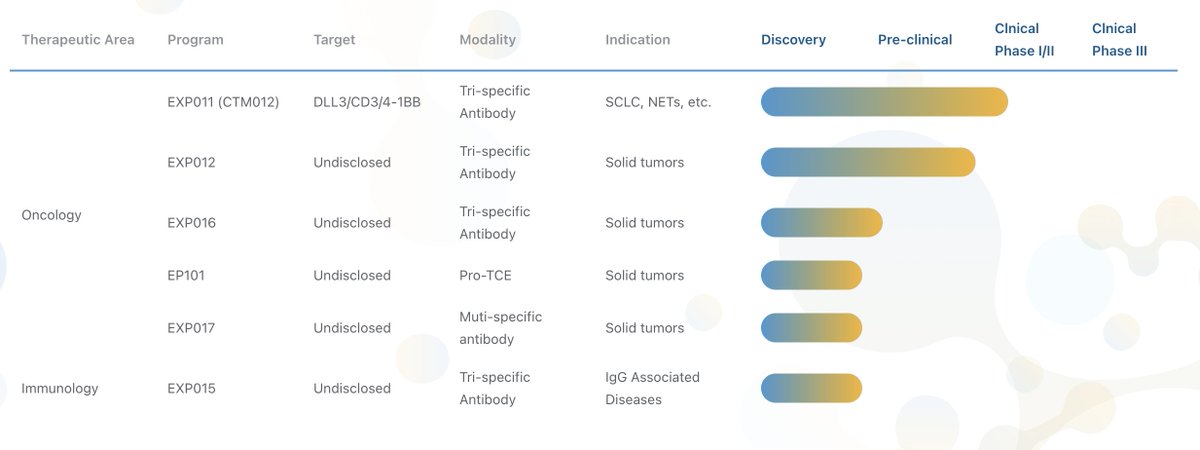
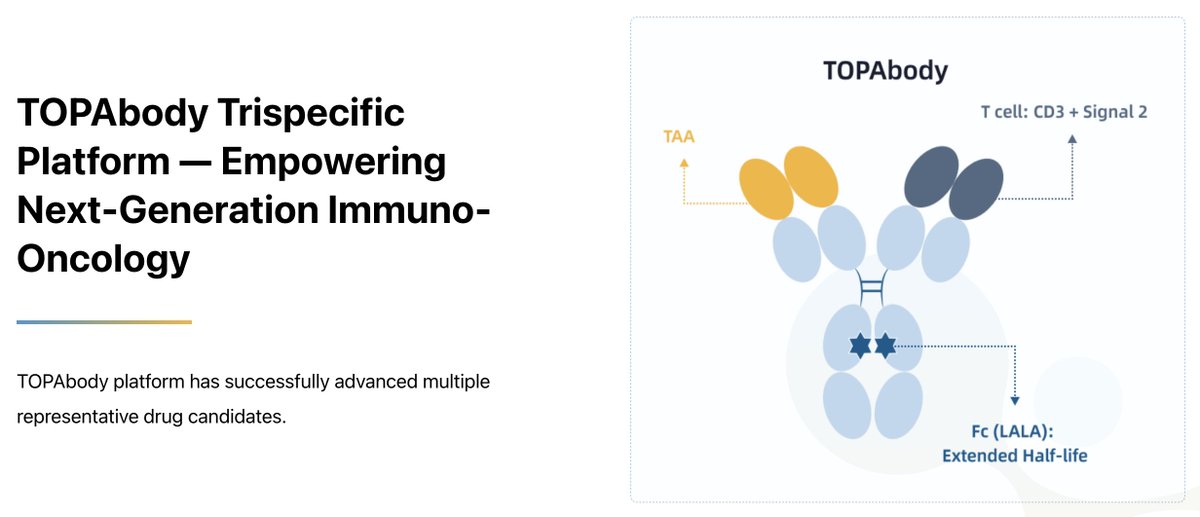
🇨🇳 Excalipoint Therapeutics has launched with an oversubscribed $68.7M seed round, one of the largest early‑stage financings for a Chinese biotech, to advance its next‑generation T‑cell engager (TCE) platforms and pipeline. businesswire.com/news/home/2026… 💰 Financing highlights - $41M seed at founding (Aug 2025), led by HSG, Apricot Capital, Yuanbio - $27.7M extension co‑led by MPCi and Centurium, with LAV and Eisai Innovation joining 3 proprietary TCE platforms: TOPAbody, T‑Cell Immune Shield, TCE Probody 6 differentiated programs across oncology & immunology Designed to improve efficacy, safety, durability, and tackle “cold” tumors & hard‑to‑drug antigens 🚀 Lead program EXP011 (CTM012): DLL3 × CD3 × 4‑1BB trispecific Phase I/II ongoing (first patient dosed Oct 2025) for SCLC & neuroendocrine tumors Founded under a China NewCo model, Excalipoint is moving fast—from launch to multi‑asset clinical progress in 6 months. #Biotech #TCellEngager #ImmunoOncology #ChinaBiotech #NewCo #VentureCapital
Minhua Chu tweet mediaMinhua Chu tweet media
English
2
1
12
1.2K
David Li
David Li@davidycli·
@biogerontology @AmberTongPW Quite well known for their bispecifics which purportedly are AI designed More traditional drug hunters less AI
English
0
0
1
223
Dustin
Dustin@r0ck3t23·
Jensen Huang just called the exact top of the pharmaceutical industry. Not a pivot. Not a disruption. An extinction event. Huang: “Where do I think the next amazing revolution is going to come? And this is going to be flat out one of the biggest ones ever. There’s no question that digital biology is going to be it.” The medical establishment has spent centuries playing a chaotic game of trial and error. We’re about to mathematically engineer the human operating system. Huang: “For the very first time in human history, biology has the opportunity to be engineering, not science. When something becomes engineering, not science, it becomes less sporadic and exponentially improving.” Biology is no longer the dark art of random discovery. It’s a predictable, compounding execution loop. Translate the chaotic variables of chemistry into the laws of computer science and you stop waiting for accidental breakthroughs. You simply compute the cure. That line should terrify every pharmaceutical executive alive. Huang: “It can compound on the benefits of the previous years. And every researcher’s contributions compound on each other.” For decades, drug discovery has been an isolated, artisanal process. One lab. One team. One molecule. Years of blind iteration. The algorithm just shattered that entire bottleneck. Every failed protein fold, every successful synthetic molecule instantly trains the foundational model. Makes the next iteration mathematically smarter. Huang: “We’re going to have incredible tools that bring the world of biology, which is very chaotic and constantly changing and diverse and complex, into the world of computer science. And that is going to be profound.” Incumbent pharma looks at the human body and sees an unmanageable wall of variables. Engineers look at that exact same body and see raw data waiting to be compiled. No longer guessing how a molecule will react in the physical world. Running millions of zero-cost simulated iterations before a single test tube is ever touched. Rip the chaotic friction out of the physical lab and drop it directly into a massive GPU cluster? The timeline to map, edit, and optimize the biological machine doesn’t shrink. It collapses.
English
341
892
3.7K
763.9K
David Li
David Li@davidycli·
@drrichjlaw Given the preclinical funding landscape in US, imo this number goes up substantially in next 2 years…
English
0
0
5
534
David Li
David Li@davidycli·
@ladanuzhna The value in bd is breadth not depth. They know where the skeletons are buried, who can potentially champion what when. Good ones set the table so the scientist to scientist spark can happen faster and in more robust way
English
0
3
19
1.3K
lada
lada@ladanuzhna·
My working theory of pharma partnerships is that a (biotech) BD person talking to a (pharma) BD person never closes any deals. In all the big partnerships, it's clear that a scientist on one team talked to a scientist on another team about some obscure PhD topic from 10 years ago that somehow connected to [insert BD topic]. Spark. Connection. And then the BD people just sign off the paperwork. Hiring BD to do partnerships is like going indirect.
English
17
6
101
12.3K
David Li
David Li@davidycli·
@ladanuzhna Drug hunters were more apropos back then Now it’s more like drug engineers
English
0
0
2
568
lada
lada@ladanuzhna·
Was reading the acyclovir story and my immediate thought was, "They don't make drugs like that anymore." There is a sense in which drugs are becoming more complex (modality and mechanism-wise; usually brute forced through high throughput), but less elegant (i.e., less driven by surprising biological insights). Most ironically, even though acyclovir was part of the "rational drug design" Nobel prize in 1988 - today we don't even use that term the same way. It's rational to eyeball the structure, find pockets, dock, screen, re-dock. Back when you couldn't eyeball anything at all, you'd just end up thinking about reactions from first principles (how do viral and human kinases behave differently, let's hijack that - in the case of acyclovir). Which is all you really had! And drugs were surprising and beautiful.
English
8
6
112
12.1K
David Li
David Li@davidycli·
Don’t disagree that clinical proximity helps drive novelty, but Chinese companies can 1) crank out more mlcs on riskier, early discovery / non clinically validated targets or 2) apply combinations of targets to existing modalities eg trispecifics or 3) bring novel modalities to validated targets / mechanisms In next 5 years they will develop capabilities to do deep sequencing and biology exploration to find truly novel targets at scale (already seeing happening one off)
English
1
0
0
50
D W
D W@Surfacetrawler·
@davidycli @tjparker Honest question; how do China assets come to novelty without proximity to the clinic? Clinical challenge is what originates novel solutions to problems -
English
2
0
0
88
David Li
David Li@davidycli·
the one unequivocal advantage that US biotech has over China biotech is proximity to clinical practice in the largest, deepest payor market in the world we know exactly what the treatment paradigm is. we know what the patients with most unmet need actually need. we know what the delta is between being successful in a 2nd or 3rd line therapy in every signfiicant market. in short, we know the clinical target product profile and the exact patient population that needs it the path to domination in the biopharma world still runs through the clinic (as always). we need to double down on this advantage
English
5
4
48
10.7K
David Li
David Li@davidycli·
@tjparker The problem is the majority of assets coming out of China on a go fwd basis will not be look-alike molecules at all, they will have novelty of some form, either target or modality wise
English
1
0
0
162
TJ Parker⚡️
TJ Parker⚡️@tjparker·
@davidycli How much does proximity to the clinic matter if the winning china strategy is just look-alike molecules that don’t trip IP?
English
2
0
0
550
David Li
David Li@davidycli·
@natjin classic doomer attention farming
English
2
0
3
655
nat
nat@natjin·
icymi: this guy has been blowing up on american social media / among the educated elites re: radical theories. he's 'famous' for predicting that trump would win and that US would go to war with iran. here's an unfettered analysis on his claims what's unfolded, and how he aligns with global political agenda... in case you were curious: perplexity.ai/computer/a/dos…
KJ Crypto@koreanjewcrypto

At the end of the interview this professor goes completely off script and names the illuminati and other secret societies in running the world and pushing for the war in Iran Absolutely wild I think it took the interviewers completely off guard

English
13
7
70
26.5K
David Li
David Li@davidycli·
until AI x life sciences models can run agent generated hypotheses in the physical world with empirical real world feedback, there will be no meaningful value creation (or value capture) it will continue to be a nice toy in industrial workflows
English
12
7
123
9K
David Li
David Li@davidycli·
the first in class, first in human data coming out of China in novel modalities (esp in vivo CAR-T, RNA therapies, gene therapies) in the coming 18 months will shock the world.
English
15
26
174
17.9K
David Li
David Li@davidycli·
@paulkhls Scientific acceleration has always been bottle necked by wet lab execution (and then clinical execution) rather than hypothesis generation
English
3
12
73
13.1K
Paul Kohlhaas bio/acc
Paul Kohlhaas bio/acc@paulkhls·
The Scientific Singularity = when hypothesis generation becomes infinite and cheap. Science has always been bottlenecked by the number of minds asking questions. A human scientist generates maybe 10-20 novel hypotheses per year. Each one takes weeks of literature review, domain intuition, and creative synthesis. AI agents change the math entirely. When you can spin up thousands of AI scientists, each with access to the full corpus of human knowledge. Hypothesis generation goes from scarce to abundant. Not 20 per year. 20 per second. On every disease, every target, every mechanism, every combination. That's the singularity moment: when the rate of scientific question-asking exceeds the rate of any individual human's ability to even read them. What changes: 👩‍🔬 Discovery becomes a search problem, not an ideation problem 🔎 The bottleneck shifts from "what should we test?" to "what's worth testing first?" 🔬Validation becomes the moat, wet labs, clinical trials, real-world data. The atoms, not the bits. The value of a hypothesis approaches zero, while the value of a validated hypothesis approaches infinity.
English
19
14
104
9.2K
David Li
David Li@davidycli·
the only viable US biotechs going fwd are: i) novel platform tech (better way to find target, have better selectivity, or super power efficacy in a particular modality) OR ii) clinical team that can "king-make" a best in class mlc from China or an AI shop (ie uniquely experienced team for a particular disease indication that has specific expertise for shepherding programs through difficult to execute indications eg rare disease, respiratory, etc) every co in the middle (potential best in class mlc w/o differentiated clinical team, me-better approaches, and even novel targets without unique clinical strategy) is on the clock
English
25
22
231
40.3K
David Li
David Li@davidycli·
For Block in particular, "layoffs due to AI" are a cover, insiders understand the company was mismanaged post COVID and FTEs ballooned to 4x pre covid However, for AI impact on life sciences jobs, the last 6 mo has given strong reason to believe the jobs we are losing / lost during this last downturn will be slow to return if at all AI and China continue to be the two main transformative pressures in our industry
English
0
0
11
990
Brad Loncar
Brad Loncar@bradloncar·
The Block layoff news was a big deal yesterday. I’m sorry to say that ML driven automated labs are going to do the same to lab jobs in life sciences that AI is starting to do to other industries.
English
24
4
67
32.9K
David Li
David Li@davidycli·
Chinese biotech is steadily climbing the innovation curve Lots of evidence for this theme in recent weeks. at JPM in Jan, a full blown FIC targets symposium for chinese biotechs. last week, suzhou genhouse outlicenses novel target mat2a synthetic lethal ph1 ready small molecule to Gilead for $80M upfront. Last year, I wrote about the need for American biotech to lean into novel biology. How to respond if Chinese biotech is also moving into novel targets? For one, have seen American biotech still has advantage in developing *novel technology platforms* (for the time being). Am actively working with next gen cell therapy armoring technology, target logic gates for CAR signaling, etc that are all cutting edge platform technology companies. The challenge with these technologies is that they still need to reach value inflection point quickly (generally FIH clinical POC). Given the tx fundraising landscape, human data is still king, and it's far cheaper / faster to get that signal in China market this circles a ground truth that is market reality - even if not everyone recognizes it: American biotech needs to use every tool at disposal to remain competitive
English
1
4
49
5.8K