Post

changethis
changethis@xcanceluser·
No one's making the claim they were unfathomably large though, you imagined that argument. You have to realize the ships Columbus used were rather small (largest being a carrack at ~58 ft) compared to a standard galleon. So a Ming treasure ship would have looked massive compared to that (~166 ft), but just somewhat large compared to a standard Spanish galleon (150 ft).
English
2
0
8
2K
JSONmaxxing
JSONmaxxing@JSONmaxxing·
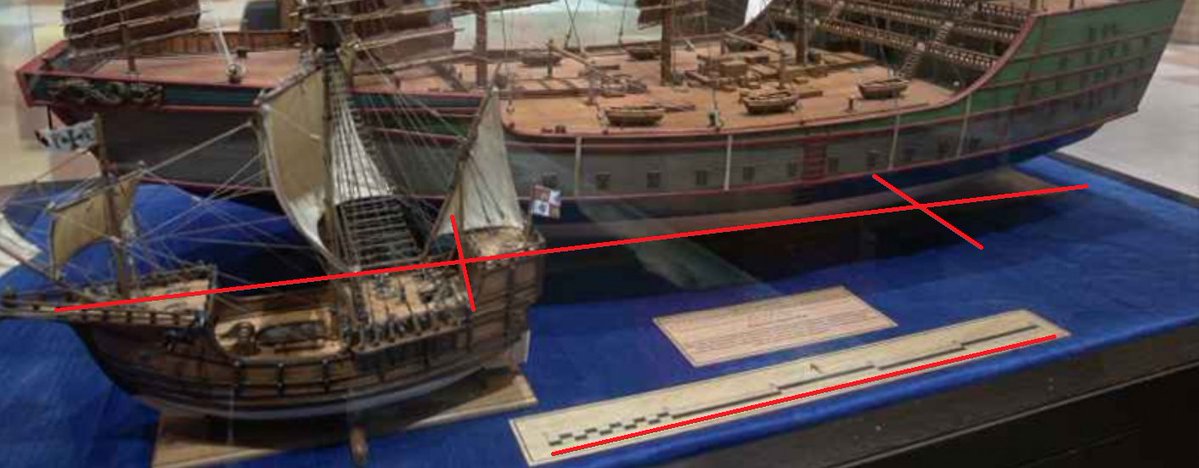
@xcanceluser @Noahpinion the model portrayed in the photo that Noah was responding to is clearly meant to be ~450 ft (more than 4x as long as a galleon), which is also the figure that is still taught in every Chinese textbook, and which is a completely fictional number "no one" x.com/JSONmaxxing/st…
JSONmaxxing@JSONmaxxing

1. the original, authentic version of 瀛涯勝覽 does not mention the dimensions of the ship. The copy which added the "450 ft" (44 zhang) description was the 澹生堂刻本, which was produced in the 1580s-1620s. Whether it is earlier than the novel is debatable, but in either case, it is clear that the "450 ft" characterization is a late-16th century invention, created nearly 200 years after the original voyage. There is no intermediate work that supports this description. 2. The 5000 liao record is consistent with the Western 200 ft (61 m) estimate, not the 450 ft (137 m) claim which is the fantasy that is often taught in Chinese textbooks This is very simple math. "liao" is a unit of volume describing the cargo volume. The cargo volume is proportional to the displacement of the ship. Thus, just like the displacement, a ship's liao is proportional to the *cube* of the length of a ship Let x be the liao capacity of the ship Let y be the length in meters x = k(y^3) where k is a constant We know that a Song-era Quanzhou trading ship excavated was measured at 34.6 meters and recorded at 1000 liao Hence we can arrive at an estimate of k: 1000 = k(34.6^3) k ≈ 0.024 If a treasure ship is 450 ft (137 m), x ≈ 0.024(137^3) ≈ 61712 liao If a treasure ship is 200 ft (61 m) x ≈ 0.024(61^3) ≈ 5448 liao Hence, the "5000 liao" description actually implies a ship slightly smaller than the Western historical consensus, a "200 ft" ship. Meanwhile, the "450 ft" ship would imply a cargo volume that is more than 12 times larger than the recorded "5000 liao".

English
1
0
4
184
changethis
changethis@xcanceluser·
Except that Columbus did not use galleons, but instead the much smaller carrack and caravels in his fleet. The carrack/caravels measured 50-60 ft, whereas a Ming treasure ship measured 166 ft, so the model does look to be accurate. Columbus's ships would have looked puny next to a Spanish galleon or Venetian galleass.
English
2
0
0
109
JSONmaxxing
JSONmaxxing@JSONmaxxing·
sigh. if you had just paid a little attention you'd notice the model grossly over-estimates the size of both ships, which is actually what tends to happen outside of historical circles. eyeballing from two different angles, the models are approximately 30 meters (~100 ft) and 120 meters (~400 ft). which both imply a displacement that's about 8 times as large as their actual size. let me go back a little bit and review what happened here. we have Noah and a few other posters trying to correct a common Chinese historical myth, one which is receiving tens of thousands of likes at the moment and thus misleading potentially millions of people. you, random China-loving gwailo, barge in and say "no one's claiming that". when in fact it would have taken you 5 seconds to ascertain that the 400 ft estimate is exactly what the model is portraying, what its comment section is claiming, and also apparently what Kaiser Kuo believes. this is why it's particularly frustrating to deal with people like you. you have such a tribalistic instinct to defend China as some gwailo with a meagre dose of Chinese knowledge that you are willing to strawman every reasonable criticism of China while steelmanning even the dumbest myths from the "Chinese" side. you think this is somehow supposed to make you a friend of China. you don't really seem concerned that you are, in fact, reinforcing far-right mythologies about the Ming dynasty and that at this very moment, "Ming nationalists" on the Chinese internet are calling for massacres of Manchu and Hui people, and that is why some of us are really insistent on debunking pro-Ming mythologies. you don't really know half as much as you think you do. it might be better to listen to people who do.
JSONmaxxing tweet mediaJSONmaxxing tweet media
English
0
0
1
23
Paylaş