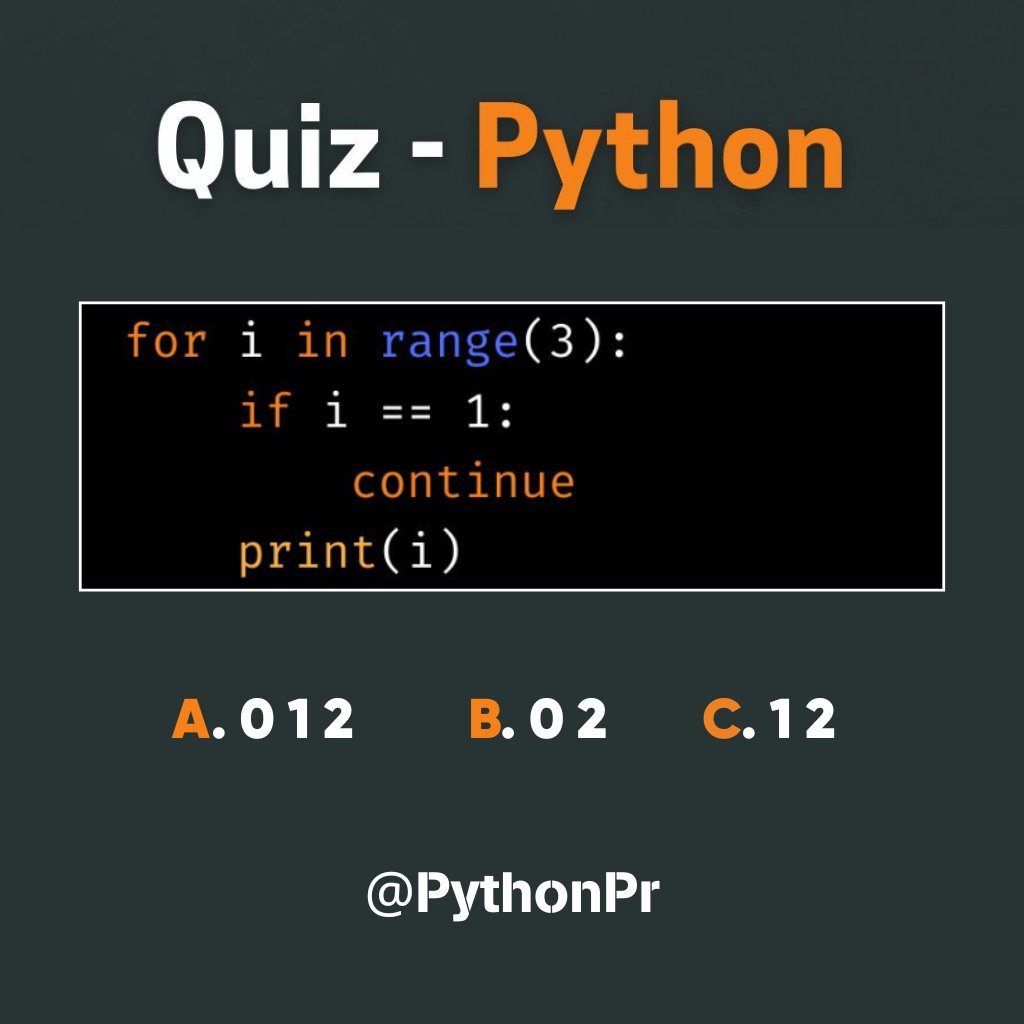
The Python code snippet in the post uses a `for` loop with `range(3)` to iterate over 0, 1, and 2.
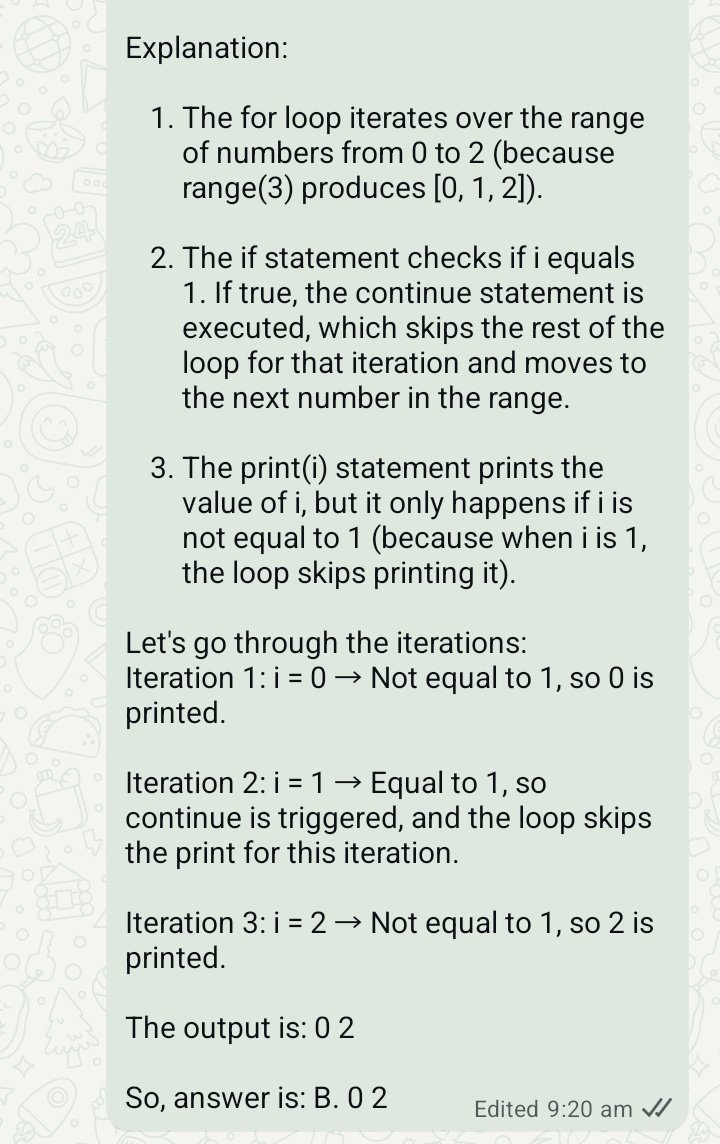
When `i == 1` the `continue` statement skips printing 1, resulting in output "0 2" (option B).
This quiz highlights `continue` which affects loop flow by bypassing remaining code in an iteration, a feature rooted in Python’s design to enhance control structures.
@PythonPr The for loop iterates through the numbers 0, 1, and 2. When the value of i is 1, the if condition is met, and the continue statement is executed.
Therefore, the print(i) statement is skipped when i is 1, and the value is not printed.
Answer is:b 0 2
@PythonPr Answer spoiler:
It's B) 02! The continue statement skips the rest of the current iteration when i == 1, so only 0 and 2 get printed. The loop runs 3 times (i = 0, 1, 2), but when i equals 1, continue jumps straight to the next iteration without executing print(i).
@PythonPr range(3) generates the numbers 0, 1, and 2,when i = 0, the condition i == 1 is false, so it prints 0; when i = 1, the condition is true, so continue skips the print statement and nothing is printed; finally, when i = 2, the condition is false again, so it prints 2 {B}
@PythonPr continue: when match found it skip body and goes to increment part. Basically skip the current particular index. My personal name to it as Index skipper.
break: when match found it skip the whole loop. For current and upcoming indices. My personal name to it as Loop breaker @grok
@PythonPr B. 02. Range start from zero (0), when i is 1 then skip to the next iteration. After that print 2. Range(3) means that iteration is less than 3. So the 3 does not include in the iteration