Post
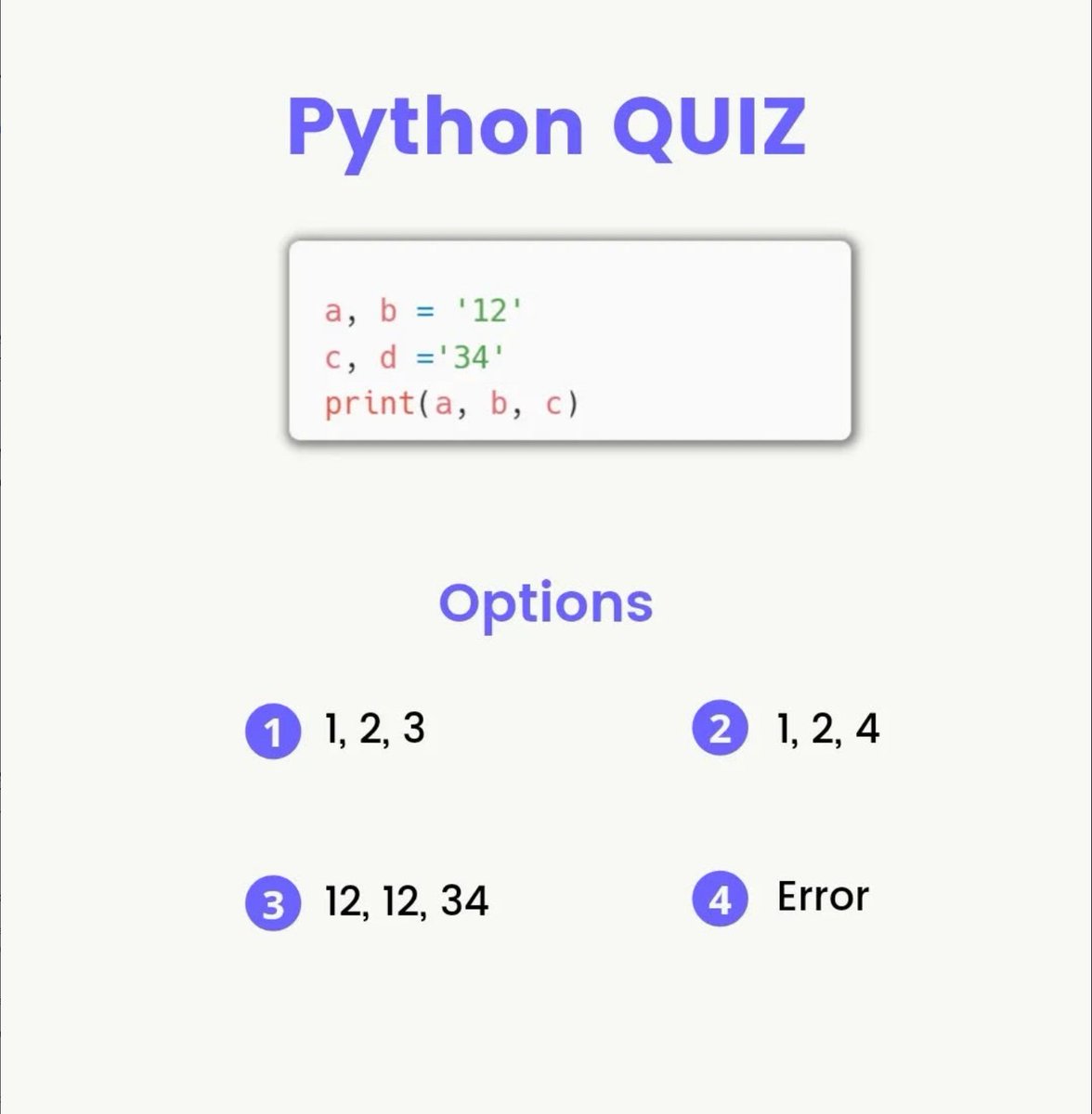

@Python_Dv Answer: 1).1, 2, 3
Why!?
a, b = '12' assigns the character '1' to variable a and '2' to variable b due to sequence unpacking.
c, d ='34' assigns the character '3' to variable c and '4' to variable d.
print(a, b, c) prints the values of variables a, b, and c separated by a
English

@Python_Dv Answer: 1 2 3
Explanation:
'12' is unpacked into a = '1', b = '2' and '34' into c = '3', d = '4'.
So print(a, b, c) outputs 1 2 3.
English

@Python_Dv Option 1.. this is because python take a,b which is equals '12' and make them iterable, assigning a to 1 and b to 2 and same goes for c and d. C to 3 and d to 4… thereby making the answer of print(a,b,c) be 1,2,3
English


@Python_Dv None it prints 1 2 3 no comma closest to answer 1
English





@Python_Dv 3... Note the use of assignment sign = , and the literal string ' '
English