Post
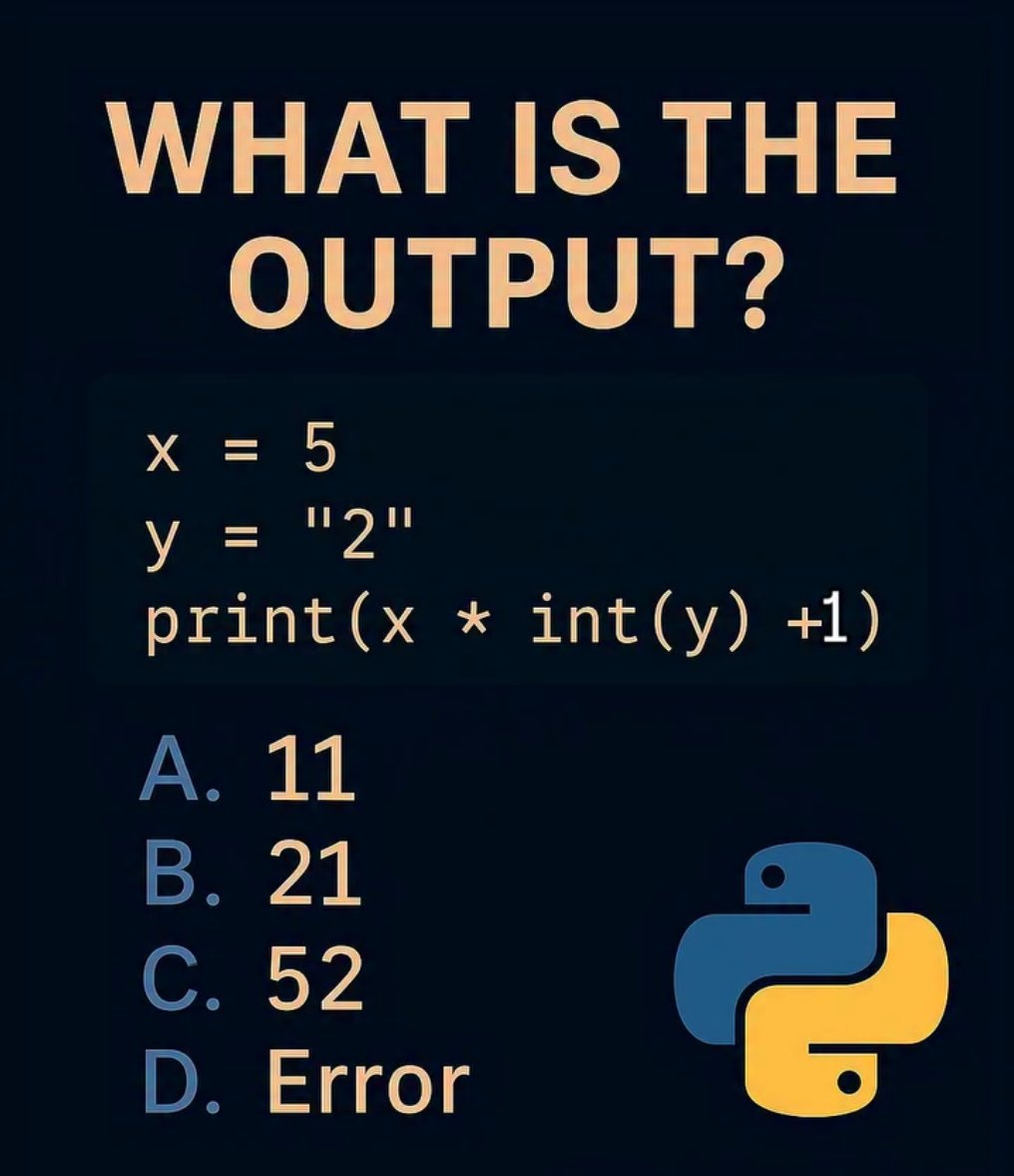

@Python_Dv Answer: A) 11 ✅
Explanation:
y is "2" (string), int(y) converts it to 2.
So the expression becomes: 5 * 2 + 1 = 11.
English

@Python_Dv Answer: A. 11
This tests understanding of variable types and type casting.
Why!?
The variable x is assigned the integer value 5.
The variable y is assigned the string value "2".
The expression int(y) converts the string "2" into an integer 2.
The multiplication x * int(y)
English

@Python_Dv A) 11 ✅Great quiz! The key here is explicit type conversion: int(y) turns the string "2" into an integer 2, so it's 5 * 2 + 1 = 11.Without the int(), it'd raise a TypeError since you can't multiply int by str directly. Common gotcha for beginners! 📷🐍
English

@Python_Dv Print( 5*int(2)+1)
2 turned integer and
finally: 5*2+1= 11..
first sequence of action is * and than + last process in coding.
English

@Python_Dv Even an 11 year old can answer it. Be Man give something challenging😏
English


@Python_Dv A. 11
x variable is assigned 5 and y variable is assigned a string 2 .
which is then type casted to int and perform the operation .
English

@Python_Dv x is assigned the integer value 5
y is assigned the string value "2"
int(y) converts the string "2" into the integer 2
x * int(y) performs the multiplication: 5 * 2, resulting in 10
... + 1 adds 1 to the result: 10 + 1, resulting in 11
print(...) displays the final value, 11.
English



@Python_Dv A=11
Since int("2") converts the string into int type and 5*2+1=11.
English









@Python_Dv 11
Because
x is an integer and y is string but converted to integer and performed bodmas in print statement + 1 which equates to 11
English