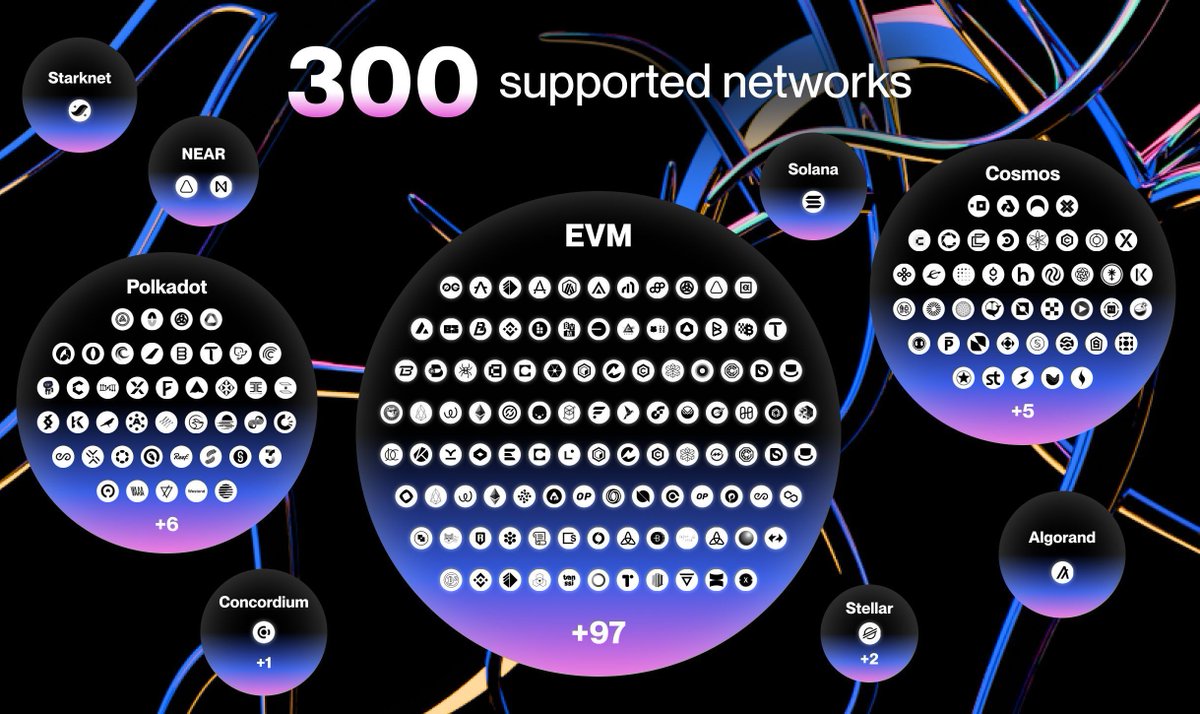
SubQuery just passed 300 supported networks — it’s hard to believe how far this journey has come.
We started in 2020 inside the @Polkadot ecosystem, backed by a grant from @Web3foundation. At the time, non-EVM developers were stuck. If you wanted to build a dApp, the first step wasn’t building your product — it was building your own indexer. Meanwhile, @Ethereum teams were flying ahead with plug-and-play tooling.
So in early 2021, we launched SubQuery to change that.
From day one we built around three principles: performance, customer-driven features, and wide-chain support — and those pillars still define everything we do.
We shipped the SubQuery Dictionary to unlock massive indexing speed gains. We added support for the Frontier EVM layer, helping bridge EVM compatibility into non-EVM worlds.
And then in 2022, we expanded beyond Polkadot for the first time — starting with @avax, then rapidly into @cosmos, @Algorand, @FlareNetworks, @NEARProtocol, and others. In many of those ecosystems, we became — and in some cases still are — the only independent, open-source, decentralised indexer.
In 2023, we doubled down on EVM, bringing our indexing support to 194 EVM chains — not overnight, not in hype cycles — but consistently, one integration at a time.
And this year, in 2025, we hit one of our most requested milestones ever: @solana support is now live. High-performance indexing for one of the fastest blockchains in the world — powered by SubQuery.
Along the way, we kept shipping:
Multi-chain indexing. GraphQL subscriptions. Block handler filtering. Multi-threaded performance. Real-time error logging. Unfinished block syncing. SDK v2.0. Then v3.0 with full manifest control.
And now — 300 networks later — one thing is clear:
We didn’t scale by hype. We scaled by shipping, listening, and showing up for builders over and over again.
To every team that trusted us — thank you.
To every developer still building — we’re just getting started.
English