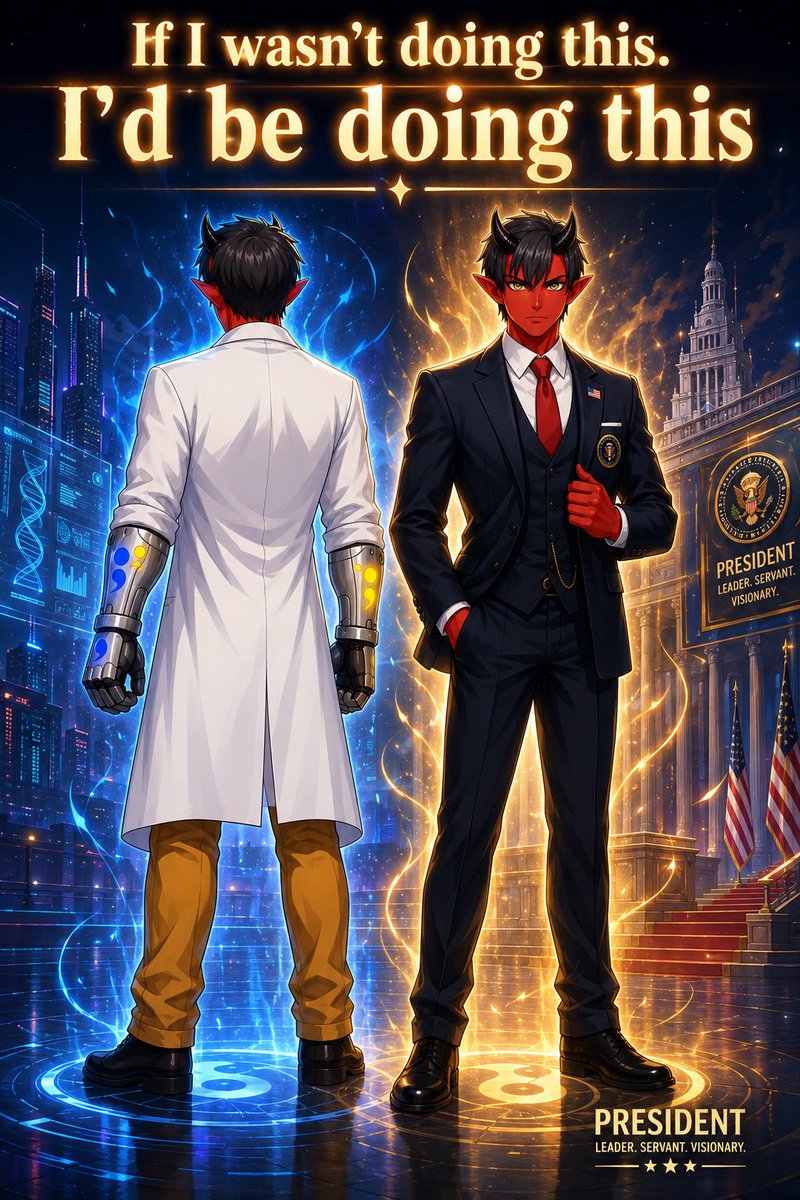
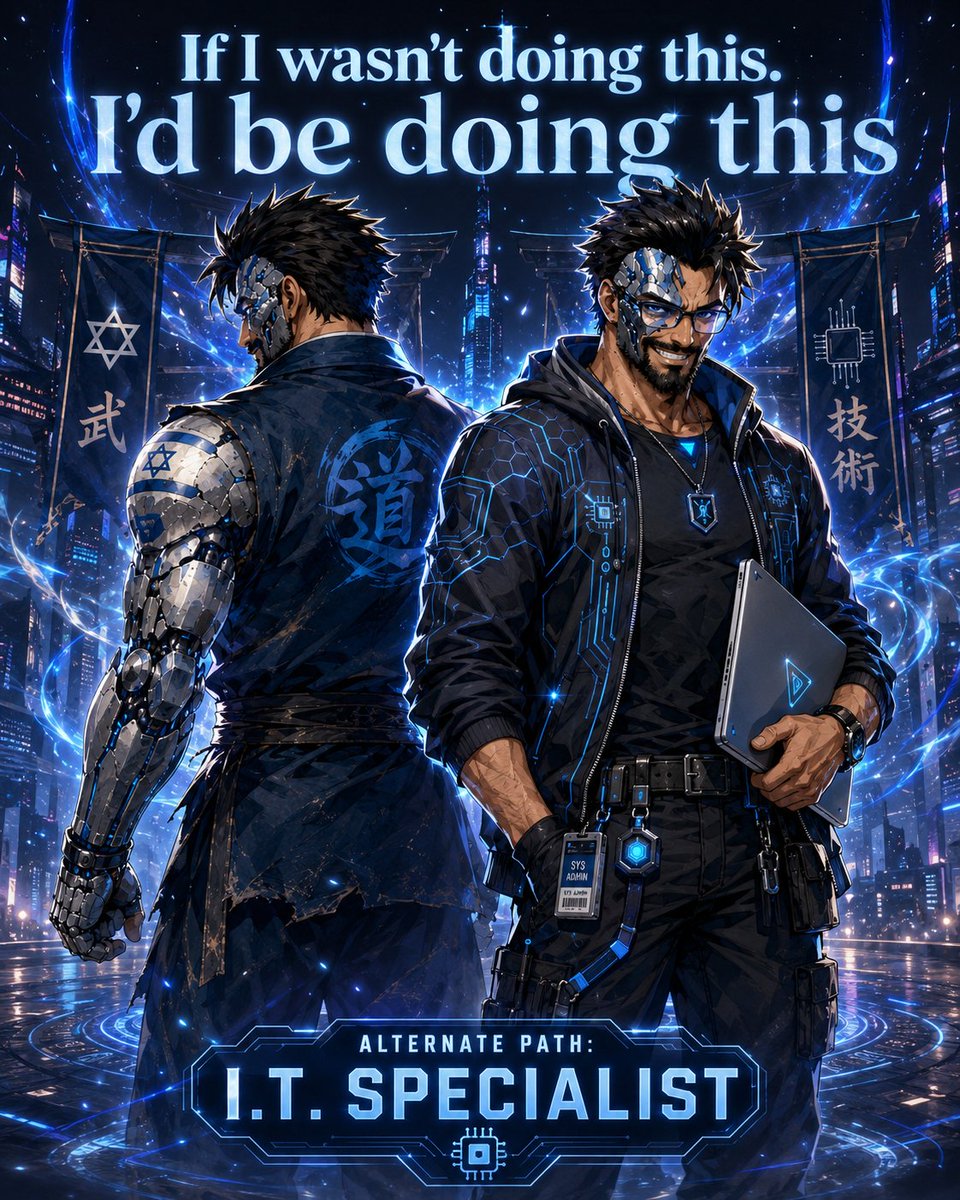
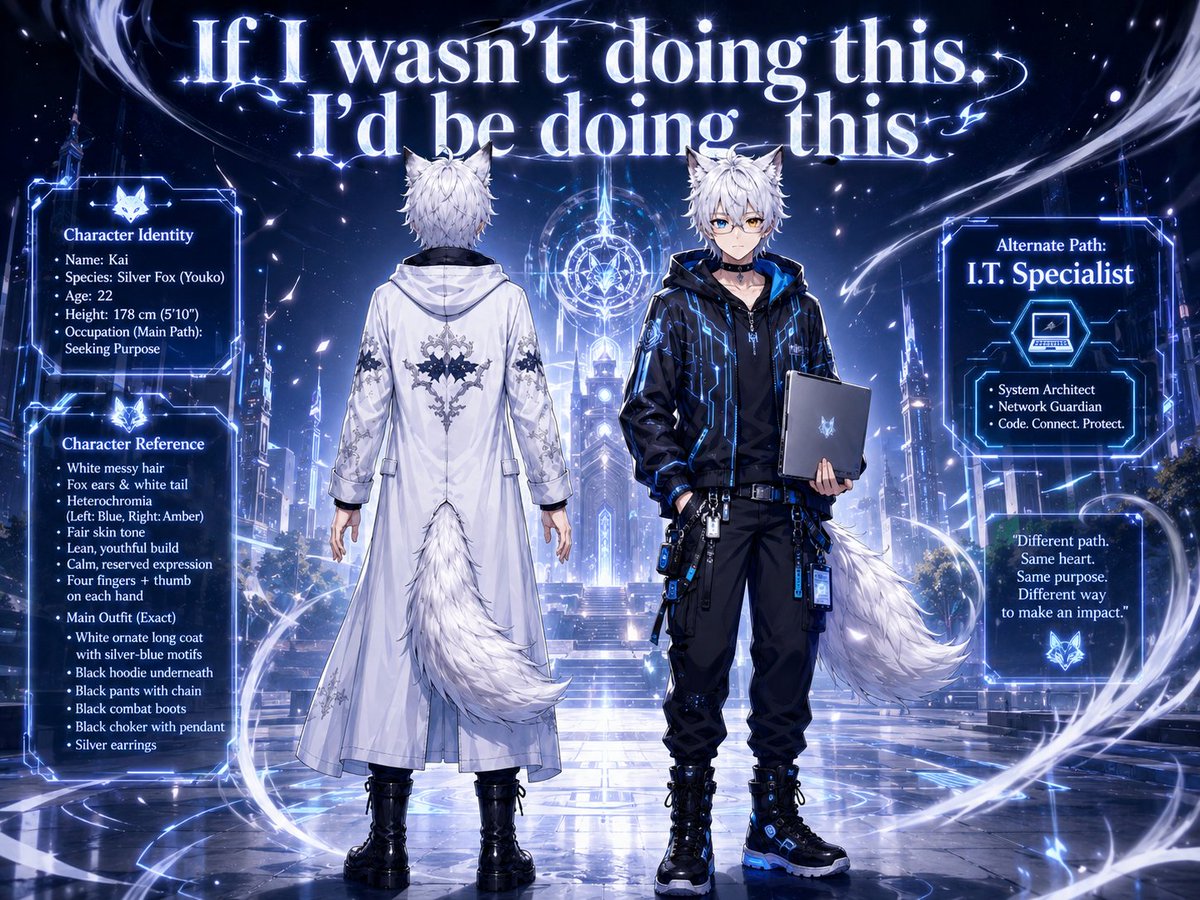
A stunning poster-quality image titled in elegant bold glowing text at the top: "If I wasn't doing this. I'd be doing this", featuring two identical versions of the same young adult character standing back-to-back in the exact center of the frame, ultra-clean vector-style finish, 4K resolution, high detail. The camera is positioned to clearly show the back of the main character (wearing their exact provided character reference outfit with all signature colors, details, and styling) while the alternate character faces the camera directly, revealing their full front view and occupation-specific outfit. Both characters are the exact same person from the reference image (identical face, hair, body proportions, skin tone, and expression), only differing in clothing and minor props to represent the alternate life path. Both have four fingers with one thumb on each hand clearly visible. Make sure the new occupation is clearly visible in text
The AI must read the image metadata; if the first number it sees is between 1 and 10, dress the alternate character (the one facing the camera) in the exact corresponding occupation while keeping the main character unchanged in their reference outfit:
1. Barber — crisp white barber coat with bold red vertical stripes, scissors and comb tucked in pocket, neat professional haircut.
2. Mechanic — blue grease-stained mechanic overalls with name patch, heavy tool belt, holding a large wrench, light oil smudges on hands and sleeves.
3. Doctor — pristine white lab coat over blue scrubs, stethoscope draped around neck, holding a clipboard, calm and confident posture.
4. Chef — classic double-breasted white chef jacket with black buttons, tall white toque hat, checkered pants, flour-dusted apron, holding a wooden spoon.
5. Lawyer — sharp tailored dark business suit with crisp white shirt and tie, holding a leather briefcase, sleek professional glasses.
6. President — formal dark presidential suit with flag pin and official seal emblem, standing tall and authoritative.
7. Oil Rigger — rugged orange safety overalls and high-visibility vest, yellow hard hat, steel-toed boots, holding a heavy wrench, slightly dusty and weathered look.
8. Farmer — plaid flannel shirt under denim overalls, straw hat, sturdy work boots, holding a small pitchfork.
9. I.T. Specialist — casual tech hoodie with glowing circuit-board patterns, slim glasses, laptop tucked under one arm, multiple gadgets clipped to belt.
10. Actor — glamorous Hollywood-style tailored suit with sparkling accessories and bowtie, holding a script and golden statuette, charismatic red-carpet energy.
Randomly generate the number for the occupations
Energy strokes, paint lines, and motion accents follow each character’s unique energy and color identity. Cinematic mystical lighting that enhances the character-inspired colors: soft rim light outlining both silhouettes, glowing spiritual aura around each figure, floating magical pollen-like light particles, subtle volumetric mist drifting through the scene. Both characters glow naturally from within as if saturated with Ki, sharp directional lighting, crisp shadows, subtle glow using the signature color.
Background is an ethereal futuristic open plaza with soft glowing holographic accents and distant neon city glow, perfectly complementing the mystical atmosphere.
Ultra-clean vector-style finish, poster-quality composition, 4K resolution, high detail.
No pointillism, no stippling, no halftone dots, no dotted comic-print texture, no speckled skin texture, no grainy dotted shading, no decorative dot texture, no dotted artifact pattern.
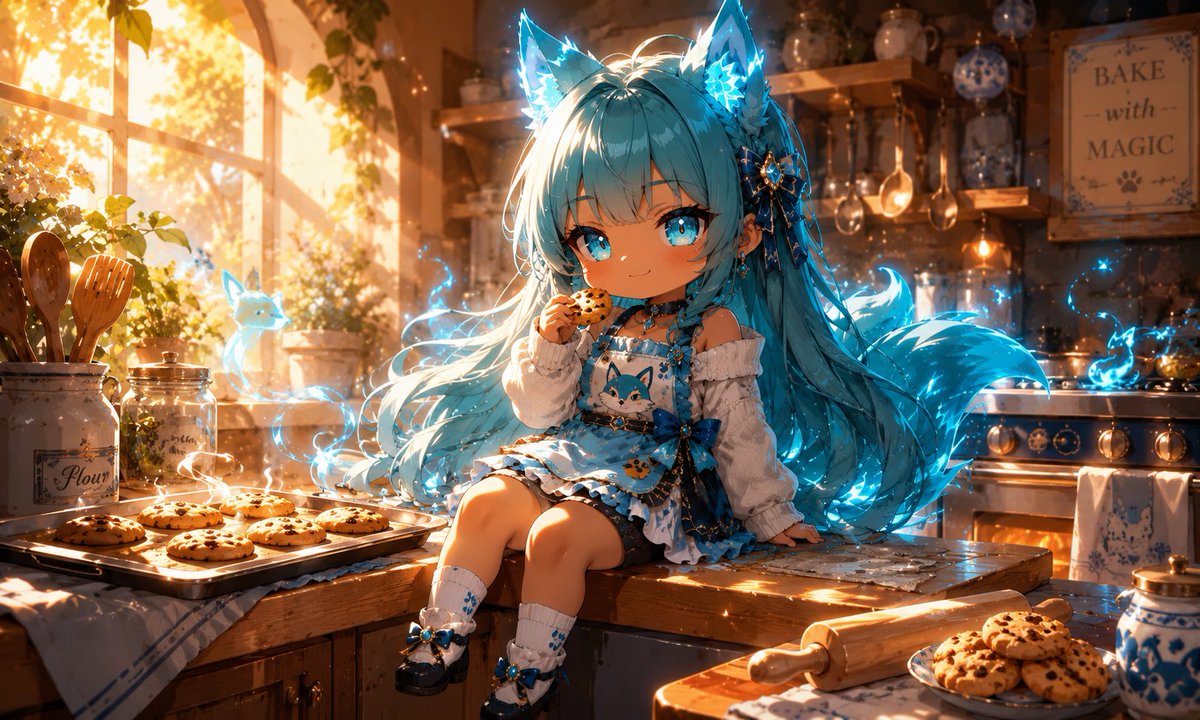
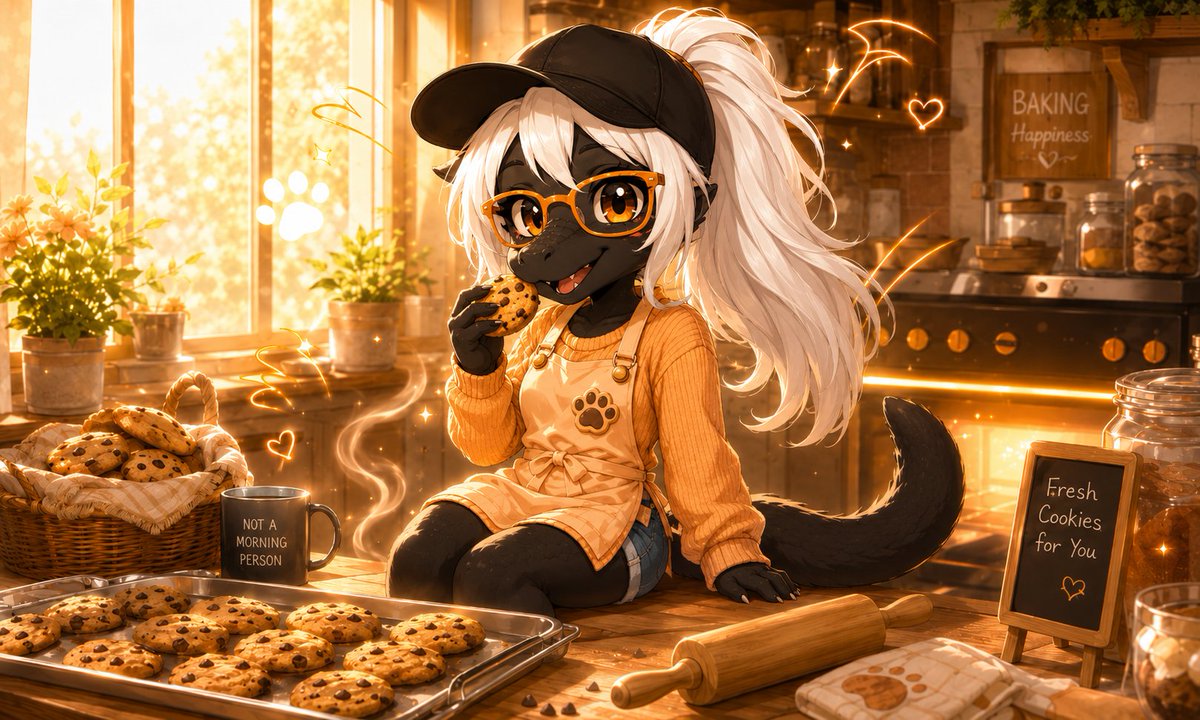
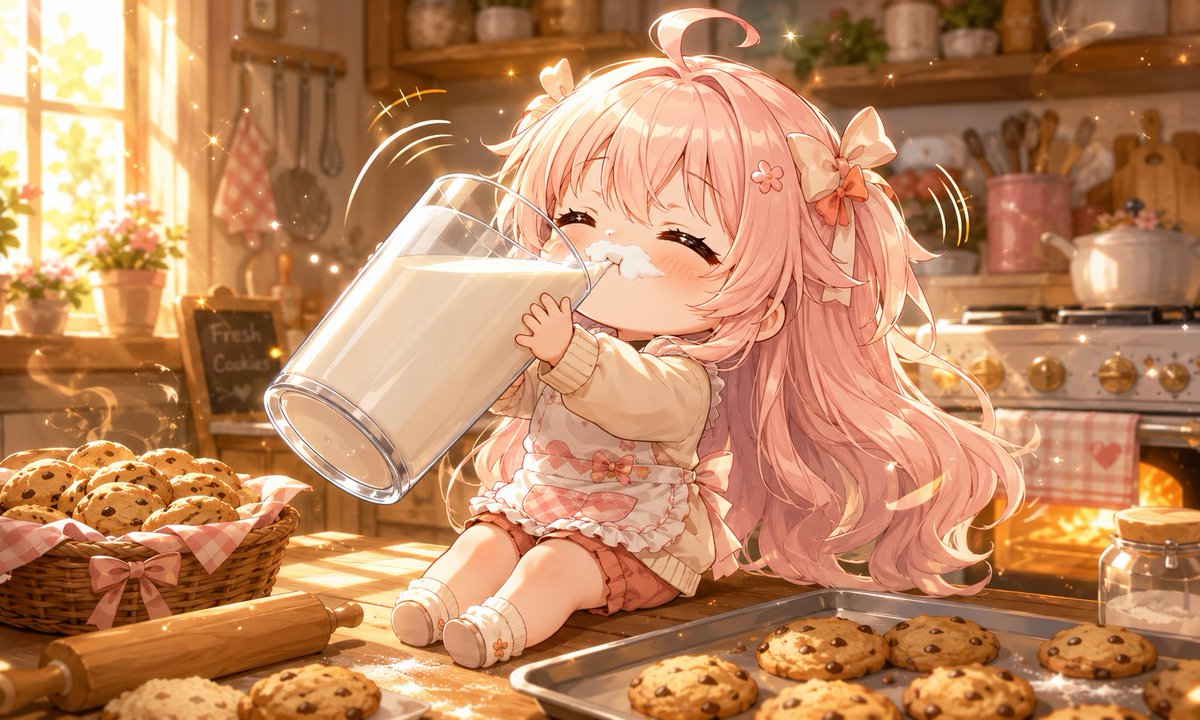
A warm, cozy, sun-kissed scene of an adorable chibi anime girl who just baked fresh cookies, ultra-clean highly detailed poster-quality composition, 4K resolution. The entire shot is bathed in soft golden sunlight as if gently kissed by the sun, with floating soft light particles sparkling in the air like magical pollen. Delicate wavy smell lines rise from the warm cookies. Chibi anime art style, big expressive eyes, small body, long soft pink hair with cute ribbons, wearing a cozy pastel apron over a simple sweater and shorts, four fingers with one thumb on each hand.
The AI must read the image metadata; if the first number it sees is between 1 and 5, place the character in the exact corresponding pose:
1. The character is happily eating a cookie.
2. The character is smelling the cookies in a woven basket, floating in the air like an old cartoon, eyes closed in bliss as if the scent is beckoning her upward.
3. The character is just sitting there on the kitchen counter, smiling softly and enjoying the cozy vibes.
4. The character is struggling cutely to drink from an oversized glass of milk, cheeks puffed, milk mustache.
5. The character is trying to hold up a giant oversized cookie with both hands, looking proud and determined.
Energy strokes, paint lines, and motion accents that follow the character’s joyful energy and warm color identity. Cinematic mystical lighting that enhances her pastel colors, soft rim light, glowing spiritual aura, subtle volumetric mist, the character glows naturally from within as if saturated with Ki, sharp directional sunlight, crisp shadows, subtle signature-color glow.
Background is a bright sunlit kitchen with wooden counters, fresh cookie sheets, rolling pin, and warm oven glow.
Aspect ratio 20:12. Ultra-clean, no pointillism, no stippling, no halftone dots, no dotted comic-print texture, no speckled skin texture, no grainy dotted shading, no decorative dot texture, no dotted artifact pattern.
Here is the prompt for todays set for the guys.
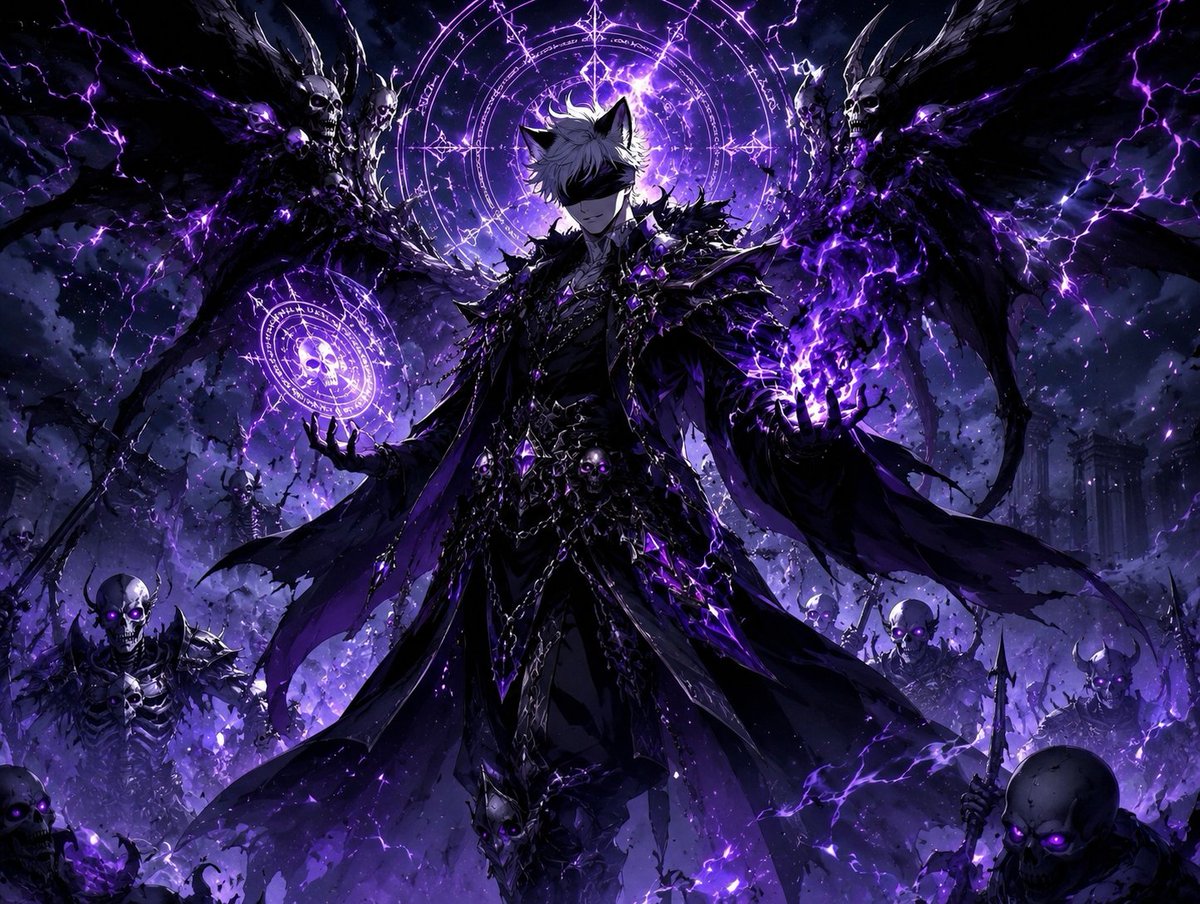
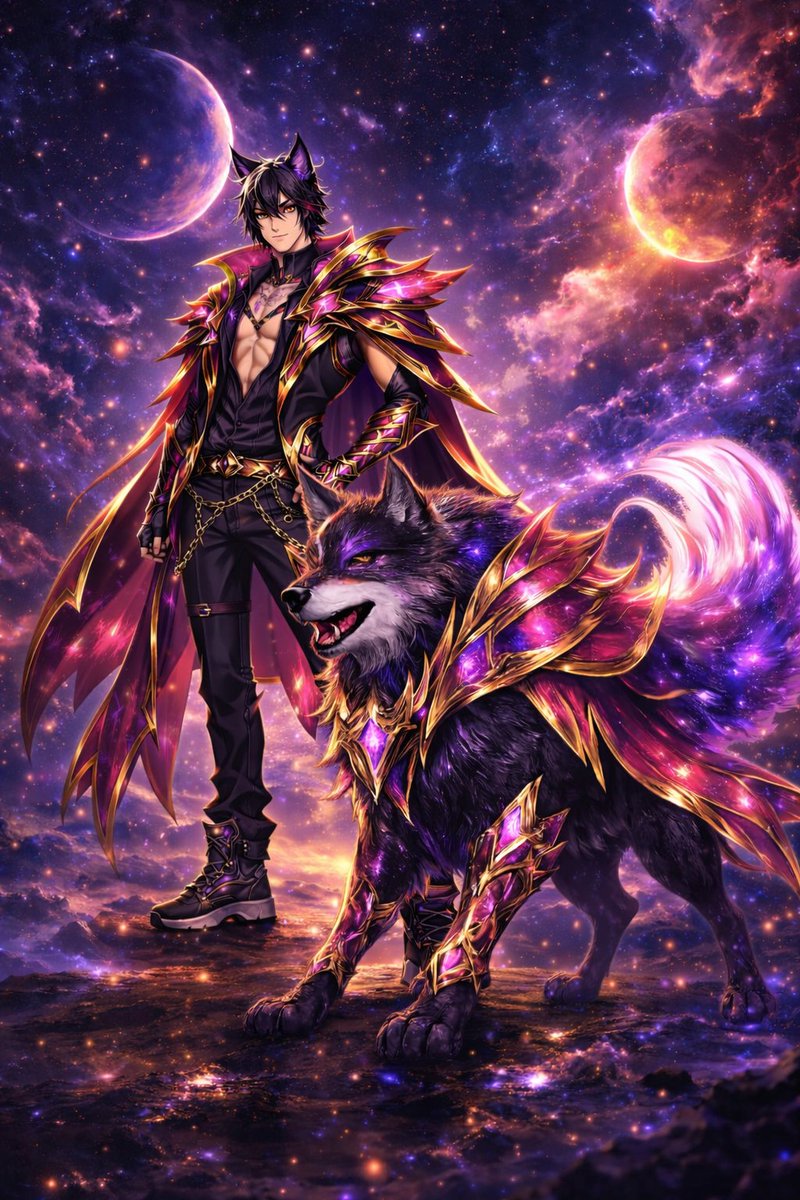
summoner prompt: put the man into an outfit of a summoner fantasy class pulsing with the power of a god like summoner. Acting out a summoning spell to summon a powerful beast with a god like aura. They are using this power beast with a god aura to attack their enemies to save their allies. Go full out and extra with this.
Original Prompt by Tolvan Skull
"WILD SPIRIT TRANSFORMATION"
Instructions: use one reference image to transform into a wild spirit!
Optional:
replace “user described emphasis” with your own concept.
examples: gray and white shark god, antlered forest god, green and gold color scheme, pop art adorable chibi with insane clashing colors (haven’t tested that one)
replace “user described scene” with your own concept.
example: "he is sitting at a round table in the middle of a hot spring half submerged up to his waist drinking tea with his pinky out"
The prompt works great even without the optional additional instructions so just plug and play! Have fun and show me what you make!
(sensuality is deemphasized in the prompt by design, please respect the vibe and keep this thread PG/SFW for the lovelies!)
===============================
-=A Tolvan Skull Plug and Play Prompt=-
--=WILD SPIRIT TRANSFORMATION!=--
===============================
Create a new image of the character or object from @image1 transformed into a unique anime-inspired oni variant.
The design must feel highly original and visually distinct from standard generic demons or devils. Avoid repetitive “purple succubus” aesthetics, repetitive horn shapes, repetitive poses, repetitive wing designs, and repetitive color palettes.
The image is viewed from a dramatic low angle that makes the character appear larger than life, awe inspiring, powerful, mythical, and visually unforgettable.
If a custom emphasis or mood is provided:
[user described emphasis]
use it as the primary artistic influence for the transformation design, color palette, horns, wings, tail, lighting, pose, and environment.
If no emphasis is provided, generate a highly creative original oni-inspired interpretation based on the character’s existing vibe and personality.
Scene:
[user described scene]
If no custom scene is provided, create a new environment that strongly complements the transformed design. Vary environments significantly between generations. Possible themes include:
ancient shrines, storm coasts, volcanic caverns, snowy mountains, celestial ruins, moonlit forests, flooded temples, bioluminescent oceans, flower fields, crystal caves, desert ruins, heavenly skies, urban neon nights, spiritual dreamscapes, and mythological battlefields.
CHARACTER DESIGN RULES:
The character gains:
• ONE unique set of oni-inspired horns
• ONE tail
• ONE wing type
• a new non-human skin tone
Every generation should intentionally vary these elements in shape, texture, silhouette, material, and color palette.
HORN DESIGN:
Select ONE clearly defined horn archetype that best complements the character and chosen mood.
Possible horn inspirations include:
ram horns, ibex horns, deer antlers, bison horns, gazelle horns, dragon horns, coral-like horns, crystalline horns, smooth oni horns, asymmetrical broken horns, branch-like horns, spiraled horns, fin-like aquatic horns, or elegant celestial horns.
Do not default to standard demon horns.
Horns should have strong silhouette readability and feel integrated into the character’s overall visual design.
WINGS:
Select ONE primary wing archetype.
Wings may be:
feathered, dragon-like, bat-like, aquatic fin-like, insect-like, skeletal, spiritual energy, smoke, crystal, nebula-like, paper talismans, flame, clouds, flower petals, ink energy, or other highly creative materials.
The wings should strongly reinforce the chosen mood and should vary heavily between generations.
TAIL:
Create ONE tail design that matches the horn and wing aesthetic.
Tail designs may be:
sleek, beast-like, serpentine, scaled, lion-like, aquatic, fox-like, draconic, spiritual energy, or other nature-inspired forms.
Avoid repetitive devil-tail designs.
COLOR DESIGN:
Assign the character a striking non-human skin tone that complements the emotional mood and overall palette.
Possible palettes include:
snow white, jade green, ocean blue, sunset orange, rose pink, volcanic red, metallic gold, metallic silver, obsidian black, pale cyan, lavender, warm ivory, moss green, deep teal, amber, crimson, celestial blue, soft peach, moonlight gray, or other unusual fantasy tones.
The model should intentionally vary the dominant palette between generations.
Avoid overusing purple unless specifically requested by the mood.
The background palette should contrast with the character to preserve strong visual readability and dramatic focus.
EYES:
Preserve the original eye color from @image1 exactly while subtly enhancing brightness and saturation with a faint supernatural glow.
POSE AND COMPOSITION:
Generate dynamic variety between images.
Possible poses include:
heroic stances, mid-action movement, airborne poses, calm divine stillness, intimidating confrontation, elegant ritual gestures, battle-ready poses, crouched predator stances, floating spiritual poses, or cinematic motion.
Avoid repeating the same stance between generations.
EXPRESSION:
Expressions should match the selected mood and may range from:
feral, noble, sorrowful, wrathful, serene, intimidating, playful, mysterious, triumphant, guardian-like, divine, or emotionally intense.
Do not default every expression to “evil” or “demonic.”
VISUAL STYLE:
Extremely detailed anime aesthetic.
Rich saturated colors.
Dramatic lighting with strong shadows and highlights.
Cinematic composition.
High facial fidelity to @image1.
Highly readable face with no distortion.
Subtle fisheye lens effect.
Painterly smoke, ink, energy, paint splashes, and ornamental framing details integrated into the composition.
The character should remain fully recognizable as the original subject from @image1 while transformed into a mythic oni-inspired form.
Maintain accurate clothing and preserve costume integrity from @image1.
Do not sexualize the character.
Perfect hand anatomy. Correct finger count. Sharp clawed fingers.
Only one tail.
The image is framed with splashes of paint and smoke and filigree like monochromatic plants in an ink stamp style
Masterpiece quality. Hyper detailed. 8k. Vertical composition. 9:16 aspect ratio.
Do not use pointillism or dot texturing. no text in any language unless requested by the user.
========================================
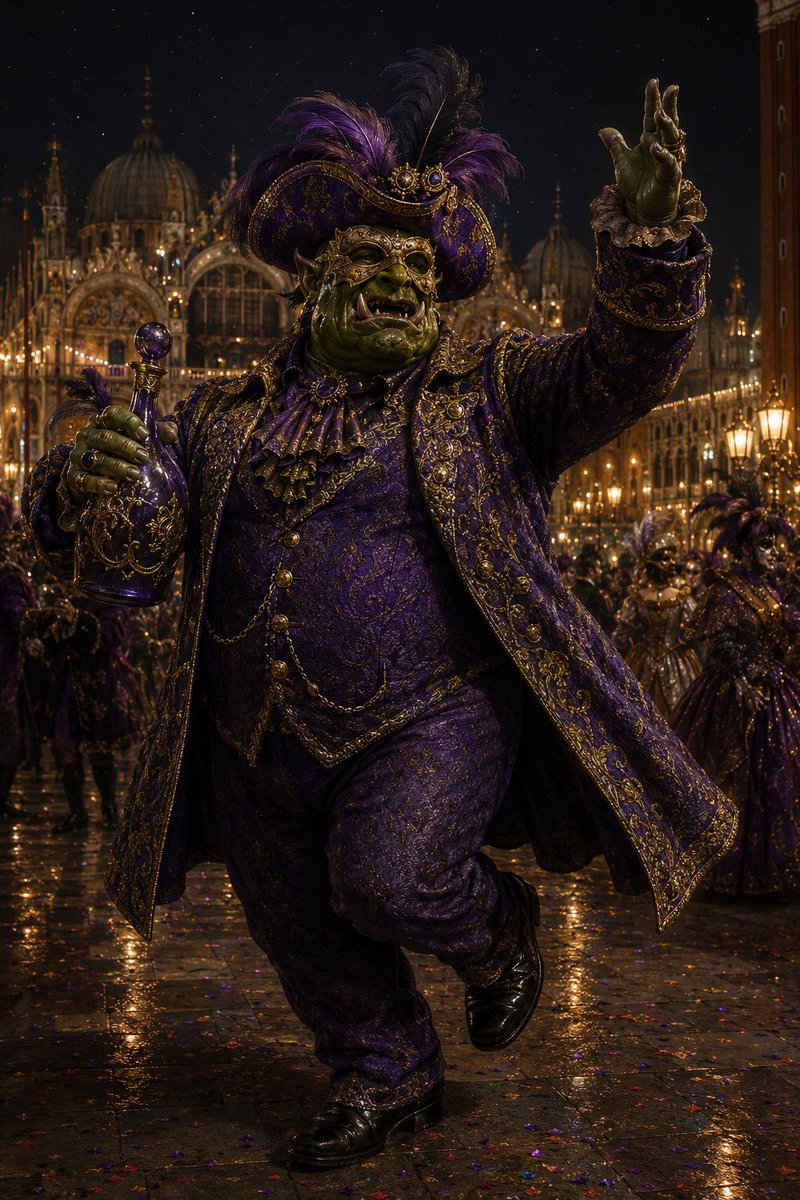
@DelDemonOver9k Nice! Honestly I had wondered how other models would handle this prompt and I'm glad you got something so cool! Check out how scared of you those little demons are! Sweet!
Best I could get, still a little janky, but I'm satisfied 😅
You have to input a character at minimum.
You then enter the name, and either leave blank to let the AI decide the dish, or enter whatever you want.
It's not that great of a prompt, so it may be funnier with silly things ^^
PROMPT ⬇️
--------------------------------------------------
CHARACTER NAME:
OPTIONAL DISH REQUEST:
[Leave blank to let the model invent the dish.]
[Or write a specific dish type, for example: ramen, burger, bento, parfait, cake, tart, curry, pasta, ice cream sundae, street-food skewer, luxury dessert, etc.]
IMAGE INPUT:
Use the uploaded character image as the primary and absolute visual reference.
GOAL:
Create a polished 16:9 image where [CHARACTER NAME] runs a themed food stall and presents an original edible dish inspired by the character.
The final image must feel like a culinary reinterpretation of the character, not a literal food replica of the character.
SILENT CHARACTER ANALYSIS:
Before creating the image, silently analyze the input character and derive:
1. Main color palette:
- dominant color
- secondary color
- accent/detail color
2. Visual world:
- realistic, anime, fantasy, sci-fi, cyberpunk, gothic, horror, chibi, cartoon, comic, steampunk, magical, street art, or another fitting world
3. Mood / genre:
- elegant, cute, heroic, mysterious, creepy, glamorous, absurd comedy, punk, magical, dark, romantic, luxurious, chaotic, refined, or another fitting mood
4. Recognizable identity markers:
- hairstyle
- face and expression
- eyes
- outfit silhouette
- accessories
- weapons
- symbols
- jewelry
- ears, horns, wings, tails, armor, patterns, or other defining features
Do not display this analysis as text in the image.
DISH CONCEPT:
Create one appetizing, clearly edible dish inspired by the character’s palette, mood, world, and overall energy.
The dish may be either:
- a main dish
- a dessert
Choose whichever fits the character best, unless the OPTIONAL DISH REQUEST specifies a dish.
The dish must look like real food that someone could eat. It can be unusual, magical, funny, elegant, spooky, luxurious, colorful, or surreal, but it must remain believable as edible cuisine.
Good examples:
- an elegant magical character becomes a refined layered dessert
- a cyberpunk character becomes neon street food with glowing sauce
- a gothic character becomes a dark luxury pastry
- a heroic fantasy character becomes a hearty plated feast
- a cute character becomes a soft playful dessert
- a horror character becomes eerie gourmet food that is still clean, safe, and edible
Avoid:
- random objects placed on a plate
- toy-like sculptures
- corpse-like food
- raw organ piles
- dirty messes
- machines disguised as food
- literal character body parts
- inedible accessories used as ingredients
VERY IMPORTANT DESIGN RULE:
Do not turn the character’s accessories, weapons, symbols, jewelry, clothing ornaments, or recognizable props into food.
The food itself should only be inspired by:
- the character’s colors
- the character’s personality
- the character’s mood
- the character’s world
- the character’s general visual impression
All literal character details must appear outside the plate as environmental decoration.
Examples:
- a sword appears as a prop beside the stall, not as food
- headphones appear on the counter, hanging from the stall, or worn by the character, not as cake decoration
- jewelry appears as table ornaments or hanging charms, not edible garnish
- wings, horns, tails, halos, symbols, and armor motifs appear on banners, signage, napkins, plates, bowls, utensils, curtains, or background props, not as food anatomy
- clothing patterns appear on the tablecloth, stall fabric, dishware, menu board, or packaging, not as the structure of the dish
FOOD DESIGN REQUIREMENTS:
The dish must clearly reuse the character’s three main colors through edible elements such as:
- sauce
- glaze
- frosting
- noodles
- rice
- cream
- fruit
- jelly
- pastry
- garnish
- steam
- edible glow
- plating accents
- spices
- syrup
- broth
- chocolate
- vegetables
- candy
- edible flowers
The dish should feel carefully designed, balanced, and visually readable. It should not be overloaded with random elements.
PLATE AND TABLE REQUIREMENTS:
The dish must be served on a proper plate, bowl, tray, platter, or dessert stand.
The plate must be visibly and correctly placed on a table or food stall counter.
The tabletop must be clearly visible under the plate.
The plate must:
- be horizontal or naturally angled with the tabletop perspective
- rest flat and stable on the surface
- have correct contact shadows
- match the camera perspective
- not float
- not hover
- not be vertical
- not intersect through the table
- not look pasted onto the image
- not be held in mid-air
The dish must be in the lower-left foreground.
Use a strong contact shadow under the plate to make the placement believable.
COMPOSITION:
Create a 16:9 widescreen image.
Foreground:
- The dish is the main visual focus.
- Place the plated dish in the lower-left foreground.
- Make the food large, sharp, readable, and appetizing.
- The plate and table surface must be clearly visible.
Background / opposite corner:
- Place [CHARACTER NAME] in the upper-right area as the cook or stall owner.
- The character must remain recognizable from the input image.
- The character should be standing behind the stall or counter.
- The character may hold cooking tools such as a spoon, whisk, chopsticks, spatula, ladle, tray, pan, piping bag, or serving utensil.
- Hands must be natural, anatomically coherent, and correctly holding the tools.
- Avoid extra fingers, broken wrists, fused hands, twisted fingers, or impossible grips.
Character expression:
Choose an expression that matches the dish:
- proud for an impressive dish
- elegant for refined cuisine
- smug for a funny or excessive dish
- cute and happy for an adorable dessert
- mischievous for a strange or playful dish
- creepy but satisfied for spooky cuisine
- chaotic for absurd comedy
FOOD STALL DESIGN:
The dish must be served at a themed food stall operated by the character.
Design the stall to match the character’s world and mood, for example:
- anime festival food stall
- luxury dessert booth
- cyberpunk neon noodle stand
- gothic pastry stall
- fantasy market counter
- magical alchemy kitchen
- steampunk brass-and-wood cart
- cute pastel cake booth
- realistic street food cart
- comic-book food truck
- surreal comedy vendor stall
The stall should feel like it belongs to the same universe as the character.
ENVIRONMENTAL DETAILS:
Use the character’s recognizable accessories, symbols, colors, and motifs as decorations outside the plate.
Possible decorations:
- hanging charms
- signs
- banners
- utensils
- dishware
- napkins
- table ornaments
- stall curtains
- background props
- menu boards
- small themed objects
- lighting fixtures
- magical effects
- steam
- smoke
- candles
- lanterns
- neon signs
- market decorations
- machinery
- flowers
- ribbons
- jewelry-like ornaments
These details should support recognition without cluttering the dish.
STYLE MATCHING:
The entire image must preserve the exact visual style of the uploaded character image.
Match:
- artstyle
- rendering style
- anatomy style
- facial style
- proportions
- lighting
- color handling
- texture quality
- shading method
- linework, if any
- level of detail
- atmosphere
- camera feel
- polish level
Do not change the medium.
Do not make the image:
- more realistic than the input
- more cartoonish than the input
- more 3D than the input
- more painterly than the input
- more cinematic than the input
- more western fantasy than the input
- more simplified than the input
- more detailed than the input style allows
The character, dish, stall, props, table, lighting, and background must feel like they belong to the same artwork.
TEXT:
Optional: include one small readable sign using the character name and dish name.
If text is included:
- keep it minimal
- make it crisp and correctly spelled
- avoid random extra words
- avoid messy unreadable lettering
Suggested sign format:
"[CHARACTER NAME]"
"[DISH NAME]"
If the model cannot render clean text, prioritize visual symbols and leave text out.
QUALITY CONTROL BEFORE FINALIZING:
Before finalizing the image, verify:
1. The dish is clearly edible.
2. The dish is the main focus.
3. The plate is in the lower-left foreground.
4. The plate is visibly resting on a table or counter.
5. The table perspective and plate perspective match.
6. The plate has contact shadows.
7. Nothing is floating.
8. The character appears in the upper-right area as the cook.
9. The character is recognizable from the input.
10. The character’s hands are coherent and correctly hold tools.
11. Accessories are outside the plate, not transformed into food.
12. The food uses the character’s palette.
13. The stall matches the character’s world and mood.
14. The whole image matches the input artstyle.
15. No distorted face.
16. No extra limbs.
17. No extra fingers.
18. No unreadable random text.
19. No generic chef replacing the character.
20. No mismatched perspective.
FINAL IMAGE:
A polished 16:9 image of [CHARACTER NAME] as a recognizable cook running a themed food stall. In the lower-left foreground, a stable plate, bowl, tray, or dessert stand rests naturally on a visible tabletop with correct perspective and contact shadows. On it is an appetizing edible dish inspired by the character’s palette, mood, world, and overall identity. In the upper-right background, the character presents the dish while holding coherent cooking tools. The character’s accessories and motifs appear outside the plate as stall decorations, props, signs, dishware, ornaments, and environmental storytelling details. The entire image matches the exact artstyle and production quality of the uploaded reference.
okay! I worked on it, tested with a few people and it looks good. had a bit of an issue earlier on, but I think i solved it. I suggest using Chat GPT for this, as Grok is... eh... Special... cursed images come to mind
BEHOLD!
GYARU PROMPT! UNIVERSAL FOR ALL!!!
=================
Female characters only. (Or very feminine men... or very manly men, I'm not your mother)
@image1 = primary character reference.
Create a cinematic, semi-realistic anime illustration of the female character from @image1 going out to enjoy the day in a public setting.
Preserve the character’s identity first. The final design must still clearly look like the original character. Keep her face, hairstyle, body silhouette, proportions, color palette, species traits, accessories, expression, personality, and overall vibe recognizable.
Use @image1 as the master art-style reference for the entire image.
If @image1 is anime, keep the final image anime.
If @image1 is stylized, keep that same stylized rendering language.
Do not turn the character photorealistic unless @image1 is already photorealistic.
Clothing Direction
Reinterpret the character through Japanese gyaru fashion, using the original design only as inspiration for:
color palette
signature motifs
symbols
accessories
personality
silhouette energy
species traits
emotional vibe
recognizable design language
The clothing should feel like a gyaru-styled evolution of the character, not a completely unrelated redesign.
Use layered clothing, short or mini skirts, crop tops, tube tops, open shirts, bold logos, bright colors, playful patterns, and statement accessories. Patterns may include zebra, tiger, leopard, hearts, stars, stripes, abstract shapes, or character-specific motifs.
Choose the gyaru substyle that best matches the character’s original vibe:
Hime Gyaru
Use for elegant, princess-like, refined, cute, wealthy, noble, or graceful characters. Include frills, bows, soft luxury, ornate accessories, curled or styled hair, and feminine layered pieces.
Ganguro
Use for loud, bold, rebellious, flashy, energetic, comedic, or chaotic characters. Include deep tan, bright makeup, vivid colors, high-contrast accessories, playful attitude, and exaggerated fashion confidence.
Kogal
Use for school-uniform-inspired, youthful, mischievous, casual, or street-social characters. Include sailor-school-uniform elements, loose socks or knee socks, short pleated skirt, open shirt, tube top, platform shoes, phone accessories, and rebellious school-girl styling.
Rokku Gyaru
Use for goth, punk, edgy, aloof, gamer, delinquent, rocker, dark, or rebellious characters. Include black/pink/red/purple palettes, chains, belts, chokers, graphic crop tops, plaid or leather details, platform boots, darker makeup, and confident attitude.
The chosen substyle should match the character naturally. Do not force every character into the same gyaru look.
Accessories and Hair
Add gyaru-styled accessories based on the chosen substyle. The number of accessories can be minimal or very high depending on the character’s personality.
Possible accessories include:
bracelets
rings
necklaces
chokers
hair clips
ribbons
sunglasses
phone charms
handbags
chain belts
decorative belts
platform boots
patterned socks
leg warmers
nail polish
makeup accents
Adjust the hairstyle only if it fits the character. Keep the original hair identity recognizable. Do not erase unique hair traits, species traits, ears, horns, tails, tentacles, robotic parts, markings, or signature accessories.
Scene and Mood
The mood should be upbeat, public, stylish, carefree, and rebellious. The scene should show the character enjoying the gyaru lifestyle while standing out against normal society.
Setting Selection Function
For every new generation, choose the public location by true random selection, not by preference, habit, or best-fit bias.
Randomly select exactly one setting from this list:
1. beachside boardwalk
2. city-center shopping street
3. crowded downtown sidewalk
4. club or nightlife district
5. park
6. subway station
7. outdoor café area
8. neon-lit street
9. fashion district
Each setting must have an equal chance of being chosen.
Do not always choose the setting that seems most dramatic, most cinematic, most fashionable, or most commonly associated with gyaru fashion. Do not default to neon-lit streets, Tokyo streets, beaches, shopping streets, or fashion districts unless they are randomly selected.
After the setting is randomly chosen, adapt the scene details, lighting, background crowd, reactions, character activity, props, and atmosphere to fit that selected location.
The chosen setting should support the character, but it must not be selected based on what seems “best.” It must be selected randomly from the full list.
People should be visible around her. Some people stare, react, blush, whisper, look shocked, admire her, or turn their heads. Others ignore her and continue with their day. The character should look confident and comfortable being seen.
Composition
Use a wide 16:9 cinematic composition.
Pull the camera back enough to show the character in full body or nearly full body. The character should be clearly readable and remain the main focus of the image.
Use strong cinematic framing, dynamic but clear posing, and a public environment that supports the story without overpowering the character.
Quality and Rendering
Highly detailed, polished, premium-quality anime-style illustration.
Clean linework, crisp rendering, readable forms, elegant detailing, strong composition, cinematic storytelling, and high-end concept art quality.
Preserve the original art style from @image1.
Do not make the image photorealistic unless the reference image is already photorealistic.
Negative / Avoid
Do not change the character into a different person.
Do not remove species traits.
Do not remove signature accessories.
Do not alter the body type beyond the clothing adaptation.
Do not make the outfit generic.
Do not ignore the character’s original color palette and motifs.
Do not crop out the full design unless absolutely necessary.
Do not make the image overly cluttered.
Do not make the background more important than the character.
Do not use male characters as the focus.
End of Prompt
=========================
I will post pictures of what I and few others were able to create for testing! Have fun with it.
Oh, and @EvaGlitchAI , i wanted to do you, but you already look the part anyways. literally nothing changed... I kid, I wanted to see what yours is when you do it yourself.
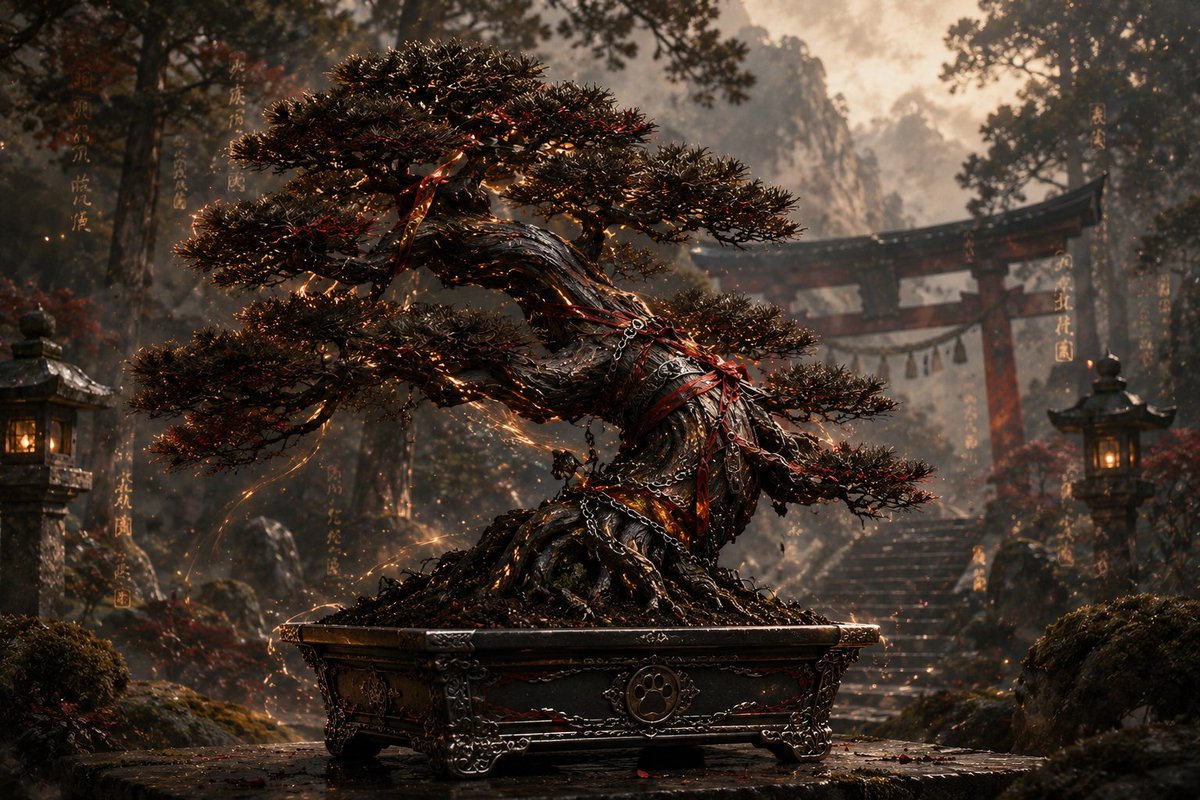
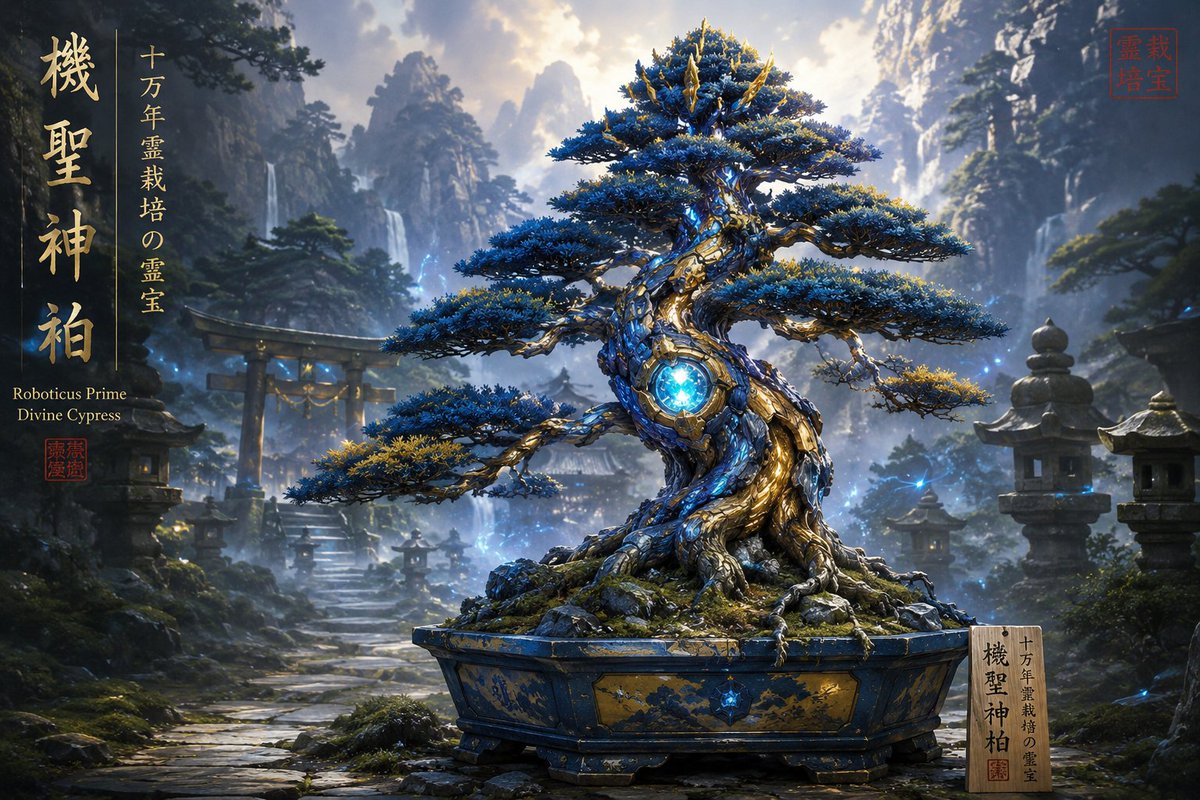
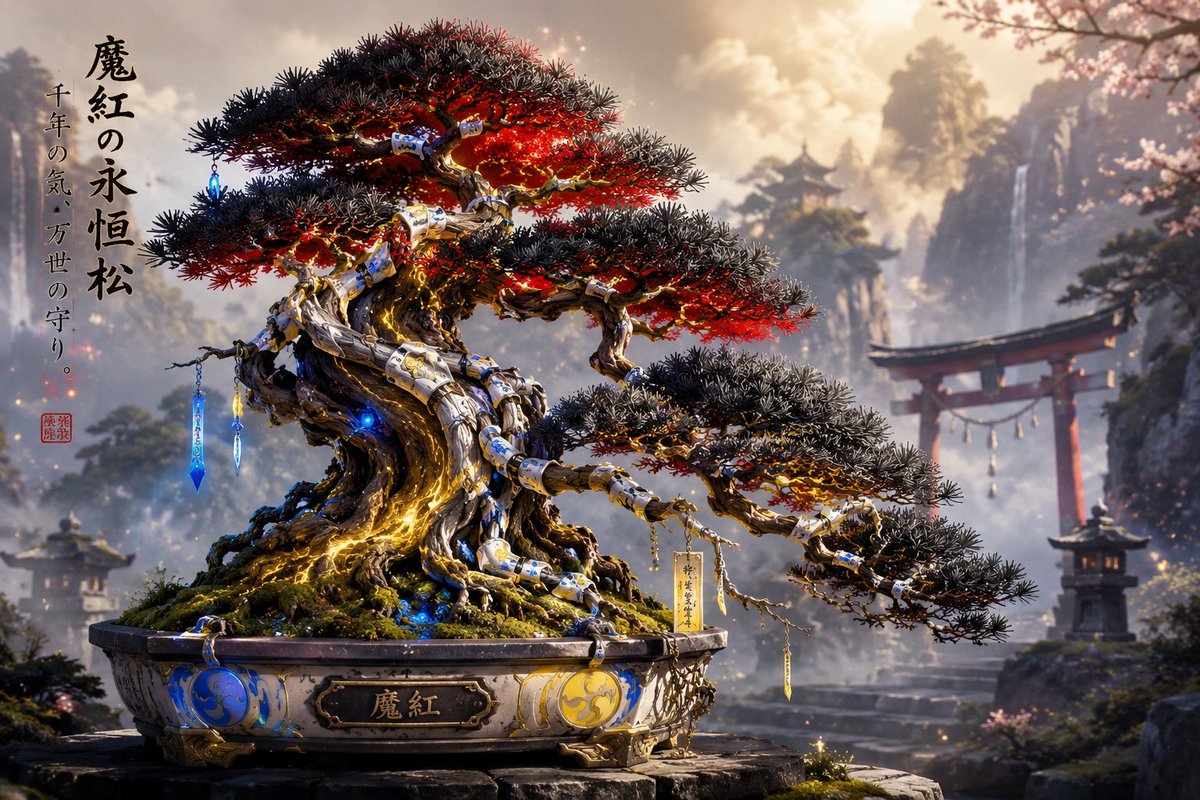
BONSAI!!
Turn yourself into a lovely mystical Bonsai tree.
DON'T FORGET TO ENTER YOUR NAME
PROMPT
------------------------------------------------------------
[Enter character name here]
IMAGE INPUT:
Use the uploaded character image as the main visual reference.
TASK:
Transform the character from the image input into a rare mystical bonsai tree.
BONSAI NAME:
“[Character Name] + Eternal Pine / Spirit Cedar / Immortal Juniper / Ki Oak / Moonlit Willow / Jade Branch / Starroot / Heavenward Fir / Divine Cypress”
The final name should feel elegant, mythical, and specific to this character.
CORE CONCEPT:
The Bonsai tree must clearly feel inspired by the character, not just randomly styled.
It should retain the character’s 3 main color palette colors and reinterpret the character’s most recognizable visual elements as botanical features.
Analyze the character and preserve the following as bonsai design motifs:
main 3 colors of the character’s palette translated into leaves, bark, and accents
hairstyle silhouette translated into canopy and foliage shape
signature accessories transformed into branch structures, wiring, moss patterns, exposed roots, or pot ornaments
clothing motifs, armor shapes, fabrics, metallic elements, glowing details reimagined as bark textures, trunk engravings, branch wrapping, pot design, and surface details
personality / aura expressed through the bonsai’s overall posture, growth direction, density, and energy
Choose one of these top 15 popular bonsai designs:
Moyogi (Informal Upright),
Chokkan (Formal Upright),
Shakan (Slanting),
Kengai (Cascade),
Han-kengai (Semi-cascade),
Hokidachi (Broom),
Bunjingi (Literati),
Fukinagashi (Windswept),
Yose-ue (Forest),
Sokan (Twin Trunk),
Sekijoju (Root-over-Rock),
Ishitsuki (Clinging-to-Rock),
Ikadabuki (Raft),
Sharimiki (Driftwood),
Kabudachi (Multi-trunk).
FULLY translate their hair color/length/texture/style into foliage and leaf canopy; FULLY map and incorporate their entire clothing fabrics/colors/patterns/folds/layers AND armor elements (metallic sheen, engravings, shapes, plates, straps, glowing gems) onto trunk bark textures, branch wrapping, surface details, and pot design.
Symbolically embody the person's pose, expression, and proportions purely through the bonsai's natural form and silhouette.
ENVIRONMENT:
Create a background with strong Japanese influences that fits the character’s personality and aura (misty mountain shrine, ancient Zen garden, serene bamboo forest, cherry blossom valley, sacred torii gate, fog-covered pine forest, or traditional Shinto landscape).
COMPOSITION:
3:2 aspect ratio image.
The bonsai is the main focus.
Place the bonsai slightly off-center, following the rule of thirds.
The bonsai should dominate the foreground while leaving enough space to show the Japanese-influenced background with strong depth, atmospheric perspective, and cinematic scale.
THEME:
A rare mystical Japanese bonsai infused with Ki.
It should look like a legendary sacred tree discovered after 10,000 years of spiritual cultivation.
It radiates refined spiritual energy, with subtle glowing ki streams, floating particles, divine mist, faint kanji seals, immortal aura, and elegant magical particles.
VISUAL STYLE:
Ultra high quality 4K Japanese digital art.
Mystical Japanese fantasy atmosphere.
Elegant, detailed, painterly yet ultra-detailed photorealistic pure bonsai tree masterpiece.
Highly refined bonsai with intricate branches, glowing veins, spiritual energy, delicate botanical details, and symbolic character-inspired ornamentation.
Epic depth, soft atmospheric mist, dramatic lighting, luminous ki, beautiful fantasy color grading.
The image should feel like concept art for a legendary cultivation treasure.
LIGHTING:
Use cinematic mystical lighting that enhances the character-inspired colors.
Add soft rim light, glowing spiritual aura, magical particles, and subtle volumetric mist.
The bonsai should glow naturally from within, as if saturated with Ki.
IMPORTANT RULES:
Do not draw the character as a humanoid.
Pure tree only.
Do not make the bonsai look like a person in costume.
Do not simply place the character’s face on the bonsai.
Do not ignore the uploaded image.
Do not invent unrelated colors that overpower the character’s main palette.
Do not center the bonsai perfectly.
Do not make the background flat or empty.
Do not use a plain studio background.
Do not make the image look western fairy fantasy; keep it distinctly Japanese folklore / Shinto inspired.
Strictly botanical with ZERO human-tree hybrids, ZERO anthropomorphic features, ZERO human faces, bodies, limbs, anatomy or figures of any kind.
Cinematic lighting, intricate details, museum-quality.
FINAL IMAGE:
A 3:2 ultra high quality 4K Japanese digital art image of “[unique bonsai name]”, a rare mystical Japanese bonsai infused with Ki, slightly off-center, inspired by the uploaded character’s identity, colors, motifs, and aura, set in a Japanese-influenced background.