DCM

111 posts

DCM banner
DCM

DCM

@dcm_systems

The Banking Infrastructure for Tokenized Deposits and Stablecoin Payments. Chat with our AI: https://t.co/mQmeKC5x8C

London, The UK انضم Haziran 2023
52 يتبع175 المتابعون
تغريدة مثبتة
DCM
DCM@dcm_systems·
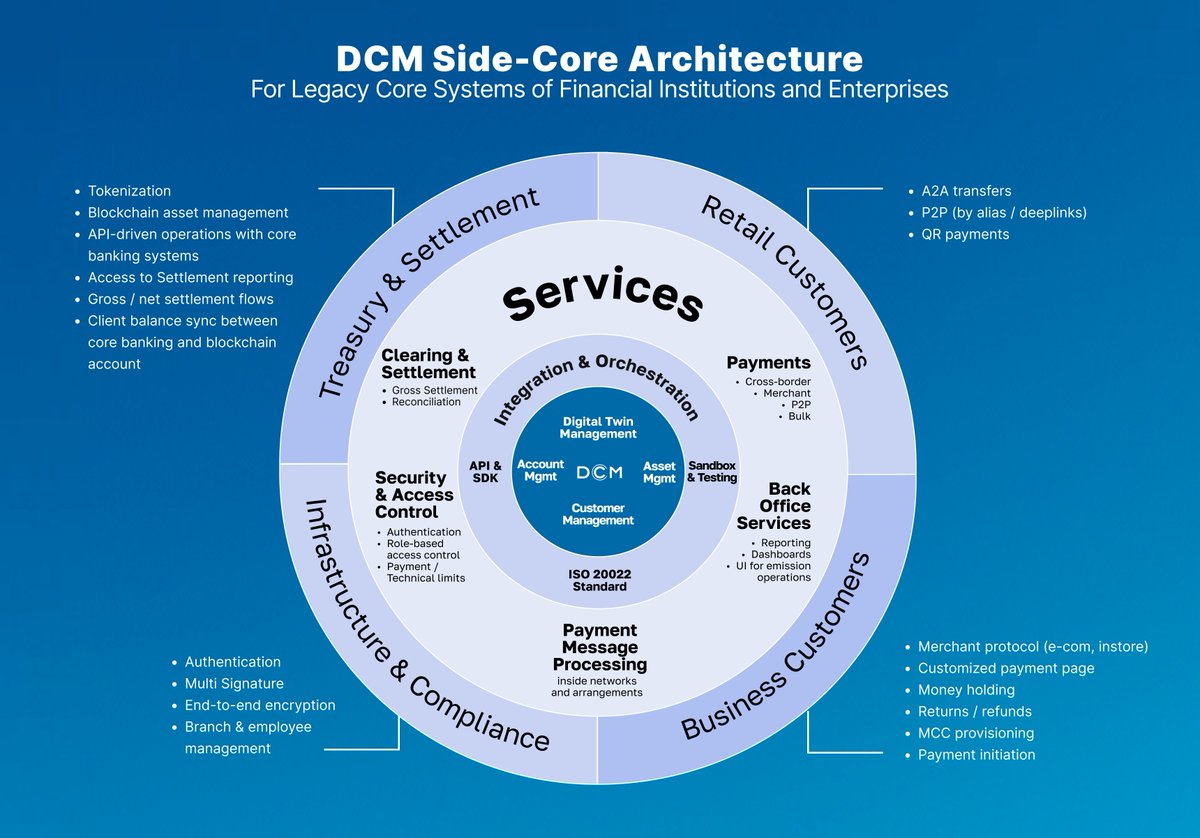
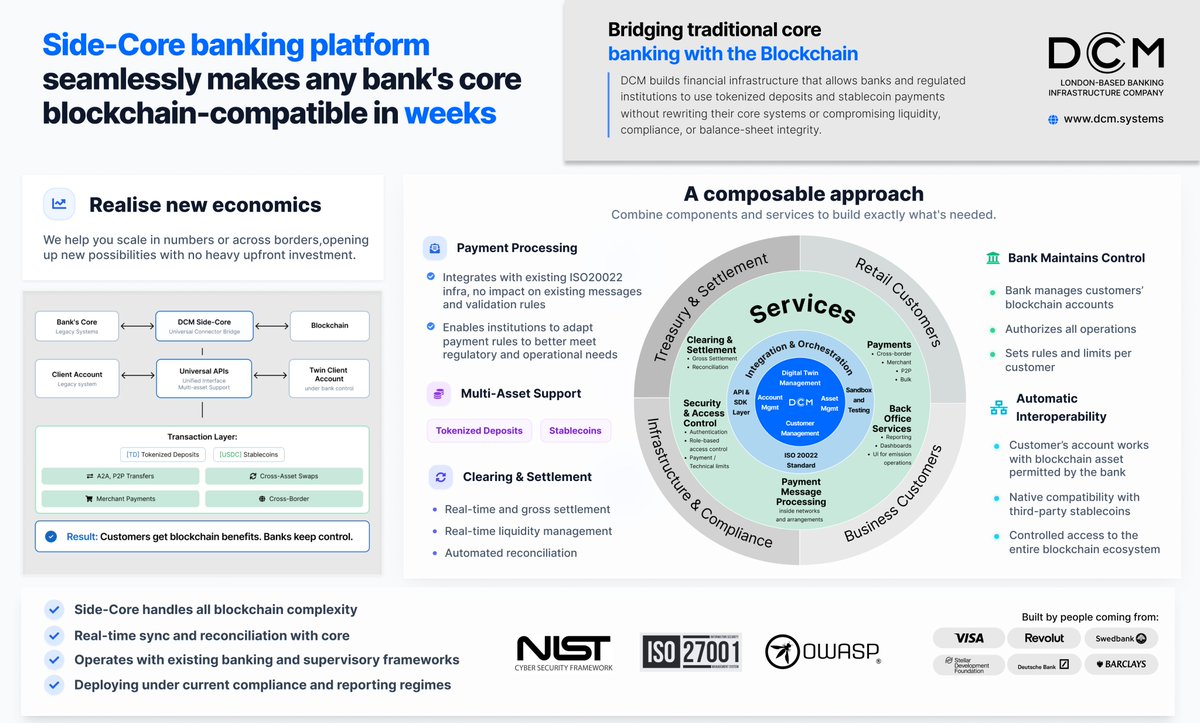
What took decades to build shouldn't have to change in weeks. Core banking systems hold more than account balances. They hold the rules, controls, and processes that keep banks running reliably — day after day, under any pressure. @dcm_systems developed a side-core platform that strengthens that foundation. It sits alongside the existing bank core, keeps all records in place, and layers new capabilities on top: real-time settlement, easy connections between institutions, and blockchain execution where it actually makes sense — all within the operating standards banks already follow. Integration takes weeks, not years. The core stays untouched. The bank just gets a new gear. Learn more on our website - dcm.systems Or ask our AI any question you have - ai.dcm.systems
English
0
0
1
49
DCM
DCM@dcm_systems·
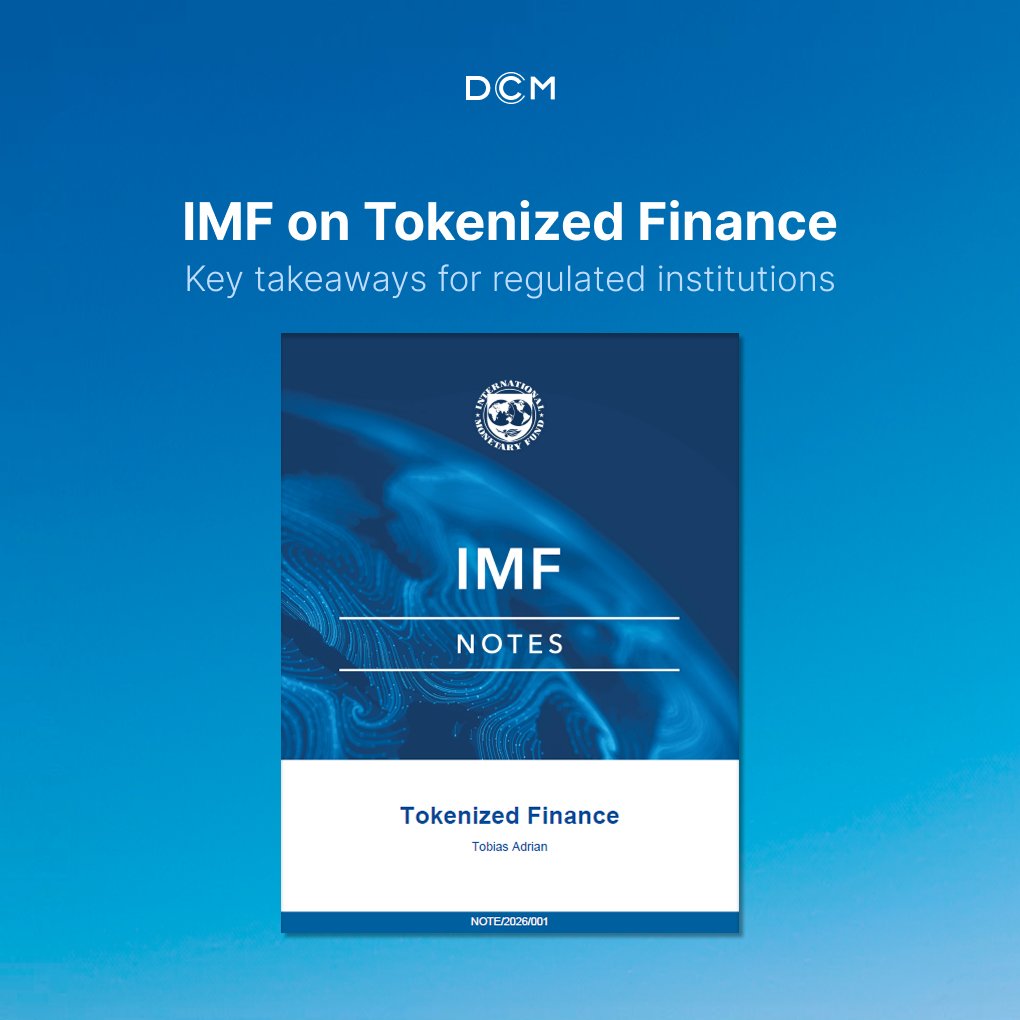
Every time we read a document like this, we come back to the same feeling: we're moving in the right direction. It just takes time. This month, the @IMFNews published a note on tokenized finance by @TobiasAdrian1, the Fund's Financial Counselor. His conclusion: tokenization is not a marginal efficiency gain. It's a structural reallocation of trust within the financial system. The IMF outlines what this future system requires: → Settlement anchored in safe assets (tokenized deposits or wCBDC) → Shared ledgers with clear institutional governance → Legal certainty and finality → Interoperability across institutions and borders → Crisis management tools that work at machine speed When we read this, we weren't surprised. This is what we've been building — and what we launched in production in late 2024. The prozora.network is a live interbank network built leveraging blockchain, with an institutional governance layer anchored by the Central Bank’s payment system. Payments settle atomically. Compliance is embedded. Participants are identified and regulated. Not a pilot. Not an MVP. Production. Documents like this matter to us — not as validation, but as a compass. When leading policymakers describe what the future of finance should look like, it helps us make sure we're still on the right track. The window for shaping tokenized financial architecture is open. As the IMF notes — it won't remain so indefinitely. This note is worth reading. Read the note here - elibrary.imf.org/view/journals/…
DCM tweet media
English
0
1
2
24
DCM
DCM@dcm_systems·
@swiftcommunity is bringing its blockchain-based shared ledger to MVP — and it could be one of the most significant moves in cross-border banking in years. Why this matters This isn't just another experiment. We're talking about practical infrastructure that promises 24/7 settlement, interoperability of tokenized deposits across banks, better liquidity management, and far less manual reconciliation. If the MVP reaches real transaction volumes, it sends a clear signal: the industry is moving from proof-of-concept to production rails. @dcm_systems helps banks connect to new settlement infrastructure through a side-core layer: - No core replacement required - State synchronization across core, payment rails, and the DLT layer - Managed limits, controls, and provable reconciliation - Ready for ISO 20022 ↔ blockchain interoperability with optional stablecoin liquidity integration If you're at a bank thinking about how to get ready for these rails — and how to move from pilot to production — chat with our AI to explore integration architecture and what it takes to go live in your environment - ai.dcm.systems Or contact us via website dcm.systems
Swift@swiftcommunity

Our plans to build a blockchain-based shared ledger have reached a major new milestone. After completing its design phase with a global group of banks, we are now shaping the ledger’s first MVP iteration, which will enable interoperability between banks’ tokenised deposits and facilitate 24/7 cross-border payments. 📅The MVP is planned to go live with real-world transactions this year, as we work in parallel with banks internationally to help accelerate the industry's transition to digital finance. The ledger will allow payments to be executed using tokenised deposits, leverages existing compliance processes and supports multiple settlement options. The result? - Faster payment execution - Better liquidity visibility - Reduced reconciliation efforts - Interoperability across institutions ⚡Learn more about how our progress on the ledger is part of a parallel track strategy to power a best-in-class payments experience, however value moves: swift.com/news-events/ne… #CrossBorderPayments #Ledger

English
0
1
3
116
DCM
DCM@dcm_systems·
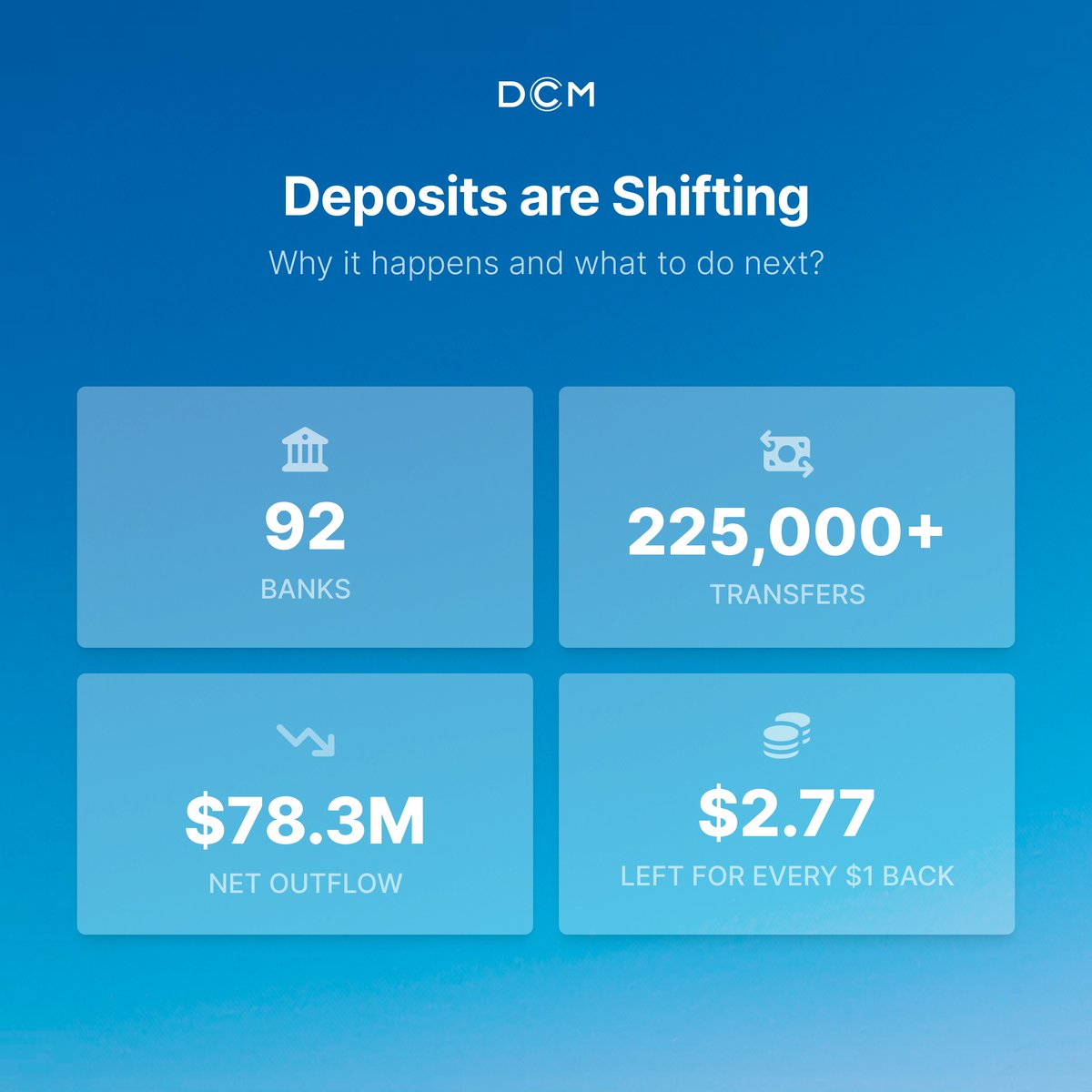
Deposits are already moving For every $1 returning from @coinbase $2.77 left. That’s what a @klarivis study found across 92 community banks But deposit flight may actually be a settlement rail shift We break down what it means for banks in our article dcm.systems/blog/deposits-…
DCM tweet media
English
0
0
1
61
DCM
DCM@dcm_systems·
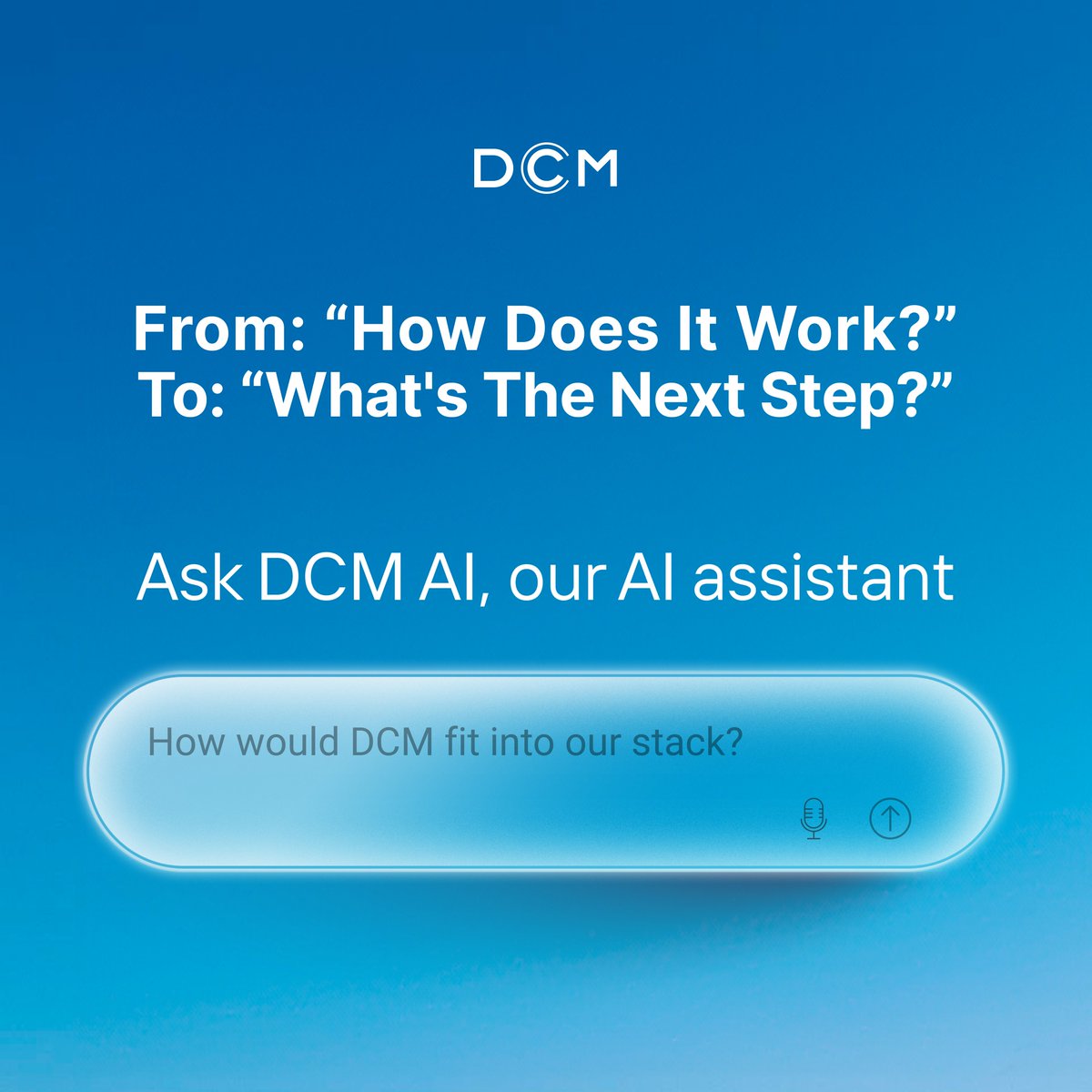
We launched DCM AI - our on-site AI assistant Trained on DCM’s side-core architecture, operating model, and documentation, it helps teams map DCM to real infrastructure, constraints, and payment flows Try it: ai.dcm.systems
DCM tweet media
English
0
0
1
88
DCM
DCM@dcm_systems·
Every era has its engine. In banking, the next engine is infrastructure that moves at digital speed - while keeping governance intact. DCM makes banks blockchain-ready in weeks, not years. We work with any banking core and add a Side-core layer that enables tokenized deposits and stablecoin payment flows without disrupting what already works. Speed at Scale. Trust by Design. @StellarOrg @DenelleDixon @JoseFDaPonte @rajachak75 @a16zcrypto @swiftcommunity @hedera @avax @Temenos @FISGlobal @TCS_BaNCS @FinastraFS @Mambu_com @thoughtmachine @PROFILESoftware @ITSGroup @Lyst_Tech @NeptuneFintech @Fimpleos @probanx @Finacle @Avaloq @10XBanking @fivedegrees
English
2
0
2
170
DCM
DCM@dcm_systems·
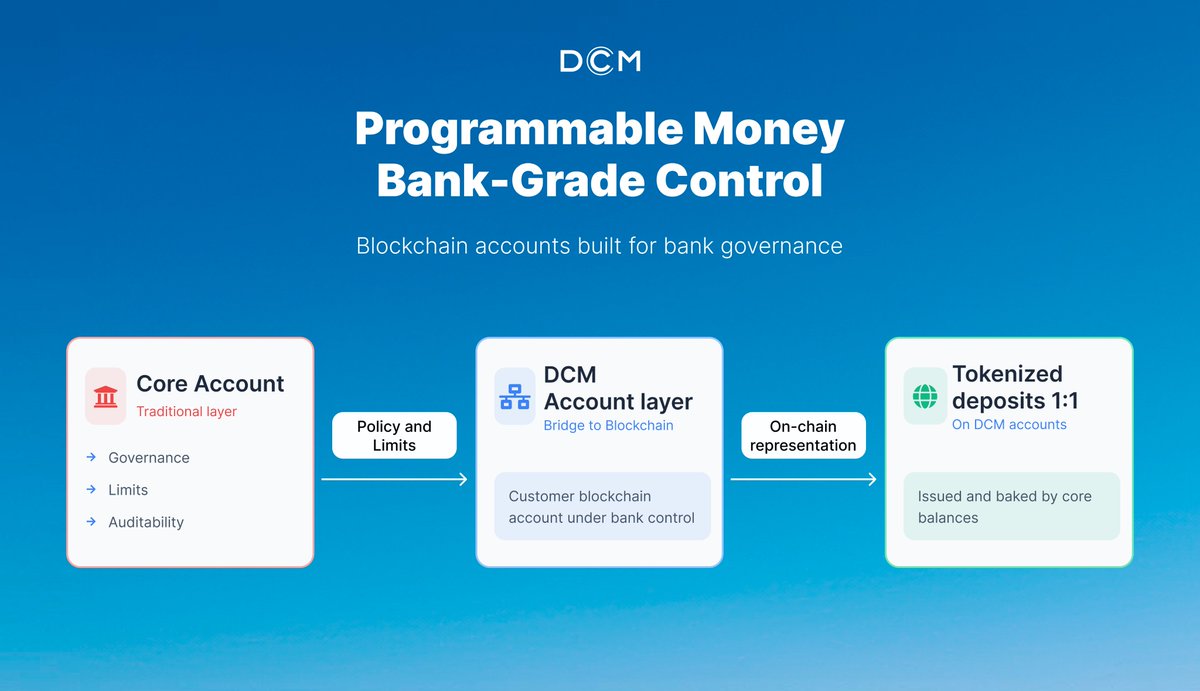
Most tokenization journeys succeed or fail at the account layer. A token can move fast, yet the bank still needs governance, limits, auditability, and operational control. @dcm_systems enables banks to create and manage customer blockchain accounts under bank control. On top of these accounts, banks can issue tokenized deposits backed 1:1 by core balances. The outcome is practical: Customers get blockchain reach and multi-asset interoperability, including permitted stablecoins where policy allows. Banks retain rules, limits, authorizations, monitoring, and audit trails - by design. Programmable money with bank-grade control. Our AI agent can help you assess infrastructure fit and integration pathways. Explore it on our website → dcm.systems
DCM tweet media
English
0
0
2
109
DCM
DCM@dcm_systems·
Real-time rails speed up execution — but also shift where risks appear. The real question isn’t how fast money moves, but how safely balance sheets and controls can keep pace. The rail is one slice. The operating model is the whole wheel. #DigitalBanking #Banking
DCM tweet media
English
0
0
0
56
DCM
DCM@dcm_systems·
We are privileged and excited to have Transparent Network (prozora.network), a bank consortium, among the dear clients we serve with white gloves. More to come in 2026 @StellarOrg
English
1
2
4
106
DCM
DCM@dcm_systems·
Stablecoins report $35 trillion in 2025 transactions. @McKinsey 's new analysis shows that: - 1% of the total represents actual payments. - the rest: trading loops, exchange shuffling, smart contract mechanics. Can we expect 10% this year? We asked whether banks are trying to compete with non-bank stablecoins for that 1% or 10%. And got opinions, they tokenize the infrastructure that already moves $1.7 quadrillion annually. Through Tokenized deposits and deposit tokens. Just 5% migration to blockchain = $85 trillion—dwarfing stablecoin projections. We at DCM call it not a disruption. Infrastructure upgrade. Thank you, @McKinsey Financial Services, Matt Higginson, @artemis, for a closer look at what the data really shows. linkedin.com/pulse/stableco…
English
0
0
3
96
DCM
DCM@dcm_systems·
Completely agree. DCM's digital twin system (side-core banking platform) for existing accounts, along with liquidity on the bank's balance sheet, feeds those numbers into the blockchain. People can be sceptical about that, but it's a reality. @The_DTCC
DTCC@The_DTCC

DTC Tokenization Service aims to bridge digital representations of traditional assets with digitally native tokens that exist entirely on-chain. Interoperability is the foundation of tokenization. We're building it. Explore our tokenization initiatives: brnw.ch/21wZlnS

English
0
0
2
236
DCM
DCM@dcm_systems·
Payments are becoming real-time. Liquidity moves across borders instantly. Blockchain-based settlement infrastructures are no longer experimental, they are operational. At the same time, core banking systems, balance-sheet controls, and regulatory frameworks remain tightly coupled to slower settlement models. This creates a coordination problem that @dcm_systems Side-core banking platform was built to solve. Most institutions do not struggle with asset design. They struggle with synchronizing state across fragmented systems: cores, payment rails, settlement layers, and emerging blockchain infrastructure. @dcm_systems Side-core banking platform allows banks and regulated institutions to operate tokenized deposits and stablecoin payments, while keeping the bank core as the system of record. Liquidity, compliance, and balance-sheet integrity remain under institutional control. - No core replacement - No regulatory reset - No exposure to open-market dynamics unless explicitly intended. We summarized how this works, what it enables, and where it fits in the monetary stack in a short one-pager below @StellarOrg @ethereum @solana @a16zcrypto @swiftcommunity @hedera @avax @Temenos @FISGlobal @TCS_BaNCS @FinastraFS @Mambu_com @thoughtmachine @PROFILESoftware @ITSGroup @Lyst_Tech @NeptuneFintech @Fimpleos @probanx @Finacle @Avaloq @10XBanking @sdkfinance @fivedegrees @DenelleDixon @JoseFDaPonte @rajachak75 #TokenizedDeposits #BankingInnovations #Payments #BankingInfrastructure #Settlement #LiquidityManagement #FinancialInfrastructure #BlockchainSettlement #DLT #Stablecoins #Interoperability #RegulatedFinance #BankGrade
DCM tweet media
English
1
0
3
127
DCM
DCM@dcm_systems·
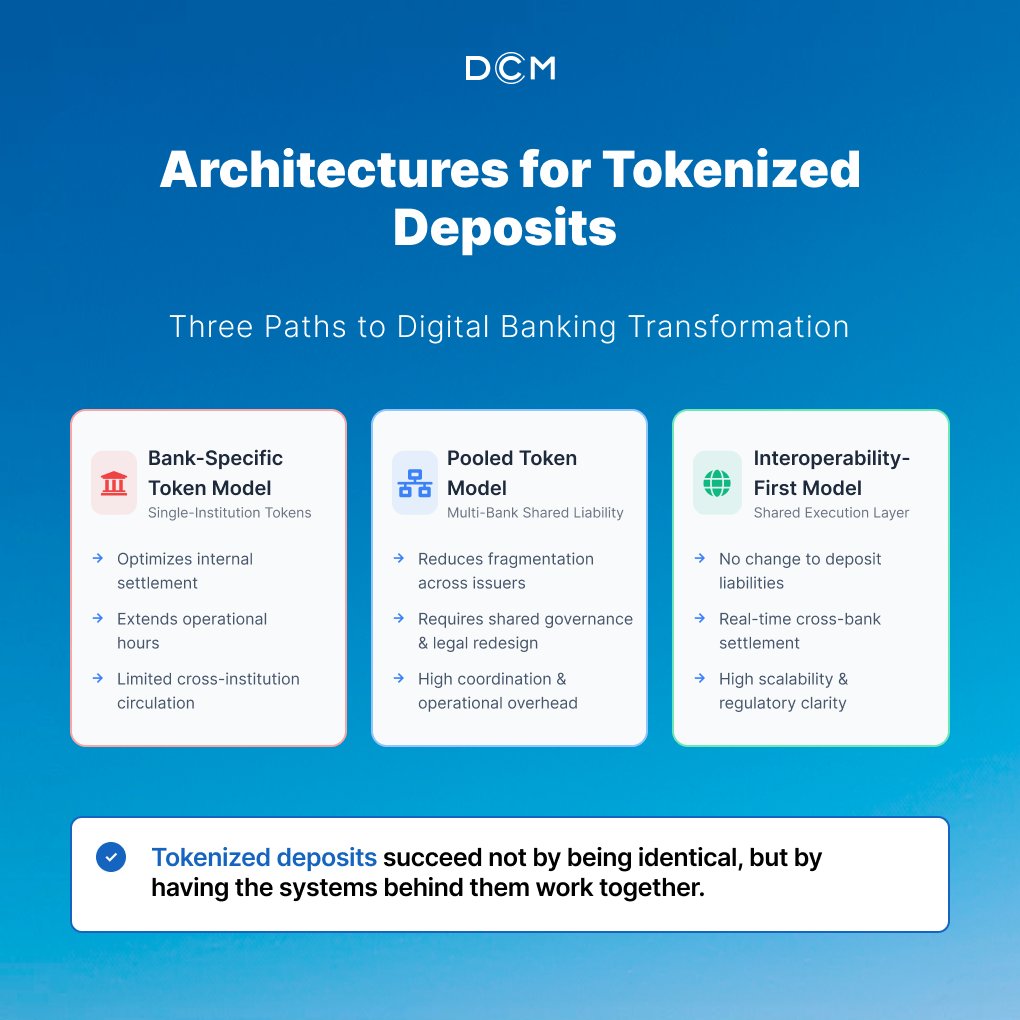
Tokenized deposits are often treated as a single idea, but behind that label sit three very different architectures, each with its own incentives, constraints, and long-term impact on how money moves across institutions. Pick the wrong model, and you end up with fragmentation, governance deadlocks, or a de facto new currency. This isn’t a theoretical debate. It’s a practical question about how the next generation of banking infrastructure will actually function. We break down all three architectures, their implications, and the futures they lead to in our latest article - dcm.systems/blog/architect…
DCM tweet media
English
0
0
0
74
DCM
DCM@dcm_systems·
What actually happens when stablecoins and fractional-reserve deposits meet real-world stress? A new deep dive into a question that keeps resurfacing in every conversation we have with banks and regulators, but rarely gets examined through real events. In the article we unpack: ✓ how the USDC–SVB depeg exposed the speed and brutality of on-chain price discovery ✓ why the SVB bank run shows what happens when liquidity risk meets modern information flows ✓ what JPM’s tokenized deposit system proves about where tokenization works and where it absolutely does not ✓ why pushing fractional-reserve liabilities onto open rails creates dynamics no liquidity buffer can absorb ✓ why the “one model will win” narrative ignores how different these instruments behave when the pressure is real If you're working on digital settlement, interbank interoperability, or thinking about how credit-backed money should live on programmable infrastructure - these scenarios matter more than the definitions themselves. Read here: dcm.systems/blog/real-worl…
DCM tweet media
English
0
0
1
70
DCM
DCM@dcm_systems·
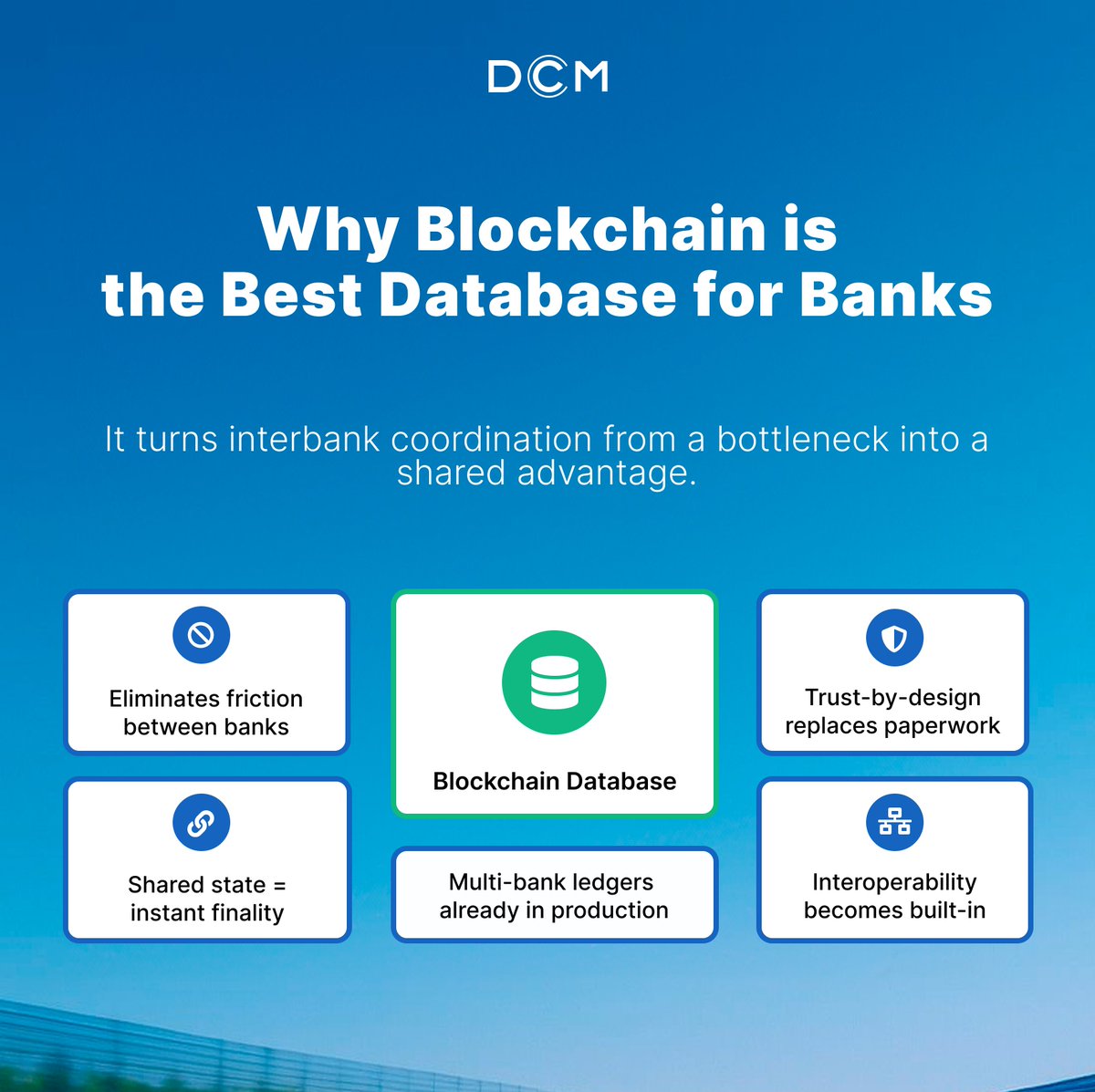
Banks don’t actually need “blockchain”. They need a better database. And a blockchain, used in the right way, is exactly that. Before discussing use cases or products, it’s worth looking at the core problem it solves. Most of the friction in banking today doesn’t come from the assets or the customers - it comes from the way banks coordinate with each other. And that’s where a shared ledger makes the biggest difference. ➤ Banks don’t struggle inside their own walls - the problem appears between banks. Every bank runs its own database with its own rules and processes. When money moves across institutions, everything depends on messaging, reconciliation, and waiting for systems to sync. That’s where delays, errors, and operational costs come from. ➤ A shared ledger creates finality where it didn’t exist before. If multiple banks operate on the same shared state, they no longer have to guess what the others have recorded. No “pending”, no end-of-day reconciliation - just a single agreed version of truth. ➤ Trust is embedded in the architecture, not in paperwork and manual checks. Today, banks coordinate huge operational frameworks just to keep their databases aligned. On a shared ledger, the rules execute automatically. It’s not “trustless”, but it is trust-by-design. ➤ Interoperability becomes built-in instead of bolted-on. Traditional databases weren’t designed to interact with those of other institutions. That’s why payments rely on long messaging chains and intermediaries. On a shared ledger, assets and instructions follow the same rules no matter which bank creates them. ➤ And we already see real deployments. JPM Coin, DBS, MAS pilots - these are not “crypto experiments”. They are multi-bank networks running on a common ledger, reducing reconciliation work and shortening settlement cycles. ✓ The idea is simple: For the first time, banks have a database that works beyond a single institution and acts as a synchronized, shared source of truth. Everything else is just an implementation detail. @StellarOrg @ethereum @solana @a16zcrypto @swiftcommunity @hedera @avax @Temenos @FISGlobal @TCS_BaNCS @FinastraFS @Mambu_com @thoughtmachine @PROFILESoftware @ITSGroup @Lyst_Tech @NeptuneFintech @Fimpleos @probanx @Finacle @Avaloq @10XBanking @sdkfinance @fivedegrees @DenelleDixon @JoseFDaPonte @rajachak75
DCM tweet media
English
0
0
1
83
DCM
DCM@dcm_systems·
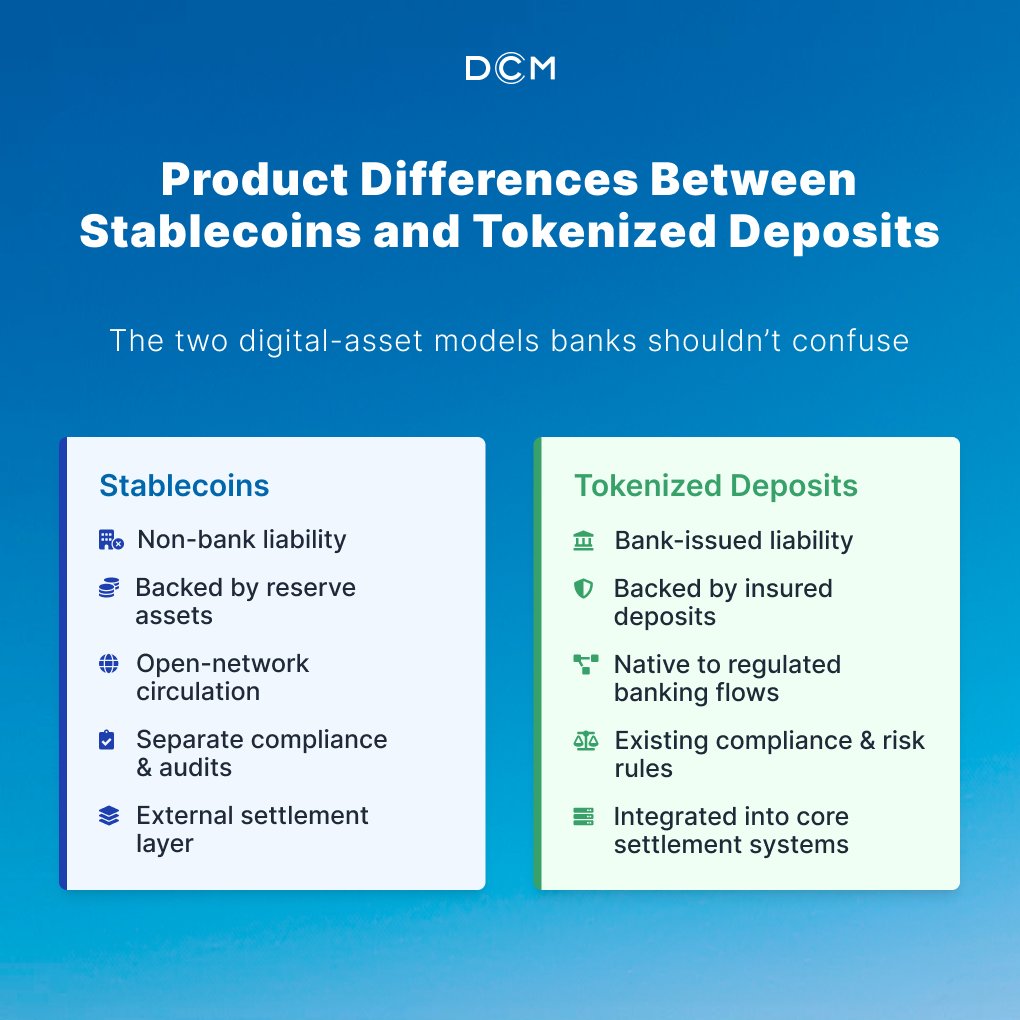
A Product Comparison: Tokenized Deposits vs Stablecoins Stablecoins and tokenized deposits are often discussed together because they can use the same blockchain rails. But they are different products with different roles, economics, and regulatory treatment. ➤  Stablecoin is mainly a public-market liquidity product. Most major stablecoins today are issued by non-banks and sit outside commercial banks’ balance sheets from a user’s perspective. They move across open networks, into wallets, exchanges, and global payment flows. Issuing one requires dedicated reserves, audits, compliance paths, and treasury processes. For many banks, it is more efficient to integrate a large, trusted stablecoin than to operate their own. ➤  Tokenized Deposit is a regulated banking product. They represent the same deposits that are already placed on a bank’s balance sheet, now transferable over modern rails. Regulatory treatment, capital and liquidity rules, accounting, and risk frameworks remain fundamentally the same, with additional controls where needed. The main change is in the infrastructure layer: settlement becomes real-time, programmable, and interoperable across networks. In simple terms: stablecoins extend banks’ reach into open digital markets, while tokenized deposits modernize the money banks already operate with. Banks won’t choose between them. They will use stablecoins for external operations and tokenized deposits to upgrade internal, regulated money. @StellarOrg @ethereum @solana @a16zcrypto @swiftcommunity @hedera @avax @Temenos @FISGlobal @TCS_BaNCS @FinastraFS @Mambu_com @thoughtmachine @PROFILESoftware @ITSGroup @Lyst_Tech @NeptuneFintech @Fimpleos @probanx @Finacle @Avaloq @10XBanking @sdkfinance @fivedegrees @DenelleDixon @JoseFDaPonte @rajachak75
DCM tweet media
English
0
1
2
100
DCM
DCM@dcm_systems·
There won’t be a thousand public stablecoins. Banks and companies may create internal tokens, but only a few stablecoins can realistically scale in the open market. Here’s why we think so: 1 ) The economics don’t scale Running a public stablecoin requires reserves, compliance, audits, and liquidity management — fixed costs that only make sense at a large scale, where interest on reserve assets becomes meaningful. Integrating a trusted, liquid stablecoin is almost always simpler and safer than maintaining a fragmented one 2 ) Too many public issuers create friction Even with perfect transparency, a market with hundreds of public stablecoins becomes harder to settle, integrate, and route liquidity across. Money works best when systems converge around a few widely accepted units — most businesses need access to digital money, not their own currency. 3 ) Digital Money Needs Scale, Trust, and Interoperability Stablecoins only work at scale when they have trust, liquidity, interoperability, regulatory alignment, and broad acceptance. You don’t get that from thousands of issuers. You get it from a small number of trusted, liquid, interoperable assets. ➤ Where banks fit in Banks won’t launch thousands of their own tokens, they already issue the most trusted form of money today: deposits. Tokenizing them keeps the same balance-sheet structure and regulation, while adding real-time settlement and blockchain interoperability. Tokenized deposits scale. A thousand private stablecoins don’t. ✔ The real future Not a thousand different stablecoins, but a few major stablecoins + bank-grade infrastructure + tokenized deposits powering real-time, interoperable digital money. That’s the model that actually works. #DigitalBanking #Banking #CoreBanking #DigitalTransformation #BankingInfrastructure #Fintech #BankingInnovation #DLT #TokenizedDeposits #stablecoins
DCM tweet media
English
0
0
1
79