

Philippe Marschall
1.1K posts

Unlike Macs, the X Elite has the potential to truly threaten AMD and Intel in gaming thanks to native DX/Vulkan support.
Yet, they successfully wasted the die area on their priciest X2 chip by slapping in a base M5 tier GPU and cramming it with 18 CPU cores for Cinebench score

ExoticSpice@ExoticSpice101
lmao snapdragon WoA is dead. What are these prices….. $2050 for a normal X2 Elite. For $150 more you can get a much better M5 Pro MacBook.
English
@debasishg That’s how it looks. Same for Babylon. Loom / virtual threads are in since 21. 26 had the 4th preview of structured concurrency.
English

@pmarscha ok, so value objects are not related to JDK 26 .. but Valhalla Early-Access Builds are available for JDK 26 ..
English
value objects in JDK 26 will be a game changer in data oriented programming ..
Value objects are identity-less and immutable by design.
The JVM is allowed to:
• Flatten (inline) them directly into the memory layout of the containing object or array.
• Eliminate the per-instance header and padding that regular objects require.
• Store them contiguously, just like a C struct or a Rust struct.
Concrete performance wins delivered:
• Cache-friendly data structures: Point[], Complex[], Vector3d[], record-like data carriers, etc., now behave like primitive arrays.
• No more @ Contended hacks (the old annotation that manually padded fields to avoid false sharing).
• Better locality in collections (e.g., ArrayList or specialized value collections will be dramatically faster).
• Reduced GC pressure because fewer objects = fewer things for the garbage collector to scan.
• AOT / JIT friendliness - the compiler can make much more aggressive assumptions about layout and inlining.
Paul@PaulLarionov
JDK 26: - build-in HTTP/3 - AOT caching for lightning-fast startup - project Valhalla: value objects, goodbye memory overhead, hello CPU cache - project Loom: structured concurrency making async code as easy as sync - project Amber: pattern matching & data-oriented programming - project Babylon: running pure Java natively on GPUs for AI
English
@kmcnam1 #option_mysql_safe-updates" target="_blank" rel="nofollow noopener">dev.mysql.com/doc/refman/8.4…
QME


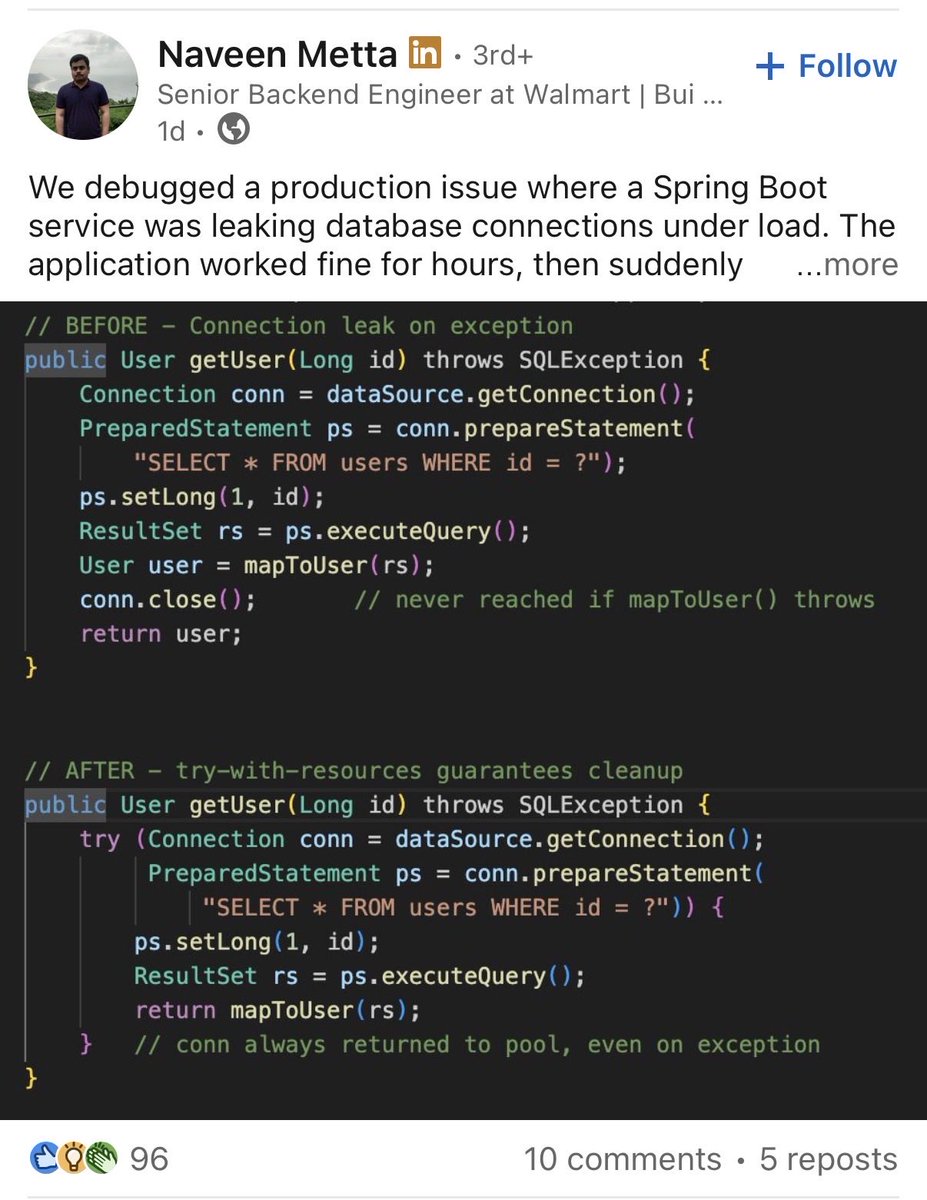
@phyziyx @ptr_to_joel They should and they very well may do so. Connection pools are usually exposed as DataSource objects to the application. Just by looking at the code it’s impossible to tell whether getConnection opens a physical connection or gets one from a pool.
English

@ptr_to_joel Shouldn't they be using a pooled connection? which is usually handled by the driver/library of your choice unless you're implementing your own?
English

@lavenderleaf86 @ptr_to_joel Only a sith deals in absolutes. I was on a project with tables that had 140 columns. SELECT * would have cut down the allocation by about two oders of magnitude. It stopped being beneficial once we introduced virtual columns for function based indices.
English

@ptr_to_joel Besides the other red flags everyone already mentioned, I’m surprised no one is freaking out about “select *” in production. This would not only be an insta-fire from me but the school this guy graduated would be sued.
If this is your skill level just use an ORM at this point.
English
@lezate_ @LewisCTech @ptr_to_joel I’d be interested to see numbers with current Hibernate and either DTO projection or StatelessSession. It could even be faster as it uses index based ResultSet access, something you’d generally want to avoid in “hand written” code.
English

@pmarscha @LewisCTech @ptr_to_joel jpa and other nonsense is too slow for some apps. jdbc is simpler and still pretty convenient.
English
@SimonLevermann @ptr_to_joel Theoretically the spec says closing the PreparedStatement should implicitly close the ResultSet, whether the driver actually does this is a different matter. But yes, everything AutoColseable should go into a try-with-resources.
English
@LewisCTech @ptr_to_joel 3. “It depends”, if it’s from a pool it will return it to the pool. The spec saying it should also release all the resources (prepared statement, result set, …) but whether the driver actually follows the spec is a different question.
English
@LewisCTech @ptr_to_joel 2. The connection should come from the pool / currently active transaction. #getConnection way still be called, DataSource can come from the pool,
English

Xorg has now officially abandoned the “master” branch of their X11 implementation…
And moved all development to a newly created“main” branch based on a 2 year old version of Xorg (from February of 2024), losing a large number of enhancements (by the XLibre developer) in the process.
This appears to have been done so that Xorg could virtue signal by removing code now successfully used by XLibre (the Xorg fork gaining in popularity), which is seen by those controlling Xorg as having the “wrong political views”.
cgit.freedesktop.org/xorg/xserver/c…


English
@CrystalRacing What I meant is I don’t see the need to prescribe all the engine details when you have a fuel flow limit in place.
English

@pmarscha The fuel flow limit isn't really the issue like it was between 2014-25. The tiny size of the MGU-K battery store (4 kilojoules) cannot store enough power to help a car push fully for an entire lap. That's what I meant by energy starvation - super clipping thru speed traps
English
F1 2026 regs are simply peak bureaucracy
Front axle energy? No, Audi might slap us all
Bigger MGU-K RAM capacity? No, cars might be too heavy
More driver input? No, but here's active aero
English
@JRbwaker @thef1diplomat But without Audi we would be recuperating with the front which would be much more effective.
English

@thef1diplomat It’s not Audis fault, it was always going to be 50:50 engine battery, that’s where his criticism is rooted.
English

@cookskii @thef1diplomat No front recuperation because auf Audi LMP1. Rest is follow up issues because recuperating with the rear is not nearly as effective.
English

@_devJNS Unfortunately Microsoft Defender for Linux is a thing.
English





A Warhammer 40K movie is a question of when, not if.
English