Palladin
50.6K posts

Palladin
@EdwinWine1
Exposing the failures in the British State https://t.co/hqea6WHrFj
Abyssal Beigetreten Ekim 2020
5.7K Folgt3.3K Follower
Angehefteter Tweet

@Ameer_Kotecha If Burnham becomes PM how long will it be before everyone realises its going to be at least as bad
English

@ZaffranRiver 1. One of the perps fractured the spine of a police officer with a sledgehammer
2. They collectively are associated by JOINT ENTERPRISE.
3. This was not a peaceful demonstration.
English

These sentences are heinous and indicative of a dangerous move to curtail the right to protest.
Rangzen@revoltinghippie
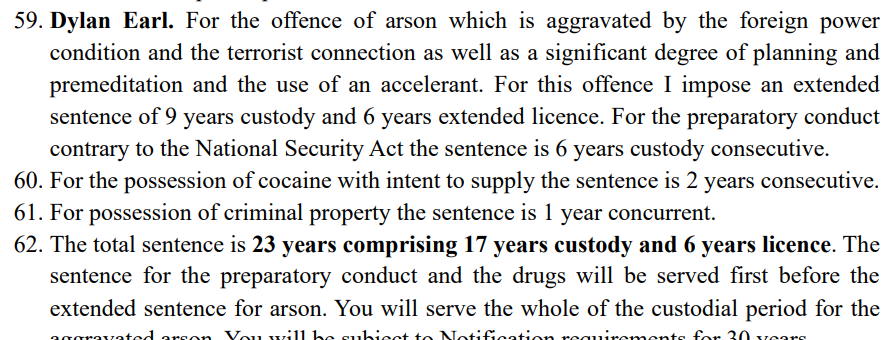
Judge Johnson who sentenced the Filton 4 to prison today is the same Judge who reduced Tommy Robinson's sentence for contempt of court
English

Terrorism as an Aggravating Factor in Sentencing
Under Section 69 of the UK Sentencing Act 2020, a court can find that an ordinary criminal offence has a "terrorist connection" even where the defendant has not been charged or convicted of a terrorism offence. If the court makes that finding, it becomes a significant aggravating factor and can increase the sentence imposed. The court must be satisfied that the offence was committed for the purpose of advancing a political, religious, racial, or ideological cause and was intended to influence government or intimidate the public. Additional consequences can include stricter release provisions, extended licence periods, and terrorism notification requirements. �
The Guardian +2
Did the Defence Know This Was an Issue?
Yes.
The defence knew before sentencing that the prosecution was seeking a finding of a terrorist connection and argued extensively against it. The issue was litigated before and during the proceedings. However, the jury was not told that a terrorism finding could later be sought and was not asked to determine it. The question was reserved for the trial judge to decide after conviction. Defence lawyers, campaign groups, and several legal commentators argued that this was unfair because the defendants were tried for criminal damage and related offences, not terrorism offences. The judge nevertheless ruled at sentencing that a terrorist connection existed and treated it as an aggravating factor. �
The Guardian +3
In Practical Terms
The defendants were not convicted of terrorism offences. They were convicted of criminal damage and, in Samuel Corner's case, grievous bodily harm. The judge then concluded that the offences were committed to advance a political or ideological cause and therefore had a terrorist connection for sentencing purposes. That finding contributed materially to the severity of the sentences imposed. �
The Guardian +2
English

@CharlieMoloney @AaronBastani Unusual? This judge cut his teeth in behind closed doors cases for the government and security services. He helped the Gov with their ludicrous proscription against Palestine Action.
Are you just a fucking sheep, happy that whatever the government does is okidoki? Fuck you man.
English

Terrorism as an Aggravating Factor in Sentencing
Under Section 69 of the UK Sentencing Act 2020, a court can find that an ordinary criminal offence has a "terrorist connection" even where the defendant has not been charged or convicted of a terrorism offence. If the court makes that finding, it becomes a significant aggravating factor and can increase the sentence imposed. The court must be satisfied that the offence was committed for the purpose of advancing a political, religious, racial, or ideological cause and was intended to influence government or intimidate the public. Additional consequences can include stricter release provisions, extended licence periods, and terrorism notification requirements. �
The Guardian +2
Did the Defence Know This Was an Issue?
Yes.
The defence knew before sentencing that the prosecution was seeking a finding of a terrorist connection and argued extensively against it. The issue was litigated before and during the proceedings. However, the jury was not told that a terrorism finding could later be sought and was not asked to determine it. The question was reserved for the trial judge to decide after conviction. Defence lawyers, campaign groups, and several legal commentators argued that this was unfair because the defendants were tried for criminal damage and related offences, not terrorism offences. The judge nevertheless ruled at sentencing that a terrorist connection existed and treated it as an aggravating factor. �
The Guardian +3
In Practical Terms
The defendants were not convicted of terrorism offences. They were convicted of criminal damage and, in Samuel Corner's case, grievous bodily harm. The judge then concluded that the offences were committed to advance a political or ideological cause and therefore had a terrorist connection for sentencing purposes. That finding contributed materially to the severity of the sentences imposed. �
The Guardian +2
English

@CharlieMoloney @AaronBastani this is drivel made self-evident by the fact you cannot cite a single example of similar sentencing
English

You don't understand the law.
They were not charged with terrorism. It was an aggravating factor used in sentencing.
The defense lawyers were aware of this.
Terrorism as an Aggravating Factor in Sentencing
Under Section 69 of the UK Sentencing Act 2020, a court can find that an ordinary criminal offence has a "terrorist connection" even where the defendant has not been charged or convicted of a terrorism offence. If the court makes that finding, it becomes a significant aggravating factor and can increase the sentence imposed. The court must be satisfied that the offence was committed for the purpose of advancing a political, religious, racial, or ideological cause and was intended to influence government or intimidate the public. Additional consequences can include stricter release provisions, extended licence periods, and terrorism notification requirements. �
The Guardian +2
Did the Defence Know This Was an Issue?
Yes.
The defence knew before sentencing that the prosecution was seeking a finding of a terrorist connection and argued extensively against it. The issue was litigated before and during the proceedings. However, the jury was not told that a terrorism finding could later be sought and was not asked to determine it. The question was reserved for the trial judge to decide after conviction. Defence lawyers, campaign groups, and several legal commentators argued that this was unfair because the defendants were tried for criminal damage and related offences, not terrorism offences. The judge nevertheless ruled at sentencing that a terrorist connection existed and treated it as an aggravating factor. �
In Practical Terms
The defendants were not convicted of terrorism offences. They were convicted of criminal damage and, in Samuel Corner's case, grievous bodily harm. The judge then concluded that the offences were committed to advance a political or ideological cause and therefore had a terrorist connection for sentencing purposes. That finding contributed materially to the severity of the sentences imposed. �
English
Palladin retweetet

If people want to criticize "terrorist connection" as an aggravating factor, fine. But the claim that its use in Filton trial is unprecedented is simply not true. It's part of law since 2008, and was used in a property crime as recently as last October
judiciary.uk/wp-content/upl…


English

@francesweetman I think its the combination of AI and hacking and the plucking or creation of prosecutable material.
English

This is potentially an extremely serious issue. Not only could AI be used to fabricate evidence. It could also be used to place electronic evidence on a device.
Pull undesirable images for example and place them.
How could we know it doesn't don't because its hallucinating and has assumed the person is a criminal.
English
Palladin retweetet

This is the first case of its kind in UK criminal justice history.
A Derbyshire officer allegedly used AI to fabricate evidential material across multiple cases not one. The Crown Prosecution Service is now reviewing every conviction those cases touched.
Three days ago, the UK government announced PoliceAI.
£140 million. a national AI centre for policing. 40 new facial recognition vans. AI tools for every force in England and Wales by 2027. the official goal: "get responsible AI into the hands of officers."
Three days later: criminal investigation into an officer for using AI to manufacture evidence.
the interim director of PoliceAI put out a statement today.
"our work is rooted in transparency."
97% of all criminal investigations in the UK now involve digital evidence. that's this year's figure.
AI is already being used to summarise case files, triage evidence, and assist with disclosure.
one officer already used it to manufacture evidence across multiple cases.
nobody noticed until now.
Polymarket@Polymarket
JUST IN: UK police launch criminal investigation into officer accused of using AI to “create evidence”
English
Palladin retweetet

McFadden Flew to Rotterdam to Solve a Problem His Own Department Already Explained.
Pat McFadden has been to the Netherlands. He visited a Jongerenpunt, a Dutch youth hub, and came back impressed. The Netherlands has a NEET (Not in Education, Employment, or Training) rate of 4.9 percent among 18 to 24 year olds. Britain's is 15.1 percent. McFadden's solution is to open 180 Youth Hubs over the next two years, rising to 360 by 2029, offering wraparound services, CV advice, housing support and apprenticeship pathways, backed by £2.5 billion over three years.
But he did not need to fly to Rotterdam. The explanation for the gap between Britain and the Netherlands is sitting in his own department's data.
Since 2020, 27 young non-EU migrants have been hired in Britain for every one young British worker. Non-EU youth employment has risen 355 percent. The young British workforce has grown by 0.3 percent. Over the same period, NEET numbers have risen by almost 250,000, now exceeding one million. The Centre for Social Justice published these figures, drawn from the government's own HMRC payroll data, on the same day Alan Milburn's review into youth worklessness concluded there was "no evidence" that immigration played any role. The government's own numbers say otherwise. McFadden's department has the evidence. It chose Rotterdam instead.
The £2.5 billion figure deserves scrutiny. Spread across three years and "almost one million young people," it amounts to roughly £800 per person per year. The government has separately confirmed it spends twenty-five times more paying unemployed young people benefits than it spends helping them find work. £2.5 billion against that backdrop is not a system reset. It is a press release with a budget line attached.
The document contains an admission worth dwelling on. It notes that Dutch youth report the second highest rate of depressive symptoms in the world, behind only Britain's, and that Dutch anxiety rates are only slightly lower than Britain's. It then concludes that "the difference is not health but how the country responds to it." This quietly demolishes years of government framing that attributed Britain's NEET crisis substantially to a mental health epidemic among young people. If a country with comparable mental health outcomes can achieve a NEET rate three times lower, mental health was never the primary explanation. The government has now admitted this in writing while continuing to commission reviews that lead with it.
What the Netherlands actually does, and what this document carefully avoids drawing any connection to, is maintain a labour market where 35 percent of young people pursue vocational training against 22 percent in Britain, and where over half of Dutch young people have workplace experience by age 19. That requires entry-level jobs to exist in sufficient numbers for young nationals to fill them. Britain's October budget did the opposite. The employer National Insurance rise and a near twenty percent jump in the youth minimum wage made entry-level hiring more expensive at the exact moment 27 migrants were being hired for every one British young person. Two policies, the same government, working in the same direction, both squeezing British youth out of the market the Netherlands keeps open for its own.
McFadden's Youth Hubs may help some young people navigate a broken system. They will not address why the system is broken. A generation of British youngsters has been priced out of the jobs that once gave their parents a start, replaced by imported labour at a rate of 27 to 1, while the minister responsible flew to Rotterdam to study a country that simply never created the problem Britain manufactured at home. The answer was never in the Netherlands. It was in the HMRC data, on his own desk, the whole time.
"The £2.5 billion figure deserves scrutiny. Spread across three years and 'almost one million young people,' it amounts to roughly £800 per person per year."


English

@WingsScotland What do you make of @Jonathan_K_Cook
argument?
"But that obviously can't be the explanation because three of the activists had nothing to do with that incident and yet they were convicted as terrorists by the judge anyway."
English

NEW: Bloomberg Saturday read
— Andy Burnham is planning to move quickly after Makerfield to secure a coronation. His supporters think John Healey’s resignation kills off Keir Starmer’s chances of survival. They think Wes Streeting and Al Carns don’t have the numbers, and that Burnham can quickly get 250+ Labour MPs and most of the cabinet to back him.
— Starmer insists he’ll fight, but the question is what the cabinet does. Burnham’s supporters want them to tell the PM to agree a handover. Before Healey resigned, Starmer’s allies hoped he could battle on because most of the cabinet would back him to stay. Aides suggest the calculus is changing and Healey’s brutal exit makes it more likely they tell Starmer it’s over.
— Even Starmer loyalists are very critical of the PM. They wish he’d been bolder, found the defence money from welfare, net zero or elsewhere, and sacked Ed Miliband. Several allies say they can’t believe Miliband and Shabana Mahmood (who they say privately plotted with Burnham and Miliband to oust Starmer) are still in the cabinet, but Healey isn’t. One says that’s the final evidence of his lack of authority, political judgment and decision-making ability.
— Starmer’s relationship with Rachel Reeves has been tested to the limit. Her resistance led Starmer to renege on his Munich speech and overrule Healey and Jonathan Powell. She effectively buried his survival strategy of focusing on security. Reeves allies argue it’s her job to make the numbers add up and if Starmer wanted more money for defence he could have imposed more departmental cuts but was unwilling.
— Burnham will not keep Reeves on as his chancellor, despite her allies pitching her to stay. Reappointing her would not be the change he’s promising, one Burnham supporter says. They say they spoke to Reeves around the locals and came away believing she would help them persuade Starmer to go, but she didn’t follow through.
— The turmoil is rattling UK allies. European diplomats contacted British counterparts in recent days complaining about the uncertainty over the UK’s defence spending plans, the slow pace of the uplift and Healey’s departure. They’ve also asked for information about Burnham’s plans for foreign policy and defence but got no answer.
— If Burnham does become PM he’ll face the same problems. His critics say he’s never uttered a word of substance on defence or foreign policy, shows no interest in it and has no plan. It is not impossible that in the next few months the British PM has to join negotiations with Putin over Ukraine. “Can you imagine Burnham doing that?” asks one official, especially with Powell likely to leave with Starmer.
— Starmer’s chaos also distracted from what might otherwise have been a bad week for Burnham. He got away with his WASPI gaffe thanks to Healey. Labour MPs are also critical of his plans on immigration. One aide said his proposal to end asylum hotel contracts and move responsibility for housing migrants to local authorities is amateurish and toxic.
— It all leaves Labour MPs in a state of total despair. Starmer looks finished but Burnham has no obvious plan and keeps making basic mistakes that foreshadow another troubled premiership, one said. If Burnham loses Makerfield, Labour appears to have no other options.
bloomberg.com/news/articles/…
English
Palladin retweetet

@TonyGreenstein The jury's role is limited to deciding guilt on the charged offences. Aggravating factors like motivation, intent details, harm caused, or statutory enhancements (terrorist connection, hate crime aggravation, etc.) are assessed by the judge post-conviction.
English
Palladin retweetet

1. The judge can indeed impose the terrorist connection, whether it is so charged or not, per s.69 Sentencing Act 2020.
2. Crown Court sentences don't set precedents. This is trite - and as an MP, you really ought to know this.
3. The sentences are neither disproportionate, nor wrong. There was serious damage (£1.2m) to property, and a police officer's spine was fractured with a sledgehammer.
What's "wrong" here is that MPs are outraged that people have been appropriately sentenced for such crimes that include GBH by fracturing a police officer's spine with a sledgehammer.
We should not have MPs who think this way.
English

So fuck you
Sgt Kate Evans of Avon & Somerset Police.
Nature of the Attack
Evans was struck twice in the back with a 3kg (approximately seven-pound) sledgehammer during the incident at the Elbit Systems facility in Filton, Bristol.
Physical Injuries
The most serious injury was a fractured spine. Trial evidence indicated fractures to several transverse processes in the lumbar region of the spine, including the right third lumbar vertebra, a probable fracture of the second lumbar vertebra, and a displaced fracture of the fourth lumbar vertebra.
Immediate Effects
Evans described experiencing intense pain immediately after the attack. She reported a shock sensation through her back and legs, pins and needles in both legs, and difficulty sitting upright. Basic daily activities became difficult and she required assistance during the early stages of recovery.
Medical Treatment
Treatment consisted of pain management and physiotherapy. No reports indicate that major spinal surgery was required, but the injuries required prolonged medical supervision and rehabilitation.
Time Off Work
Evans was absent from work for approximately three months following the attack.
Long-Term Physical Recovery
At sentencing in June 2026, nearly two years after the assault, Evans stated that she was still receiving treatment for her injuries. The ongoing nature of the treatment suggests that the effects of the spinal fractures had not fully resolved.
Career Impact
Following the injury, Evans returned to policing on restricted duties. She told the court that the lasting effects of the assault contributed to her giving up her position as a police sergeant.
Psychological Impact
Evans reported sleep disturbance, waking in panic, recurring distressing dreams, and continuing emotional effects from the incident. She also stated that she received hostile communications after the case became public.
Current Recovery Status
Publicly available information indicates that Evans survived the attack, returned to policing in a limited capacity, and continues to receive medical treatment. There is no evidence from court reporting that she suffered paralysis or permanent loss of mobility, but the injuries were sufficiently serious to constitute grievous bodily harm and continued to affect her almost two years after the assault.
English

3 of the 4 people didn’t attack the police officer and all of the 4 were cleared of violent intent. So the only disgrace here is the lie you’re telling to justify a clear miscarriage of justice & the use of anti-terror laws to justify your government’s complicity in a genocide.
Chris Philp MP@CPhilpOfficial
Smashing up property and attacking a police officer with a sledgehammer is not “protest” It’s violence Zack Polanski is a disgrace. Anyone voting Green is supporting this nonsense
English

Sgt Kate Evans of Avon & Somerset Police.
Nature of the Attack
Evans was struck twice in the back with a 3kg (approximately seven-pound) sledgehammer during the incident at the Elbit Systems facility in Filton, Bristol.
Physical Injuries
The most serious injury was a fractured spine. Trial evidence indicated fractures to several transverse processes in the lumbar region of the spine, including the right third lumbar vertebra, a probable fracture of the second lumbar vertebra, and a displaced fracture of the fourth lumbar vertebra.
Immediate Effects
Evans described experiencing intense pain immediately after the attack. She reported a shock sensation through her back and legs, pins and needles in both legs, and difficulty sitting upright. Basic daily activities became difficult and she required assistance during the early stages of recovery.
Medical Treatment
Treatment consisted of pain management and physiotherapy. No reports indicate that major spinal surgery was required, but the injuries required prolonged medical supervision and rehabilitation.
Time Off Work
Evans was absent from work for approximately three months following the attack.
Long-Term Physical Recovery
At sentencing in June 2026, nearly two years after the assault, Evans stated that she was still receiving treatment for her injuries. The ongoing nature of the treatment suggests that the effects of the spinal fractures had not fully resolved.
Career Impact
Following the injury, Evans returned to policing on restricted duties. She told the court that the lasting effects of the assault contributed to her giving up her position as a police sergeant.
Psychological Impact
Evans reported sleep disturbance, waking in panic, recurring distressing dreams, and continuing emotional effects from the incident. She also stated that she received hostile communications after the case became public.
Current Recovery Status
Publicly available information indicates that Evans survived the attack, returned to policing in a limited capacity, and continues to receive medical treatment. There is no evidence from court reporting that she suffered paralysis or permanent loss of mobility, but the injuries were sufficiently serious to constitute grievous bodily harm and continued to affect her almost two years after the assault.
English

@EdwinWine1 @FreeTheWorId And the truth.......MRI scan showed no damage.
Only the insane support psychopath Netanyahu's genocidal, apartheid colony & thousands of crimes against humanity committed by its depraved IOF verminous scum.
All Israeli-connected death factories should be closed down.


English

Evil has many faces. This is one of them. If you know, you know. There is nothing I could say about this matter that would highlight or emphasize the injustice. It speaks for itself. #Filton4

English

I don't care whether its territory not. He hit a police officer in the back with a sledgehammer.
If labelling it terrorism allows the judge to give a longer sentence great.
IMHO an exemplary 20 years without remission was more appropriate.
Protest all you want, use violence nope. Use violence like that is not acceptable. If you want to fight go to Gaza join Hamas. Post a selfie
English

@Jack62Swans @FarRightSkip Well maybe but is Zack (women can have a Penis) Polanski is absolutely the best possible solution obvs.
English

@FarRightSkip Seriously? Are you blind to those who actually hold the power in Restore? A group of Jew hating, anti semitic racists? Lowe is the senile figurehead for these truly dangerous ethno nats.
English

As a new low for this country this takes some beating.
Meet Sam who fractured a police woman's spine with a sledgehammer
@TfL
Heidi Bachram@HeidiBachram
“Meet Sam” posters put up on tube trains this morning ahead of his sentencing for hitting a female police officer with a SLEDGEHAMMER. I don’t want to meet Sam ever. @TfL
English