Umberto | Mostly Data 🧙♂️
1.4K posts

Umberto | Mostly Data 🧙♂️
@MostlyData_
PhD in Physics - Quant. Team Lead @Bitwise Onchain Solutions
Beigetreten Nisan 2013
1.4K Folgt1.2K Follower
Angehefteter Tweet

Lately I've spent a bit of time into data to measure real scheduling effects.
However, some theoretical work was needed as well.
Here you can see how:
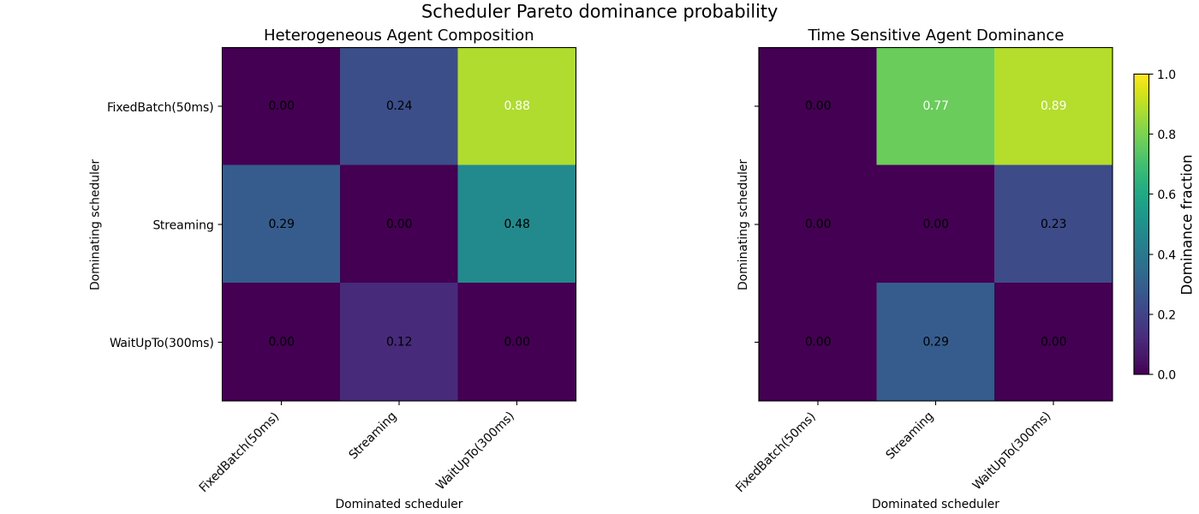
- Waiting up to the end of the slot is not good
- Under competition, batching is the scheduler that minimize agents' loss
- Despite what people think, streaming txs is the scheduler that reduce agents' loss in a higher variety of situations
- Batching is bad when you are e.g. trying to land oracle updates
Chorus One@ChorusOne
English

@SamaiSpeaks @alessandrod I write things to make people fell asleep. You’ll thank me later
English

@alessandrod This guy needs to stop writing cool stuff in high elvish.
I literally fell asleep listing to this article on my eleven reader last night.
English


@KamBenbrik More you use AI more they can train and improve the model. It’s a do ut des…nothing at this world is free
English

@moonshiesty > so DAG gives better censorship resistance
Do you mean MCP, right? Even if I think they are equivalent. For DAG is the ordering that in principle can be manipulated.
Re the encryption, I guess that’s the issue. But I’m not an expert
English

i see, so DAG gives better censorship resistance
what ive heard is that if you broadcast to enough concurrent proposers its unrealistic that a single proposer can meaningful change tx inclusion fairness but it sounds MCP has better guarantees there
> A validator sees tx T1 on a shared object, but T1 is economically bad for them
if the DAG encrypts txs is the difference is that DAGs still require object metadata, and so they leak more information to proposers so they can infer whether a tx is economically bad?
English

question: if blockchains with DAG based consensus (hedera, sui) haven't found success with trading, why would solana MCP be any different?
only meaningful difference between MCP and DAGs is the batch auction
ive never heard anyone active on DAG blockchains tell me they want a batch auction
and never heard any MM or trader tell me they want to see solana look more like hedera or sui
English

A DAG can look similar to MCP when it is truly multi-proposer: multiple validators can add concurrent blocks, and final ordering is derived from that shared structure. Sui is closer to this model. Hedera is not: it is an event-DAG with virtual voting, not MCP-style batch inclusion.
The key difference is tx inclusion fairness.
Let’s comsider this Gedankenexperiment:
A validator sees tx T1 on a shared object, but T1 is economically bad for them. They omit it from their DAG block and include T2 instead, which touches the same shared object and benefits them.
Another validator includes T1 later.
The DAG consensus then produces a valid order, but that order already reflects a strategic inclusion decision upstream.
So DAG is different from MCP. MCP guarantees that any proposed in time tx is included, and ordering cannot be manipulated by proposers (in case of encryption, w/o you can still do things around that)
English

@MostlyData_ DAG based systems allow traders to get inclusion from multiple regions
*not a consensus expert
English

@LoganJastremski Can you specify what you mean? The 150ms latency is on block finalization, which is a net positive outcome regardless of how you order txs (and until we are at >150ms slot time the two remains largely uncorrelated)
English

Fair correction! You’re right that under FixedBatch, the scheduler buffers everything regardless of conflict status. The parallelism is downstream of the scheduling decision, not a bypass around it. Non-conflicting txs still eat the batch delay even though they don’t need serialization. I overstated that.
Stepping back from the intra-slot optimization for a second. What are your thoughts on 150ms latency (post Alpenglow) cost on non-contentious state (payments, etc) actually mattering since traditional finance settles on T+1 to T+2.
English

Lately I've spent a bit of time into data to measure real scheduling effects.
However, some theoretical work was needed as well.
Here you can see how:
- Waiting up to the end of the slot is not good
- Under competition, batching is the scheduler that minimize agents' loss
- Despite what people think, streaming txs is the scheduler that reduce agents' loss in a higher variety of situations
- Batching is bad when you are e.g. trying to land oracle updates
Chorus One@ChorusOne
English

@joaomendoncaaaa Yeah, probably I should pivot again to make sense of how Universe works
English

Umberto, the mostly data legend, is trying to make sense of solana drama
good luck Umberto
Umberto | Mostly Data 🧙♂️@MostlyData_
@barrett_io I looked at who rt'd it...who is supposed to be the "mev ppl whose job it is to take your money"?
English

@0xSharples That’s interesting. Wondering why…probably one should deep dive into it
English

Scheduler debates on Solana miss the point: no scheduler is best everywhere.
Streaming wins for mostly independent flow.
Short batching can win for time-coupled races. But those races are account-local, so applying the same rule to every tx is not welfare-optimal.
The right question is not “batch or stream?” It is: where is contention, and what source of loss dominates there?
That points to adaptive short-window scheduling — not a one-size-fits-all rule.


Chorus One@ChorusOne
English

@teddyfuse You should definitely go to Naples and try zeppole there
English

@aceddeca1 @ChorusOne Most of the work is based on simulations, so not specifically for this that's more theoretical.
But I have to think about empirical measures.
Thanks for the support 🙏
English

@MostlyData_ @ChorusOne I meant more as in if you segmented blocks out by those using dz edge if that would give less noise in evaluating the metrics.
Enjoying the article and trying to read in between work pauses. Appreciate all that you did to put it together. Has been educational
English

I don't think at this stage. DZ can in principle make you see a tx earlier, but I doubt this can change scheduler logic.
For execution ordering, that's more interesting. The metric developed still is an on-chain fingerprint that remains a function of orderflow. DZ can change orderflow shape, so in principle this is an interesting case to study. Tho, at this stage I don't think you'll see meaningful differences
English

@ChorusOne Does DZ edge create an ideal set to evaluate Execution Ordering and Scheduler Logic?
English

@LoganJastremski (btw, thanks for reading it and providing feedbacks)
English

> On Solana’s parallel VM, non-conflicting transactions execute simultaneously regardless of scheduler design. They never queue behind each other, so the scheduling question is mostly moot for them
That's assuming you don't delay txs execution. These execute in parallel only when scheduler decide the deadline of waiting ends. Otherwise these wait as any other tx.
> These are exactly the systematic competition scenarios where your Figure 9 shows batching Pareto-dominates streaming.
The point is subtler than this. If you account for the previous point (e.g. FixedBatch still make non conflicting txs waiting) you have that FixedBatch is only benefitting this type of txs.
> So the SVM already produces something close to the adaptive batch sizing your conclusion calls for through the runtime itself. Non-conflicting txs get streaming via parallelism
well, this is not true. Most of the confusion arise from your first assumption around non conflicting txs.
English

@barrett_io I looked at who rt'd it...who is supposed to be the "mev ppl whose job it is to take your money"?
English

this is is being rt’d by mev ppl whose job it is to take your money
think for a second
Ramzy@ramzyyalii
Just waiting till the rest of world realizes that retail activity is literally all that matters and this entire industry has been focused on the wrong user demographic for years
English
Umberto | Mostly Data 🧙♂️ retweetet

Most people sleep on how much schedulers affect Solana's transaction execution — and even more misunderstand what they actually do.
Spoiler: execution order alone doesn't create value.
Full breakdown in the article 👇
Chorus One@ChorusOne
English

💯 for sure if you measure that Solana is the leading ecosystem
Was mostly complaining about interpretation from volume. To me, it’s still not a suitable metric.
For example, you see uniswap as 2nd, well if you check for volume most of it is coming from sandwiching (where you need to move a lot of liquidity to steal few $). Is looking at volume informative for retail?
English

@MostlyData_ @therealchaseeb Volume is a proxy measure and a crude one at that but it does tell an important story - people, mostly retail, want to trade and use applications that are completely native to Solana. That's important.
English

Just waiting till the rest of world realizes that retail activity is literally all that matters and this entire industry has been focused on the wrong user demographic for years
SolanaFloor@SolanaFloor
🚨NEW: @Pumpfun has become the #1 protocol by 24-hour DEX volume across all chains.
English

@ramzyyalii @therealchaseeb Sure, but lot of snipes, manipulation etc.
So to me volume is not a clear metric to evaluate it.
English

@ramzyyalii @therealchaseeb The assumption is that all volume on pump is retail?
English